
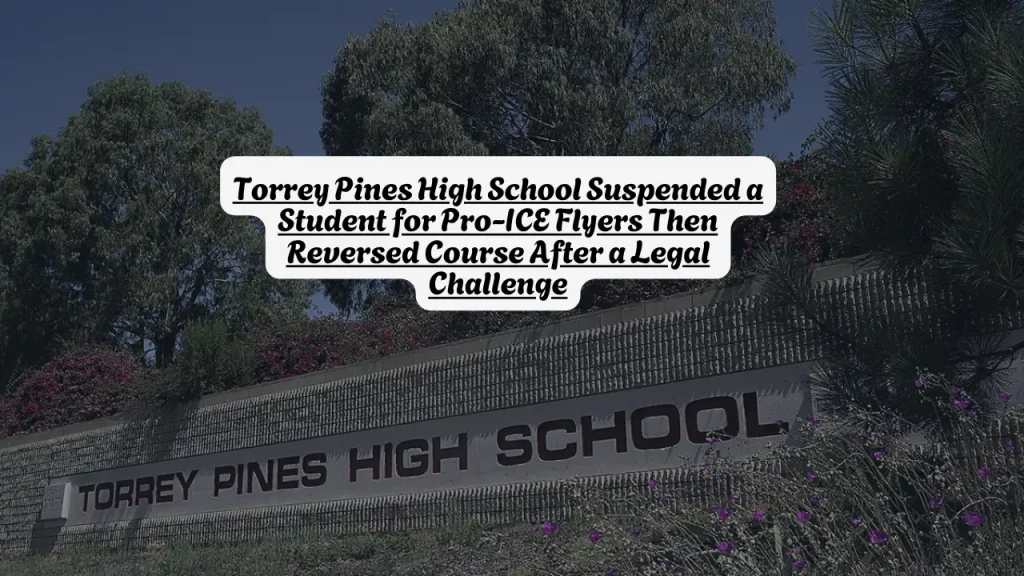
Torrey Pines High School Suspended a Student for Pro-ICE Flyers Then Reversed Course After a Legal Challenge
In April 2026, the Foundation for Individual Rights and Expression (FIRE) announced that a California school district had expunged the suspension of a high school junior after he put up a pro-ICE poster on campus. The case raises a direct question about viewpoint discrimination in public schools: can a school punish one student for political speech while letting students on the other side say whatever they want? If you were disciplined at a public school for expressing a conservative or pro-government viewpoint, this case may matter to you.
Quick Facts: The Torrey Pines Pro-ICE Suspension Case
| Field | Detail |
| School | Torrey Pines High School, San Diego, CA |
| School District | San Dieguito Union High School District |
| Incident Date | Late February 2026 |
| What Happened | Student suspended one day for posting pro-ICE flyers |
| Legal Basis Alleged | First Amendment to the U.S. Constitution — viewpoint discrimination |
| Organization Involved | Foundation for Individual Rights and Expression (FIRE) |
| Outcome | Suspension expunged on March 23, 2026 |
| Current Case Status | Resolved — no active litigation filed as of May 20, 2026 |
| Last Updated | May 20, 2026 |
What Is the Torrey Pines Pro-ICE Suspension Case About?
On February 6, 2026, hundreds of students at Torrey Pines High School peacefully staged a mid-school-day walkout to protest ICE and U.S. immigration enforcement policy. Students displayed posters including “FUCK ICE” and “ICE is KKK spelled differently.” The school did not discipline any of those students.
Two weeks later, a 17-year-old junior put up a handful of flyers reading “We heart ICE,” signed “Real Americans,” in hallways during his lunch period. The flyers were taken down soon after, and days later he was suspended for one day.
The student said he met with the assistant principal, who told him the flyers were “unacceptable,” “incendiary,” and “dehumanizing.” The school claimed the flyers violated its rules against harassment and intimidation. The student said it felt especially unfair because some of the anti-ICE signs during the walkout used profanity, yet only he faced discipline for a message he considered tame by comparison.
This is the heart of a viewpoint discrimination claim under the First Amendment. Public schools receive government funding and must treat student speech equally regardless of political viewpoint. When a school punishes one side of a debate while ignoring the same behavior from the other side, it crosses a constitutional line. If you were a student at a public school disciplined for speech while others expressing opposite views were left alone, you may have grounds for a consumer rights lawyer or civil liberties attorney to review your case.
Related article: Subaru EyeSight Class Action Lawsuit, Newer Models Can Slam on the Brakes for No Reason, Suit Says
Are You Part of the Student Free Speech Fight? Here Is How to Know
The Torrey Pines case is resolved, but it reflects a pattern playing out in public schools nationwide. The ACLU of Nevada has a form on its website where students can report whether they have been disciplined for engaging in First Amendment activity. If any of the following apply to you or your child, consulting a consumer rights lawyer or First Amendment attorney is the right first step.
You may have a claim if:
- You are or were a student at a public school (K–12)
- You were suspended, expelled, or disciplined for expressing a political opinion
- Other students who expressed the opposite view were not disciplined for the same conduct
- Your speech caused no physical disruption and was displayed in a common area or shared on social media outside school hours
- You were disciplined for supporting a government agency, immigration enforcement, or any other pro-government position
You are likely NOT in this situation if:
- You attended a private school — the First Amendment does not apply to private institutions
- Your speech directly threatened or targeted another student
- Your discipline was based on truancy or leaving campus, not the message itself
What the Law Says About Student Political Speech
The foundational case here is Tinker v. Des Moines Independent Community School District (1969), in which the U.S. Supreme Court held that students do not “shed their constitutional rights at the schoolhouse gate.” Schools can only restrict student speech if it causes — or is reasonably likely to cause — a substantial disruption to the school environment.
FIRE attorney Conor Fitzpatrick argued that the school punished this student for nondisruptively voicing an opinion contrary to the walkout protesters, and that is precisely where the First Amendment steps in. He also noted that expressing an opinion that upsets someone is not harassment and is not fighting words.
FIRE Supervising Senior Attorney Conor Fitzpatrick stated that school administrators cannot pick and choose which opinions students are allowed to express, and that voicing an opinion which makes others upset is not harassment or intimidation — it is American democracy in action.
For a broader look at how consumer class action lawsuits protect everyday Americans when institutions overstep their authority, AllAboutLawyer.com covers active cases across the country.
What Happened After FIRE Got Involved
After FIRE sent a letter requesting documents related to the suspension, the school district notified the organization on March 23, 2026, that the suspension was being expunged from the student’s record. The student, who worried the suspension would affect his college applications, said the outcome sent a message to other students not to be afraid to stand up for what they believe in.
The San Dieguito Union High School District had claimed the pro-ICE flyers amounted to harassment and intimidation, even though the school had previously allowed anti-ICE walkouts where students displayed vulgar and hostile slogans against federal agents.
No lawsuit was filed in court in this case. The school backed down once a free speech organization stepped in. That matters: schools often reverse course before litigation begins when faced with a credible First Amendment challenge. If you or your child faced similar punishment, a free legal consultation with a civil liberties or education rights attorney could resolve the issue quickly — before it affects college applications or permanent records.
What Should You Do If Your School Punished You for Political Speech?
You do not need to file a lawsuit to get results. Here are your options right now:
- Document everything. Save screenshots, printed flyers, any written communication from school administrators, and witness names.
- Request the disciplinary record in writing. You have the right to see what is in your student file.
- Contact FIRE. The Foundation for Individual Rights and Expression takes student cases at no cost. Their website is thefire.org.
- Contact the ACLU in your state. The ACLU of Nevada, for example, maintains a form specifically for students disciplined for First Amendment activity.
- Consult a private education rights attorney if you want to pursue compensation for damages, such as lost academic opportunities or harm to college applications.
- Do not sign anything from the school district admitting wrongdoing before speaking to an attorney.
Most class members in cases like this do not need to do anything actively right now. If a broader legal action develops from nationwide school speech cases, affected students may be automatically included. Monitor FIRE’s case tracker at thefire.org for updates.
Torrey Pines / San Dieguito Case Timeline
| Milestone | Date |
| Anti-ICE Student Walkout at Torrey Pines | February 6, 2026 |
| Student Posts Pro-ICE Flyers | Late February 2026 |
| Student Suspended for One Day | Late February 2026 |
| FIRE Contacts School District | March 2026 |
| Suspension Expunged from Record | March 23, 2026 |
| FIRE Public Announcement | April 1, 2026 |
| Formal Lawsuit Filed in Court | TBD — no lawsuit filed as of May 20, 2026 |
| Broader Pattern of Cases Nationally | Ongoing — 300+ anti-ICE walkouts in 2026 alone |
Frequently Asked Questions
Is there a class action lawsuit against the San Dieguito Union High School District over student speech?
No class action has been filed as of May 20, 2026. The specific case involving the Torrey Pines student was resolved when the district expunged the suspension after FIRE intervened. No litigation was filed in court.
Do I need to do anything right now to be included if a lawsuit is filed later?
Not at this point. If a broader legal action develops, affected students are typically included automatically. The important thing right now is to document your experience and preserve any evidence of discriminatory discipline.
Is the San Dieguito Union High School District case the same as a CCSD case?
No. CCSD most commonly refers to the Clark County School District in Las Vegas, Nevada. This case involves the San Dieguito Union High School District in San Diego County, California. No verified expulsion or suspension of a student for pro-ICE speech has been reported in Nevada’s CCSD as of the date of this article.
Can a school legally punish a student for supporting ICE
A public school cannot discipline a student for a political viewpoint if students expressing the opposite view were not similarly disciplined. That is called viewpoint discrimination and it violates the First Amendment under Tinker v. Des Moines (1969). Schools cannot favor one viewpoint over another, and when students express themselves non-disruptively, the First Amendment guarantees their right to freedom of speech regardless of the opinion they share.
How will I know if a school speech lawsuit settles?
Monitor FIRE’s official website at thefire.org for case updates. If a formal lawsuit is filed in federal court, it will appear on PACER, the public court records system.
Can I file my own lawsuit against a school district for punishing my political speech?
Yes. You can file an individual civil rights lawsuit under 42 U.S.C. § 1983, which allows individuals to sue government entities — including public school districts — for violating constitutional rights. A school that receives federal funding is a de facto arm of government and cannot arbitrarily silence a student, especially when the opposite viewpoint is not only tolerated but encouraged by teachers and administration. Speak with a First Amendment attorney or civil rights lawyer about your specific situation.
What if my student’s discipline has already been reversed — is it too late to pursue a claim?
Not necessarily. If the school reversed discipline only under pressure, a civil rights attorney can assess whether compensatory damages are available for harm already done — including impacts on college applications, extracurricular eligibility, or emotional distress.
Prepared by the AllAboutLawyer.com Editorial Team and reviewed for factual accuracy against the official FIRE case announcement and verified news reporting from ABC10 San Diego and The Nevada Independent. Last Updated: May 20, 2026
Disclaimer: This article is for informational purposes only and does not constitute legal advice. Legal claims and outcomes depend on specific facts and applicable law. For advice regarding a particular situation, consult a qualified attorney.
About the Author
Israr Ahmad is a legal content researcher with 4+ years of experience covering class action settlements and consumer rights cases. He has researched and published coverage of 2,500+ settlements using verified court records, settlement administrator filings, and government sources. Learn more about Israr.