
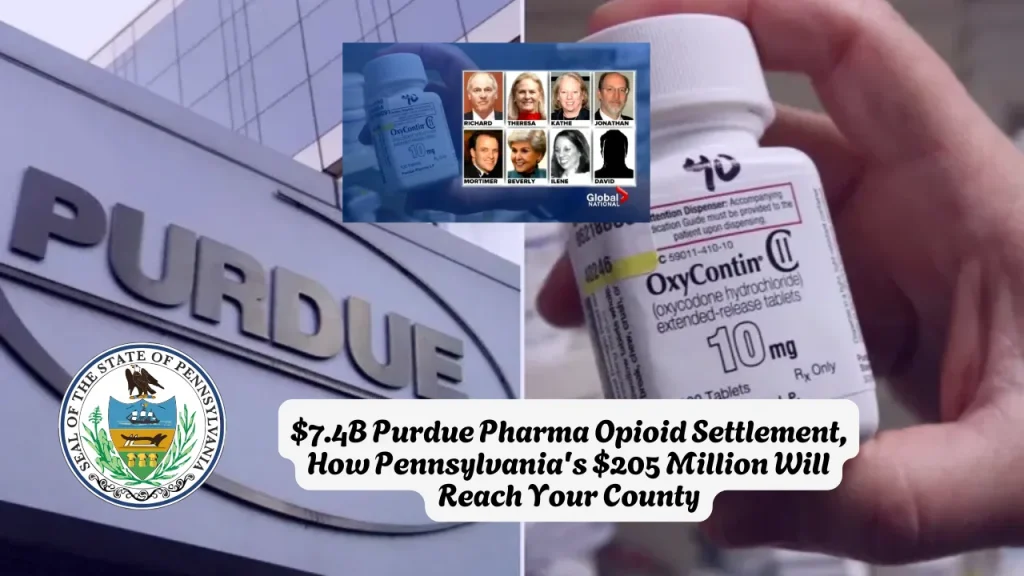
$7.4B Purdue Pharma Opioid Settlement, How Pennsylvania’s $205 Million Will Reach Your County
The Purdue Pharma Opioid Settlement is a $7.4 billion resolution with Purdue Pharma and the Sackler family, with Pennsylvania expected to receive more than $205 million over the next 15 years, with funds beginning to arrive as early as late 2026. With this settlement, Pennsylvania has now secured over $2 billion in opioid settlement funds from multiple pharmaceutical companies — money directed toward addiction treatment, overdose prevention, and recovery programs across all 67 counties. There is no claim form for most Pennsylvanians. The money flows through a structured trust to counties and local governments.
Quick Facts: Purdue Pharma Settlement — Pennsylvania
| Field | Detail |
| Total Settlement Amount | $7,400,000,000 |
| Pennsylvania Share | $205,000,000+ over 15 years |
| Claim Deadline | No individual claim form — funds distributed through Pennsylvania Opioid Misuse and Addiction Abatement Trust |
| Who Benefits | All 67 Pennsylvania counties (70%), litigating subdivisions (15%), Commonwealth (15%) |
| Payout Per Person | TBD — individual victim payouts determined through Purdue bankruptcy proceedings |
| Settlement Status | Legally effective May 1, 2026 |
| Administrator | Pennsylvania Opioid Misuse and Addiction Abatement Trust (POMAAT) |
| Official Source | attorneygeneral.gov / paopioidtrust.org |
| Last Updated | May 2, 2026 |
Current Status
- Attorney General Dave Sunday announced on May 1, 2026 that the $7.4 billion national opioid settlement with Purdue Pharma and the Sackler family has become legally effective, with funds expected to begin arriving in Pennsylvania as early as late 2026.
- Pennsylvania sued Purdue in 2019. Funds could be distributed to the Commonwealth and its subdivisions as early as late 2026.
- In 2023, more than 83% of Pennsylvania’s 4,719 overdose deaths were opioid-related — underscoring exactly why this settlement money matters and why every county in the state has a stake in how it gets spent.
What Is the Purdue Pharma Lawsuit About? In re Purdue Pharma L.P., No. 19-23649 (Bankr. S.D.N.Y.)
The settlement resolves litigation over Purdue Pharma’s and the Sackler family’s role in fueling the opioid crisis by producing and aggressively marketing opioids across the United States, contributing to the nation’s largest drug crisis. Purdue made OxyContin — a powerful prescription painkiller — and state attorneys general alleged the company pushed it on doctors and patients while deliberately minimizing its addiction risk in violation of state consumer protection laws.
A coalition of attorneys general launched a multistate investigation of Purdue in 2016, and Pennsylvania sued Purdue in 2019. After Purdue filed for bankruptcy that same year, the state took a lead role in the bankruptcy proceedings. A prior settlement collapsed when the U.S. Supreme Court in June 2024 ruled that bankruptcy courts could not grant sweeping legal immunity to the Sackler family as non-bankrupt parties — forcing negotiators back to the table and resulting in a significantly larger payout.
The trust distributes funds across three broad categories: payments to individual victims, reimbursements to states and local governments for opioid-related expenses, and funding for addiction treatment and prevention programs. Pennsylvania’s structure goes further than most states in pushing that money directly to local communities — making it one of the most county-driven opioid settlement systems in the country.
Related article: Purdue Pharma Is Gone, How the OxyContin Maker Dissolved and Replaced by Knoa Pharma Who Runs Its Successor
Who Benefits from the Purdue Pharma Settlement in Pennsylvania?
This is not a traditional class action with an online claim form. Pennsylvania’s opioid settlement money runs through a formal trust structure, and understanding that structure tells you exactly where the funds land.
In Pennsylvania, 70% of the funding goes to counties. Cities and other organizations that were involved in the lawsuits — such as county district attorney offices — get 15%. The remaining 15% goes to the state.
Pennsylvania is one of nine states that have given majority control of settlement spending to local governments. That means your county commissioner — not a state agency — largely decides how the money gets used in your community.
You may benefit from this settlement if:
- You live in any of Pennsylvania’s 67 counties and access opioid treatment, prevention, or recovery programs that receive settlement funding
- Your county or city receives a direct distribution and directs it toward local treatment infrastructure
- You filed a personal injury claim in Purdue’s bankruptcy proceedings as a direct victim of OxyContin or another Purdue product
You are likely NOT a direct cash recipient if:
- You did not file a personal injury claim in the Purdue bankruptcy before that window closed
- You are looking for an online claim form — one does not exist for this settlement
- You are a provider or organization seeking reimbursement outside the POMAAT process
To receive funds, counties and litigating subdivisions must submit a Certification Form by November 15 each year, and distributions are made on or about December 15 to counties and subdivisions, and on or about June 15 to the Commonwealth.
How Much Will Pennsylvania Receive and How Is It Distributed?
Pennsylvania is expected to receive more than $200 million from this settlement over the next 15 years, with Pennsylvania having now secured over $2 billion in total opioid settlement funds across all pharmaceutical company settlements combined.
Pennsylvania will invest more than $1.7 billion received from all opioid settlement agreements over two decades, in all 67 Pennsylvania counties, to help mitigate the effects of the opioid epidemic. The Purdue settlement adds a critical new layer on top of what the state has already secured from distributors, pharmacies, and manufacturers like Johnson & Johnson.
How the Purdue money flows once it reaches Pennsylvania:
Counties and litigating subdivisions — which receive 85% of Pennsylvania’s opioid settlement funds — have already spent approximately $14 million on treatment medications for opioid use disorder, $8 million on prevention strategies, and $6.5 million on recovery support from earlier settlement waves. The Purdue funds will follow the same pipeline. Requirements from the opioid settlement mandate that at least 85% of the money be spent on opioid abatement — a rule designed to avoid the mistakes of the 1990s tobacco settlement, when funds were frequently diverted to general budgets and spent on programs unrelated to public health.
What Should You Do If You Were Affected by Purdue’s Opioids in Pennsylvania?
For most Pennsylvanians, no immediate action is required. Funds flow automatically through the POMAAT structure to counties and subdivisions. But if you or your family was personally harmed, here are your concrete options right now:
- Contact the Pennsylvania Opioid Misuse and Addiction Abatement Trust at paopioidtrust.org to understand how funds are allocated to your county and which programs are currently funded
- Track your county’s spending using the public Pennsylvania Opioid Settlement Data dashboard at paopioidsettlementdata.org — when members of the public can see where the money is going, they can hold systems accountable for using the funds effectively
- Contact your county commissioners to find out what opioid recovery services your county’s share will fund — and to weigh in on how that money gets spent in your community
- If you believe you had an unfiled personal injury claim as a direct victim, speak with a consumer rights lawyer about whether any individual options remain — most bankruptcy claim windows are now closed, but an attorney can assess your specific situation
- Save any medical records or prescription documentation connecting you or a family member to OxyContin or other Purdue products in case they become relevant to future proceedings
- Monitor attorneygeneral.gov for AG Sunday’s updates on when the first Pennsylvania distributions from this settlement will be released
Purdue Pharma Settlement Timeline — Pennsylvania
| Milestone | Date |
| Multistate Investigation Launched | 2016 |
| Pennsylvania Sued Purdue Pharma | 2019 |
| Purdue Filed for Bankruptcy | September 2019 |
| POMAAT Trust Established by PA Court Order | 2022 |
| Prior Settlement Invalidated by Supreme Court | June 2024 |
| Revised Bankruptcy Plan Approved | November 2025 |
| New $7.4B Settlement Announced | January 2025 |
| All 55 Attorneys General Sign On | June 2025 |
| Settlement Legally Effective | May 1, 2026 |
| First Pennsylvania Distributions Expected | Late 2026 |
| Final Payments to Pennsylvania | ~2040 |
Frequently Asked Questions
Is there a class action lawsuit against Purdue Pharma that Pennsylvania residents can still join?
No. The litigation is resolved. A coalition of attorneys general launched a multistate investigation of Purdue in 2016, and the settlement became legally effective May 1, 2026. The window to file new personal injury claims in Purdue’s bankruptcy has closed. A free legal consultation can clarify whether any individual options remain in your situation.
Do I need to do anything right now to receive money from this settlement?
For most Pennsylvanians, no. Funds flow automatically through POMAAT to your county and local government. If you are a county official or program director, you must submit a Certification Form to the Trust by November 15 each year to receive your distribution by December 15.
When will Pennsylvania counties actually receive their Purdue settlement money?
Funds are expected to begin arriving in Pennsylvania as early as late 2026. Based on prior settlement distribution cycles, counties and litigating subdivisions can expect their annual notification by September 1, certification due November 15, and distribution on or about December 15.
Can I see how my county is spending its opioid settlement money?
Yes. The Pennsylvania Opioid Settlement Data dashboard at paopioidsettlementdata.org tracks county-level spending in real time. For example, Butler County has received approximately $4.47 million, with nearly $300,000 dedicated to a new recovery center, and the Bucks County Drug and Alcohol Commission has spent around $800,000 to provide residents with access to the appropriate length of treatment.
Can I file my own lawsuit against Purdue Pharma or the Sacklers?
The settlement permanently bars the Sacklers from selling opioids in the U.S. and resolves the multistate litigation. Filing new suits against Purdue is not viable given the completed bankruptcy. Speak with a private attorney about any remaining individual options.
How does Pennsylvania make sure counties spend the money correctly?
The Pennsylvania Opioid Misuse and Addiction Abatement Trust distributes the funds and reviews spending. Its 13-member board has the power to cut funding from counties if it decides they spent money in ways that do not align with the requirements of the agreements. Counties must report spending annually, and the trust can — and has — rejected programs that fall outside approved opioid abatement strategies.
What happened to Purdue Pharma as a company?
Purdue’s bankruptcy plan won final court approval in November 2025, and the company is proceeding with dissolving and transferring its assets to the settlement trust. Its manufacturing operations transferred to Knoa Pharma LLC on May 1, 2026, under independent oversight, with strict restrictions on opioid marketing.
Will an individual opioid victim payment affect my taxes?
If you receive a direct personal injury payment through Purdue’s bankruptcy process, it may be taxable depending on what it compensates. Speak with a tax professional about your specific payment type before filing.
Sources & References
- Pennsylvania Attorney General — Official Settlement Announcement
- Pennsylvania Opioid Misuse and Addiction Abatement Trust — Payment and Reporting
- Pennsylvania Opioid Settlement Data Dashboard — County-Level Tracking
- Penn State University — How Opioid Settlement Funds Are Helping Pennsylvanians
Prepared by the AllAboutLawyer.com Editorial Team and reviewed for factual accuracy against official Pennsylvania Attorney General announcements and the Pennsylvania Opioid Misuse and Addiction Abatement Trust on May 2, 2026. Last Updated: May 2, 2026
Disclaimer: This article is for informational purposes only and does not constitute legal advice. Legal claims and outcomes depend on specific facts and applicable law. For advice regarding a particular situation, consult a qualified attorney.
About the Author
Israr Ahmad is a legal content researcher with 4+ years of experience covering class action settlements and consumer rights cases. He has researched and published coverage of 2,500+ settlements using verified court records, settlement administrator filings, and government sources. Learn more about Israr.