
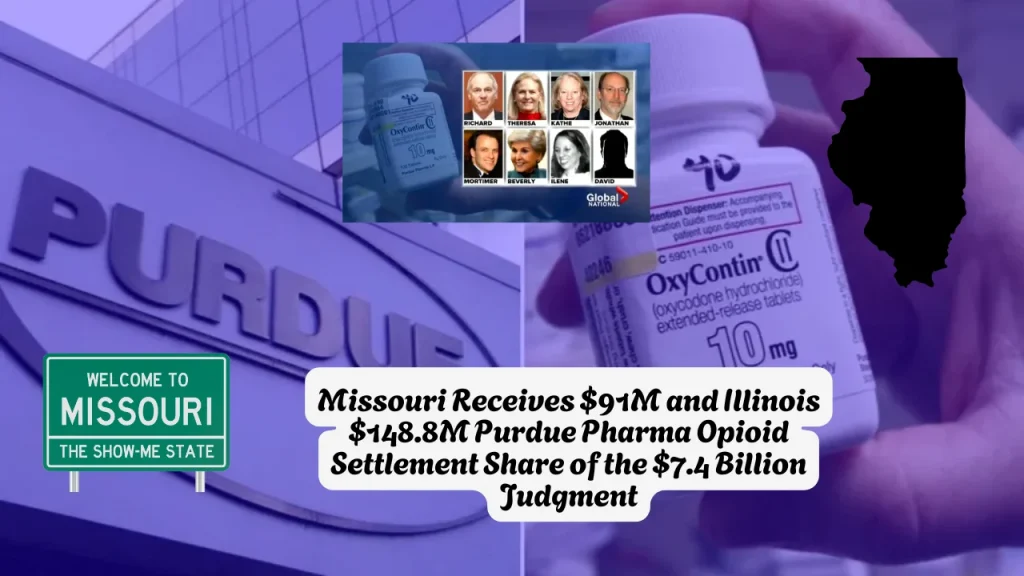
Missouri Receives $91M and Illinois $148.8M Purdue Pharma Opioid Settlement Share of the $7.4 Billion Judgment
The Purdue Pharma Opioid Settlement is a $7.4 billion resolution with Purdue Pharma and its owners, the Sackler family, that took effect Friday — with Missouri set to receive more than $91 million and Illinois projected to receive around $154 million. The settlement caps nearly a decade of work by attorneys general across the country pursuing investigations and litigation over Purdue’s and the Sacklers’ role in fueling the opioid crisis. There is no claim form for most residents — funds flow to state and local governments for addiction treatment, prevention, and recovery programs.
Quick Facts: Purdue Pharma Settlement — Missouri & Illinois
| Field | Detail |
| Total Settlement Amount | $7,400,000,000 |
| Missouri Share | $91,333,005.76 over 15 years |
| Illinois Share | $148,800,000 over 15 years |
| Claim Deadline | No individual claim form — funds go to state, counties, and municipalities |
| Who Benefits | State governments, counties, municipalities, and opioid victims who filed bankruptcy claims |
| Payout Per Person | TBD — individual victim payouts determined through bankruptcy proceedings |
| Settlement Status | Legally effective May 1, 2026 |
| Missouri Administrator | Missouri Attorney General Catherine Hanaway’s office |
| Illinois Administrator | Illinois Opioid Remediation Advisory Board (IORAB) / AG Kwame Raoul’s office |
| Last Updated | May 2, 2026 |
Current Status
- Missouri Attorney General Catherine Hanaway announced on May 1, 2026 that the landmark settlement has taken effect, with payments beginning immediately. Missouri’s $91 million will be distributed to state and local governments and individual victims over the coming years.
- Illinois’s $148.8 million will be doled out over the next 15 years, mostly in the next three, under the deal reached last spring by a coalition of state attorneys general including Illinois AG Kwame Raoul.
- The Sacklers are paying more than $1.5 billion immediately, followed by approximately $500 million in May 2027, $500 million in May 2028, and $400 million in May 2029, with Purdue paying approximately $900 million today as well.
What Is the Purdue Pharma Lawsuit About? In re Purdue Pharma L.P., No. 19-23649 (Bankr. S.D.N.Y.)
A nationwide investigation of Purdue Pharma was launched in 2016 over the company’s role in fueling the opioid epidemic through the over-prescription of painkillers like OxyContin and the deliberate downplaying of addiction risk. The legal theory at the core of the case rests on violations of state consumer protection laws and federal statutes governing deceptive trade practices — Purdue told doctors and patients that OxyContin was less addictive than it actually was, and communities across the country paid a catastrophic price.
Missouri sued Purdue Pharma in 2017. After Purdue filed bankruptcy in September 2019, the attorneys general took a lead role in the bankruptcy proceedings, including negotiating a new settlement that obtained more money from the Sacklers after the U.S. Supreme Court in June 2024 invalidated provisions from a prior settlement. That ruling sent negotiators back to the table — and the result was a significantly larger payout than the original deal would have produced.
The trust will distribute funds across three broad categories: payments to individual victims, reimbursements to states and local governments for opioid-related expenses, and funding for addiction treatment and prevention programs. For anyone in Missouri or Illinois who lost a family member to opioids or struggled with addiction personally, understanding how these funds reach communities — and who controls the money — matters as much as the total dollar figure.
Related article: $7.4B Purdue Pharma Opioid Settlement, How Pennsylvania’s $205 Million Will Reach Your County
Are You Part of the Purdue Pharma Settlement in Missouri or Illinois?
This is not a traditional consumer class action where you visit a website and file a claim. Here is how to understand whether this settlement affects you directly.
You may benefit from this settlement if:
- You live in Missouri or Illinois and access opioid treatment, recovery, or prevention services that are funded by state opioid settlement money
- Your city or county receives a direct distribution and allocates it toward local recovery infrastructure
- You filed a personal injury or creditor claim in Purdue’s bankruptcy proceedings as a direct victim of OxyContin or another Purdue opioid product
You are likely NOT a direct cash recipient if:
- You did not file a personal claim in Purdue’s bankruptcy before the claims deadline closed
- You are searching for an online claim form — one does not exist for this settlement
- You are a Missouri or Illinois business or healthcare provider seeking reimbursement outside the bankruptcy process
In Illinois, the Allocation Agreement provides that a majority of the state’s money will go to the Illinois Remediation Fund for abatement programs statewide, with a portion distributed directly to Illinois counties and eligible municipalities to support remediation programs in their communities. The Illinois Opioid Remediation Advisory Board makes funding recommendations based on population, opioid use disorder rates, overdose deaths, and the volume of opioids that flowed into each region.
How Much Will Missouri and Illinois Receive — and Where Does It Go?
Over the next 15 years, Missouri is expected to receive $91,333,005.76 from the settlement. That money will be distributed to state and local governments and individual victims, with most funds arriving in the first three years.
Illinois is receiving $148.8 million as part of the nationwide settlement, marking the state’s latest payout from companies that systematically addicted generations of Americans to opioids. Across all opioid settlements combined, Illinois expects to receive more than $1.4 billion in total settlement funds by 2038, to be used throughout the state to address the opioid crisis.
For individual opioid victims who filed claims in Purdue’s bankruptcy, approximately $865 million has been earmarked specifically for individual victims — the largest direct compensation pool for people harmed by the opioid crisis. However, divided across hundreds of thousands of claimants, individual payouts remain modest. The majority of the $7.4 billion is structured as community abatement money, not personal compensation for damages.
What Should You Do If You Were Affected by Purdue’s Opioids in Missouri or Illinois?
For most residents, no immediate action is needed. The funds flow through government channels automatically. But if you or someone in your family was personally harmed, here are your practical steps right now:
- Contact your state attorney general’s office — Missouri residents can reach the AG at ago.mo.gov, and Illinois residents can visit illinoisattorneygeneral.gov for updates on how funds are being allocated to local treatment programs
- Check with your county or city government to find out what opioid recovery services your local share will fund
- If you believe you had an unfiled personal injury claim, speak with a consumer rights lawyer about whether any individual legal options remain — most paths through the bankruptcy are now closed, but an attorney can advise on your specific situation
- Save any medical records or prescription documentation connecting you or a family member to OxyContin or other Purdue products in case they are relevant to future proceedings
- Monitor the Missouri AG’s official site at ago.mo.gov, and watch for Purdue and the Sacklers’ release of more than 30 million documents related to their opioid business — those documents may reveal additional details about how aggressively the company marketed its products in your community
Purdue Pharma Settlement Timeline
| Milestone | Date |
| Multistate Investigation Launched | 2016 |
| Missouri Sued Purdue Pharma | 2017 |
| Illinois Sued Purdue and Sacklers | 2019 |
| Purdue Filed for Bankruptcy | September 2019 |
| Prior Settlement Invalidated by Supreme Court | June 2024 |
| Revised Bankruptcy Plan Approved | November 2025 |
| New $7.4B Settlement Announced | January 2025 |
| All 55 Attorneys General Sign On | June 2025 |
| Settlement Legally Effective | May 1, 2026 |
| First Payments Begin | May 2026 (immediate) |
| Final Payments to States | 2040 |
Frequently Asked Questions
Is there a class action lawsuit against Purdue Pharma that Missouri or Illinois residents can join?
The litigation phase is over. Fifty-five attorneys general representing all eligible U.S. states and territories previously signed onto the settlement, which became legally effective May 1, 2026. The window to file new claims in the bankruptcy has closed. If you have questions about individual options, a free legal consultation with an employment discrimination attorney or consumer rights lawyer can clarify your situation.
Do I need to do anything right now to receive money from this settlement?
For most Missouri and Illinois residents, no. The settlement provides funds to communities across the country as well as individuals and other groups who filed claims in the bankruptcy proceedings. If you did not file a personal injury claim in the bankruptcy, you will not receive a direct check — but your community will benefit through funded treatment programs.
When will Missouri and Illinois actually receive their settlement funds?
Missouri’s Attorney General confirmed payments will begin immediately, with most funds distributed in the first three years. Illinois funds will flow under the same schedule, with the Illinois Opioid Remediation Advisory Board directing state-level allocations.
Can I file my own lawsuit against Purdue Pharma or the Sacklers now?
The settlement permanently bars the Sacklers from selling opioids in the U.S. and resolves the multistate litigation. Filing new suits against Purdue is not viable given the bankruptcy. Speak with a private attorney about whether any independent options remain for your specific situation.
How will Illinois make sure the money reaches communities that need it most?
The Illinois Opioid Remediation Advisory Board is tasked with seeking an equitable allocation of resources to all parts of the state, considering factors including population, opioid use disorder rates, overdose deaths, and the amount of opioids shipped into a region.
What happened to Purdue Pharma as a company?
Purdue’s bankruptcy plan won final court approval in November 2025. Purdue can now proceed with dissolving the company and transferring its assets to the settlement trust. Its manufacturing operations transferred to Knoa Pharma LLC on May 1, 2026, under independent oversight, with strict restrictions on opioid marketing.
Will my individual opioid victim payment affect my taxes?
If you receive a direct personal injury payment through Purdue’s bankruptcy process, it may be taxable depending on what it compensates. Speak with a tax professional about your specific payment type before filing.
Sources & References
- Missouri Attorney General — $7.4B Settlement Goes Into Effect
- Illinois Opioid Settlements Initiative — Allocation Agreement and Fund Distribution
- Pennsylvania Attorney General — Settlement Statement and Payment Schedule
Prepared by the AllAboutLawyer.com Editorial Team and reviewed for factual accuracy against official state attorney general announcements on May 2, 2026. Last Updated: May 2, 2026
Disclaimer: This article is for informational purposes only and does not constitute legal advice. Legal claims and outcomes depend on specific facts and applicable law. For advice regarding a particular situation, consult a qualified attorney.
About the Author
Israr Ahmad is a legal content researcher with 4+ years of experience covering class action settlements and consumer rights cases. He has researched and published coverage of 2,500+ settlements using verified court records, settlement administrator filings, and government sources. Learn more about Israr.
People showing up you have I have proof that I was prescribed 30MG oxycodone to keep you safe it’s all about keeping you safe every 4 hours along with fentanyl patches and suckers to quail cancer. After stopping myself and going into detox and then to Suboxone for three and a half years I find myself in my room dying of pain and cannot stand or bear the embarrassmen But do any law agency that cares to investigate I have proof sitting right in front of Me.