
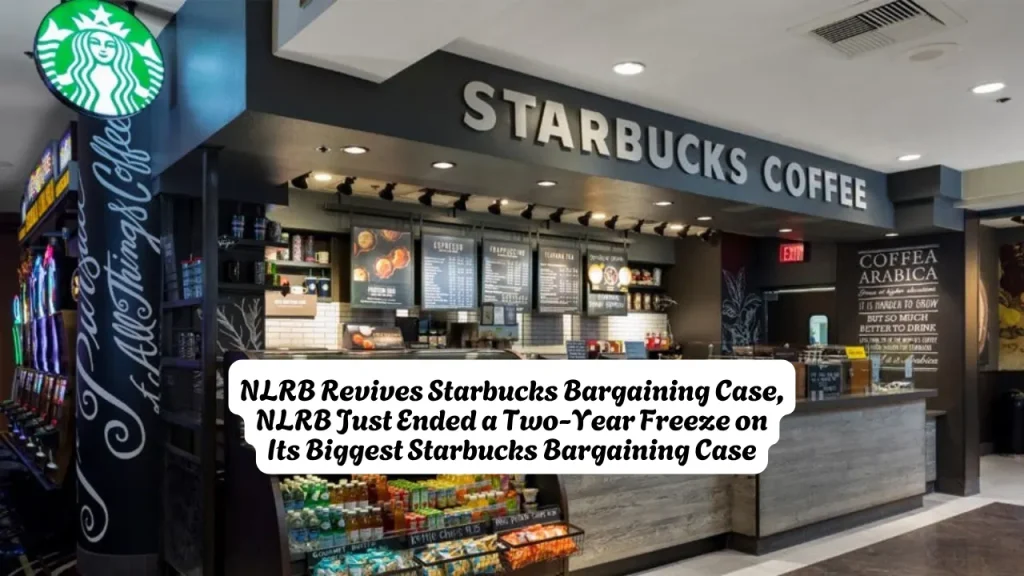
NLRB Revives Starbucks Bargaining Case, NLRB Just Ended a Two-Year Freeze on Its Biggest Starbucks Bargaining Case
Long-percolating National Labor Relations Board litigation accusing Starbucks of snubbing Workers United at hundreds of cafes is set to move forward after a two-year delay, with the board lifting the stay in the consolidated case. The NLRB’s decision to revive the hearing — reported March 26, 2026 — puts one of the most consequential labor cases in recent American history back on track at a moment when Starbucks and Workers United are still trying to hammer out a first contract and the Trump-era NLRB’s own direction remains contested.
| Field | Detail |
| Case Type | Consolidated unfair labor practice — refusal to bargain |
| Respondent | Starbucks Corporation |
| Charging Party | Workers United (affiliated with SEIU) |
| Core Allegation | Section 8(a)(5) — failure and refusal to bargain in good faith |
| Stores Involved | Hundreds of unionized U.S. cafes |
| Procedural Status | Stay lifted; hearing ordered to proceed |
| Stay Duration | Approximately two years |
| Announcement Date | March 26, 2026 |
| Governing Law | National Labor Relations Act |
Where things stand right now:
- The NLRB lifted the stay in the consolidated case and directed the proceeding to move forward to a hearing before an administrative law judge.
- As of early 2026, not a single Starbucks location in the United States has a ratified first contract, despite the union winning its first election more than four years ago.
- The Trump administration fired the NLRB’s previous General Counsel, and her replacement — drawn from a management-side law firm — has not yet signaled how aggressively the agency will pursue this consolidated case.
Why the NLRB Froze the Starbucks Bargaining Case for Two Years in the First Place
To understand why lifting this stay matters, you have to understand what caused it.
On April 26, 2023, U.S. labor board prosecutors indicated that Starbucks corporate leadership had failed and refused to negotiate with the unions representing 144 unionized Starbucks cafes — essentially engaging in “surface bargaining,” going through the motions at the table without genuine intent to reach agreements. The NLRB consolidated those charges into a single mega-case covering hundreds of stores — a vehicle powerful enough, if Workers United won, to potentially force Starbucks into real contract negotiations across its entire unionized footprint at once.
Then the case stalled. The likely reason: the Supreme Court’s June 2024 ruling in Starbucks Corp. v. McKinney, which tightened the standard for federal injunctions in NLRB cases, created legal uncertainty about how far the board could push enforcement. The Supreme Court rejected a more permissive rule that some federal circuits had applied to NLRB injunction requests, replacing it with a higher threshold across all circuits. That ruling sent lawyers on both sides recalibrating, and the consolidated bargaining case sat in suspended animation.
Now the NLRB has cleared the way for it to proceed — a significant procedural step even if the board’s political composition and general counsel have changed under the current administration.
What Starbucks Is Actually Accused of Doing at the Bargaining Table
The consolidated case centers on Section 8(a)(5) of the National Labor Relations Act — the provision that requires employers to bargain in good faith with certified unions. Under federal labor law, “good faith” is not just showing up. It means engaging meaningfully with proposals, exchanging information, and genuinely working toward a potential agreement.
Workers United filed more than 1,100 unfair labor practice charges against Starbucks, including allegations of retaliation, store closures, and bad-faith bargaining tactics. The consolidated hearing focuses specifically on the bargaining failures — the pattern of canceled sessions, rejected proposals, and what the union characterizes as deliberate delay across hundreds of stores simultaneously.
NLRB Administrative Law Judge Michael A. Rosas, in a separate 2023 decision covering Starbucks’s conduct during the Buffalo-area organizing campaign, found that Starbucks had violated the National Labor Relations Act hundreds of times through what he described as “egregious and widespread misconduct demonstrating a general disregard for the employees’ fundamental rights.” That ruling — covering organizing-phase conduct rather than bargaining — set the factual backdrop against which the consolidated bargaining case will now proceed.
Related article: $10.9M Financial Education Services FTC Refund, Did You Pay FES, United Wealth Education, or United Wealth Services?
Four Years Since the First Union Vote — and Still No Starbucks Contract
The scale of what has not happened is the most important context for this hearing.
Workers United began organizing in Buffalo, New York in December 2021. National framework bargaining began in April 2024 and produced 33 tentative agreements over nine months, covering approximately 98% of contract terms. The core economic package — covering pay, hours, and staffing — has not been resolved.
In February 2024, Starbucks committed to reaching a first master contract by the end of the year. That deadline passed without an agreement. The stalemate then triggered the longest national unfair labor practice strike in Starbucks history.
Beginning in November 2025, more than 12,000 workers from 670 stores across the country walked off the job in a strike tied to the company’s annual red cup holiday promotion — one of its most profitable periods of the year. Many workers returned in early 2026, though strikes continue in parts of the country.
The NLRB’s consolidated hearing will now examine whether Starbucks’s conduct during those years at the bargaining table — across hundreds of stores and dozens of bargaining sessions — constituted a systematic refusal to bargain in good faith, or legitimate hard bargaining that simply hasn’t reached agreement yet. That is a factual and legal line the administrative law judge will have to draw.
What a Starbucks Loss at the NLRB Hearing Could Mean for Workers
If the administrative law judge finds that Starbucks violated Section 8(a)(5) across the consolidated stores, the remedies could be significant — and they don’t typically include monetary damages in the traditional sense.
Standard NLRB remedies for refusal-to-bargain violations require the employer to bargain in good faith upon request — with a formal order directing it to do so. In particularly serious cases, the board can seek a “Gissel bargaining order” compelling recognition regardless of election results, though those are reserved for the most extreme misconduct.
In the separate Buffalo-era case, ALJ Rosas ordered Starbucks to reinstate unlawfully fired workers, reimburse workers for consequential harm, grant union access to stores, post remedial notices electronically including on all social media and at all U.S. stores, reopen an unlawfully closed facility, and have senior executives — including Howard Schultz — personally read a Notice to Employees or be present while it was read. The consolidated bargaining case could produce similarly broad remedies if the ALJ finds widespread violations.
The Trump NLRB’s Role — and Why It Complicates Everything
The NLRB that lifted this stay and ordered the case to proceed is not the same board that originally built it.
The Trump administration fired the NLRB’s general counsel, who had directed the agency to pursue stronger remedies for workers fired for organizing. Her replacement comes from Morgan Lewis, a law firm known for representing corporations in labor cases — and the same firm currently representing employers the NLRB is charged with holding accountable.
That creates an unusual dynamic: the agency is reviving a massive case against Starbucks even as its own leadership reflects employer-side legal perspectives. Whether the NLRB’s new general counsel will prosecute the consolidated bargaining case with the same force as its predecessor — or quietly allow it to narrow, settle, or stall again — is the central question hanging over this development.
Key Milestones in the Starbucks-Workers United NLRB Saga
| Milestone | Date |
| First Starbucks union election (Buffalo, NY) | December 2021 |
| Workers United organizing reaches 400+ stores | 2022–2023 |
| ALJ Rosas finds Starbucks violated NLRA hundreds of times | March 2023 |
| NLRB consolidates refusal-to-bargain charges, hundreds of stores | April 2023 |
| Supreme Court tightens NLRB injunction standard (Starbucks v. McKinney) | June 2024 |
| National framework bargaining begins | April 2024 |
| 33 tentative agreements reached (98% of terms) | November 2024 |
| Economic package (pay, hours, staffing) remains unresolved | 2024–2026 |
| Longest Starbucks national strike begins (Red Cup Strike) | November 2025 |
| Strike winds down, sporadic actions continue | Early 2026 |
| NLRB lifts stay, orders consolidated hearing to proceed | March 26, 2026 |
| Hearing date before ALJ | TBD |
Frequently Asked Questions
What is the NLRB’s consolidated Starbucks bargaining case actually about?
The consolidated case alleges that Starbucks violated Section 8(a)(5) of the National Labor Relations Act — the duty to bargain in good faith — at hundreds of unionized stores simultaneously. Rather than litigating each store’s bargaining history in separate proceedings, the NLRB consolidated the charges to determine whether Starbucks engaged in a company-wide pattern of refusing to genuinely negotiate with Workers United.
Why was the case stayed for two years?
The precise reasons the NLRB put the consolidated case on hold have not been fully disclosed publicly. The most likely factors include the legal uncertainty created by the Supreme Court’s June 2024 ruling in Starbucks Corp. v. McKinney, which changed the standard for federal court injunctions in NLRB cases, as well as the broader national framework bargaining talks that began in April 2024 and produced 33 tentative agreements.
Does Starbucks have to bargain in good faith even if it disagrees with the union’s demands?
Yes. Under the National Labor Relations Act, good faith bargaining does not require an employer to agree to any particular proposal — but it does require genuine engagement, exchange of information, and a real effort to reach agreement. Repeatedly canceling sessions, refusing to counter proposals, or engaging in bad-faith tactics that are designed to never reach a deal violates the law regardless of what the employer thinks about the union’s demands.
Has any Starbucks location reached a contract with Workers United?
As of early 2026, no Starbucks location in the United States has a ratified first contract, despite the union winning its first election more than four years ago. Framework bargaining has produced 33 tentative agreements covering most non-economic terms, but the core economic package — pay, hours, and staffing — remains unresolved.
What happens if Starbucks loses the consolidated NLRB hearing?
An administrative law judge would issue a recommended order — typically requiring Starbucks to bargain in good faith and potentially including broader remedies like posting notices, granting union access, and making workers whole for economic harm caused by the delay. The board then reviews and adopts or modifies the ALJ’s decision. Any final order can be appealed to a federal circuit court.
What role does the Trump-era NLRB play in this case going forward?
The NLRB’s new general counsel — appointed under the Trump administration and drawn from a management-side law firm — now controls how aggressively the agency prosecutes this case. The general counsel decides which witnesses to call, what remedies to seek, and whether to pursue settlement. Labor advocates have raised concerns about whether the agency will prosecute the case with full force.
What does “surface bargaining” mean in the Starbucks context?
Surface bargaining is when an employer goes through the motions at the bargaining table — attending sessions, presenting proposals — without any genuine intent to reach agreement. It is illegal under the NLRA. Indicators include repeatedly canceling sessions, refusing to respond to proposals, taking inflexible positions on every issue, and deliberately dragging out the process to frustrate workers’ ability to obtain a contract.
Sources & References
- NLRB Case Docket: Starbucks Corporation, Case No. 20-CA-306021
Last Updated: March 28, 2026
Disclaimer: This article is for informational purposes only and does not constitute legal advice. Legal claims and outcomes depend on specific facts and applicable law. For advice regarding a particular situation, consult a qualified attorney.
About the Author
Israr Ahmad is a legal content researcher with 4+ years of experience covering class action settlements and consumer rights cases. He has researched and published coverage of 2,500+ settlements using verified court records, settlement administrator filings, and government sources. Learn more about Israr.