
NATO’s Deterrence Strategy Against Russia, What’s Happening and Why It Matters
On October 12, 2026, NATO’s Supreme Allied Commander Europe, U.S. Air Force Gen. Alexus Grynkewich, told the Warsaw Security Forum that any attack on alliance territory would meet a decisive military response. He described the approach as block, blunt and break. The next day, NATO’s annual nuclear deterrence exercise, Steadfast Noon, begins in Italy.
Together, these developments raise legal and practical questions. What does NATO promise its members? What do the North Atlantic Treaty and the UN Charter allow and forbid? Does Article 5 mean automatic war? And does this posture mean a NATO-Russia conflict is close? This article explains the strategy and the legal framework, and separates what is confirmed from what is claimed.
Quick Facts
| Detail | What is known |
| Latest development | Oct. 12, 2026: Gen. Alexus Grynkewich (SACEUR) warned of a decisive response to any attack on alliance territory |
| His framework | “Block, blunt and break,” reportedly presented as a “theory of victory” |
| NATO’s stated aim | Prevent an attack by convincing an aggressor it would fail and face unacceptable costs |
| Core treaty provision | Article 5 of the North Atlantic Treaty (1949): collective defense |
| Nuclear exercise | Steadfast Noon begins Oct. 13, 2026 in Italy, with 17 nations. NATO says it is routine, uses no live weapons and is not directed at any country |
| Eastern-flank activity | Eastern Sentry (launched September 2025), Baltic Sentry (launched January 2025), multinational forward forces |
| Legal limits | The UN Charter’s ban on the threat or use of force (Art. 2(4)), the right of self-defense (Art. 51), and international humanitarian law |
| Is Ukraine covered by Article 5? | No. Ukraine is not a NATO member |
| Does this mean war is imminent? | No. Warnings, exercises and defensive deployments do not establish that an attack is imminent |
Reporting cutoff: October 13, 2026. This is a fast-moving subject; recheck official NATO sources before relying on any detail.
What Is Happening?
NATO is making its message to Russia more explicit: an attack on one member would bring a collective response meant to stop the assault and keep the attacker from achieving its goals.
According to Reuters, Grynkewich said NATO’s response would not be limited to the forces carrying out the first attack. It would also reach the systems that support, sustain and control them. The remarks were meant to signal readiness and discourage any decision to attack an ally.
The warning comes amid tension between Russia and European governments over the war in Ukraine, reported airspace violations, cyber incidents and sabotage allegations. Russia has denied involvement in various alleged sabotage operations and has rejected the idea that it plans to attack NATO countries. The facts of each incident must be assessed separately.
Reporting also describes a late-September 2026 Russian warning that it would be ready to use its full arsenal, including nuclear weapons, if NATO tried to isolate the Kaliningrad exclave, and NATO rejecting that rhetoric. That account comes from press reporting and should be verified before publication.
What Is NATO’s Deterrence Strategy?
Deterrence means discouraging an action by making its expected costs and risks too high. NATO’s approach combines political unity, conventional forces, nuclear capabilities, air and missile defense, cyber defense, intelligence, exercises and the ability to reinforce a threatened member.
1. Forward military presence
Multinational forces on the eastern flank are meant to show that an attack on one country would immediately involve troops and assets from several allies. NATO has strengthened this posture since Russia’s 2014 annexation of Crimea and its full-scale invasion of Ukraine in 2022. Reporting describes battlegroups in several eastern members growing toward larger formations, and a multinational forward land forces presence announced for Finland in June 2026. Details of the scale of each deployment should be checked against NATO’s official pages.
2. Reinforcement and readiness
Deterrence is only credible if NATO can move forces and supplies to a threatened area. Press accounts say the alliance maintains a pool of more than 300,000 troops at high readiness under its force model. That requires transport, logistics, infrastructure and exercises among countries with different equipment and procedures.
3. Air and missile defense
NATO’s air policing and integrated air and missile defense help detect and respond to aircraft, missiles and drones. Low-cost drones and low-flying objects create hard decisions about identification, response and the risk of escalation.
4. Cyber, space, undersea and critical infrastructure
Modern operations depend on networks, satellites, energy systems, ports and undersea cables. Baltic Sentry, launched in January 2025, focuses on protecting undersea infrastructure. Eastern Sentry, launched in September 2025 after airspace incidents involving Russian drones and aircraft, strengthens vigilance along the eastern flank. Both are military activities, not new treaties.
5. Drones, sensors and AI
Reporting says NATO is developing a strategy built around large numbers of relatively inexpensive drones, sensors and AI-assisted targeting, informed by lessons from Ukraine. Bloomberg reported on such plans in October 2026. These reports should not be read as proof that NATO has adopted a fully autonomous combat system or approved a specific operational plan unless official documents confirm it.
6. Nuclear deterrence
NATO relies on nuclear deterrence as part of its overall posture, with U.S. forces and contributions from the United Kingdom and France. Dual-capable aircraft and related procedures are exercised regularly. The aim is to discourage nuclear use or aggression that could threaten the survival of allies. Any nuclear confrontation would have catastrophic consequences, which is why critics and supporters alike focus on communication, command and political control.
7. Defense spending
At the June 2025 summit in The Hague, allies agreed to a target of 5% of GDP annually on defense and security-related spending by 2035, reported as 3.5% for core defense and 1.5% for related resilience and infrastructure. Pace of implementation varies among allies.
Why Is Russia Treated as the Main Threat?
NATO’s 2022 Strategic Concept described the Russian Federation as the alliance’s “most significant and direct threat.” That is NATO’s official assessment. It is not a ruling by an international court, and it does not mean every Russian action is an attack on NATO.
NATO cites Russia’s invasion of Ukraine, nuclear signaling, airspace incidents, cyber activity and alleged sabotage. Russia criticizes NATO enlargement and deployments near its borders as threatening. NATO says its measures are defensive. Russia’s invasion of Ukraine is a documented event. Responsibility for individual cyber incidents or acts of sabotage needs evidence in each case.
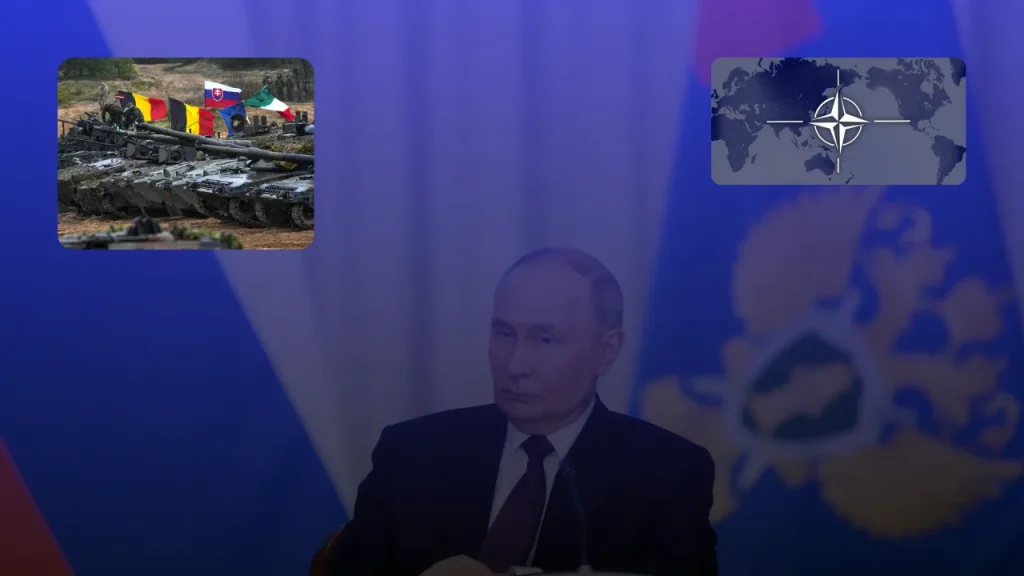
What Does the North Atlantic Treaty Actually Require?
The treaty was signed in Washington on April 4, 1949. Several articles matter here.
Article 5: collective defense
The parties agree that an armed attack against one or more of them in Europe or North America “shall be considered an attack against them all.” Each ally agrees to assist the attacked party by taking “such action as it deems necessary, including the use of armed force,” in exercise of the right of individual or collective self-defense recognized by Article 51 of the UN Charter.
Article 5 therefore does not automatically require every member to declare war or to respond identically. Each ally decides what action it considers necessary. It also does not mean every border incident triggers a military response.
Article 6: geographic scope
Article 6 defines what counts as an armed attack covered by Article 5: an attack on the territory of a party in Europe or North America, on certain islands in the North Atlantic area, or on forces, vessels or aircraft of a party in those areas. Ukraine is outside it.
Article 11: constitutional processes
The treaty is to be carried out by the parties “in accordance with their respective constitutional processes.” In the United States, this means Congress’s powers over war remain relevant, and the Senate attached that understanding when it ratified the treaty in 1949. Whether and how the U.S. would act in a specific crisis would run through the Constitution, the War Powers Resolution (50 U.S.C. §§ 1541–1548) and statutes governing deployments.
Congress also acted on the question of leaving the alliance. Reporting on the fiscal year 2024 National Defense Authorization Act (section 1250A) says it bars a president from withdrawing from NATO without Senate approval by a two-thirds vote or an act of Congress. Check the statute’s current text before citing it.
Article 4: consultations
Any member can request consultations when it believes its territorial integrity, political independence or security is threatened. Poland and Estonia reportedly invoked Article 4 in September 2025 after airspace incidents. Article 4 consultations do not mean NATO has found that an armed attack occurred.
Article 3: resilience
Allies agree to maintain and develop their individual and collective capacity to resist armed attack. This underpins national resilience measures and spending commitments.
Articles 1 and 2
Article 1 commits members to settle disputes peacefully and to refrain from the threat or use of force inconsistent with UN purposes. This is a treaty-level restatement of the UN Charter’s rule.
Has Article 5 ever been invoked?
Once. NATO invoked it after the September 11, 2001 terrorist attacks on the United States. That shows the provision covers more than a conventional invasion by a state.
Cyber and hybrid attacks
NATO has said since its 2014 Wales Summit that a cyberattack could trigger Article 5, and its 2021 Brussels Summit statement said this would be decided case by case. Reporting notes NATO has kept some strategic ambiguity about the threshold for hybrid and gray-zone incidents. Researchers describe a “deterrence gap” between conventional readiness and continuous below-threshold activity.
The International Law Behind NATO’s Posture
NATO’s actions are governed by international law beyond the treaty.
UN Charter Article 2(4): the ban on force
States must refrain from the threat or use of force against another state’s territorial integrity or political independence, or in any manner inconsistent with the UN’s purposes. This is a core rule of modern international law. Military force is unlawful unless a recognized legal basis applies.
UN Charter Article 51: self-defense
Nothing in the Charter impairs “the inherent right of individual or collective self-defence if an armed attack occurs” against a UN member, until the Security Council has taken measures needed to maintain peace. Measures taken must be reported to the Security Council. Key points from the law:
- Armed attack threshold. In Nicaragua v. United States (ICJ, 1986), the court said an “armed attack” covers the most grave forms of the use of force, not every incident.
- Collective self-defense. The same case indicated that collective self-defense generally requires the victim state to declare itself attacked and to request help.
- Necessity and proportionality. Self-defense must be necessary and proportionate, principles associated with the Caroline incident and applied in later ICJ decisions.
- Anticipatory self-defense. Whether and when a state can act against an imminent threat is contested. Article 5 is not a blanket authorization for a preventive war.
UN Charter Articles 52 and 53: regional arrangements
Article 52 recognizes regional arrangements for maintaining peace if consistent with the Charter’s purposes. Article 53 says enforcement action under regional arrangements requires Security Council authorization. NATO frames its operations as collective self-defense under Article 51 rather than as Article 53 enforcement. NATO is a collective-defense alliance, not an unrestricted right to use force whenever a member sees a threat.
Article 103
Under Article 103, obligations under the UN Charter prevail over conflicting obligations under other treaties, including the North Atlantic Treaty.
International humanitarian law
If an armed conflict occurs, the law of armed conflict applies regardless of whether the resort to force was lawful. It includes distinction between civilians and combatants, proportionality and precautions in attack, reflected in the Geneva Conventions and Additional Protocol I (articles such as 48, 51, 52 and 57) and in customary law. Grynkewich’s reference to striking supporting and command systems does not establish a policy of hitting every target inside Russia. Any actual strike would be judged against the circumstances, the military objective and these rules.
Nuclear weapons law
In its 1996 advisory opinion on the Legality of the Threat or Use of Nuclear Weapons, the ICJ said a threat or use of nuclear weapons must comply with the UN Charter and humanitarian law, and the court could not conclude whether it would be lawful in an extreme circumstance of self-defense in which a state’s survival is at stake. Nuclear-sharing arrangements are debated under the Nuclear Non-Proliferation Treaty. NATO states are not parties to the 2017 Treaty on the Prohibition of Nuclear Weapons.
Status of forces
The NATO Status of Forces Agreement (1951) and bilateral arrangements, such as the U.S.-Poland Enhanced Defense Cooperation Agreement, govern the legal status, jurisdiction and movement of allied personnel in host countries.
What Is “Block, Blunt and Break”?
The phrase is a way to explain the military logic of deterrence. It is not a new treaty or a decision to attack Russia.
- Block: stop an attack from achieving its immediate objective, using forward forces and air, naval, cyber and space support.
- Blunt: reduce the attacking force’s effectiveness using sensors, drones, defensive operations and precision fires.
- Break: if the attack continues, target the system that sustains it, including command nodes, logistics and supporting infrastructure, and potentially strike beyond the immediate front.
Reporting says Grynkewich also stressed that NATO would fight even if U.S. forces were engaged elsewhere, and that nuclear rhetoric would not split the alliance. Those details come from press accounts of the speech.
Steadfast Noon
NATO announced on October 8 that the exercise would involve 17 nations and match the usual scale of earlier editions. The alliance says it uses no live weapons and is not linked to current events or directed at any country. It tests procedures and readiness related to nuclear deterrence.
Supporters argue credible deterrence helps prevent attacks. Critics raise concerns about escalation, accidents and humanitarian consequences. An exercise held during a tense period does not, on its own, show that an attack is expected. Distinguish NATO’s official explanation from speculation about its timing.
What About Ukraine?
Ukraine is not covered by Article 5, because it is not a NATO member. An attack on Ukraine does not automatically trigger NATO’s collective-defense duty. NATO members support Ukraine in various ways, and the legal basis for each country’s assistance depends on the type of aid and the arrangements involved. Ukraine’s right to defend itself against Russia’s invasion is separate from NATO’s obligations to its members.
Could NATO and Russia End Up in a Direct War?
A direct conflict is a serious risk that both sides have reasons to avoid, but the current warnings and exercises do not show it is imminent. Situations that could raise escalation risk include:
- an armed incident causing deaths or major damage on NATO territory;
- an airspace or maritime confrontation in which forces misread each other;
- a cyber or infrastructure incident attributed to a state without shared evidence;
- nuclear threats or movements read as preparation for attack;
- a fast chain of retaliation leaving little time for diplomacy.
These are risk factors, not predictions.
What Are the Main Legal Limits on a NATO Response?
- The treaty: Article 5 is triggered by an armed attack within Article 6. Article 4 provides consultation. Each ally decides its own action under Article 5, subject to its constitutional processes under Article 11.
- The UN Charter: Article 2(4) bars unlawful force, Article 51 allows self-defense against an armed attack, and Article 103 gives the Charter priority.
- Humanitarian law: distinction, proportionality and precautions apply once armed conflict exists.
- National law: each member has its own approval procedures, including the U.S. Constitution and the War Powers Resolution.
- Evidence and attribution: a cyber incident, airspace violation or infrastructure failure must be assessed on its own facts. An incident is not automatically an armed attack.
What Happens Next?
- Steadfast Noon runs from October 13, 2026.
- Eastern-flank announcements from NATO may add assets or activities. Judge each by its stated purpose.
- Statements by NATO’s Secretary General, governments and commanders. A commander’s remarks are not a treaty commitment.
- Evidence on specific incidents, such as new airspace violations, cyberattacks or sabotage claims.
- Formal policy documents, such as summit declarations, which are stronger evidence of policy change than commentary.
Frequently Asked Questions
What is NATO’s deterrence strategy against Russia?
It is the alliance’s approach to discouraging an attack through collective defense, conventional forces, nuclear deterrence, air and missile defense, cyber resilience, readiness and reinforcement.
What did NATO’s top commander say on October 12, 2026?
Gen. Grynkewich warned of a decisive response to any attack on alliance territory and described a block, blunt and break approach that could reach beyond the initial attacking force.
Does Article 5 mean every member must declare war?
No. Each ally assists a member under armed attack by taking the action it deems necessary, which may include armed force, and acts through its own constitutional processes.
Does Article 5 apply if Russia attacks Ukraine?
No. Ukraine is not a NATO member.
Has Article 5 been invoked before?
Once, after the September 11, 2001 attacks.
What is the difference between Article 4 and Article 5?
Article 4 allows a member to request consultations over a threat. Article 5 addresses collective defense after an armed attack.
Can NATO legally strike targets inside Russia?
It depends on the circumstances and international law. Article 5 is not a blanket authorization. A strike would need a legal basis, such as self-defense against an armed attack, and would have to follow humanitarian law.
What is Steadfast Noon?
NATO’s annual nuclear deterrence exercise. The 2026 edition begins October 13 in Italy with 17 nations and uses no live weapons.
What is Eastern Sentry?
A NATO activity launched in September 2025 to strengthen vigilance on the eastern flank after airspace incidents.
Is NATO preparing for an imminent war with Russia?
The statements and exercises discussed here do not establish that. NATO says its measures are defensive and meant to prevent aggression.
The Bottom Line
NATO’s message is that an attack on one ally would not be an isolated event. The alliance is coordinating conventional, air-defense, cyber and nuclear capabilities to make aggression less likely to succeed. The legal framework matters as much as the military message: Article 5 is a collective-defense commitment with national discretion on how to respond, Article 4 provides consultations, and the UN Charter and humanitarian law set the limits on any use of force.
The evidence supports a clear conclusion: NATO is emphasizing readiness and deterrence amid heightened tensions with Russia. It does not show that a NATO-Russia war is about to begin.
Sources and Legal References
- Reuters, NATO general sets out tough military response to any “foolish” Russian attack (Oct. 12, 2026). https://www.reuters.com/world/nato-general-sets-out-tough-military-response-any-foolish-russian-attack-2026-10-12/
- NATO, NATO holds annual nuclear exercise Steadfast Noon (Oct. 8, 2026). https://www.nato.int/en/news-and-events/articles/news/2026/10/08/nato-holds-annual-nuclear-exercise-steadfast-noon
- NATO, Deterrence and defence. https://www.nato.int/en/what-we-do/deterrence-and-defence/deterrence-and-defence
- NATO, Strengthening NATO’s eastern flank (updated Sept. 29, 2026). https://www.nato.int/en/what-we-do/deterrence-and-defence/strengthening-natos-eastern-flank
- NATO, 2022 Strategic Concept. https://www.nato.int/nato_static_fl2014/assets/pdf/2022/6/pdf/290622-strategic-concept.pdf
- NATO, Collective defence and Article 5. https://www.nato.int/en/what-we-do/introduction-to-nato/collective-defence-and-article-5
- North Atlantic Treaty (Washington, Apr. 4, 1949), Articles 1 to 6 and 11.
- Charter of the United Nations, Articles 2(4), 51, 52, 53 and 103. https://www.un.org/en/about-us/un-charter/full-text
- Military and Paramilitary Activities in and against Nicaragua (Nicaragua v. United States), ICJ (1986); Legality of the Threat or Use of Nuclear Weapons, ICJ Advisory Opinion (1996).
- Geneva Conventions (1949) and Additional Protocol I (1977); Treaty on the Non-Proliferation of Nuclear Weapons; Treaty on the Prohibition of Nuclear Weapons (2017).
- War Powers Resolution, 50 U.S.C. §§ 1541–1548; National Defense Authorization Act for Fiscal Year 2024, sec. 1250A (NATO withdrawal limits).
- Agreement between the Parties to the North Atlantic Treaty regarding the Status of their Forces (1951).
- NATO summit declarations: Wales (2014), Brussels (2021) and The Hague (2025).
- Bloomberg, reporting on NATO plans involving drones and AI (Oct. 2026). Verify the original article before relying on it.
Disclaimer: This article provides general information on a developing international matter and is not legal advice. Official statements, treaty text and verified reporting should be checked again before publication or updating.
About the Author
Israr Ahmad is a legal content researcher with 4+ years of experience covering class action settlements and consumer rights cases. He has researched and published coverage of 2,500+ settlements using verified court records, settlement administrator filings, and government sources. Learn more about Israr.