
Monsanto Roundup Lawsuit 27 April 2026 Update The Supreme Court Case That Could End Cancer Claims Nationwide
🔴 Breaking — Updated April 27, 2026: Oral arguments in Monsanto Company v. Durnell, No. 24-1068, took place this morning at 11:00 AM ET before the U.S. Supreme Court. A ruling is expected by early July 2026. This article will be updated as reporting from the argument emerges.
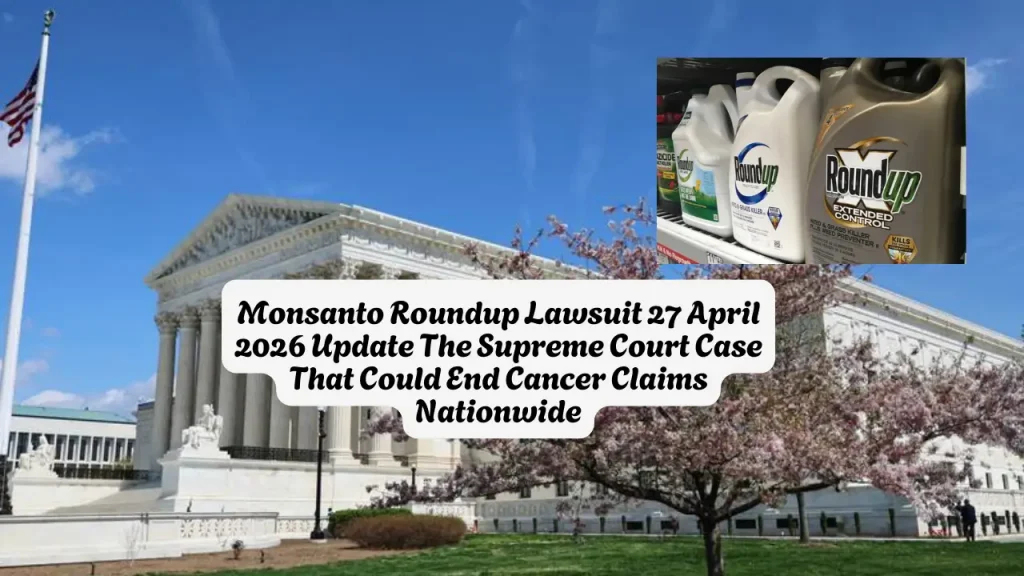
Monsanto is facing a class action lawsuit and thousands of individual suits alleging that its Roundup weedkiller caused non-Hodgkin’s lymphoma in users who were never warned of the cancer risk. The U.S. Supreme Court heard oral arguments today, April 27, 2026, in Monsanto Company v. Durnell, No. 24-1068 — a case that could decide whether every one of those lawsuits survives or gets wiped out by federal law.
Quick Facts
| Field | Detail |
| Lawsuit Filed | 2019 (Durnell v. Monsanto, Missouri state court) |
| Defendant | Monsanto Company (owned by Bayer AG) |
| Alleged Violation | Failure to warn under state tort law; Federal Insecticide, Fungicide, and Rodenticide Act (FIFRA) preemption at issue |
| Who Is Affected | Anyone who used Roundup or glyphosate-based products and developed non-Hodgkin’s lymphoma |
| Current Court Stage | U.S. Supreme Court — oral arguments held April 27, 2026 |
| Court & Jurisdiction | Supreme Court of the United States; original verdict from Missouri state court |
| Lead Counsel — Monsanto | Paul D. Clement, Clement & Murphy PLLC, Alexandria, VA |
| Lead Counsel — Durnell | Ashley Conrad Keller, Keller Postman LLC, Chicago, IL |
| Proposed Settlement | $7,250,000,000 — proposed by Bayer in February 2026; pending court approval |
| Opt-Out Deadline | June 4, 2026 |
| Supreme Court Decision Expected | Early July 2026 |
| Pending Claims Nationwide | Approximately 67,000 active claims |
| Official Case Docket | supremecourt.gov, No. 24-1068 |
| Last Updated | April 27, 2026 |
What Is the Monsanto Roundup Lawsuit About? Monsanto Company v. Durnell, No. 24-1068
If you’ve ever sprayed Roundup in your yard, on a farm, or along a fence line, this case is about you. Monsanto sold Roundup — built on the chemical glyphosate — as one of the safest weedkillers on the market for decades. Its ads from the 1990s and early 2000s showed people applying it in shorts and t-shirts, with no protective gear. Monsanto’s advertisements portrayed Roundup as completely safe, and the plaintiff argues those marketing materials — not just the label — show the company failed to warn users of cancer risk.
In 2015, the International Agency for Research on Cancer classified glyphosate as “probably carcinogenic to humans,” setting off a wave of lawsuits against Monsanto from Americans diagnosed with non-Hodgkin’s lymphoma after using the product. Non-Hodgkin’s lymphoma is a cancer of the lymphatic system. Over 100,000 people have now sued. Monsanto’s parent company, Bayer, has already paid more than $10,000,000,000 resolving earlier cases.
The specific case before the Supreme Court centers on John Durnell, a Missouri man who used Roundup regularly and later developed non-Hodgkin’s lymphoma. A Missouri jury awarded him $1,250,000, finding that Monsanto failed to adequately warn him of potential cancer risks. The Missouri Court of Appeals affirmed that verdict, rejecting Bayer’s argument that federal law blocked the claim. Monsanto took the case to the Supreme Court — and what happens next will affect tens of thousands of cancer patients still waiting for compensation.
This case sits at the intersection of consumer rights law and federal preemption — the legal doctrine that federal law can override state law. A consumer rights lawyer watching this case closely will tell you the stakes extend well beyond Roundup: a ruling for Monsanto could limit failure-to-warn claims against pesticide makers across the entire country.
Are You Part of the Roundup Class Action Lawsuit?
If you used Roundup and later received a non-Hodgkin’s lymphoma diagnosis, you may have a claim — but the Supreme Court’s ruling will directly shape your options. Here’s how to assess where you stand right now.
You may be part of this litigation if:
- You used Roundup or any glyphosate-based herbicide — residential or commercial
- You were diagnosed with non-Hodgkin’s lymphoma after regular exposure
- Your diagnosis occurred after periods of repeated or prolonged use
- You used Roundup prior to Bayer removing glyphosate from its residential consumer products
- You are a farmworker, landscaper, groundskeeper, or agricultural worker with documented Roundup exposure
You are likely NOT included if:
- You used Roundup but have not received a cancer diagnosis
- You developed a different type of cancer not linked to glyphosate in scientific literature
- You are seeking to join the proposed $7,250,000,000 class settlement and have already retained private counsel in a separate individual claim — check with your attorney before the June 4, 2026 opt-out deadline
The critical deadline right now: Class members have until June 4, 2026 to opt out of Bayer’s proposed $7,250,000,000 settlement if they want to pursue their own lawsuits. If you opt in and the Supreme Court later rules against Monsanto, your individual claim may have been worth more than the settlement. If you opt out and the Court rules for Monsanto, your state-law claim may be dismissed entirely. This is the exact gamble hundreds of thousands of claimants are navigating right now.
Related article: UNC-Chapel Hill vs. The Press, The Lawsuit Over the $1.2 Million SCiLL Report They Won’t Release
What Are Roundup Plaintiffs Seeking in This Lawsuit?
This section has two layers: what individual plaintiffs seek, and what the Supreme Court case is actually deciding.
At the individual case level, plaintiffs like John Durnell seek compensation for damages — medical costs, lost wages, pain and suffering, and punitive damages for what they allege was Monsanto’s knowing concealment of cancer risk. Plaintiffs have won more than $4,000,000,000 in jury verdicts against Monsanto across prior trials. A Missouri appellate court affirmed a $611,000,000 verdict as recently as May 2025.
At the Supreme Court level, the question is narrower but more consequential: whether the Federal Insecticide, Fungicide, and Rodenticide Act (FIFRA) preempts state failure-to-warn claims where the EPA has not required the warning. In plain English — if the EPA says a cancer warning isn’t required on the label, can a state jury still find Monsanto liable for not including one?
Monsanto’s answer is no. The company argues that “once EPA makes that judgment, the label is the law” and “cannot be second-guessed by lay juries applying the law of 50 states.”
Durnell’s answer is also no — but for a different reason. Durnell argues that his claim is based not on Roundup’s label but on Monsanto’s marketing materials from the 1990s and 2000s. Because FIFRA governs labeling rather than marketing, his lawyers argue his claim falls outside the scope of federal preemption entirely.
If the Court rules for Monsanto, people harmed by pesticides could lose any avenue for obtaining damages to cover their medical expenses and lost wages — not just for Roundup, but potentially for any pesticide product where the EPA has not required a warning.
What Should You Do If You Were Affected by Roundup?
You have a live, time-sensitive decision to make — especially with the June 4, 2026 opt-out deadline approaching before the Supreme Court rules.
If you have an existing Roundup claim and an attorney: Contact your attorney immediately about the June 4 opt-out deadline for Bayer’s proposed settlement. Do not make this decision without legal advice — the outcome of today’s Supreme Court argument could shift the calculation dramatically depending on which way the justices signal they are leaning.
If you used Roundup and have a cancer diagnosis but no attorney: The settlement would be funded over as long as 21 years, and Bayer has the right to walk away if too many people opt out. A free legal consultation with a product liability attorney who handles Roundup cases can help you decide whether to join the settlement or pursue an individual claim.
If you have not filed a claim yet: Save all documentation — medical records showing your diagnosis, purchase receipts, records of where and how often you used Roundup, any employment records if you used it professionally. These will matter regardless of which direction the Supreme Court rules.
Monitor the docket at: supremecourt.gov, No. 24-1068
Monsanto Roundup Class Action Lawsuit Timeline
| Milestone | Date |
| Glyphosate classified “probably carcinogenic” by IARC | 2015 |
| John Durnell files suit in Missouri state court | 2019 |
| Missouri jury awards Durnell $1,250,000 | TBD — exact trial date not confirmed in available sources |
| Missouri Court of Appeals affirms $1,250,000 verdict | February 2025 |
| Missouri Supreme Court declines to hear appeal | TBD — exact date not confirmed in available sources |
| Missouri appellate court affirms separate $611,000,000 verdict | May 27, 2025 |
| U.S. Solicitor General recommends Supreme Court hear Monsanto’s appeal | December 2, 2025 |
| Supreme Court grants certiorari (agrees to hear the case) | January 16, 2026 |
| Trump administration files amicus brief supporting Monsanto | March 25, 2026 |
| Bayer proposes $7,250,000,000 class settlement | February 2026 |
| Oral arguments at U.S. Supreme Court | April 27, 2026 — TODAY |
| Opt-out deadline for proposed Bayer settlement | June 4, 2026 |
| Supreme Court decision expected | Early July 2026 |
| Proposed settlement payment timeline | TBD — Bayer proposes funding over up to 21 years, pending final court approval |
Frequently Asked Questions
Is there a class action lawsuit against Monsanto over Roundup?
Yes. More than 100,000 people have sued Monsanto — now owned by Bayer — claiming Roundup’s active ingredient, glyphosate, caused their non-Hodgkin’s lymphoma and that Monsanto failed to warn them of the risk. The U.S. Supreme Court heard arguments in the lead case, Monsanto v. Durnell, No. 24-1068, on April 27, 2026.
Do I need to do anything right now to be included?
If you have an existing claim, the most urgent action is the June 4, 2026 opt-out deadline for Bayer’s proposed $7,250,000,000 settlement. Missing it could lock you into the settlement before the Supreme Court rules. If you haven’t filed yet, consult a product liability attorney as soon as possible.
When will a settlement be reached in the Roundup case?
Bayer has proposed a $7,250,000,000 settlement to cover current and future non-Hodgkin’s lymphoma claims. It still requires court approval and depends partly on how many claimants opt out. The Supreme Court’s ruling — expected by early July 2026 — could affect whether that settlement moves forward on its current terms.
Can I file my own Roundup lawsuit instead of joining the settlement?
Yes — if you opt out of the proposed class settlement before June 4, 2026, you preserve the right to pursue an individual claim. However, if the Supreme Court rules that FIFRA preempts state failure-to-warn claims, individual state-law lawsuits could be severely weakened or dismissed. Talk to a class action lawsuit attorney before that deadline passes.
How will I know if the Roundup lawsuit settles or the Supreme Court rules?
The Supreme Court’s decision will be published at supremecourt.gov and widely reported. For the settlement specifically, updates are tied to court approval proceedings. Monitor the official docket at No. 24-1068 on the Supreme Court website.
What does FIFRA preemption mean for my Roundup claim?
FIFRA — the Federal Insecticide, Fungicide, and Rodenticide Act — is the federal law that governs pesticide labels. Monsanto argues that because the EPA approved Roundup’s label without requiring a cancer warning, no state jury can hold the company liable for failing to include one. If the Supreme Court agrees, most Roundup failure-to-warn claims would be dismissed. If it disagrees, the litigation continues and the proposed settlement’s terms may shift.
Why is the Trump administration siding with Monsanto?
The Trump administration filed an amicus brief through the Solicitor General supporting Bayer, arguing that allowing state warning requirements would create an inconsistent patchwork across the country. Notably, advocacy groups aligned with the Make America Healthy Again movement filed briefs on the opposite side — in support of Durnell.
How much money has Monsanto already paid in Roundup verdicts and settlements?
Bayer has already paid more than $10,000,000,000 resolving Roundup cases and still faces roughly 67,000 active claims. The proposed class settlement would add another $7,250,000,000 — funded over as long as 21 years.
Sources & References
- U.S. Supreme Court Official Docket — Monsanto Company v. Durnell, No. 24-1068: supremecourt.gov
- SCOTUSblog Case Page: scotusblog.com/cases/monsanto-company-v-durnell
Disclaimer: This article is for informational purposes only and does not constitute legal advice. Legal claims and outcomes depend on specific facts and applicable law. The June 4, 2026 opt-out deadline for Bayer’s proposed settlement is a real legal deadline — consult a qualified attorney before that date if you have a pending claim or believe you may qualify. For advice regarding your specific situation, consult a licensed attorney.
Prepared by the AllAboutLawyer.com Editorial Team and reviewed for factual accuracy against the U.S. Supreme Court official docket, SCOTUSblog, and verified reporting from CNN, The New Lede, and Earthjustice on April 27, 2026. Last Updated: April 27, 2026
About the Author
Israr Ahmad is a legal content researcher with 4+ years of experience covering class action settlements and consumer rights cases. He has researched and published coverage of 2,500+ settlements using verified court records, settlement administrator filings, and government sources. Learn more about Israr.