
Minute Maid Fruit Punch Class Action Lawsuit 2026, Why Coca-Cola Faces “100% Natural Flavors” Claims
The Coca-Cola Company is facing a new putative class action alleging that its Minute Maid Fruit Punch falsely advertises “100% Natural Flavors” while containing citric acid that the plaintiff says is industrially manufactured and works as an artificial flavoring ingredient.
Latrice Zuniga filed Zuniga v. The Coca-Cola Company, Case No. 3:26-cv-50534, on November 4, 2026, in the U.S. District Court for the Northern District of Illinois. She alleges consumers paid more for the fruit punch because they believed its flavoring was entirely natural.
The complaint points to the product’s own ingredient list, which reads “citric acid (provides tartness).” According to Zuniga, that wording shows the ingredient contributes to flavor, which she says contradicts the label.
The lawsuit seeks damages, restitution and changes to the marketing on behalf of purchasers in Illinois and nine other states.
The allegations have not been proven. Coca-Cola has not been found liable, no class has been certified, and there is no Minute Maid settlement, administrator or claim form.
Zuniga v. The Coca-Cola Company: Quick Facts
| Detail | Verified information |
| Lawsuit | Zuniga v. The Coca-Cola Company |
| Case number | 3:26-cv-50534 |
| Filed | November 4, 2026 |
| Court | U.S. District Court, Northern District of Illinois |
| Presiding judge | Iain D. Johnston |
| Magistrate judge | Margaret J. Schneider |
| Plaintiff | Latrice Zuniga |
| Defendant | The Coca-Cola Company |
| Plaintiff’s attorney | Kevin Laukaitis, Laukaitis Law LLC |
| Product | Minute Maid Fruit Punch (59 fl oz carton pictured in the complaint) |
| Challenged labeling | “100% Natural Flavors” |
| Ingredient at issue | Citric acid |
| Main allegation | False advertising and deceptive food labeling |
| Proposed classes | Illinois class and 10-state consumer class |
| Class certification | Not granted |
| Settlement amount | None announced |
| Claim deadline | None |
| Current status | Pending putative class action |
Primary source: Federal complaint (Document 1), filed November 4, 2026.
Why Is Coca-Cola Being Sued Over Minute Maid Fruit Punch?
The dispute is about what a shopper understands from the words “100% Natural Flavors” on a drink carton. Zuniga argues the phrase promises that no artificial or synthetic ingredient contributes to the flavor. Yet the punch contains citric acid, which adds tartness.
She alleges the citric acid is not taken straight from citrus fruit but made commercially through fermentation and industrial processing. The complaint makes three main arguments:
- Misleading representation. Coca-Cola allegedly presents the drink as having only natural flavorings while adding industrially made citric acid.
- Insufficient disclosure. The ingredient list names citric acid and its function but does not say how it is made.
- Financial harm. Consumers allegedly paid a premium because they trusted the natural-flavors claim.
This is a challenge to the honesty of a marketing claim. It does not allege that anyone was physically injured.
Who Is Latrice Zuniga, and What Does Her Complaint Say?
Zuniga lives in DeKalb, Illinois. According to paragraphs 12 to 19 of the complaint, she bought Minute Maid Fruit Punch several times in the year before filing, at a Walmart in DeKalb. She says she read and relied on the natural-flavors label and believed the drink had no synthetic or artificial flavoring ingredients. She claims she would have paid less, or not bought it, if the label had been accurate. She is represented by Kevin Laukaitis of Laukaitis Law LLC and has asked for a jury trial.
Which Minute Maid Fruit Punch Ingredients and Labels Are Challenged?
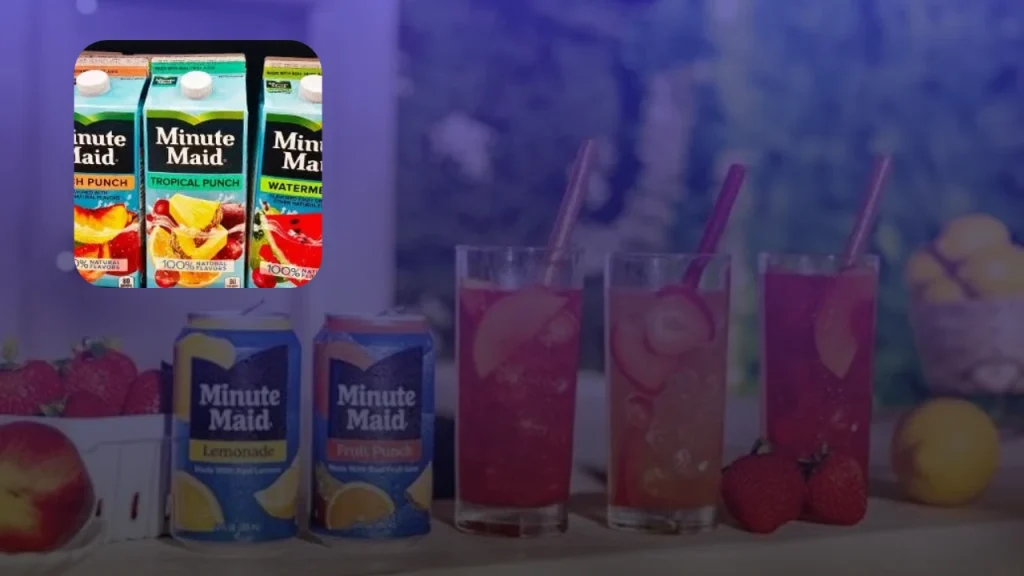
The complaint pictures the 59-fluid-ounce carton. It shows two prominent statements, “100% Natural Flavors” and “Made With Real Fruit Juice,” along with fruit imagery and the Minute Maid brand. The ingredient list reproduced in the complaint includes:
| Ingredient | Listed on challenged package |
| Pure filtered water | Yes |
| High-fructose corn syrup | Yes |
| Grape and pineapple juices from concentrate | Yes |
| Pear and apple juices from concentrate | Yes |
| Natural flavors | Yes |
| Citric acid | Yes, “provides tartness” |
| Sucralose | Yes |
| Grape skin extract | Yes, for color |
Coca-Cola’s current product information also lists citric acid, but formulations and sizes can differ from the carton in the complaint. Check the package you bought.
Does “Made With Real Fruit Juice” on Minute Maid mean 100% juice?
No. A drink can contain some real juice without being all juice. The ingredient list shows juice concentrates, so the complaint does not claim the drink lacks real juice. The specific allegation is that its flavoring includes an ingredient the plaintiff considers artificial.
Related article: Ford Recalls 36,994 Lincoln Navigators Over Passenger Seat Defect, Check Your VIN and Get the Free Repair
What Is Citric Acid, and Why Is It at the Center of the Minute Maid Lawsuit?
Citric acid is an organic acid found naturally in citrus fruits. Manufacturers use it in drinks for a sour taste and to control acidity. Commercial citric acid is usually made by fermentation with microorganisms such as Aspergillus niger, followed by recovery and refining, as the EPA’s citric acid supply chain profile describes.
Zuniga relies on that process to argue the ingredient is synthetic rather than natural.
Does industrial production make citric acid an artificial flavor under FDA rules?
Not automatically. FDA’s definition of natural flavor looks at the source, processing and purpose of a substance, and it includes qualifying fermentation products. So commercial fermentation alone does not settle whether citric acid is legally an artificial flavor. The court may have to look at its actual source, production method, technical purpose and the regulatory definitions. The claim that Coca-Cola uses synthetic citric acid is still an allegation.
Does the Zuniga lawsuit say Minute Maid Fruit Punch is unsafe?
No. It concerns alleged deceptive labeling and economic loss. Industrial manufacture does not by itself make a food ingredient unsafe, and FDA safety rules apply whether an ingredient is natural or not.
What Do FDA Rules Under 21 CFR § 101.22 Say About “100% Natural Flavors”?
The main regulation is 21 CFR § 101.22, which defines natural and artificial flavoring and sets labeling rules.
- Natural flavors, 21 CFR § 101.22(a)(3). Flavoring constituents from listed natural sources such as plants, fruits, vegetables, edible yeast, certain animal products and qualifying fermentation products. Their significant function must be flavoring, not nutrition.
- Artificial flavors, 21 CFR § 101.22(a)(1). Substances used to add flavor that do not meet the natural-source criteria. This matters most when a label suggests every flavoring is natural.
- Chemical preservatives, 21 CFR § 101.22(j). When an ingredient is added as a chemical preservative, its name generally must be paired with a statement of that function. Minute Maid’s list says citric acid “provides tartness,” which Zuniga says shows a flavoring role. The court may have to decide whether the ingredient’s real technical role supports that.
FDA has no single formal regulation defining “natural” for all food labeling. Its general policy asks whether artificial or synthetic substances have been added that consumers would not normally expect. That is separate from the specific definition of natural flavors, so a key question is whether Minute Maid’s exact wording misleads reasonable consumers under federal and state law.
Which State Consumer Protection Laws Does Zuniga v. Coca-Cola Invoke?
The complaint has three counts.
Count I: Multistate consumer protection statutes
| State | Principal law cited |
| California | Unfair Competition Law, Business and Professions Code § 17200 |
| Florida | Deceptive and Unfair Trade Practices Act, § 501.201 |
| Illinois | Consumer Fraud and Deceptive Business Practices Act |
| Massachusetts | Chapter 93A |
| Michigan | Consumer Protection Act |
| Minnesota | False Advertising Act, § 325F.67 |
| Missouri | Merchandising Practices Act |
| New Jersey | Consumer Fraud Act |
| New York | General Business Law §§ 349 and 350 |
| Washington | Consumer Protection Act, RCW 19.86 |
These laws differ on how deception, causation, recoverable loss and remedies must be shown.
Count II: Illinois Consumer Fraud and Deceptive Business Practices Act
Zuniga alleges violations of 815 ILCS 505/2, saying Coca-Cola’s misleading label influenced purchases and caused financial loss.
Count III: Unjust enrichment under Illinois law
Pleaded as an alternative theory: Coca-Cola allegedly collected money through sales induced by the disputed claims and should not keep that benefit. The complaint also asks for injunctive relief, damages, restitution, interest, costs and attorneys’ fees.
Who Could Be Included in the Minute Maid Class Action?
The complaint proposes two overlapping groups:
- Illinois Class: Illinois purchasers of Minute Maid Fruit Punch with the challenged labeling, for personal, family or household use, during the period allowed by law.
- Multistate Class: Qualifying purchasers in California, Florida, Illinois, Massachusetts, Michigan, Minnesota, Missouri, New Jersey, New York and Washington.
Proposed exclusions include resellers and people asserting personal bodily-injury claims. The complaint does not fix a calendar period; it refers to the maximum period applicable law allows. No class has been certified, and the states and conditions could change.
Is There a Minute Maid Fruit Punch Settlement or Refund?
No. As of November 17, 2026, there is no court-approved settlement, compensation fund, claim form, administrator, payment deadline or guaranteed refund.
The complaint invokes the Class Action Fairness Act and alleges more than $5 million in controversy for jurisdiction. That does not mean Coca-Cola agreed to a $5 million settlement. If a class settlement is ever reached, the court-approved notice will explain who qualifies and how payments are calculated.
Is Coca-Cola Facing Other Minute Maid Fruit Punch Lawsuits?
Yes.
- Alarcon v. The Coca-Cola Company, No. 2:26-cv-11868 (Central District of California), filed October 11, 2026 by Annette Alarcon, Deborah Patt and Deidre Moorhead. It also challenges “100% Natural Flavors” on Minute Maid Fruit Punch over industrially manufactured citric acid.
- Delvalle v. The Coca-Cola Company, No. 1:24-cv-06163, an earlier case over a different statement, “No Preservatives Added,” alleging citric acid functioned as a preservative.
The 2026 cases are separate federal proceedings with similar theories. They show how one ingredient can produce different labeling disputes depending on the exact claim and its alleged function.
How Does the Minute Maid Case Compare With Other Citric Acid Lawsuits?
Other companies face related claims. In Gatorade “Hydrates Better Than Water” Class Action Lawsuit, What Walsh v. PepsiCo Claims, a plaintiff challenges hydration advertising and alleges citric acid and sodium citrate make natural-flavor claims misleading. Celestial Seasonings Class Action Lawsuit, “All Natural” Claims Face Legal Challenge Over Citric Acid and Artificial Flavors covers similar allegations about herbal teas. And Canada Dry Class Action Lawsuit, Three Active Cases Target Ginger Ale Labeling, “Made in Canada” Claims, and Natural Flavoring looks at ginger ale marketing.
These involve different defendants, so allegations in one case do not establish liability in another. For background on how these cases move from complaint to payout, read How Class Action Lawsuits Work.
What Should Minute Maid Fruit Punch Buyers Do Now?
You do not need to file a claim because no settlement exists. If you are concerned about the label, keep receipts, Walmart or other retailer order histories, photos of the package and ingredient panel, and approximate purchase dates. You can also watch the federal docket. Do not register with unofficial websites or pay anyone promising a Minute Maid payout.
What Happens Next in Zuniga v. The Coca-Cola Company?
The case is before U.S. District Judge Iain D. Johnston and Magistrate Judge Margaret J. Schneider. The public docket confirms the November 4 complaint. Likely next steps are Coca-Cola’s response, a possible motion to dismiss, discovery on the citric acid’s sourcing and purpose, and a future motion for class certification.
Contested questions may include whether the label would mislead reasonable shoppers, whether the citric acid is legally an artificial flavor, whether federal law preempts some state-law theories, and whether buyers suffered measurable loss. No substantive response from Coca-Cola was verified in the records reviewed, and no trial date or judgment exists.
Minute Maid Fruit Punch Lawsuit FAQs: Zuniga v. Coca-Cola
Why is Coca-Cola being sued over Minute Maid Fruit Punch?
A consumer alleges the “100% Natural Flavors” claim is misleading because the drink contains citric acid she says is industrially made and used for flavoring.
Does Minute Maid Fruit Punch contain citric acid?
Yes. The challenged 59-ounce package lists citric acid and says it provides tartness.
Is citric acid legally an artificial flavor?
It depends on the ingredient’s source, production process, function and FDA’s definitions. The plaintiff’s view that it is artificial remains an allegation.
Is Minute Maid Fruit Punch made with real juice?
The ingredient list includes fruit juices from concentrate. “Made With Real Fruit Juice” is not a claim that the drink is 100% juice.
Can I join the Minute Maid class action?
No class has been certified. The complaint proposes purchaser classes covering Illinois and nine other states.
Can I get a refund from Coca-Cola because of this lawsuit?
No lawsuit-related payment or refund program has been announced.
Has Minute Maid Fruit Punch been recalled?
No recall tied to these allegations was identified. This is a labeling lawsuit, not an established safety incident.
Has Coca-Cola lost the case?
No. The allegations have not been decided, and there is no finding of liability.
The Bottom Line on the Minute Maid Fruit Punch Lawsuit
Zuniga v. The Coca-Cola Company asks whether a drink can claim “100% Natural Flavors” while containing commercially made citric acid that provides tartness. Zuniga says that misleads shoppers who expect only natural flavoring. Whether the ingredient is artificial, and whether the label deceives, are still disputed.
For now this is a pending putative class action, not a settlement. No compensation is available, and no court has ruled that Coca-Cola’s labeling violates the law.
Primary Sources and Court Records
- Zuniga v. The Coca-Cola Company, Original 26-Page Federal Complaint (PDF), filed November 4, 2026
- Zuniga v. Coca-Cola, Federal Docket, No. 3:26-cv-50534
- Coca-Cola, Official Minute Maid Fruit Punch Product Information
- FDA, Use of the Term Natural on Food Labeling
- 21 CFR § 101.22, Natural Flavors, Artificial Flavors and Chemical Preservatives
- EPA, Citric Acid Supply Chain Profile (PDF)
- Alarcon v. Coca-Cola, Separate California Federal Docket
- FDA, Types of Food Ingredients
Disclaimer: This article is general U.S. legal information, not legal or medical advice. The lawsuit contains unproven allegations. Buying the product does not establish eligibility for compensation, and no settlement or certified class exists.
Researched and written by Israr Ahmad, legal content researcher and founder of AllAboutLawyer.com. All facts verified against the federal complaint and court docket, Coca-Cola’s official Minute Maid product information, FDA guidance, 21 CFR § 101.22 on the eCFR, and the EPA citric acid supply chain profile, as of November 17, 2026. Last Updated: November 17, 2026.
About the Author
Israr Ahmad is a legal content researcher with 4+ years of experience covering class action settlements and consumer rights cases. He has researched and published coverage of 2,500+ settlements using verified court records, settlement administrator filings, and government sources. Learn more about Israr.