
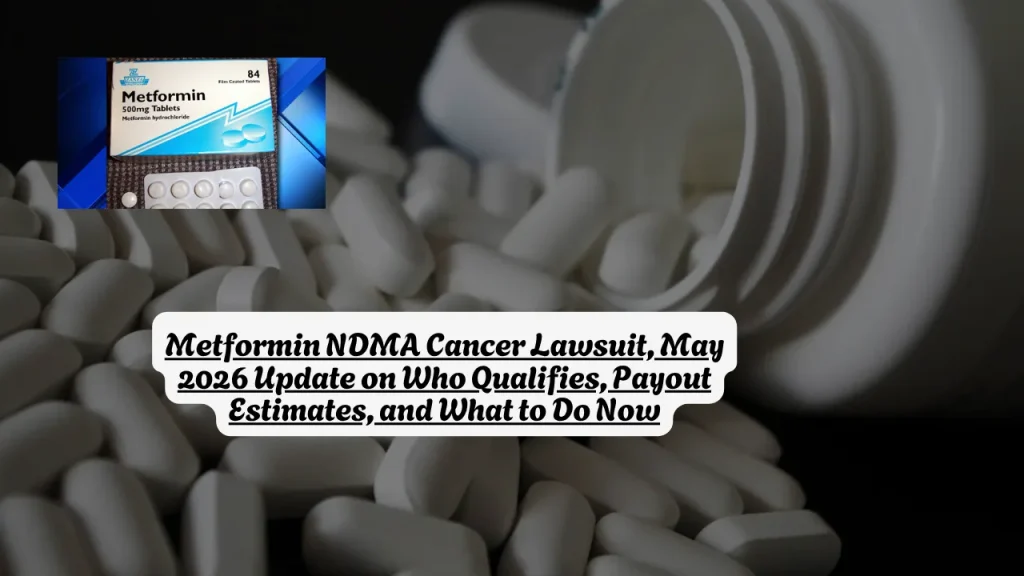
Metformin NDMA Cancer Lawsuit, May 2026 Update on Who Qualifies, Payout Estimates, and What to Do Now
Prepared by the AllAboutLawyer.com Editorial Team and reviewed for factual accuracy against FDA official recall notices, the FDA’s NDMA in Metformin updates page, and current litigation reporting as of May 6, 2026. Last Updated: May 6, 2026
Medical Notice: Do not stop taking metformin without talking to your doctor first. Stopping diabetes medication abruptly can be dangerous. This article covers legal claims — not medical advice.
Metformin is facing a growing wave of individual lawsuits and mass tort litigation alleging that certain extended-release formulations were contaminated with NDMA (N-Nitrosodimethylamine) — a chemical the FDA and the International Agency for Research on Cancer classify as a probable human carcinogen. Since 2020, 14 companies have voluntarily recalled extended-release metformin after testing found possibly unsafe amounts of NDMA. People who took those recalled products and later developed cancer are now pursuing legal action against the manufacturers — and the litigation is still actively developing in 2026.
What the Metformin Lawsuit Is About and Where It Stands in May 2026
| Field | Detail |
| Drug Involved | Metformin hydrochloride extended-release (ER) tablets — 500 mg, 750 mg, 1000 mg |
| Contaminant | NDMA (N-Nitrosodimethylamine) — probable human carcinogen |
| FDA Acceptable Limit | 96 nanograms per day |
| Recalls Issued | 2020–2022 — over 30 products recalled by 14+ manufacturers |
| Alleged Violation | Product liability — manufacturing defect and failure to warn |
| Current Legal Structure | Individual lawsuits; MDL consolidation under active discussion; no certified federal class action |
| Cancer Types Linked | Liver, colorectal, stomach, bladder, kidney, esophageal cancers |
| Estimated Payout Range | $10,000–$500,000+ depending on cancer type, duration of use, and documented damages |
| Filing Deadline | Varies by state — 1 to 6 years from diagnosis or discovery |
| Settlement Status | No global settlement reached as of May 6, 2026 |
| Last Updated | May 6, 2026 |
Why Metformin Is Being Sued — The NDMA Contamination Explained
Metformin is one of the most prescribed drugs in the United States. The drug is the most widely prescribed diabetes medication worldwide, with an estimated 40 million prescriptions dispensed every year in the U.S. alone. It works by reducing the amount of sugar the liver releases into the bloodstream and helping the body respond to insulin. Millions of people with type 2 diabetes rely on it every day.
The problem is not the drug itself. It is what was found inside specific formulations during manufacturing.
In May 2020, the FDA concluded its investigation and found unacceptable levels of NDMA in several lots of extended-release metformin. The FDA’s acceptable daily intake limit for NDMA is 96 nanograms — a threshold set because regulators recognize the substance can cause cancer. Testing by independent pharmacy Valisure found results that were far worse. Valisure found unacceptably high levels of NDMA in 42% of samples it tested. Some samples contained ten times the FDA-approved limit for NDMA. Valisure filed a citizen petition with the FDA demanding a full recall.
NDMA is the same carcinogen at the center of the Zantac NDMA cancer lawsuit, which resulted in GSK paying an estimated $2.2 billion to settle approximately 80,000 cancer claims. The metformin litigation is following a similar path — with one critical difference. Unlike Zantac, the FDA actually recalled metformin products, which provides plaintiffs with strong evidentiary support that the contamination was real and exceeded safe limits.
The lawsuits allege manufacturers knew or should have known their production processes could generate NDMA at dangerous levels, failed to test adequately, and failed to warn patients and physicians about the cancer risk. Under product liability law, manufacturers have a duty to ensure their drugs are safe and to warn consumers of known risks. Plaintiffs argue that duty was breached.
Related article: Madison Hankle Sues University of Missouri After Falling 15 Feet Through Unsecured Campus Grate
Which Metformin Products Were Recalled — Brands and Manufacturers
Only extended-release (ER) formulations were affected. Immediate-release metformin showed no detectable NDMA in FDA testing. If you took the standard immediate-release tablet, this litigation likely does not apply to you.
The manufacturers who issued voluntary recalls of extended-release metformin between 2020 and 2022 include:
Teva Pharmaceuticals (labeled as Actavis), Amneal Pharmaceuticals, Apotex Corp, Lupin Pharmaceuticals, and Marksans Pharma (labeled as Time-Cap Labs) all recalled metformin hydrochloride extended-release tablets in 500 mg and 750 mg doses beginning in June 2020.
Additional manufacturers who issued recalls include AVKARE Inc., Nostrum Laboratories, Sun Pharmaceutical Industries (which recalled Riomet ER), Granules USA, Granules Pharmaceuticals, Preferred Pharmaceuticals, RemedyRepack Inc., and Viona Pharmaceuticals.
Brand names for metformin sold in the U.S. include Glucophage, Fortamet, Glumetza, and Riomet. Generic versions from the above manufacturers are the primary focus of the recalls and litigation.
To check whether your specific product and lot number was recalled, use the FDA’s searchable database at FDA.gov — Search Recalled Metformin Products. Your lot number is printed on your pill bottle label.
Are You Part of the Metformin Lawsuit?
This is not a certified class action with a claim form you can file today. These are individual lawsuits — meaning your case is evaluated on its own facts. Here is how to assess whether you may have a claim.
You may qualify if:
- You took metformin extended-release tablets from a manufacturer that issued a recall between 2020 and 2022
- You took the medication for a prolonged period — generally one year or longer — since lawsuits center on long-term NDMA exposure
- Your specific product appears on the FDA’s recalled metformin list
- You were diagnosed with one of the cancers linked to NDMA exposure: liver, colorectal, stomach, bladder, kidney, or esophageal cancer (pancreatic cancer claims are also being evaluated)
- Your cancer diagnosis came after a period of extended metformin ER use
You likely do NOT qualify if:
- You took only the immediate-release (IR) form of metformin — FDA testing found no NDMA in those products
- You took ER metformin for only a short period — a few weeks or months
- Your specific lot and manufacturer were not on the FDA recall list
- You have not been diagnosed with a cancer type currently linked to NDMA exposure
Families of individuals who died from a qualifying cancer after taking recalled metformin may also pursue wrongful death claims on behalf of their loved ones.
What May 2026 Looks Like for the Metformin Litigation
As of May 6, 2026, here is an honest assessment of exactly where things stand.
No federal class action exists. There is no certified federal class action for metformin NDMA claims as of early 2026. Most cases are being handled as individual lawsuits, with MDL consolidation under active discussion. Some state-level class action filings have been attempted but none are fully certified.
Why individual lawsuits — not a class action — are the right path for cancer claimants. Class action lawsuits are, in general, only seeking money spent on the medication rather than the thousands of dollars some patients have lost due to an inability to work and treatment costs. If you developed cancer, an individual lawsuit gives your claim its own value based on your specific medical bills, lost wages, pain and suffering, and duration of exposure. Your case does not get averaged with thousands of others.
Bellwether trials are coming. Discovery phases in multiple cases have uncovered internal manufacturer communications that plaintiffs’ attorneys believe show companies were aware of contamination risks earlier than publicly disclosed. Bellwether trials — test cases that go to trial first to help both sides gauge how juries might react — are expected soon. Their outcomes often drive settlement negotiations.
The trajectory mirrors Zantac in its early years. The metformin lawsuit status in 2026 reflects a litigation that is still in its active growth phase. Cases continue to be filed, pretrial procedures are underway, and the legal community expects significant movement in the second half of the year. The key difference favoring metformin plaintiffs: the FDA actually issued recalls, giving plaintiffs a stronger evidentiary foundation than Zantac claimants had. A similarly complex pharmaceutical MDL — the Depo-Provera brain tumor litigation — shows how quickly mass tort cases grow once bellwether trials begin signaling jury receptiveness.
Estimated Payouts — What Metformin Cancer Claims May Be Worth
There are no confirmed settlement amounts in the metformin litigation as of May 2026. Any website quoting specific guaranteed payouts is speculating. What follows are estimates based on how similar pharmaceutical mass tort cases have resolved.
Most estimates place individual metformin lawsuit payouts between $10,000 and $500,000 or more. The exact amount depends on your cancer diagnosis, how long you took metformin, and the strength of your documentation.
The factors that drive compensation higher include the severity of your cancer diagnosis (advanced stage cases typically receive more), the length of time you took the recalled product, documented proof that your specific lot was recalled, strong medical records linking your diagnosis to NDMA exposure, and economic losses like lost wages or out-of-pocket medical costs.
Compensation can include both economic losses — such as medical bills and lost income — and non-economic losses — such as pain and suffering and mental anguish. Families who lost a loved one to a qualifying cancer may also seek funeral costs and loss of companionship.
What to Do Right Now If You Took Recalled Metformin
Step 1 — Do not stop taking metformin without speaking to your doctor. This is the most important step. Stopping a diabetes medication abruptly can cause dangerous spikes in blood sugar. If you are concerned about your prescription, discuss alternatives with your physician — do not self-discontinue.
Step 2 — Check the FDA recall list. Go to FDA.gov and search the recalled metformin list. You need your medication’s manufacturer name and lot number, both printed on your prescription bottle. If your product appears, save that information.
Step 3 — Preserve your prescription records. Contact your pharmacy and request a complete fill history for your metformin prescription. This documents which manufacturer’s product you received, what dose, and for how long.
Step 4 — Gather your medical records. If you have been diagnosed with liver, colorectal, stomach, bladder, kidney, or esophageal cancer, obtain your full diagnosis records, treatment history, and pathology reports. These form the core of any compensation for damages claim.
Step 5 — Consult a pharmaceutical injury attorney — free. Most attorneys handling these cases work on contingency — you pay nothing unless you win. Filing deadlines depend on your state’s statute of limitations, which typically ranges from 2 to 6 years from your cancer diagnosis or from when you learned the contamination may have caused your condition. Do not wait. Some state deadlines may already be approaching for people diagnosed in 2020 or 2021.
Step 6 — Do not throw away your pill bottles. If you still have any of the recalled metformin, keep it. Physical samples can be tested as evidence in your case.
Metformin Lawsuit Timeline
| Milestone | Date |
| FDA Begins Investigating NDMA in Metformin | December 2019 |
| Valisure Finds NDMA in 42% of Batches, Files FDA Petition | March 2020 |
| FDA Confirms Unacceptable NDMA Levels in ER Metformin | May 28, 2020 |
| First Recalls Begin (Teva, Amneal, Apotex, Lupin, Marksans) | June 2020 |
| Additional Manufacturer Recalls (Nostrum, Sun, Granules, others) | October 2020 – January 2021 |
| Early Class Action and Individual Lawsuits Filed | 2020–2021 |
| Viona Pharmaceuticals Recalls Additional Lots | December 2021 |
| Recalls Wind Down — Over 30 Products Recalled Total | 2022 |
| Individual Cancer Lawsuits Continue Filing | 2023–2026 |
| MDL Consolidation Under Active Discussion | Ongoing as of May 2026 |
| Bellwether Trials Expected | TBD — second half of 2026 |
| Expected Settlement Timeline | TBD — no global settlement reached as of May 6, 2026 |
Frequently Asked Questions
Is there a class action lawsuit against metformin manufacturers right now?
Not at the federal level. There is no certified federal class action for metformin NDMA claims as of early 2026. Cancer claimants are pursuing individual lawsuits, which typically offer larger compensation than class action participation because each case is evaluated on its own medical and financial damages.
Do I need to do anything right now to be included in the metformin lawsuit?
Yes — unlike class actions where you are automatically included, individual pharmaceutical lawsuits require you to hire an attorney and file your own claim. You are not automatically covered. Filing deadlines depend on your state’s statute of limitations, which typically ranges from 2 to 6 years from your cancer diagnosis. Waiting increases the risk of missing your window permanently.
When will a metformin settlement be reached?
TBD. No global settlement has been announced as of May 6, 2026. Bellwether trials — which often trigger settlement negotiations — are expected in the second half of 2026. If early trials favor plaintiffs, manufacturers may feel pressure to negotiate. Settlement timelines in mass pharmaceutical litigation of this scale typically run 3 to 7 years from initial filing.
Can I file my own lawsuit against metformin manufacturers instead of joining a class action?
Yes, and for cancer claimants, individual lawsuits are generally the recommended path. If you believe contaminated metformin caused you to develop cancer, you need to speak with an attorney to determine whether you can make a legal claim. Most pharmaceutical injury attorneys take these cases on contingency — no upfront fee.
How will I know if the metformin lawsuit settles?
If you are already working with an attorney, they will notify you directly. If you are not yet represented, monitor FDA.gov for regulatory updates and check back here. Once a settlement framework is announced, affected individuals will receive notification if they are registered with a participating law firm.
Does immediate-release metformin carry the same cancer risk?
No, based on current FDA testing. FDA testing has not shown NDMA in immediate-release (IR) metformin products — the most commonly prescribed type of metformin. The recall and litigation focus specifically on extended-release formulations from manufacturers whose products tested above the 96 nanogram daily intake limit.
Should I stop taking metformin because of this lawsuit?
No. Stopping without medical guidance is dangerous for people with type 2 diabetes. Patients taking extended-release metformin that has been recalled are supposed to discuss the risk with their doctors and keep taking metformin until a doctor gives them a different treatment option or replacement. Talk to your physician about your prescription — do not self-discontinue.
Sources & References
- FDA — NDMA in Metformin: Updates and Press Announcements: fda.gov
- FDA — Search Recalled Metformin Products (Official Lot Number Database): fda.gov
- Teva Pharmaceuticals USA — Official Voluntary Recall Notice (June 2, 2020): fda.gov
Disclaimer: This article is for informational purposes only and does not constitute legal advice or medical advice. Legal claims and outcomes depend on specific facts and applicable law. Do not stop taking any prescribed medication without consulting your physician. For advice regarding your specific legal situation, consult a qualified attorney.
If you are experiencing emotional distress related to a health diagnosis, support is available. You can speak with a professional or a trusted person for guidance.
About the Author
Israr Ahmad is a legal content researcher with 4+ years of experience covering class action settlements and consumer rights cases. He has researched and published coverage of 2,500+ settlements using verified court records, settlement administrator filings, and government sources. Learn more about Israr.