
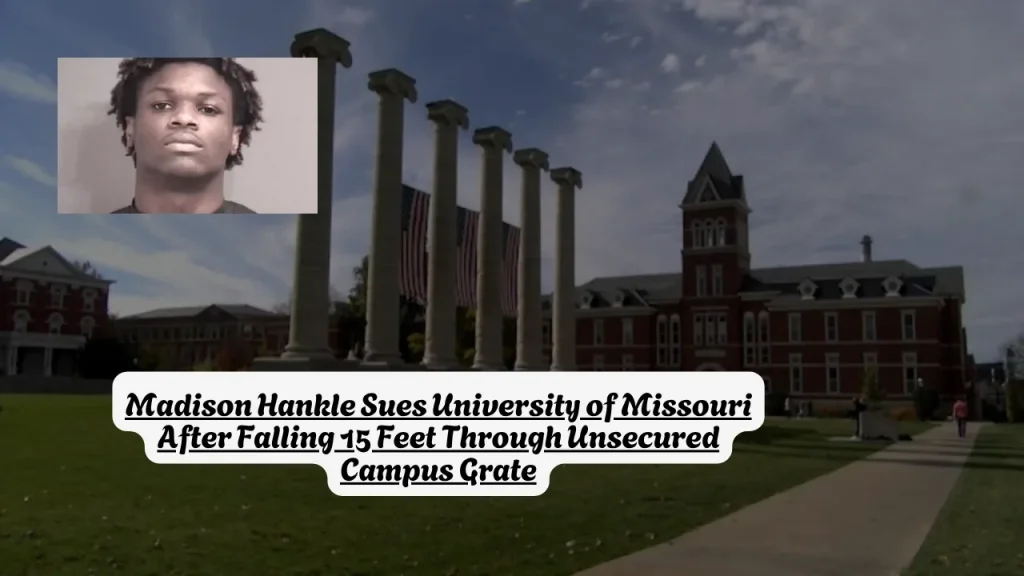
Madison Hankle Sues University of Missouri After Falling 15 Feet Through Unsecured Campus Grate
Prepared by the AllAboutLawyer.com Editorial Team and reviewed for factual accuracy against ABC17 News reporting (May 4, 2026) and court filings in Boone County Circuit Court, Columbia, Missouri. Last Updated: May 6, 2026
The University of Missouri is facing a lawsuit filed in Boone County Circuit Court alleging that a student fell through an open, unsecured grate on campus in April 2024 and landed roughly 15 to 20 feet below the surface. The attorney for Madison Hankle filed a petition on Monday in Boone County that is suing MU for damages. The university is listed as a defendant along with another person, Silas Schipper Jr., who is described as a student in the lawsuit. The petition claims Hankle suffered permanent injuries — and that it would have cost the university less than $50 to prevent the accident.
Hankle v. University of Missouri — Quick Facts
| Field | Detail |
| Plaintiff | Madison Hankle |
| Defendants | University of Missouri; Silas Schipper Jr. (fellow student) |
| Date of Incident | April 13, 2024 |
| Location | Sidewalk between Mizzou Rec Center and Stankowski Field, Columbia, MO |
| Where Filed | Boone County Circuit Court, Columbia, Missouri |
| Date Filed | May 4, 2026 |
| Alleged Violation | Premises liability (MU); Negligence (Schipper) |
| Injuries Alleged | Permanent injuries |
| Settlement Status | No settlement — active litigation |
| MU’s Response | “We are aware of the claim and expect any statements we have about the matter to be presented in the course of the court proceeding” — MU spokesman Christopher Ave |
| Last Updated | May 6, 2026 |
What Happened on April 13, 2024 — The Grate Fall at Mizzou
This was a routine night on campus that turned catastrophic in an instant.
The petition claims Hankle was walking with friends on April 13, 2024, on the sidewalk between the Mizzou Rec Center and Stankowski Field. Schipper had allegedly opened the grate and it was dark with no signage indicating it was open when Hankle fell through the opening and landed about 15 to 20 feet below the surface.
Think about that for a moment — 15 to 20 feet. That is roughly the height of a two-story building, dropped straight down through a hole in the sidewalk with no warning, no light, and nothing to break the fall. The petition alleges there was no signage telling anyone the grate had been opened, and the darkness of the area made the opening invisible to someone walking normally along the path.
Two separate defendants face two separate legal theories. MU faces a premises liability claim — meaning the university, as the owner and operator of the campus, had a legal duty to maintain safe conditions for students walking on its sidewalks, and failed that duty. Schipper faces a negligence claim — meaning his act of opening the grate, without taking any steps to warn others or secure the area, created an unreasonably dangerous condition that directly caused Hankle’s injuries.
Court documents allege it would have cost the university fewer than $50 to secure the grate. That detail is significant. In a premises liability case, one of the key questions is whether the property owner knew or should have known about a dangerous condition and failed to address it at a reasonable cost. The petition is essentially arguing that MU had every ability to prevent this — and chose not to, even though the price of prevention was trivial.
Related article: Over 90,000 Talcum Powder Ovarian Cancer Lawsuit, May 2026 Update on Settlements, Verdicts, and Who Qualifies
Why MU Can Be Held Liable — The Premises Liability Claim Explained
Under Missouri premises liability law, a university owes its students the same duty of care that any business owner owes to customers on their property. Students on campus are classified as invitees — people who have been invited onto the property and to whom the highest duty of care applies.
That duty requires MU to inspect its grounds, identify hazardous conditions, and either fix them or warn people about them. A grate over a subsurface opening along a heavily used student walkway — between two of the most trafficked recreational areas on campus — is exactly the kind of condition the university is responsible for maintaining.
The petition’s allegation that securing the grate would have cost fewer than $50 directly addresses the standard legal question of whether the hazard was “reasonably preventable.” Courts look at what it would have cost to fix the danger and weigh that against the risk of harm. When a fix costs less than a tank of gas and the potential harm is falling 20 feet onto a hard surface, the balance strongly favors the injured party.
MU as a public university may raise sovereign immunity as a defense — a legal protection that can shield government entities from certain lawsuits. However, Missouri’s sovereign immunity statutes include exceptions for injuries caused by the dangerous condition of public property. The nature of this claim — an unsecured grate on a public walkway — appears to fall squarely within the type of case where those immunity exceptions apply. That said, this determination will ultimately be for the court to make.
Are You Affected? Who This Lawsuit Is For
This is not a class action. This is a personal injury lawsuit filed on behalf of one individual — Madison Hankle. There is no claim form and no way to join this case.
However, this lawsuit matters beyond one student’s injuries. If you are a current MU student, a parent of a student at Mizzou, or anyone who regularly walks campus grounds between the Rec Center and Stankowski Field, this case puts a spotlight on the condition of campus infrastructure you may walk past every day.
If you or someone you know suffered a separate injury on MU’s campus due to a hazardous condition — an unsecured opening, broken pavement, poor lighting, lack of signage — you may have your own independent claim. Campus premises liability cases are evaluated individually based on the specific hazard, the specific injury, and what the university knew or should have known. A free legal consultation with a personal injury attorney can help you understand your options.
What Madison Hankle Is Seeking
The petition alleges Hankle suffered permanent injuries from the fall. The lawsuit seeks damages — a legal term covering the full range of harm a person suffers as a result of another party’s negligence. In a case like this, damages can include:
- Medical expenses — emergency care, surgery, hospitalization, rehabilitation
- Future medical costs if the injuries require ongoing treatment
- Lost wages or earning capacity if the injuries affect the ability to work
- Pain and suffering — both physical and emotional
- Loss of enjoyment of life
The petition does not specify a dollar amount, which is common at the filing stage of personal injury litigation in Missouri. The exact compensation sought will become clearer as the case develops through discovery.
Hankle v. MU — Case Timeline
| Milestone | Date |
| Grate fall incident occurs | April 13, 2024 |
| Petition filed in Boone County Circuit Court | May 4, 2026 |
| MU acknowledges the claim | May 4, 2026 |
| Defendant responses due | TBD — pending court scheduling |
| Discovery phase | TBD |
| Trial or settlement | TBD |
Frequently Asked Questions
Is there a class action lawsuit against the University of Missouri over this incident?
No. This is an individual personal injury lawsuit filed by Madison Hankle. No class action exists, and there is no claim form to complete. Only Hankle is the plaintiff in this case.
Is there a lawsuit against the University of Missouri right now?
Yes. The attorney for Madison Hankle filed a petition on Monday in Boone County that is suing MU for damages, after Hankle allegedly fell through an open grate near the Mizzou Rec Center on April 13, 2024. The case was filed May 4, 2026, and is now active in Boone County Circuit Court.
When will the MU grate fall lawsuit be resolved?
TBD. The petition was just filed on May 4, 2026. Missouri personal injury cases typically take 1–3 years from filing to resolution, depending on whether the parties settle or proceed to trial. No hearing dates have been set publicly as of May 6, 2026.
Can I file my own lawsuit against MU if I was injured on campus?
Possibly. Campus premises liability claims are evaluated individually. If you suffered an injury on MU property due to a hazardous condition the university knew about or should have known about, you may have a valid claim. Missouri has a five-year statute of limitations for personal injury cases, meaning the clock generally starts from the date of your injury. Consult a personal injury attorney to evaluate your specific situation.
What does “premises liability” mean in this case?
Premises liability is the legal principle that property owners — including universities — are responsible for maintaining safe conditions on their property. When they fail to do so and someone is injured, they can be held financially responsible. In this case, MU’s alleged failure to secure or warn about an open grate on a campus sidewalk forms the core of the premises liability claim against the university.
Is the student who opened the grate also being sued?
Yes. The university is listed as a defendant along with another person, Silas Schipper Jr., who is described as a student in the lawsuit. MU is accused of premises liability, while Schipper is accused of negligence. The two defendants face different legal theories but are named in the same petition.
What did MU say about the lawsuit?
MU issued a brief statement. MU spokesman Christopher Ave wrote: “We are aware of the claim and expect any statements we have about the matter to be presented in the course of the court proceeding.” The university has not publicly disputed or confirmed any of the allegations.
Sources & References
- ABC17 News (KMIZ) — “Student sues MU after falling through grate on campus in 2024,” Ryan Shiner, May 4, 2026: abc17news.com
- Boone County Circuit Court — Petition filed May 4, 2026 (Hankle v. University of Missouri and Silas Schipper Jr.)
Disclaimer: This article is for informational purposes only and does not constitute legal advice. Legal claims and outcomes depend on specific facts and applicable law. For advice regarding a particular situation, consult a qualified attorney.
About the Author
Israr Ahmad is a legal content researcher with 4+ years of experience covering class action settlements and consumer rights cases. He has researched and published coverage of 2,500+ settlements using verified court records, settlement administrator filings, and government sources. Learn more about Israr.