
McCafé Sugar-Free Vanilla Lawsuit, Why McDonald’s Corporation Is Being Sued Over Vanilla Lattes, Cappuccino and Iced Coffee
The McCafé sugar-free vanilla lawsuit is a putative class action against McDonald’s Corporation. It claims the company marketed four McCafé vanilla drinks as “Sugar Free” even though the whole milk in them naturally contains sugar.
The case is Mercado v. McDonald’s Corporation, Case No. 1:26-cv-09142, filed on October 19, 2026, in the U.S. District Court for the Southern District of New York.
Here is the core of the dispute. A customer who orders a drink with “Sugar Free” in its name may reasonably expect almost no sugar. The complaint says some servings contain between 1 and 18 grams of sugar, mostly lactose, the natural sugar in milk. Some news summaries round the low end to “about 2 grams.”
These are allegations in a newly filed complaint. No court has found that McDonald’s did anything unlawful, and the company has not been shown to have misled anyone.
McDonald’s McCafé Sugar-Free Lawsuit: Quick Facts
| Item | Detail |
| Defendant | McDonald’s Corporation |
| Named plaintiff | Alexander Mercado (Bronx, New York) |
| Case | Mercado v. McDonald’s Corporation |
| Case number | 1:26-cv-09142 |
| Court | U.S. District Court, Southern District of New York |
| Filed | October 19, 2026 |
| Products | Four McCafé “Sugar Free” vanilla drinks |
| Alleged sugar | 1 to 18 grams per serving, depending on drink and size |
| Class certification | Not granted |
| Settlement | None announced |
| Official settlement website | None exists. No settlement or claims administrator has been announced |
| Case status | Putative class action, pending (as of November 3, 2026) |
Why Did Alexander Mercado Sue McDonald’s Corporation?
According to the complaint, Alexander Mercado bought an Iced Sugar Free Vanilla Latte at a McDonald’s at 5765 Broadway in the Bronx in about September 2026. He paid roughly $4.
He says the words “Sugar Free” in the drink’s name led him to believe it had no sugar. He later learned it contained at least 7 grams of sugar from lactose.
He alleges that he would not have bought the drink, or would have paid less, had he known. He also raises these points about how McDonald’s presents nutrition information:
- “Sugar Free” appears prominently in the drink names.
- In-store menu boards do not show total sugar for these drinks.
- The ordering kiosk has a Nutrition & Ingredients screen, but the complaint says it does not clearly disclose total grams of sugar in the finished drinks.
- Listing whole milk as an ingredient, he argues, does not tell a customer the drink contains natural sugar.
The last point carries the case. Mercado is not saying McDonald’s used milk. He is saying the overall message, a “Sugar Free” name on a milk-based drink, gives a misleading impression of the finished product.
Which McDonald’s McCafé Drinks Are Named in Mercado v. McDonald’s Corporation?
The complaint names four beverages:
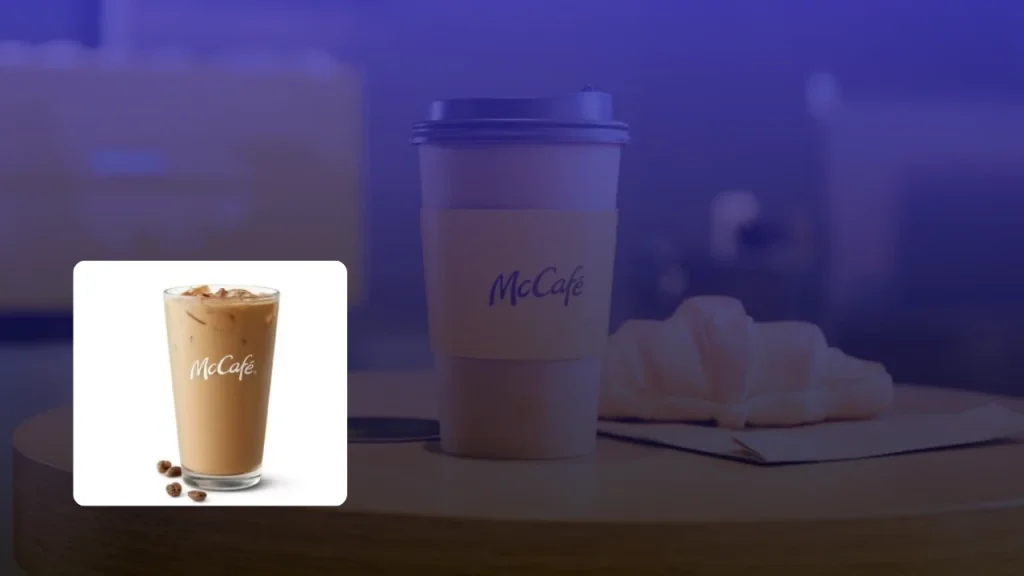
- Sugar Free Vanilla Latte. A hot espresso drink with steamed whole milk and sugar-free vanilla syrup.
- Iced Sugar Free Vanilla Latte. The iced version of the latte, the drink Mercado says he bought.
- Sugar Free Vanilla Cappuccino. Espresso and milk with sugar-free vanilla flavoring.
- Iced Sugar Free Vanilla Coffee. Iced coffee with sugar-free vanilla syrup and dairy.
How Much Sugar Does the Complaint Say Is in Each McCafé Drink?
These figures come from McDonald’s nutrition listings as cited in the complaint. They are not laboratory results or court findings.
| McCafé drink | Small | Medium | Large |
| Sugar Free Vanilla Latte | 11g | 14g | 18g |
| Iced Sugar Free Vanilla Latte | 7g | 8g | 11g |
| Sugar Free Vanilla Cappuccino | 7g | 8g | 12g |
| Iced Sugar Free Vanilla Coffee | 1g | 2g | 2g |
The size-by-size range is 1 gram (small Iced Sugar Free Vanilla Coffee) to 18 grams (large Sugar Free Vanilla Latte). Plaintiffs’ summaries often describe this as “2 to 18 grams.”
For comparison, the FDA’s “sugar free” threshold is less than 0.5 grams per serving.
Why Is Lactose in McDonald’s Whole Milk at the Center of the Lawsuit?
Milk naturally contains lactose, a sugar made of glucose and galactose. Nobody has to add it. It comes with the milk.
That creates the legal question the court will eventually face:
- Sugar-free syrup: the syrup itself may contain no sugar.
- Sugar-free finished drink: the whole beverage, milk included, has to meet the federal standard for a “sugar free” claim.
A customer can get a sugar-free syrup and still end up with a drink that has 11 or 18 grams of total sugars.
Under 21 C.F.R. § 101.9(c)(6)(ii), “total sugars” include naturally occurring sugars such as lactose. The FDA separates total sugars from added sugars, but milk sugar counts toward total sugars even when nothing was added during preparation.
Which Federal Laws and FDA Regulations Apply to the McDonald’s “Sugar Free” Claim?
21 C.F.R. § 101.60(c)(1): The FDA “Sugar Free” Rule
This is the key regulation. It governs claims like “sugar free,” “free of sugar,” “no sugar,” “zero sugar,” “without sugar” and “sugarless.” A food generally has to meet these conditions:
- Under 0.5 grams of sugars per reference amount customarily consumed and per labeled serving.
- Ingredient limits. The food generally cannot contain an ingredient that is a sugar or is understood to contain sugars, unless the required qualifying statement appears in the ingredient statement.
- Calorie disclaimer. Unless the food qualifies as low or reduced calorie, the claim must be accompanied by a statement such as “not a low calorie food,” “not a reduced calorie food” or “not for weight control.”
The complaint alleges that the four McCafé drinks exceed the sugar threshold and lack the calorie disclaimer.
The regulation also explains why the FDA has this rule. Consumers often read “sugar free” as a sign of a low-calorie or reduced-calorie food, which is why the disclaimer exists.
21 C.F.R. § 101.60(c)(2): “No Added Sugar” Is a Different Claim
McDonald’s has not said it relied on this, but the contrast is useful. A “no added sugar” claim is governed by a separate provision of § 101.60(c)(2), with its own conditions. “Sugar free” is the stricter claim because it looks at total sugars, not just sugar added during preparation.
21 C.F.R. § 101.13(q)(5): Nutrient Content Claims in Restaurants
Nutrient content claims on food served in restaurants must still follow the applicable federal requirements. A McDonald’s drink made and served in a restaurant does not automatically escape the sugar-free rules.
21 U.S.C. § 343(a)(1): Misbranding Through False or Misleading Labeling
Under the Federal Food, Drug, and Cosmetic Act, food is misbranded if its labeling is false or misleading in any particular. Mercado’s theory is that calling a finished milk drink “Sugar Free” is misleading when it carries several grams of lactose.
21 U.S.C. § 343(r)(1)(A): Nutrient Content Claims and Misbranding
This section treats a food as misbranded if it carries a nutrient content claim that does not comply with FDA regulations. A “sugar free” name is a nutrient content claim, so § 101.60 sets the standard the claim has to meet.
21 C.F.R. § 101.11 and 21 U.S.C. § 343(q)(5)(H): Restaurant Menu Labeling
Covered chains with 20 or more locations must show calories for standard menu items on menus and menu boards. Other nutrition information, including total sugars, only has to be available in writing on request, along with a statement that this information is available.
This matters because McDonald’s does not break federal law just because a menu board lacks grams of sugar. The sharper question is whether the written nutrition information was properly available, and whether the alleged lack of clear sugar disclosure at the kiosk supports Mercado’s state-law claims. No court has ruled on that.
21 U.S.C. § 337(a): Who Can Enforce the Federal Food Law?
Proceedings to enforce the FDCA generally must be brought by the United States. Private consumers usually cannot sue directly under the FDCA.
That is why Mercado pleads state consumer-protection claims. Federal labeling rules serve as the benchmark for the alleged deception, rather than as the cause of action itself.
21 U.S.C. § 343-1: Federal Preemption of State Labeling Requirements
States generally cannot impose nutrition-labeling or nutrient-content-claim requirements that differ from the federal ones (see § 343-1(a)(4) and (a)(5)). McDonald’s may argue that the state claims are preempted. Mercado’s answer will likely be that his claims only enforce the existing federal sugar-free standard. No court has decided this.
Which State Consumer-Protection Laws Does the Complaint Invoke Against McDonald’s?
New York General Business Law § 349: Deceptive Acts and Practices
Section 349 bars deceptive acts or practices in business and trade. A plaintiff generally must show consumer-oriented conduct that is materially misleading and caused injury. Under § 349(h), a plaintiff can recover actual damages or $50, whichever is greater. A court may increase damages up to three times actual damages, capped at $1,000, for a willful or knowing violation.
New York General Business Law § 350 and § 350-e: False Advertising
Section 350 covers false advertising. The private remedy in § 350-e allows actual damages or $500, whichever is greater, and a court may increase the award up to three times actual damages, capped at $10,000, for a willful or knowing violation.
These are remedies Mercado asks for. They are not automatic payments.
Consumer-Protection Laws in California, Florida, Illinois, Massachusetts, Michigan, Minnesota, Missouri, New Jersey, New York and Washington
The complaint proposes a Multi-State Class for purchasers in these ten states:
- California
- Florida
- Illinois
- Massachusetts
- Michigan
- Minnesota
- Missouri
- New Jersey
- New York
- Washington
For context, here are the main consumer-protection statutes in those states. This table shows general state law, not the specific counts in the complaint, which should be checked against the filed complaint.
| State | Main consumer-protection statute |
| California | Unfair Competition Law (Bus. & Prof. Code § 17200), False Advertising Law (§ 17500), Consumers Legal Remedies Act (Civ. Code § 1750) |
| Florida | Deceptive and Unfair Trade Practices Act (Fla. Stat. § 501.201 et seq.) |
| Illinois | Consumer Fraud and Deceptive Business Practices Act (815 ILCS 505) |
| Massachusetts | Chapter 93A |
| Michigan | Michigan Consumer Protection Act (MCL 445.901 et seq.) |
| Minnesota | Consumer Fraud Act (Minn. Stat. § 325F.68 et seq.) |
| Missouri | Merchandising Practices Act (Mo. Rev. Stat. § 407.010 et seq.) |
| New Jersey | Consumer Fraud Act (N.J.S.A. 56:8-1 et seq.) |
| New York | General Business Law §§ 349 and 350 |
| Washington | Consumer Protection Act (RCW 19.86) |
Each state has its own rules on reliance, causation, injury and available damages. A result under New York law would not automatically carry over to the other nine states.
Unjust Enrichment Claim for the Nationwide Class
Unjust enrichment lets a person try to recover money another party received at their expense. Mercado argues that McDonald’s collected money from customers who bought the drinks believing they were sugar free, and he seeks restitution. The requirements vary by state, which could complicate a nationwide class.
One summary of the complaint also lists breach of express warranty and fraud. Check the filed complaint before relying on those two counts.
What Is Mercado Asking McDonald’s Corporation to Pay in the McCafé Lawsuit?
| Relief requested | What it means |
| Actual damages | Financial losses of eligible consumers |
| Price-premium damages | The extra amount customers allegedly paid because of the “Sugar Free” label |
| Statutory damages | Amounts set by state consumer laws |
| Treble damages | Increased damages for knowing or willful violations, where the statute allows |
| Restitution | Return of money allegedly obtained through unjust enrichment |
| Attorneys’ fees and costs | Legal expenses, where law permits |
| Injunctive relief | A court order on the allegedly misleading labeling |
| Declaratory relief | A judicial declaration of the parties’ rights |
A lawsuit asks for relief. A court decides what to award. There is no confirmed payment amount, no guaranteed refund and no per-drink payment.
Who Could Be in the Proposed McDonald’s McCafé Classes?
The complaint proposes three overlapping groups:
- Nationwide Class: U.S. consumers who bought one or more of the four drinks for personal, family or household use.
- New York Class: New York consumers who bought the drinks for personal, family or household use.
- Multi-State Class: purchasers in the ten states listed above.
The groups are not limited to people with diabetes or lactose intolerance, and nobody has to show a physical injury. The theory is about financial harm from a misleading name. Because no class is certified, nobody is a class member yet.
Has Mercado v. McDonald’s Corporation Settled?
No. As of November 3, 2026, I found no settlement, court-approved payment program or claim form in this case.
| Date | Development |
| September 2026 | Mercado allegedly buys an Iced Sugar Free Vanilla Latte in the Bronx |
| October 19, 2026 | Complaint filed |
| October 20, 2026 | Summons issued; court orders an initial pretrial conference |
| November 3, 2026 | No class certification, settlement or merits ruling found |
I found no answer or motion to dismiss from McDonald’s in the records I could verify, and no public statement from McDonald’s about this complaint. The court’s scheduling order is procedural. It says nothing about whether the allegations are true.
What Happens Next in the McDonald’s McCafé Sugar-Free Case?
- McDonald’s responds. After service, it can answer or move to dismiss. It could argue the product names are not misleading, that federal rules preempt the state claims, or that Mercado has not shown recoverable harm. These are possible arguments, not positions McDonald’s has taken.
- The court tests the claims. Judges look at whether the complaint properly pleads each claim, including the preemption question under 21 U.S.C. § 343-1.
- Class certification under Federal Rule of Civil Procedure 23. Mercado must satisfy Rule 23(a): numerosity, commonality, typicality and adequacy of representation. For a damages class under Rule 23(b)(3), common questions must predominate and a class action must be the superior method. A ten-state class under different state laws makes predominance a real hurdle.
- Settlement or continued litigation. The parties can negotiate, or the case can move through discovery and possibly trial. Any class settlement needs court approval under Rule 23(e).
What Should Customers Who Bought McDonald’s McCafé Sugar-Free Drinks Do Now?
You do not need to file anything. There is no claim form.
If you bought one of the four drinks, these steps cost nothing:
- Check past orders in the McDonald’s app or delivery apps.
- Keep receipts, order confirmations and payment records.
- Note which drink, what size and roughly when.
- Screenshot the menu or kiosk listing and the nutrition information if you see it.
- Follow the docket for Mercado v. McDonald’s Corporation, 1:26-cv-09142, for class certification or settlement news.
Keeping a receipt does not make you a class member or guarantee money.
How Does the McDonald’s McCafé Lawsuit Compare to the Starbucks Sugar-Free Lawsuit?
They are separate cases against different companies, with a shared theory. Walsh et al. v. Starbucks Corporation, No. 2:26-cv-03745, was filed on October 2, 2026, in the U.S. District Court for the Western District of Washington. It targets eight Starbucks “Sugar-Free” protein drinks that allegedly contain 13 to 21 grams of sugar.
Both cases ask whether a drink labeled “Sugar Free” can contain large amounts of lactose from milk. The McDonald’s case covers four McCafé vanilla drinks. Neither case has produced a settlement or a finding of liability.
Related consumer-labeling cases covered by AllAboutLawyer:
- Starbucks Sugar-Free Protein Drinks Lawsuit, Walsh v. Starbucks Corporation Alleges Up to 21 Grams of Sugar
- Trader Joe’s & Welch’s Allulose Lawsuits, Were You Affected?
- Target Market Pantry Coffee Creamer Class Action, Were You Shorted on Servings?
Frequently Asked Questions About the McDonald’s McCafé Sugar-Free Vanilla Lawsuit
Is McDonald’s Corporation really being sued over sugar-free vanilla coffee?
Yes. Alexander Mercado filed a putative class action against McDonald’s Corporation on October 19, 2026. He alleges that four McCafé drinks sold as “Sugar Free” contain naturally occurring milk sugar.
How much sugar is in the McDonald’s Sugar Free Vanilla Latte, according to the complaint?
The complaint’s figures are 11 grams (small), 14 grams (medium) and 18 grams (large).
Does the McDonald’s sugar-free syrup contain the sugar?
The lawsuit mainly blames lactose in whole milk. It does not depend on proving the syrup contains added sugar.
Can McDonald’s call a drink “sugar free” under 21 C.F.R. § 101.60 if it contains lactose?
Lactose counts toward total sugars. A food generally needs less than 0.5 grams of sugars per serving and must meet the regulation’s other conditions to carry the claim. Whether McDonald’s met those conditions is for the court.
Does the McDonald’s lawsuit cover every McCafé drink?
No. It names four vanilla drinks. It does not automatically cover regular coffee, ordinary vanilla lattes or other flavors.
Can people with diabetes or lactose intolerance join the McDonald’s lawsuit?
The proposed classes are based on buying the drinks, not on a medical condition. People with those conditions would not be treated differently solely because of the condition.
Can I file a claim in Mercado v. McDonald’s Corporation?
Not now. There is no settlement, administrator or claim form.
How much money could McDonald’s customers receive?
Nothing has been set. The complaint seeks several kinds of damages, but no compensation has been awarded or agreed.
Has McDonald’s Corporation admitted its “Sugar Free” drinks contain sugar?
Everyone agrees milk contains lactose. The dispute is over using “Sugar Free” for the finished drink. I found no admission of wrongdoing by McDonald’s in this case.
What is the case number for the McDonald’s vanilla latte lawsuit?
Mercado v. McDonald’s Corporation, No. 1:26-cv-09142, in the U.S. District Court for the Southern District of New York.
When will the McDonald’s sugar-free lawsuit settle?
No settlement date exists. The case was filed in October 2026 and is still at the earliest stage.
Bottom Line: What the McCafé Sugar-Free Lawsuit Means for McDonald’s Customers
The complaint says McDonald’s sold four McCafé vanilla drinks as “Sugar Free” while whole milk gave them between 1 and 18 grams of sugar, depending on drink and size. The question for the court is whether that labeling met 21 C.F.R. § 101.60 and the consumer-protection laws Mercado relies on.
The outcome could affect how restaurant chains name drinks that pair sugar-free syrups with milk. For now, no court has found McDonald’s violated the law, no class is certified, and there is no settlement or payment program. If you bought these drinks, keep your records and watch the docket.
Sources
- Mercado v. McDonald’s Corporation, No. 1:26-cv-09142 (S.D.N.Y. filed Oct. 19, 2026): federal docket record
- 21 C.F.R. § 101.60: Nutrient content claims for sugar and calorie content
- 21 C.F.R. § 101.9: Nutrition labeling of food
- 21 C.F.R. § 101.11: Restaurant menu nutrition labeling
- 21 C.F.R. § 101.13: Nutrient content claims
- 21 U.S.C. § 337: Enforcement of the Federal Food, Drug, and Cosmetic Act
- 21 U.S.C. § 343-1: Federal preemption of state food labeling
- New York General Business Law § 349
- New York General Business Law § 350-e
- Federal Rule of Civil Procedure 23
- Walsh v. Starbucks Corporation, case page with complaint (Hagens Berman)
This article is for general information only. AllAboutLawyer.com is an independent legal information website, not a law firm, and nothing here is legal advice.
Researched and written by Israr Ahmad, legal content researcher and founder of AllAboutLawyer.com. All facts verified against the federal court docket for Mercado v. McDonald’s Corporation (S.D.N.Y.), the Code of Federal Regulations, the U.S. Code and the New York General Business Law, as of November 3, 2026. Last Updated: November 3, 2026.
About the Author
Israr Ahmad is a legal content researcher with 4+ years of experience covering class action settlements and consumer rights cases. He has researched and published coverage of 2,500+ settlements using verified court records, settlement administrator filings, and government sources. Learn more about Israr.