
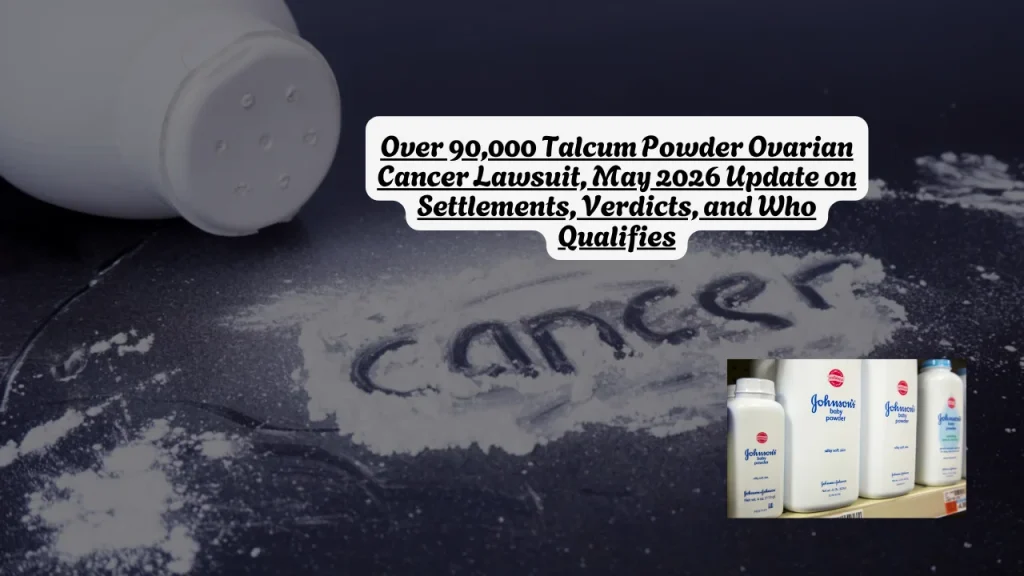
Over 90,000 Talcum Powder Ovarian Cancer Lawsuit, May 2026 Update on Settlements, Verdicts, and Who Qualifies
Legally reviewed against court records in MDL-2738, In Re: Johnson & Johnson Talcum Powder Products Marketing, Sales Practices and Products Liability Litigation, U.S. District Court for the District of New Jersey, and verified trial reporting from the U.S. District Court for the District of New Jersey, Los Angeles Superior Court, and the Philadelphia Court of Common Pleas. Prepared by the AllAboutLawyer.com Editorial Team. Last Updated: May 6, 2026
The talcum powder ovarian cancer lawsuit is one of the largest active mass tort cases in American legal history. Johnson & Johnson faces more than 90,000 lawsuits nationwide from women who developed ovarian cancer after years of using talc-based baby powder — and the company has now lost every major courtroom battle it has fought in 2025 and 2026. As of May 2026, there are 67,623 lawsuits in the talcum powder multidistrict litigation, MDL 2738, being tried in the U.S. District Court for New Jersey, presided over by District Judge Michael A. Shipp. No global settlement exists. Trials are moving forward. And for the first time in years, plaintiffs have real momentum.
Talcum Powder Ovarian Cancer Lawsuit — Quick Facts
| Field | Detail |
| Primary Defendant | Johnson & Johnson (J&J); also Avon, Colgate-Palmolive, Imerys Talc America, others |
| Products Named | Johnson’s Baby Powder, Shower to Shower, Cashmere Bouquet |
| Alleged Harm | Ovarian cancer; mesothelioma — caused by asbestos contamination in talc |
| Legal Basis | Product liability — negligence, failure to warn, false representation |
| Active MDL Lawsuits | 67,623 in federal MDL-2738 (New Jersey); 90,000+ total including state courts |
| MDL Court | U.S. District Court, District of New Jersey — Judge Michael A. Shipp |
| Global Settlement Status | None — three J&J bankruptcy attempts rejected; mediation ongoing |
| Most Recent Ovarian Cancer Verdict | $250,000 — Philadelphia, February 19, 2026 (plaintiff win) |
| Most Recent Ovarian Cancer Verdict (CA) | $40 million — Los Angeles, December 16, 2025 (plaintiff win) |
| Estimated Individual Payout | $100,000–$1 million; industry average ~$500,000 |
| First Federal Bellwether Trial | TBD — expected later in 2026 |
| Last Updated | May 6, 2026 |
May 2026 Update — What Is Happening Right Now
This litigation moved faster in the past six months than it did in the previous three years. Here is exactly where things stand.
The bankruptcy shield is gone for good. Johnson & Johnson tried three times to force a mass settlement through bankruptcy court. On March 31, 2025, the U.S. Bankruptcy Court for the Southern District of Texas denied Johnson & Johnson’s third attempt to resolve its talc-related cancer litigation through bankruptcy. The court rejected Red River Talc LLC’s prepackaged Chapter 11 plan, citing voting irregularities and impermissible third-party releases. J&J confirmed it will not appeal the ruling. That decision broke a nearly four-year logjam and returned over 90,000 cases to the active litigation track.
J&J has now lost three consecutive ovarian cancer trials. Since the bankruptcy collapsed, every ovarian cancer case that has gone before a jury has ended in a plaintiff victory. In December 2025, a California jury awarded $40 million to two women who developed ovarian cancer after using talcum powder products for years, finding J&J liable on all three claims: negligence, failure to warn, and false representation. Then in February 2026, a Philadelphia jury returned a $250,000 verdict against J&J in the second talc trial held in the city’s mass tort program, finding the company liable in a case alleging that long-term use of its talcum powder contributed to a woman’s fatal ovarian cancer.
A major scientific ruling cleared the path for trials. On January 27, 2026, a federal judge ruled that experts for talc victims should be allowed to testify about the association between talcum powder use and ovarian cancer. In a 685-page report, U.S. District Judge Freda Wolfson noted that the experts applied reliable methodologies to find a link between talcum powder use in the genital area and ovarian cancer. This ruling was a decisive blow to J&J, which had argued for years that the science linking talc to cancer was unreliable.
The Lancet retracted a key paper used to defend J&J. In April 2026, one of the most significant evidentiary shifts in the litigation occurred. The medical journal The Lancet retracted a 1977 commentary that had been widely used to support the safety of cosmetic talc. The retraction came after editors discovered the author was a paid consultant for Johnson & Johnson — a connection that was never disclosed when the piece was published. The author had shared drafts with the company before publication. This retraction strips J&J of a scientific defense it has used in courts for decades.
Congress moved to close the bankruptcy escape route permanently. On April 27, 2026, members of Congress reintroduced bills aimed at preventing companies like Johnson & Johnson from filing “Texas two-step” bankruptcies to dodge their legal liabilities.
Related article: $250M Apple Intelligence False Advertising Settlement, Did You Buy an iPhone 16 or 15 Pro? Here Is How to Get $25 to $95 Per Device From Seri Lawsuit
Mediation is underway — but no deal yet. Federal courts have ordered both sides into court-supervised mediation, aimed at determining whether a negotiated global settlement is possible. Settlement talks are ongoing as of May 2026, with both sides preparing simultaneously for trial.
For the full story on how J&J has tried to suppress the science behind these claims for over 50 years, see our detailed coverage: Former FDA Commissioner Testifies — J&J Hid Talc Risks for 50+ Years.
What J&J’s Talcum Powder Is Accused of Causing and Why
For decades, Johnson’s Baby Powder and Shower to Shower were among the most trusted household products in America. Millions of women used them as part of their daily feminine hygiene routine, sometimes for 20, 30, or 40 years. The lawsuits allege that this trust was exploited — and that J&J knew long before the public did that its products carried a serious cancer risk.
The core accusation is that talc — the mineral in talcum powder — naturally occurs close to asbestos deposits in the earth. Evidence presented in court shows that talcum powder manufacturers like Johnson & Johnson were aware of concerns surrounding talc and ovarian cancer for years while continuing to market their products as safe. Talc particles have been identified in ovarian tumors during scientific examinations. Chronic inflammation from talc and asbestos fibers may lead to abnormal cell growth over time. Women who regularly use talcum powder in the genital area have a 33% increased risk of ovarian cancer, according to the National Library of Medicine.
In July 2025, the World Health Organization took a formal step that validated what plaintiffs have argued for years: the International Agency for Research on Cancer reclassified talc from a “possible carcinogen” to a “probable carcinogen” after reviewing current scientific literature, including evidence of increased ovarian cancer risk in women who used talcum powder in the genital area.
Internal company documents presented in multiple trials show J&J was aware of asbestos contamination risks in its talc supply going back to at least the 1960s and 1970s. The December 2025 California trial focused on corporate documents from the 1960s and 1970s that indicated J&J knew their talc products could be contaminated with asbestos fibers. Despite that knowledge, the company marketed Baby Powder as pure, safe, and gentle for generations.
For the latest details on the record-breaking mesothelioma verdicts that have run alongside the ovarian cancer litigation, see: $966M Verdict Shocks J&J — Talcum Powder Lawsuit Update.
Are You Part of the Talcum Powder Ovarian Cancer Lawsuit?
This is not a class action with a claim form. These are individual lawsuits, each evaluated on its own facts, within a federal MDL that coordinates pretrial proceedings. Whether you qualify depends on your specific history with these products and your diagnosis.
You may qualify if:
- You used Johnson’s Baby Powder, Shower to Shower, Cashmere Bouquet, or other talc-based body powders regularly — particularly applied to the genital area
- You used the product for four years or more on a consistent basis
- You have been diagnosed with epithelial ovarian cancer, endometrioid ovarian cancer, fallopian tube cancer, or mesothelioma
- Your diagnosis occurred within the past few years — though statutes of limitations vary significantly by state, so speak to an attorney before assuming you are too late
- You are a family member or estate representative of someone who died from ovarian cancer or mesothelioma linked to talc use — wrongful death claims are also being pursued
You likely do NOT qualify if:
- You only used talcum powder occasionally or briefly, not as a regular feminine hygiene routine
- You have not received a qualifying cancer diagnosis
- You used only cornstarch-based baby powder products (not talc-based)
- You used talc exclusively on areas of the body not associated with the ovarian cancer claims (arms, feet) — genital use is the primary basis for ovarian cancer claims
The claimant must have regularly used talcum powder in the genital area, used Johnson and Johnson’s Baby Powder, Shower-to-Shower, or other generic baby powder products, and received a medical diagnosis of ovarian cancer.
What Verdicts and Settlements Have Paid — And What Your Case May Be Worth
Courts and juries have now paid out over $2.51 billion to women with ovarian cancer from talcum powder. These are not class action payments divided among thousands. These are individual awards based on each woman’s specific harm.
Major ovarian cancer verdicts and settlements confirmed from court records:
| Verdict / Settlement | Amount | Detail |
| Missouri — 22 women (reduced on appeal) | $2.12 billion | Originally $4.69B; appellate court upheld liability, reduced amount |
| California — Deborah Schultz & Monica Kent | $40 million | December 16, 2025 — J&J found liable on all three claims |
| Philadelphia verdict | $250,000 | February 19, 2026 — $50K compensatory + $200K punitive |
| Multi-state attorney general resolution | $700 million | Marketing-related claims |
| 1,000-lawsuit private settlement | $100 million | 2020 — ovarian cancer and mesothelioma combined |
| Missouri individual verdict | $110 million | Woman who used J&J talc for 40+ years |
| California individual verdict | $72 million | Alabama woman’s wrongful death case |
According to legal industry estimates, a talc settlement could pay out between $100,000 and $1 million per person. Industry experts project the average payout to be about $500,000. Mesothelioma cases — a separate but related litigation track — have produced significantly larger individual awards, including a $1.5 billion verdict in Baltimore in December 2025.
Factors that drive ovarian cancer claim values higher include the severity and stage of the cancer, duration and frequency of talcum powder use, whether J&J documents show the company was aware of asbestos contamination during the period you used the product, medical costs, lost income, and the emotional and physical toll of treatment.
How to Join the Talcum Powder Ovarian Cancer Lawsuit
There is no open claim form. These are attorney-managed individual lawsuits. Here is what the process looks like if you believe you qualify.
Step 1 — Gather your product history. Think back to when you used talcum powder, how often, and which brands. Look for old photos, store receipts, or ask family members who may remember. The stronger your product use history, the stronger your case.
Step 2 — Collect your medical records. You need documentation of your ovarian cancer diagnosis, including pathology reports, surgical notes, and treatment records. The type of cancer matters — epithelial ovarian cancer has the strongest documented link to talc use.
Step 3 — Contact a product liability attorney — free of charge. Most attorneys handling these cases work on a contingency fee basis, meaning you pay nothing unless they win compensation for you. Initial case reviews are free.
Step 4 — Your attorney evaluates your case. They will review your use history, diagnosis, timeline, and available evidence. If your case qualifies, they file your individual lawsuit or add you to an existing MDL case pool.
Step 5 — Do not wait. Filing deadlines depend on your state’s statute of limitations, which typically ranges from 2 to 6 years from your diagnosis or from when you learned the contamination may have caused your condition. Some states have shorter windows. If you were diagnosed years ago, your window may be narrowing.
Talcum Powder Ovarian Cancer Litigation Timeline
| Milestone | Date |
| First talcum powder lawsuit filed | 2006 |
| First major trial win for plaintiffs | 2016 |
| Missouri $4.69B verdict (22 women) | 2018 |
| Missouri verdict reduced to $2.12B on appeal | 2020 |
| J&J ends U.S. talcum powder sales | 2020 |
| First bankruptcy attempt rejected | 2021 |
| Second bankruptcy attempt rejected | 2023 |
| J&J ends global talcum powder production | 2023 |
| Third bankruptcy attempt ($8–$9B proposal) rejected | March 31, 2025 |
| WHO upgrades talc to “probable carcinogen” | July 2025 |
| Court-ordered mediation begins | September 4, 2025 |
| California $40M ovarian cancer verdict | December 16, 2025 |
| Baltimore $1.5B mesothelioma verdict (largest single plaintiff ever) | December 22, 2025 |
| Judge Wolfson rules plaintiff experts can testify — 685-page ruling | January 27, 2026 |
| Philadelphia $250,000 ovarian cancer verdict | February 19, 2026 |
| The Lancet retracts 1977 pro-talc commentary | April 19, 2026 |
| Congress reintroduces Texas Two-Step bankruptcy ban bill | April 27, 2026 |
| 67,623 federal MDL lawsuits active | May 2026 |
| First federal MDL bellwether trial | TBD — 2026 |
Frequently Asked Questions
Is there a class action lawsuit against Johnson & Johnson for talcum powder?
No — not in the traditional sense. Most cases are handled as individual lawsuits consolidated through multidistrict litigation. An MDL groups cases for pretrial purposes while preserving each plaintiff’s individual claim. This means your case gets its own value, not an averaged class-action share.
Is the talcum powder ovarian cancer lawsuit real?
Yes. Johnson & Johnson faced 67,376 pending talcum powder lawsuits in multidistrict litigation in New Jersey as of April 2026, before Judge Michael A. Shipp in U.S. District Court. Juries have awarded billions of dollars in verdicts, and the litigation is fully active in both federal and state courts.
How much will I get from a talcum powder settlement?
Legal industry estimates suggest a talc settlement could pay between $100,000 and $1 million per person, with industry experts projecting the average around $500,000. No amount is guaranteed — it depends entirely on your diagnosis, duration of use, and the facts of your case.
When will the talcum powder case settle?
TBD. No global settlement has been announced as of May 6, 2026. Court-ordered mediation is ongoing, and the first federal bellwether trial is expected later in 2026. If early trial results continue to favor plaintiffs, the pressure on J&J to negotiate meaningfully will grow significantly.
Can I still file a talcum powder lawsuit in 2026?
Possibly. The continued growth in the MDL shows that it is not too late for victims to come forward and pursue justice and compensation. However, state statutes of limitations vary from 1 to 6 years and the clock typically starts from your diagnosis. Speak to an attorney immediately — do not assume you have missed the window without checking.
Did Johnson & Johnson stop selling talcum powder?
Yes. In 2020, J&J announced the company would no longer make or market talc-based powders for the North American market, a ban that was expanded in 2023 to include all worldwide sales. The lawsuits cover decades of prior use — stopping sales does not resolve J&J’s liability for products women used for years before that decision.
What cancers are covered by the talcum powder lawsuit?
The primary cancers linked to genital talc use in these lawsuits are epithelial ovarian cancer, fallopian tube cancer, and endometrioid ovarian cancer. Epithelial ovarian cancer is the form of the disease that has been consistently linked to exposure to talc-based baby powder products. Fallopian tube cancer, another form directly linked to generations of Johnson’s baby powder use, is also subject to legal redress. Mesothelioma cases — often linked to inhaling talc fibers — run on a parallel track with separate (and often larger) verdicts.
What is the Texas Two-Step bankruptcy and why does it matter?
The Texas Two-Step is a legal maneuver J&J used three times to try to cap its liability through bankruptcy. The company would create a new subsidiary, transfer all talc liability to it, then file that subsidiary for bankruptcy — shielding J&J’s main corporate assets from jury verdicts. All three attempts failed. Congress reintroduced bills in April 2026 aimed at permanently preventing companies from using this tactic.
Sources & References
- U.S. District Court, District of New Jersey — MDL-2738, In Re: Johnson & Johnson Talcum Powder Products Marketing, Sales Practices and Products Liability Litigation: njd.uscourts.gov
- Drugwatch — Talcum Powder Lawsuit Updates (April 2026): drugwatch.com
- BusinessWire — Philadelphia Jury $250,000 Verdict (February 13, 2026): businesswire.com
- FDA — NDMA and Talc Testing Information: fda.gov
Disclaimer: This article is for informational purposes only and does not constitute legal advice. Legal claims and outcomes depend on specific facts and applicable law. For advice regarding your specific legal situation, consult a qualified product liability attorney. If you are experiencing emotional distress related to a cancer diagnosis or legal situation, support is available — please consider speaking with a healthcare professional or trusted person.
About the Author
Israr Ahmad is a legal content researcher with 4+ years of experience covering class action settlements and consumer rights cases. He has researched and published coverage of 2,500+ settlements using verified court records, settlement administrator filings, and government sources. Learn more about Israr.