
Lincoln Recalls 2026 Navigator Over Driver’s Seat That Moves on Its Own, What Owners Need to Do
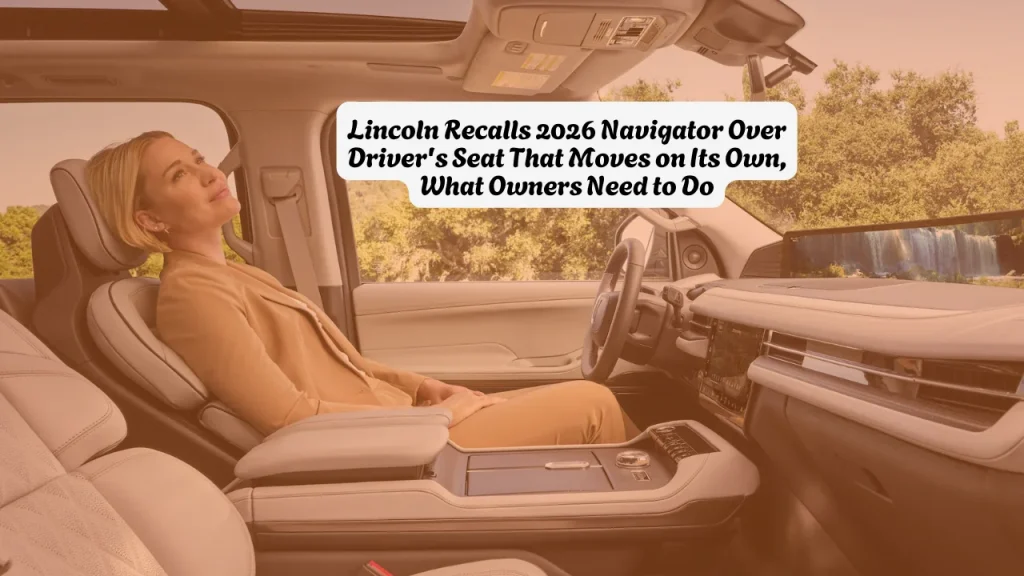
Ford Motor Company has recalled 1,189 units of the 2026 Lincoln Navigator after discovering that the driver’s seat can slide backward on its own while the vehicle is moving. The problem traces back to a software defect in the seat’s obstacle detection system. The fix is free, and owners do not need to go to a dealership to get it done — a software update can be pushed directly to the vehicle. If you own a 2026 Navigator, here is everything you need to know right now.
Recall at a Glance
| Field | Detail |
| Recall Number | 26S11 |
| Affected Vehicles | 2026 Lincoln Navigator |
| Units Affected | 1,189 |
| Production Dates | November 26, 2025 – December 16, 2025 |
| The Problem | Driver’s seat slides backward without warning at low speeds |
| Root Cause | Faulty obstacle detection software in the seat control module |
| The Fix | Software update (dealer or over-the-air) — free of charge |
| Owner Notification Letters | Mailed from March 23, 2026 |
| Ford Customer Service | 1-866-436-7332 |
| VIN Check | NHTSA.gov |
Where Things Stand Right Now
- Ford issued Recall 26S11 on March 5, 2026, when affected VINs became searchable on NHTSA.gov.
- Owner notification letters went out starting March 23, 2026 — check your mail if you haven’t received yours yet.
- This is the second recall affecting the 2026 Navigator. An earlier recall in February 2026 (Recall 26C10) covered a trailer lighting and brake issue.
- Ford has reported no accidents or injuries linked to this defect as of the recall date.
What Is Wrong With the 2026 Navigator’s Driver Seat?
The 2026 Lincoln Navigator is equipped with a power-operated driver’s seat that includes obstacle detection software. When the seat is moving and detects something blocking its path, it is designed to reverse direction to avoid damage or injury.
The problem is that this software has a bug. If the attempted reversal length exceeds the possible track travel length, the seat continuously attempts movement to the full back position on the track. In plain terms: the seat tries to slide backward, hits a limit, and instead of stopping, keeps trying to move all the way to the rear of its track.
This happens when driving at speeds of under 5 km/h — just over 3 mph — and the seat can inadvertently move backward. Some owners have reported that trying to push the seat back to its normal position using the manual adjusters does not work. The Navigator is the only Ford or Lincoln vehicle with this obstacle detection automatic reversal software, so no other model in the brand’s portfolio is affected.
Why Is This a Safety Risk?
A driver seat that slides backward without warning creates two immediate dangers. First, the driver may be startled and lose control of the vehicle. Second, and more practically dangerous, the driver could suddenly find themselves too far from the steering wheel and pedals to operate the vehicle properly.
Ford says it is not aware of any accidents or injuries related to this issue, but Navigator drivers should exercise caution — especially when maneuvering the vehicle at low speeds. The risk is highest in slow-speed situations: parking lots, driveways, and traffic stops. These are exactly the moments when a seat sliding backward could cause a driver to lose control of a 6,000-pound luxury SUV.
Related article: 3 Day Blinds Hit With Class Action Over Alleged Deceptive Spam Emails Here’s What the Lawsuit Claims
Which 2026 Navigators Are Affected?
A total of 1,189 units of the 2026 Navigator, built at the Kentucky Truck Plant between November 26 and December 16, 2025, are affected.
You may be affected if:
- You own a 2026 Lincoln Navigator
- Your vehicle was manufactured between November 26 and December 16, 2025
- Your VIN appears in the NHTSA recall database under Recall No. 26S11
If you are unsure whether your specific vehicle is part of this recall, check your 17-digit VIN on NHTSA.gov or call Ford customer service at 1-866-436-7332. You can find your VIN on the driver’s side dashboard (visible through the windshield), on your vehicle registration, or on your insurance card.
How to Get Your Navigator Fixed
The repair is straightforward and costs you nothing. Ford has two ways to deliver the fix:
Step 1 — Check your VIN at NHTSA.gov to confirm your vehicle is part of Recall 26S11
Step 2 — Watch for your recall notification letter, which was mailed starting March 23, 2026
Step 3 — Choose your repair method — either schedule an appointment at a Lincoln dealership, or wait for the over-the-air (OTA) software update to be pushed to your vehicle automatically
Step 4 — At the dealership, the service technician will update the seat control module software to remove the faulty automatic reversal function
Step 5 — If using the OTA update, ensure your vehicle is connected to Wi-Fi and confirm the update installs successfully
Step 6 — Keep your service record or OTA confirmation as proof the recall was completed
The seat control module software will be updated by a dealer, or through an over-the-air (OTA) update, free of charge. You do not have to pay anything — recall repairs are always free under federal law.
Estimated time for dealership visit: 30–60 minutes
Key Dates
| Milestone | Date |
| Affected Vehicles Manufactured | November 26 – December 16, 2025 |
| VINs Searchable on NHTSA.gov | March 5, 2026 |
| Recall Issued | March 2026 |
| Owner Notification Letters Mailed | March 23, 2026 |
| Fix Available | Software update — dealer or OTA |
| Cost to Owner | $0 |
Frequently Asked Questions
Is my 2026 Lincoln Navigator part of this recall?
Check your 17-digit VIN at NHTSA.gov or call Ford at 1-866-436-7332. Only 2026 Navigators built between November 26 and December 16, 2025 are included in this recall. If your VIN appears under Recall 26S11, your vehicle is affected.
Is it safe to drive my 2026 Navigator right now?
Ford has reported no crashes or injuries linked to this defect. The seat movement issue occurs at speeds under 3 mph, so highway driving is not the primary risk. However, Lincoln recommends caution in low-speed situations — parking, pulling out of driveways, or stop-and-go traffic — until the repair is complete.
Do I have to go to a dealership to get this fixed?
Not necessarily. Ford is offering the fix via an over-the-air (OTA) software update, which means your vehicle can receive the repair wirelessly without a dealership visit. If you prefer, a dealership can also update the software in person at no charge.
How much does the recall repair cost?
Nothing. Federal law requires manufacturers to fix recall defects at no cost to the vehicle owner. The software update for this recall is completely free whether done at a dealership or through an OTA update.
What if I already paid to have this seat issue repaired before the recall was announced?
You may be eligible for reimbursement from Ford. Contact Ford customer service at 1-866-436-7332 and provide documentation of the repair, such as a dealership invoice. Ford will advise you on the reimbursement process.
Is this connected to other recent Lincoln Navigator recalls?
Yes — this is the second recall issued for the 2026 Navigator. An earlier recall (26C10) in February 2026 covered a separate issue involving trailer lighting and brakes. That recall was part of a much larger campaign affecting over four million Ford and Lincoln vehicles combined.
What if I bought a used 2026 Navigator? Does the recall still apply to me?
Yes. Recalls apply to the vehicle, not the original buyer. If your used 2026 Navigator is within the affected production window, you have the same right to a free repair as the original owner. Check your VIN at NHTSA.gov to confirm.
Will this recall affect my Navigator’s resale value?
An open, unrepaired recall can affect resale value and may complicate private sales. Once the software update is completed, the recall is considered closed for your vehicle. Get the repair done and keep your service paperwork to show the recall was resolved.
Sources & References
Last Updated: April 13, 2026
Disclaimer: This article is for informational purposes only and does not constitute legal advice. Legal claims and outcomes depend on specific facts and applicable law. For advice regarding a particular situation, consult a qualified attorney.
About the Author
Israr Ahmad is a legal content researcher with 4+ years of experience covering class action settlements and consumer rights cases. He has researched and published coverage of 2,500+ settlements using verified court records, settlement administrator filings, and government sources. Learn more about Israr.