
Iowa and Missouri Sue New York Over Greenhouse Gas Reporting Rule That Reaches Across State Lines
Two Midwestern states have taken New York to federal court over a climate reporting rule they say crosses a constitutional line — forcing fuel producers in Iowa and Missouri to comply with New York regulations even though those businesses never set foot in New York.
The New York Rule Being Challenged
On December 1, 2025, the New York State Department of Environmental Conservation finalized its Mandatory Greenhouse Gas Reporting Program under 6 NYCRR Part 253. The rule requires certain entities to report and keep records of their annual greenhouse gas emissions.
The program covers facilities emitting 10,000 metric tons or more of carbon dioxide equivalent per year, as well as fuel suppliers delivering to end users in New York, waste haulers, electric power entities, and licensed distributors of agricultural lime and fertilizer. Violations can result in significant civil penalties, including per-day penalties for continued noncompliance.
The rule was finalized as a 340-page regulation implementing the reporting requirements of New York’s 2019 Climate Leadership and Community Protection Act. Monitoring plans are due in September 2026 for some entities and December 2026 for large emission sources. First emissions reports are due June 1, 2027, followed by third-party verification statements.
Why Iowa and Missouri Are Suing
The attorneys general of Iowa and Missouri, joined by the American Free Enterprise Chamber of Commerce and represented by the Center for Individual Rights, filed a federal lawsuit against the New York State Department of Environmental Conservation. The complaint challenges the program on constitutional grounds, arguing that the rule unconstitutionally regulates businesses, consumers, and individuals well beyond New York’s borders.
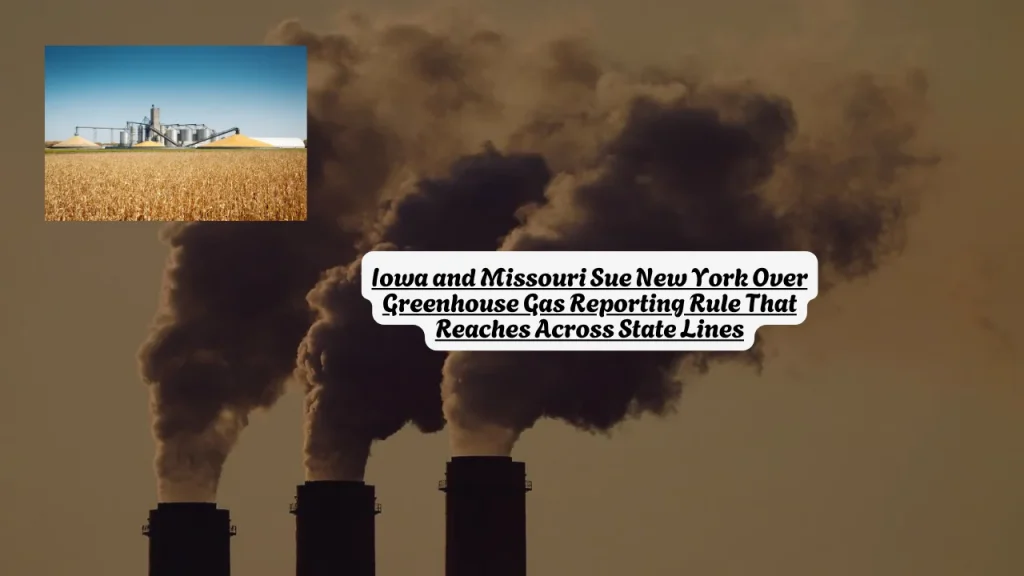
Iowa and Missouri say the rule unfairly imposes reporting and compliance obligations on ethanol and biodiesel producers located outside the state.
Missouri Attorney General Catherine Hanaway put it directly: “Missouri’s energy independence is under attack by New York’s radical greenhouse gas mandates. We have joined Iowa and the Center for Individual Rights to combat bureaucratic GHG over-regulation, and my office will keep fighting to protect Missouri agriculture from out-of-state overreach.”
The Constitutional Argument: One State Cannot Regulate Another
The legal theory at the center of this lawsuit goes beyond a policy dispute — it raises a structural question about how states can interact with each other under the U.S. Constitution.
The Center for Individual Rights Senior Litigation Counsel Mike Petrino explained: “The Constitution outlines rules for how the federal government and states interact, but it also outlines rules for how states must interact with each other. This Horizontal Federalism means that no one state can dictate the laws and regulations for another state. That’s exactly what New York is doing here.”
Legal analysts note this is the first major federal challenge to a state-level climate reporting regime since the EPA rescinded its 2009 endangerment finding in February. The question now before the court is whether a state climate regulatory framework can reach across state lines to do the work the federal government has stepped back from.
Related article: New York Times Files Second Lawsuit Against Pentagon Over Press Restrictions Challenging a Mandatory Journalist Escort Rule
What Compliance Would Actually Cost Out-of-State Businesses
According to New York’s own estimates, total compliance costs for each affected business could exceed $50,000. The regulation also subjects reporting entities to civil and criminal penalties for omissions or errors, and requires ethanol and biodiesel producers to agree to allow New York regulators to perform site inspections with no advance notice and no warrant.
An Iowa ethanol producer, for example, would be required to report on its own in-state production processes, build out a written greenhouse gas monitoring plan, retain records, and — for larger producers — hire a New York-accredited third-party verifier to audit their emissions data. Failure to comply triggers civil penalties under New York’s Environmental Conservation Law on a per-day basis, with additional penalties for incomplete or erroneous reports.
New York’s Program in Context
New York framed the program as a data-collection tool only — not an emissions cap.
The regulation is designed to collect data, improve the state’s understanding of GHG emission sources, support the annual Statewide GHG Emissions Report, and monitor New York’s progress under its Climate Act. The program is a reporting-only program that does not impose emissions reduction requirements or require the purchase of allowances.
With the program now in effect, New York joins California in requiring large emitters to report, verify, and monitor their greenhouse gas emissions. Legal analysts have noted that if EPA’s proposed rollback of federal reporting requirements takes effect, New York’s rule and California’s Mandatory Reporting Rule may function to fill the gap left by the dismantled federal program.
Why This Case Matters Beyond Iowa and Missouri
This is the first major federal challenge to a state-level climate reporting regime since the EPA rescinded its 2009 endangerment finding. The federal climate regulatory architecture is paused. The state architecture is escalating. The question of whether state rules can reach across state lines to do the work the federal government has stepped back from is now before a federal court — and it will not be the last such challenge.
Iowa and Missouri are two of the largest ethanol and biodiesel producing states in the country, making them directly in the crosshairs of any fuel-supplier provision that extends to products sold into New York.
For related coverage on how states and businesses navigate competing regulatory obligations, see our full breakdown of How To Claim A Lawsuit Settlement? Guide To Getting Paid — including how civil penalty proceedings and compliance enforcement can lead to financial liability.
Frequently Asked Questions
Does New York’s rule only apply to businesses inside New York?
No. The program covers fuel suppliers delivering to end users in New York, regardless of where those suppliers are based. This means an ethanol plant in Iowa that sells fuel delivered into New York falls within the rule’s scope.
What are the key deadlines under the New York rule?
The first reporting year covers January 1 through December 31, 2026. The initial emissions report is due June 1, 2027. Verification reports for large emission sources are due December 1, 2027.
What is the legal basis for the Iowa-Missouri challenge?
The complaint rests on constitutional principles of horizontal federalism — the idea that one state cannot impose its regulatory regime on businesses and individuals located in another state — as well as potential Commerce Clause violations.
Is this the first lawsuit of its kind against a state climate reporting program?
Yes. Legal analysts describe this as the first major federal challenge to a state-level climate reporting regime since the EPA rescinded its 2009 endangerment finding in February 2026.
Prepared by the AllAboutLawyer.com Editorial Team and reviewed for factual accuracy against verified court filings and news sources on May 19, 2026. Last Updated: May 19, 2026
Disclaimer: This article is for general informational and educational purposes only and does not constitute legal advice. Laws vary by state and jurisdiction. For advice about your specific situation, consult a qualified attorney.
About the Author
Israr Ahmad is a legal content researcher with 4+ years of experience covering class action settlements and consumer rights cases. He has researched and published coverage of 2,500+ settlements using verified court records, settlement administrator filings, and government sources. Learn more about Israr.