
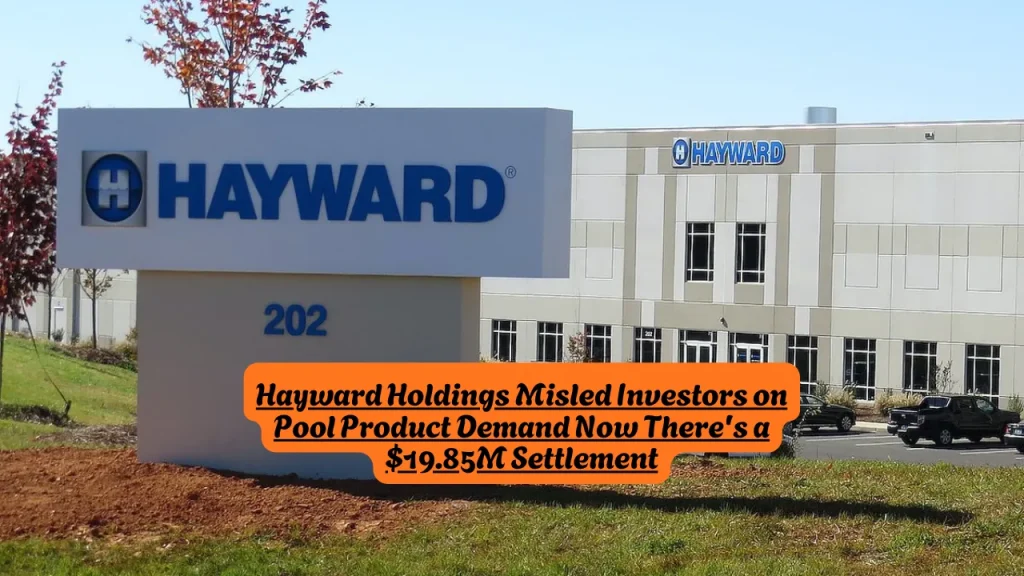
Hayward Holdings Misled Investors on Pool Product Demand Now There’s a $19.85M Settlement
Hayward Holdings Inc. and its top executives agreed to pay $19,850,000 to settle a federal securities class action lawsuit alleging they painted a false picture of demand for the company’s pool equipment during 2021 and 2022. Investors who bought HAYW common stock between October 27, 2021, and July 28, 2022, may qualify for a cash payment. The deadline to file a claim is June 19, 2026.
Quick Facts
| Field | Detail |
| Settlement Amount | $19,850,000 |
| Claim Deadline | June 19, 2026 |
| Who Qualifies | HAYW stock purchasers between Oct. 27, 2021 – July 28, 2022 |
| Payout Per Person | Varies — pro rata based on recognized loss |
| Proof Required | Yes — brokerage statements or trade confirmations |
| Settlement Status | Proposed — Fairness Hearing July 28, 2026 |
| Administrator | A.B. Data, Ltd. |
| Official Website | haywsecuritieslitigation.com |
Current Status & What Happens Next
- The court has not yet granted final approval. Judge William J. Martini will hold a fairness hearing on July 28, 2026, at 12:00 p.m. ET in Newark, New Jersey.
- Investors who want to opt out of the settlement or file a written objection must act by May 20, 2026.
- Payments go out only after final court approval, the resolution of any appeals, and processing of all valid claims. No payment date is confirmed yet.
Hayward Told Investors Demand Was Strong. It Wasn’t.
Hayward Holdings makes pool equipment — pumps, filters, heaters, and automation systems. After a pandemic-era boom in backyard pool installations, the company went public in early 2021. Its executives spent much of that year telling investors that consumer demand for pool products remained robust and that the business was growing on solid footing.
The lawsuit, filed in the U.S. District Court for the District of New Jersey, tells a different story. Lead plaintiff City of Southfield Fire and Police Retirement System alleged that Hayward and its executives engaged in a channel-stuffing strategy — flooding its distribution partners with far more product than actual consumer demand could support. Plaintiffs contended this tactic made Hayward’s short-term revenue figures look stronger than the underlying business warranted, artificially inflating the stock price throughout the class period.
When the inventory glut became impossible to hide, Hayward’s numbers collapsed. The stock dropped sharply as the alleged truth entered the market, and investors who bought during the class period absorbed significant losses. The lawsuit alleged violations of Sections 10(b) and 20(a) of the Securities Exchange Act of 1934 and Rule 10b-5. Named defendants include Hayward Holdings, its CEO and CFO, private equity sponsors CCMP Capital and MSD Partners, and several individual directors. All defendants deny any wrongdoing.
Did You Buy HAYW Stock Between October 2021 and July 2022? You May Qualify.
- You may qualify if you purchased or otherwise acquired Hayward Holdings Inc. common stock (ticker: HAYW) between October 27, 2021, and July 28, 2022, inclusive.
- You may qualify if you held HAYW shares as of the close of trading on October 25, 2022, regardless of when during the class period you originally bought them.
- You may qualify if you are an individual investor, a pension fund, a mutual fund, a trust, an estate, or any other legal entity that transacted in HAYW shares during the class period.
- You may qualify if a legal representative — an executor, trustee, guardian, or conservator — submits a claim on your behalf and provides proof of their authority to do so.
- You will not qualify if you are one of the named defendants, an immediate family member of a defendant, or a Hayward corporate officer or director covered by the standard exclusions in the official Notice.
Joint purchasers must each sign the claim form. Review the full exclusion list in the official Notice if you are uncertain about your eligibility.
Your Payout Depends on When You Bought — and When You Sold
The $19,850,000 fund distributes to eligible claimants on a pro rata basis after deducting court-approved attorneys’ fees (up to $6,616,667), litigation expenses (up to $270,000), and a lead plaintiff service award (up to $10,000). What you receive depends on your recognized loss, which the administrator calculates using a court-approved Plan of Allocation tied to when you traded.
Related article: Your Differin Acne Wash May Have Contained Benzene Galderma Just Agreed to Pay $990,000
The confirmed tiers are:
- Sold before January 24, 2022: Recognized loss = $0. No recovery for shares exited before the first alleged corrective disclosure.
- Sold between January 24, 2022, and July 28, 2022: Recognized loss equals the lesser of the difference in artificial inflation between your purchase and sale dates, or your actual out-of-pocket loss.
- Sold after July 28, 2022, through October 25, 2022: Recognized loss equals the least of: the artificial inflation at your purchase date, your purchase price minus the average closing price up to your sale date, or your out-of-pocket loss.
- Still held as of October 25, 2022: Recognized loss equals the lesser of the artificial inflation at your purchase date, or your purchase price minus $10.35 — the court-approved 90-day lookback average closing price.
Any recognized loss that calculates to a negative number is set to $0. Investors whose calculated payment falls below $10 will not receive a distribution. Individual payout amounts remain TBD until the administrator processes all valid claims.
How to File Your Claim Before June 19, 2026
Step 1 — Go to the official settlement website: haywsecuritieslitigation.com
Step 2 — Click “File Online Claim Form” to submit electronically, or download the PDF claim form to complete and mail.
Step 3 — Enter your personal details, including the last four digits of your Social Security number or taxpayer identification number.
Step 4 — Provide your complete HAYW transaction history: shares held as of October 26, 2021; all purchase, acquisition, and sale dates, quantities, and prices from October 27, 2021, through October 25, 2022; and shares held as of October 25, 2022.
Step 5 — Attach supporting documentation. Acceptable proof includes broker confirmation slips, brokerage account statements, or any official transaction records showing trade dates, quantities, and prices.
Step 6 — Submit your claim and save your confirmation number.
Mail claims to: Hayward Holdings Inc. Securities Litigation, c/o A.B. Data Ltd., P.O. Box 173127, Milwaukee, WI 53217
Phone: (866) 302-5581 | Email: [email protected]
Estimated time to complete: 10–20 minutes, longer if you need to gather older brokerage records.
Key Dates Investors Need to Know
| Milestone | Date |
| Consent Decree / Stipulation Executed | TBD |
| Claims Period Opens | Already open |
| Claim Filing Deadline | June 19, 2026 |
| Opt-Out Deadline | May 20, 2026 |
| Objection Deadline | May 20, 2026 |
| Fairness Hearing | July 28, 2026 at 12:00 p.m. ET |
| Expected Payment Date | TBD — after final approval and appeals |
Frequently Asked Questions
Do I need to hire a lawyer to get paid from this settlement?
No. Most investors file directly through the official settlement website at no cost. You only need an attorney if you plan to object to the settlement terms or if your claim involves unusual complexity. Filing a standard claim requires no legal representation.
Is this settlement real, or could it be a scam?
It is real. The case — No. 2:23-cv-04146 — is pending in the U.S. District Court for the District of New Jersey before Judge William J. Martini. A.B. Data, Ltd. administers the settlement under the supervision of Scott+Scott Attorneys at Law LLP. Only use the official site at haywsecuritieslitigation.com to file.
When will investors actually receive their money?
No payment date is confirmed. The court must grant final approval at the July 28, 2026 fairness hearing, any appeals must resolve, and the administrator must process all claims before checks go out. Expect a wait of several months after the hearing at minimum.
What happens if I do nothing and miss the June 19 deadline?
You stay in the settlement class, which means you give up your right to sue the defendants separately over these claims — but you receive no payment. Missing the deadline permanently bars you from recovering anything from this settlement fund.
What is channel stuffing, and why did it matter for HAYW investors?
Channel stuffing means pushing excess inventory into the distribution network to inflate near-term sales numbers. Plaintiffs alleged Hayward used this tactic to make revenue growth look stronger than real consumer demand supported. When distributors stopped placing new orders to work through the glut, Hayward’s results dropped sharply and the stock fell — leaving class period investors with losses.
Will the settlement payment show up on my taxes?
It may. Settlement proceeds connected to investment losses can have tax consequences depending on your individual situation. Consult a qualified tax professional in the year you receive your payment. The settlement administrator does not provide tax advice.
I held HAYW shares through a retirement account or managed fund. Can I still file?
Yes, if you were the actual beneficial owner of HAYW shares during the class period. If your shares were held through a broker, fund, or retirement account, contact your account manager to confirm your transaction records and verify you are not already covered by an institutional claim.
Can I both file a claim and object to the settlement?
Yes. You may file a claim and still submit a written objection to the court by May 20, 2026. However, if you formally exclude yourself from the settlement, you cannot file a claim or object — exclusion is the only option you cannot combine with anything else.
Sources & References
- Official Settlement Website (A.B. Data, Ltd.): haywsecuritieslitigation.com
- Official Long-Form Notice (PDF): haywsecuritieslitigation.com — Notice
- PACER Docket — Case No. 2:23-cv-04146, D.N.J.: pacer.uscourts.gov
- Hayward Holdings SEC Filings (EDGAR): sec.gov — Hayward Holdings
Last Updated: March 24, 2026
Disclaimer: This article is for informational purposes only and does not constitute legal advice. Legal claims and outcomes depend on specific facts and applicable law. For advice regarding a particular situation, consult a qualified attorney.
About the Author
Israr Ahmad is a legal content researcher with 4+ years of experience covering class action settlements and consumer rights cases. He has researched and published coverage of 2,500+ settlements using verified court records, settlement administrator filings, and government sources. Learn more about Israr.