
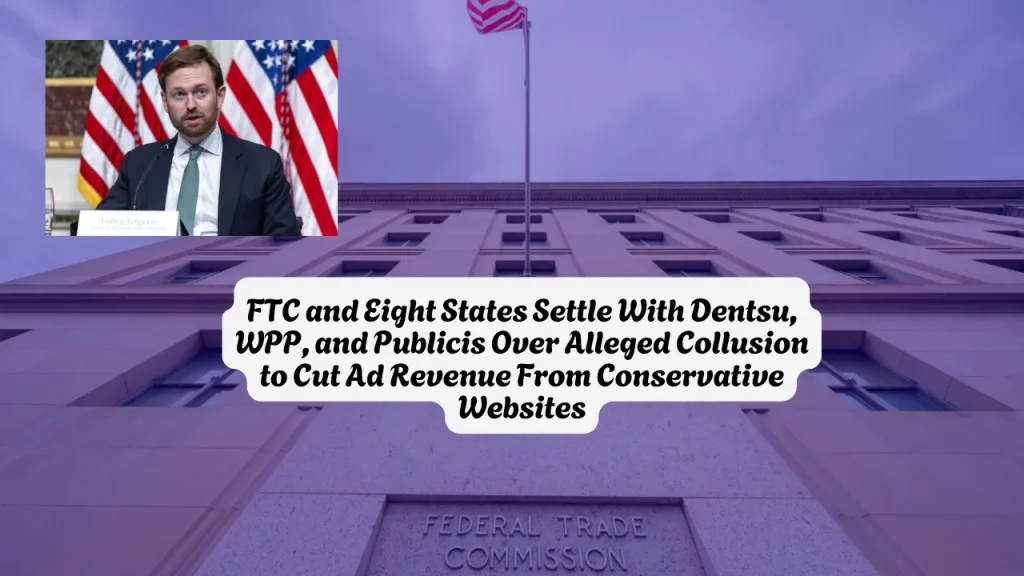
FTC and Eight States Settle With Dentsu, WPP, and Publicis Over Alleged Collusion to Cut Ad Revenue From Conservative Websites
Three of the world’s largest advertising holding companies — Dentsu, WPP (operating as GroupM Worldwide), and Publicis — reached simultaneous settlements with the Federal Trade Commission and a coalition of eight state attorneys general on April 15, 2026, resolving federal antitrust allegations that the firms illegally conspired to block advertising revenue from conservative publishers. The case was filed and simultaneously settled in the U.S. District Court for the Northern District of Texas, Fort Worth Division. No monetary penalties were disclosed; instead, the companies agreed to sweeping behavioral restrictions on how they place digital advertising going forward. The settlements still require court approval before taking effect.
Quick Case Snapshot
| Field | Detail |
| Plaintiffs | Federal Trade Commission; Attorneys General of Florida, Indiana, Iowa, Montana, Nebraska, Texas, Utah, and West Virginia |
| Defendants | Dentsu US Inc.; GroupM Worldwide LLC (d/b/a WPP Media); Publicis Inc. |
| Court | U.S. District Court for the Northern District of Texas, Fort Worth Division |
| Case Number | 4:26-cv-00469-P |
| Filing Date | April 15, 2026 |
| Judge | Not yet disclosed |
| Claims Alleged | Violation of Section 1 of the Sherman Antitrust Act; Violation of Section 5 of the FTC Act; Unlawful agreement in restraint of trade |
| Damages Sought | No monetary damages sought; behavioral injunctions requested |
| Current Status | Simultaneous complaint and proposed settlement filed; awaiting court approval |
What Did the FTC Allege Happened?
The FTC, alongside the attorneys general of Florida, Indiana, Iowa, Montana, Nebraska, Texas, Utah, and West Virginia, filed suit on April 15, 2026, against three of the world’s largest advertising agency holding companies — WPP (operating as GroupM Worldwide LLC), Publicis Inc., and Dentsu US Inc. — alleging that the firms unlawfully conspired to impose uniform “brand safety” standards across the digital advertising industry, depriving certain conservative publishers of advertising revenue and dampening competition in the market for media buying services.
At the center of the complaint is a concept called a “brand safety floor” — an industry-wide set of standards originally designed to prevent advertisers’ ads from appearing next to harmful or dangerous content online. According to the FTC complaint, the firms operated through two trade associations — the World Federation of Advertisers’ Global Alliance for Responsible Media (GARM) and the American Association of Advertising Agencies’ Advertiser Protection Bureau (APB) — to establish these common brand safety standards. The complaint alleges that under the agencies’ brand safety agreement, websites that included so-called “misinformation” were deemed to fall below the brand safety floor and thus risked becoming categorically ineligible for advertising revenue.
The FTC argues this arrangement crossed a line from legitimate brand protection into illegal coordination. The commission said the agencies “distorted America’s modern public square” and made it more difficult for publishers with “disfavored political viewpoints” to earn ad money.
The FTC’s stated concerns specifically included ad placement on Elon Musk’s social media platform X, and on Breitbart, a conservative site that became a flashpoint in debates over brand safety and viewpoint discrimination.
The complaint also pointed to internal communications suggesting coordination. An October 2024 email from a high-ranking executive at an unnamed trade association, cited in the complaint, read: “We have agreed to wait until the dust settles after the election to see where the political chips fall. We are regrouping at the end of November.”
What the Companies Agreed To — And What They Didn’t Admit
None of the three companies admitted any wrongdoing. WPP, Publicis, and Dentsu did not admit or deny wrongdoing in the settlement, but agreed to a proposed order that would stop the alleged collusion or use of exclusion lists when placing ads.
Under the proposed settlement terms, the companies agreed not to collude to restrict ad-buying services over “news and political and social commentary content.” Each firm will also be required to appoint an independent monitor to ensure compliance with the settlement terms.
In public statements after the settlement was announced, the companies struck a cooperative tone. A WPP spokesperson said the company is “pleased to finalize this agreement with the FTC, which reflects our existing and ongoing commitment to provide our clients with unbiased advice as they decide where to place their media.” Dentsu said it “remains fully committed to operating transparently, with integrity and in strict compliance with all applicable laws.” Publicis did not immediately respond to requests for comment at the time of reporting.
What Is “Brand Safety” and Why Does It Matter?
For readers unfamiliar with digital advertising mechanics, understanding this case requires a brief explanation of how online advertising works.
When a company like a car manufacturer or a bank wants to run digital ads, they typically hire an advertising agency holding company (like WPP, Publicis, or Dentsu) to purchase ad space on their behalf. These holding companies control enormous pools of ad spending and decide which websites receive that revenue.
Brand safety refers to the practice of ensuring an advertiser’s ad doesn’t appear next to content that could embarrass the brand — for example, ads for a family product running alongside graphic violence or hate speech. Industry groups like GARM created standardized lists of content categories and individual websites that brands should avoid.
The FTC’s argument is that when competing ad agencies collectively agree on which websites are “safe” or “unsafe,” they are no longer making independent business decisions — they are coordinating in a way that functions like a boycott, which can violate federal antitrust law, specifically the Sherman Act. The Sherman Act prohibits agreements among competitors that unreasonably restrain trade.
GARM said its tools had reduced the rate of ads appearing alongside harmful or illegal content from 6.1% in 2020 to 1.7% in 2023. The group discontinued its activities in August 2024 after X filed a lawsuit against it over an alleged advertiser boycott.
Regulatory and Political Background
This settlement does not exist in a vacuum. It is part of a broader pattern of FTC enforcement action under Chairman Andrew Ferguson, who has been an outspoken critic of what he characterizes as ideological bias in corporate media and advertising decisions.
In June 2025, as part of its approval of the merger between advertising giants Omnicom and Interpublic Group, the FTC required that the merged company agree not to collude or discriminate based on political or ideological views — a condition Ferguson described as addressing a “history of collusion in the advertising market for media-buying services.”
Earlier in 2025, the FTC had also sent investigative inquiry letters to roughly a dozen companies, including Ad Fontes Media Group and Media Matters for America, examining whether those groups coordinated to illegally restrain trade and harm competitors in violation of the Sherman Act.
The current settlement fits squarely into this enforcement trajectory, representing the FTC’s most direct action yet against major ad holding companies over brand safety coordination.
What Happens Next — Timeline and What to Watch
The proposed settlement is not yet final. A court must approve the settlement before it takes effect. The next key procedural steps include:
- Judicial review: The U.S. District Court for the Northern District of Texas will review the proposed consent orders and determine whether they are in the public interest before entering them as final judgments.
- Compliance monitoring: Each company is required to appoint an independent compliance monitor. How that monitor will measure and report on ad placement decisions — particularly given how complex and automated digital ad-buying has become — remains an open and closely watched question.
- Industry-wide implications: Advertisers, publishers, and trade associations across the digital media industry will be watching closely to understand where the new legal boundaries for brand safety coordination now lie.
What This Means for Conservative Publishers, Advertisers, and the Ad Industry
For conservative publishers like Breitbart, Daily Wire, and others that have claimed lost ad revenue due to brand safety exclusions, this settlement signals potential increased access to programmatic advertising dollars — though no specific repayment or compensation to affected publishers was announced or ordered.
For advertisers, the settlement raises a significant practical question: if their agencies can no longer collectively coordinate on which news and political websites to avoid, individual advertisers may need to make those decisions independently or risk their ads appearing on politically controversial content they would prefer to avoid.
For the ad industry broadly, this case sets a precedent that industry-wide brand safety standards, when coordinated among competing agencies, can attract antitrust scrutiny — potentially reshaping how agencies, trade associations, and advertisers collaborate on content standards going forward.
FAQs: What People Are Searching and Asking
What exactly did Dentsu, WPP, and Publicis allegedly do?
According to the FTC complaint, the three firms coordinated through industry trade associations to create shared “brand safety” standards that collectively excluded certain conservative news and opinion websites from receiving digital advertising revenue. The FTC alleges this coordination violated federal antitrust law.
Is there a financial payout from this settlement — and can I claim it?
No. This is not a class action lawsuit, and no compensation fund was created for affected publishers or the general public. The settlement is behavioral — the companies agreed to change how they operate going forward, rather than pay a monetary penalty or damages.
What are Dentsu, WPP, and Publicis prohibited from doing now?
Under the proposed consent orders, the firms are barred from using shared exclusion lists or coordinating with competitors on restricting ad buying based on the political or ideological content of news or commentary publishers.
Does this mean conservative websites will now receive more ad money?
Potentially, yes — but it is not guaranteed. The settlement removes a coordinated restriction, but individual advertisers still retain the right to independently decide where their ads run. Whether major brands choose to advertise on conservative outlets absent industry-wide coordination remains to be seen.
What happened to GARM, the organization at the center of this?
GARM (Global Alliance for Responsible Media), the World Federation of Advertisers group through which much of the alleged coordination occurred, disbanded in August 2024 following a lawsuit filed by Elon Musk’s X. The FTC complaint named GARM’s practices as central to the alleged illegal conspiracy.
Why was this case filed in Texas?
The case was filed in the U.S. District Court for the Northern District of Texas, Fort Worth Division. Texas is one of the eight states co-filing the lawsuit alongside the FTC, and the Northern District of Texas has become a common venue for high-profile federal regulatory actions in recent years.
Last Updated: April 18, 2026
This article is for informational purposes only and does not constitute legal advice. Allegations in a complaint are not findings of fact. All parties are presumed innocent unless and until proven otherwise in court.
About the Author
Israr Ahmad is a legal content researcher with 4+ years of experience covering class action settlements and consumer rights cases. He has researched and published coverage of 2,500+ settlements using verified court records, settlement administrator filings, and government sources. Learn more about Israr.