
Forest Hills Stadium Lawsuit, How the City’s Concert Crowd Crisis Finally Ended
A Queens homeowners group sued New York City after the NYPD repeatedly closed their private streets to manage concert crowds at Forest Hills Stadium — without permission or payment. The city settled the federal lawsuit on March 16, 2026, agreeing to pay $150,000 to the Forest Hills Gardens Corporation (FHGC). No individual consumer claims are open. This article explains what the dispute was about, who was involved, and what the settlement means going forward.
Quick Facts
| Field | Detail |
| Lawsuit Type | Federal Civil — Unconstitutional Taking of Private Property |
| Plaintiff | Forest Hills Gardens Corporation (FHGC) |
| Defendant | City of New York / NYPD |
| Settlement Amount | $150,000 |
| Settlement Date | March 16, 2026 |
| Court | U.S. District Court, Eastern District of New York |
| Settlement Status | Settled — Case Dismissed |
| Individual Claims Open | No |
| NYPD Future Obligation | Must consult FHGC on street closures going forward |
Current Status
- Court documents filed March 17 detail the terms of the settlement and the suit’s dismissal. The case was filed in New York’s Eastern District and has been dismissed.
- FHGC has not yet reached an agreement with the West Side Tennis Club or Tiebreaker over separate remaining claims, but all parties remain in communication.
- No individual homeowner claims or consumer filings are part of this settlement — the $150,000 goes entirely to the FHGC organization.
What Was the Forest Hills Stadium Lawsuit About?
The Forest Hills Gardens Corporation (FHGC) represents homeowners in the Forest Hills neighborhood of Queens. It owns the private streets surrounding Forest Hills Stadium. The organization licenses those streets to concert operators — but it stopped doing so in 2023, saying the event schedule had grown too large and disruptive.
The lawsuit accused the NYPD of continuing to close FHGC’s private streets, erecting barricades, blocking resident access, and directing concertgoers onto private property — despite FHGC’s repeated written objections and its decision not to issue licenses. The lawsuit stated that Forest Hills Stadium can be accessed entirely via public streets and nearby transit, making the use of private streets unnecessary.
The lawsuit also alleged a pattern of quality-of-life harms that came with large concert crowds, including public intoxication, public urination, littering, late-night noise, and crowds that flooded narrow residential streets — making them impassable to vehicles and hazardous for residents, including families with children and seniors.
Related article: Trump DOJ Sues Washtenaw County Over Immigration Policies, What You Need to Know
What Did the NYPD Actually Do?
In March 2025, the NYPD itself acknowledged it had no authority to close FHGC’s streets without permission — yet weeks later reversed course, authorizing a promoter-funded private security force to carry out the same street-closure program on FHGC property.
Between March 1 and April 30, 2025, the concert promoter paid nearly $50,000 to five firms that lobbied the Office of the Mayor and various City Council members on its behalf to allow the concerts to proceed.
The FHGC’s attorneys argued the city sided with a commercial concert business over the constitutional rights of local property owners. The lawsuit argued that each time the city closed FHGC’s streets and directed thousands of people onto private property, residents could not access their own homes.
What Does the Settlement Require?
The settlement does two things. First, it requires money. The City of New York agreed to pay $150,000 in full settlement, with the check mailed to the Forest Hills Gardens Corporation within 90 days.
Second, it sets new rules for how the NYPD handles future concerts. One provision requires the captain of the 112th Precinct, or a designated officer, to consult with the FHGC board president about security arrangements on Gardens property — including street closures, resident access, and rideshare pickup areas — as long as events continue at the venue.
The NYPD retains final say over security decisions. The settlement was reached without any admission of liability by the city.
How Did the Concert Schedule Grow Over the Years?
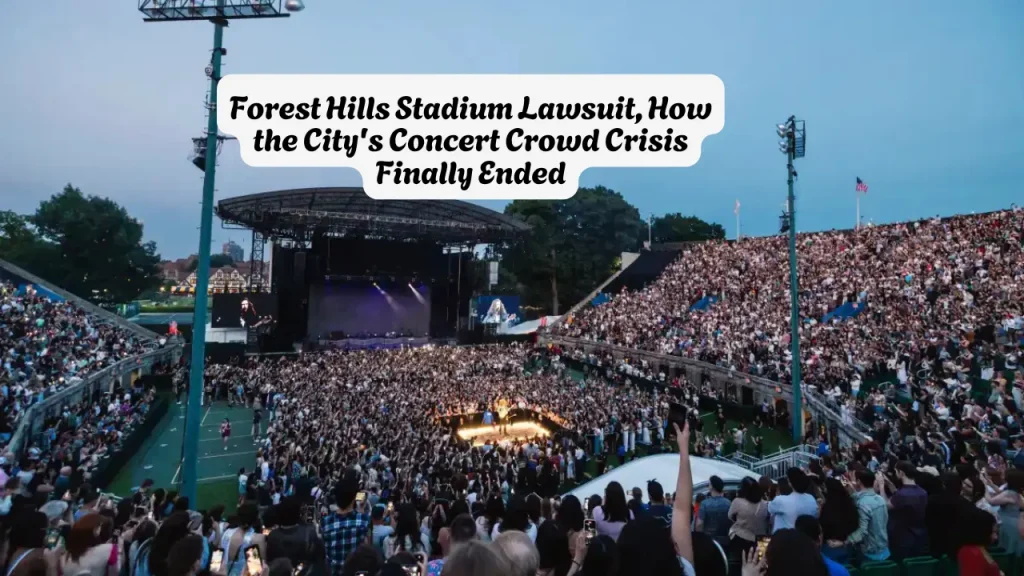
The stadium’s use expanded significantly over a short period — from an occasional concert venue to a high-volume commercial business, with 32 concerts in 2023, 38 in 2024, and 31 in 2025.
A self-funded study published in March 2026 by Forest Hills Stadium found its 2024 events season generated $42.5 million in economic activity for Forest Hills and New York. Stadium supporters and Queens Borough President Donovan Richards have called the venue a cultural asset and major economic driver for the neighborhood.
The dispute has always been about balance — not shutting concerts down entirely, but ensuring that private property rights are respected in the process.
Why Did FHGC Settle Now?
The settlement marks a significant shift in the relationship between the stadium and its neighbors. FHGC’s new board, elected overwhelmingly in December 2025, ran almost entirely on a platform of ending the lawsuits.
Jeff Mitchell, a newly elected co-chair of the FHGC board, said the organization looks forward to working with the police going forward. The new board had pointed mainly to the mounting cost of legal fees as a reason to resolve litigation.
The federal suit against the city is now the first of FHGC’s several lawsuits to be resolved. The separate state court case against the West Side Tennis Club remains active.
What Other Lawsuits Involved Forest Hills Stadium?
Multiple legal actions have surrounded this venue over the past few years:
Concerned Citizens of Forest Hills Inc. v. West Side Tennis Club — Filed in Queens Supreme Court at the end of 2023, this lawsuit alleged “unbearably loud” noise from concerts on behalf of hundreds of residents. A judge dismissed it in August 2024, finding that the plaintiffs failed to show the harm was isolated to only them.
FHGC v. West Side Tennis Club and Tiebreaker — In October 2024, Justice Joseph J. Esposito dismissed five of seven claims FHGC had filed in this Queens Supreme Court case. The dismissed claims included allegations that the concerts violated the tennis club’s contract with FHGC, that the stadium was a zoning violation, and that the club had unjustly profited. Two claims remain pending.
FHGC v. City of New York (Federal) — This is the case that just settled for $150,000, as described throughout this article.
Important Dates
| Milestone | Date |
| FHGC Terminates Street Licenses | 2022 |
| Concerned Citizens Lawsuit Filed | Late 2023 |
| Concerned Citizens Lawsuit Dismissed | August 14, 2024 |
| 5 of 7 FHGC State Claims Dismissed | October 21, 2024 |
| Federal Lawsuit Filed (FHGC v. NYC) | October 2025 |
| New FHGC Board Elected | December 2025 |
| Federal Settlement Reached | March 16, 2026 |
| Court Documents Filed | March 17, 2026 |
| Case Dismissed | March 2026 |
| $150,000 Payment Due | Within 90 days of settlement |
| State Case vs. West Side Tennis Club | Still Pending |
Frequently Asked Questions
Can individual Forest Hills residents file a claim for money from this settlement?
No. The $150,000 settlement goes directly to the Forest Hills Gardens Corporation as an organization. There is no individual claim process, and no consumer or resident can file for a share of the funds.
What is the Forest Hills Gardens Corporation (FHGC)?
FHGC is a homeowners association that represents approximately 900 property owners in Forest Hills Gardens, Queens. It owns the private streets, sidewalks, and common areas surrounding Forest Hills Stadium and the neighborhood.
Did the city admit it did anything wrong?
No. The settlement agreement states both parties reached an amicable resolution without any admission of liability by the City of New York or the NYPD.
Is Forest Hills Stadium still operating concerts?
Yes. The settlement does not shut down the stadium or its concert program. It only changes how the NYPD manages street closures and security on private FHGC property during events.
What happens with the remaining lawsuit against the West Side Tennis Club?
That case is still active in Queens Supreme Court. FHGC and the West Side Tennis Club have not yet reached an agreement, though both sides are reportedly in ongoing communication.
Will this settlement change anything for concertgoers?
Concertgoers may notice different access routes or crowd management arrangements around the stadium in future seasons, as the NYPD now must consult with FHGC before closing private streets. The stadium itself is accessible via public streets and public transit regardless.
Why did it take so long to resolve this dispute?
The previous FHGC board pursued litigation aggressively over several years. The new board elected in December 2025 ran on a platform of ending the lawsuits, citing the mounting cost of legal fees, and moved quickly to settle the federal case.
Last Updated: April 12, 2026
Disclaimer: This article is for informational purposes only and does not constitute legal advice. Legal claims and outcomes depend on specific facts and applicable law. For advice regarding a particular situation, consult a qualified attorney.
About the Author
Israr Ahmad is a legal content researcher with 4+ years of experience covering class action settlements and consumer rights cases. He has researched and published coverage of 2,500+ settlements using verified court records, settlement administrator filings, and government sources. Learn more about Israr.