
Florida Leapfrog Hospital Safety Grades Lawsuit, Can Patients Trust Hospital Ratings?
Florida Attorney General James Uthmeier has sued The Leapfrog Group and its CEO, Leah Binder, alleging the nonprofit misled patients by assigning low hospital safety grades using scores that did not reflect actual measured performance. The lawsuit was filed November 20, 2026 in the Circuit Court of the 18th Judicial Circuit, Seminole County. It challenges a grading method introduced in fall 2024, under which hospitals that declined Leapfrog’s voluntary safety survey allegedly received the lowest possible score on four safety measures even though Leapfrog lacked current performance data for them.
The dispute matters most in Palm Beach County, where five hospitals that received D or F grades had already challenged Leapfrog in a separate federal lawsuit.
Can patients still trust Leapfrog grades? The ratings remain one source of information, but patients should look at the underlying measures and compare them with independent government data. A missing grade does not show a hospital is unsafe, and the lawsuit does not prove every published grade is inaccurate. Leapfrog disputes the allegations and argues its evaluations are protected by the First Amendment. There is no patient class action, compensation fund or claim form.
Florida Leapfrog Hospital Safety Grades Lawsuit: Quick Facts
| Question | Verified information |
| Plaintiff | Florida Office of the Attorney General, Department of Legal Affairs |
| Defendants | The Leapfrog Group and CEO Leah Binder |
| Filed | November 20, 2026 |
| Court | 18th Judicial Circuit, Seminole County, Florida |
| State complaint | 38 pages, four counts |
| Principal law | Florida Deceptive and Unfair Trade Practices Act (FDUTPA) |
| Additional law | Florida Solicitation of Contributions Act, Chapter 496 |
| Main allegation | Misleading hospital grades based partly on assumed lowest scores |
| Hospitals central to the dispute | Five Palm Beach County hospitals |
| Earlier federal case | Good Samaritan Medical Center Inc. v. The Leapfrog Group, No. 9:25-cv-80526 |
| Federal ruling / appeal | March 6, 2026, for the five hospitals / Eleventh Circuit, No. 26-11527 |
| Leapfrog’s position | Disputes the lawsuit and invokes free speech protections |
| Class action / patient settlement | No / none |
| Official settlement website | None. No settlement exists |
Source: Florida Attorney General’s November 20 announcement.
Why Is Florida Attorney General James Uthmeier Suing The Leapfrog Group?
Leapfrog is a Washington, D.C.-based nonprofit that grades hospitals from A to F on safety measures such as infection prevention, medication safety, staffing and errors. The grades combine federal data with information from Leapfrog’s voluntary hospital survey.
According to the complaint, Leapfrog changed how it treated missing survey data in 2024. Before that, it could use historical information or comparisons with similar hospitals to fill gaps. Starting in fall 2024, the state alleges, Leapfrog instead gave nonparticipating hospitals the lowest score any hospital received on four measures. Florida argues this made some hospitals look much less safe than their actual performance justified, and that Leapfrog kept calling its method peer-reviewed and expert-guided despite objections from people involved in developing the ratings.
The state’s central allegation is that consumers were not told when low numerical scores reflected assumptions rather than measured hospital performance. These allegations are contested.
Which Four Leapfrog Safety Measures Does Florida Say Were Scored Unfairly?
| Measure | What it evaluates |
| Computerized Physician Order Entry (CPOE) | Systems that reduce medication-ordering errors |
| Bar Code Medication Administration (BCMA) | Technology that verifies medications before administration |
| ICU Physician Staffing | Physician coverage in intensive care units |
| Hand Hygiene | Practices meant to prevent infections |
Per paragraphs 28–36 of the complaint, Leapfrog lacked sufficient survey data on these measures for certain hospitals but assigned the lowest available scores anyway. The state alleges the four measures’ combined weight in the grade rose from about 24% to 31% under the revised method.
One example involves Good Samaritan Medical Center, whose hand-hygiene score Florida says fell from 100 to 15 after the new methodology. That reflects a scoring change, not documented deterioration in the hospital’s hand hygiene. The complaint also alleges internal Leapfrog communications acknowledged the assigned scores could substantially lower grades for nonparticipating hospitals. The court must decide whether any of this violated Florida law.
Which Five Palm Beach County Hospitals Challenged Leapfrog’s Safety Grades?
Five hospitals operated by Tenet Healthcare subsidiaries challenged the grading system in federal court:
| Hospital | Community |
| Good Samaritan Medical Center | West Palm Beach |
| Delray Medical Center | Delray Beach |
| Palm Beach Gardens Medical Center | Palm Beach Gardens |
| St. Mary’s Medical Center | West Palm Beach |
| West Boca Medical Center | Boca Raton |
They argued the methodology unfairly penalized them for declining the voluntary survey and claimed reputational and financial harm. Their participation does not show they have better clinical outcomes than every higher-rated hospital. It shows they challenged how particular grades were calculated and described. The state case draws on evidence developed in that federal proceeding.
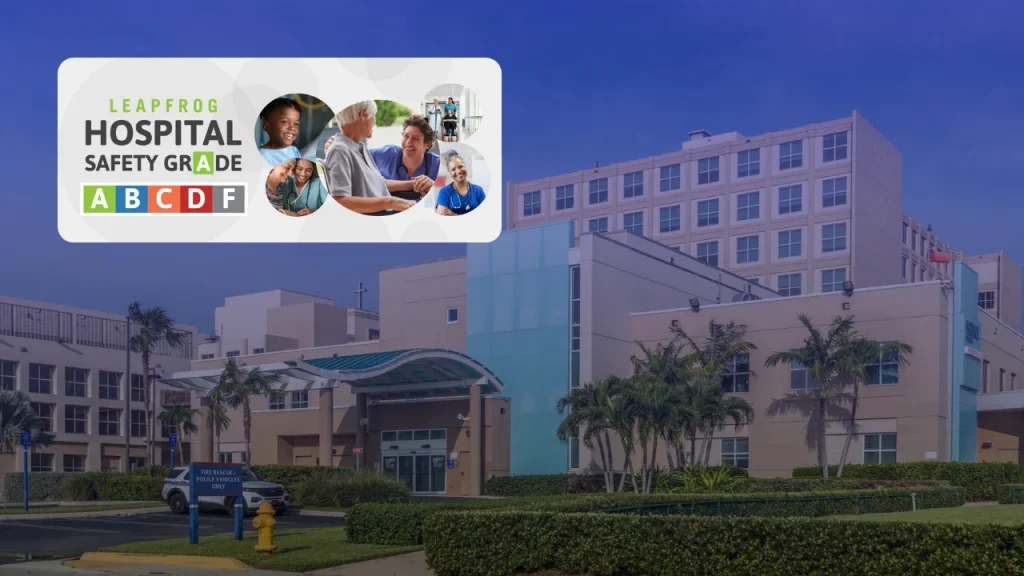
Did Patients Refuse Treatment at West Boca, Palm Beach Gardens or Delray Medical Center Because of Leapfrog Grades?
The complaint describes examples, which are litigation allegations and not medical findings:
- West Boca Medical Center: a patient with a compound finger fracture allegedly left against medical advice, with records indicating family concern about the hospital’s Leapfrog reviews.
- Palm Beach Gardens Medical Center: a patient allegedly refused heart surgery after learning of the hospital’s failing grade.
- Delray Medical Center: a patient allegedly expressed fear of treatment there, and the complaint says some publicly reported outcomes at the hospital compared favorably with national benchmarks despite the low overall grade.
Never stop urgent or medically necessary care because of an online rating. For planned procedures, discuss the rating with your physician and ask about the hospital’s results for your specific treatment.
What Are the Four Counts in Florida’s 38-Page Complaint Against Leapfrog and Leah Binder?
| Count | Allegation |
| I | Deceptive hospital safety-grade representations under FDUTPA |
| II | Unfair hospital grading practices under FDUTPA |
| III | Consumer-protection violations based on allegedly soliciting donations without required charitable registration |
| IV | Consumer-protection violations based on allegedly misleading information tied to charitable solicitations |
Counts I and II challenge the grading practices: that grades were presented as reliable safety measures without explaining that some scores were assigned without hospital-specific data, that claims of peer review and expert approval were disputed, and that giving the lowest scores to hospitals skipping a voluntary survey was unfair.
Counts III and IV concern fundraising. The complaint says Leapfrog’s Florida charitable registration renewal was denied on January 2, 2025, and that it kept soliciting donations through its websites until registration was restored on August 12, 2026, raising issues under Fla. Stat. §§ 496.405 and 496.415. The state also alleges its hospital-grade claims were used alongside fundraising in ways that could mislead donors. Reported allegations elsewhere add that Leapfrog’s main revenue comes from selling promotional “accolade” licenses, reportedly $6,700 to $29,900 a year, and that nonparticipation allegedly followed a projected $540,000 shortfall. Please verify those figures against the complaint, and note that Leapfrog says hospitals receive grades whether or not they buy a license.
No liability finding has been entered in the state case. Complaint: Florida v. The Leapfrog Group and Leah Binder, 38-page filing.
Why Did Florida File the Leapfrog Lawsuit in Seminole County Instead of Palm Beach County?
The complaint says Leapfrog uses Tel-Affects LLC, a Florida contractor in Lake Mary, Seminole County, to market and sell hospital accolade licenses, and names the Florida Alliance for Healthcare Value in Winter Springs as a regional group distributing hospital-grade information. Florida argues these activities support venue in Seminole County. The case therefore involves South Florida hospitals and alleged business operations in Central Florida.
Did a Federal Judge Already Rule Against Leapfrog in March 2026?
Yes, in the separate hospital case. On March 6, 2026, U.S. District Judge Donald Middlebrooks ruled for the hospitals in Good Samaritan Medical Center Inc. v. The Leapfrog Group, No. 9:25-cv-80526. After a bench trial, he found the challenged grading practices unfair and deceptive under Florida consumer-protection law, ordered Leapfrog to stop grading the five hospitals with the disputed method and required corrective disclosures about specified earlier grades.
Leapfrog appealed to the Eleventh Circuit (No. 26-11527). Its corrected opening brief was filed October 30, 2026, and the hospitals responded November 13. The appeal was still active when Florida filed its new suit. The federal ruling is not a final judgment in the state’s enforcement case.
What Is Leapfrog’s Defense, and Is the Florida Case a First Amendment Fight?
In its November 20 response, Leapfrog argued the government action threatens its ability to publish independent opinions on hospital safety and raises First Amendment concerns. It says its system uses evidence-based measures, federal data, voluntary survey information and expert review, and publishes its methodology. Reports also say Leapfrog maintains that hospitals do not pay to be graded.
The dispute raises a real constitutional question. Leapfrog says its grades are protected editorial judgments. Florida says consumer-protection law can reach deceptive commercial statements, including misleading claims about how ratings are calculated. The First Amendment does not automatically shield deceptive commercial conduct, but government enforcement also cannot simply suppress protected opinion. The line between protected opinion and actionable misrepresentation, and the Eleventh Circuit’s ruling, will matter a great deal.
Leapfrog’s response: Statement on Lawsuit Filed by Florida Attorney General, November 20, 2026.
How Are Leapfrog Hospital Safety Grades Calculated in Fall 2026?
The fall 2026 method uses up to 22 measures, including federal patient-safety data and data from Leapfrog’s voluntary survey.
| Category | Share of grade | Examples |
| Process and structural measures | 50% | Medication systems, staffing, safety practices, communication |
| Outcome measures | 50% | Infections, complications, preventable harm |
Some federal measures reflect earlier reporting periods, so a grade is a structured evaluation of available data, not a live measure of every patient’s safety.
What Does “Grade Not Assigned” Mean for Hospitals on Leapfrog’s Fall 2026 List?
Because of the federal ruling, Leapfrog says it is not assigning fall 2026 letter grades to about 450 hospitals that did not take its 2025 or 2026 survey. They are labeled Grade Not Assigned (GNA), which differs from Not Graded (insufficient eligible data or outside the program’s scope).
| Status | What it means |
| A–F | Letter categories under Leapfrog’s method, with A highest and F lowest |
| Grade Not Assigned | No letter grade under the current nonparticipation policy |
| Not Graded | Not enough qualifying information, or outside grading eligibility |
A hospital without a grade is not necessarily safer or less safe than one with a grade. Official method: Leapfrog Fall 2026 Hospital Safety Grade Scoring Methodology.
Can Florida Patients Still Trust Leapfrog Hospital Safety Grades?
Treat them as one input, not a verdict on your likely outcome. The lawsuit raises fair questions about transparency and missing data, and Leapfrog also publishes useful information on infections, errors and safety practices. Ask whether the data is current, whether a measure was reported or estimated, and whether the hospital provides the care you need. A hospital’s ability to treat a complex stroke, heart attack, premature infant or trauma may depend on specialty services a letter grade does not capture.
How Can Florida Patients Compare Hospitals Beyond Leapfrog Grades?
- Medicare Care Compare. Medicare Care Compare offers federal quality data: mortality, readmissions, infections and patient experience, including CMS hospital star ratings (not the same as Leapfrog’s A–F grades, and not the same as Medicare Advantage plan ratings, which are covered in UnitedHealthcare Medicare Advantage Star Ratings Lawsuit 2026, Why UnitedHealth Group Sued CMS in Georgia and What It Means for Seniors).
- CDC infection data. The CDC’s National Healthcare Safety Network tracks standardized infection ratios for central-line and catheter-associated infections, MRSA and C. difficile.
- Florida Health Finder. The state’s AHCA tool at FloridaHealthFinder.gov covers hospital quality, costs and facility information across Palm Beach, Seminole, Orange, Miami-Dade, Broward and other counties.
- Procedure-specific experience. Before planned surgery, ask your physician how often the specific surgeon and team perform your procedure, plus infection rates, specialist coverage and emergency backup.
For how negligence claims differ from ordinary complications, see Medical Malpractice Examples, Common Cases Explained.
What Penalties and Remedies Is Florida Seeking From Leapfrog?
| Requested remedy | Meaning |
| Injunction | Order stopping specified deceptive representations |
| Corrective disclosures | Clarifications to consumers and organizations receiving Leapfrog data |
| Restitution or reimbursement | Possible recovery for qualifying affected parties |
| Disgorgement | Surrender of money obtained through unlawful conduct |
| Charitable solicitation restrictions | Limits on fundraising without required registration |
| Civil penalties | Up to $10,000 per established willful violation |
| Enhanced penalties | Up to $15,000 per qualifying violation involving a senior citizen or person with a disability |
| Attorney fees and costs | Recovery of qualifying state enforcement costs (reported as sought under Fla. Stat. § 501.2105) |
These amounts are possible civil penalties, not checks for patients. No judgment has been entered in the new case.
Which Florida Statutes Apply to the Leapfrog Hospital Rating Dispute?
- Fla. Stat. § 501.204: prohibits unfair or deceptive acts in trade or commerce.
- Fla. Stat. § 501.207: gives the state enforcement authority, including injunctions and other remedies.
- Fla. Stat. §§ 501.2075 and 501.2077: civil penalties, including enhanced penalties for qualifying vulnerable consumers.
- Fla. Stat. § 496.405: charitable registration requirements.
- Fla. Stat. § 496.415: prohibits specified unlawful solicitation conduct, including certain false or misleading fundraising.
- Fla. Stat. § 496.416: ties violations of the charitable solicitation chapter to Florida consumer-protection enforcement.
Defendants may also raise First Amendment defenses. The lawsuit does not allege that CMS created the disputed grading method.
Can Florida Patients Sue Leapfrog or Get Compensation From the Attorney General’s Lawsuit?
No class action, compensation fund or claim portal exists. The Attorney General seeks restitution and other relief for qualifying parties, which may include consumers, hospitals, insurers and donors, but any individual payment would need a court order or enforceable settlement. This is a state enforcement action, so there is no class certification, opt-out deadline or class objector process. Florida’s attorneys are Office of the Attorney General lawyers, not contingency-fee counsel. If restitution is ever ordered, tax treatment would depend on what the payment covers.
The lawsuit does not establish that anyone received negligent care. A malpractice claim requires evidence a provider breached the standard of care and caused harm. For deadlines, see Medical Malpractice Statute of Limitations by State, How Long Do You Have to Sue?.
If you believe a hospital provided unsafe care, you can contact Florida’s Agency for Health Care Administration at 1-888-419-3456 or use its healthcare facility complaint form. That complaint is separate from the Attorney General’s lawsuit.
Frequently Asked Questions About Florida’s Leapfrog Lawsuit
Did Florida ban Leapfrog hospital safety grades?
No. Florida filed an enforcement lawsuit seeking limits on allegedly deceptive practices. No statewide order bans Leapfrog grades.
Are the five Palm Beach County hospitals unsafe?
The lawsuit does not establish that. The hospitals challenged the methodology behind particular grades and won a federal district court ruling that Leapfrog has appealed. Review independent, procedure-specific safety information.
Why are some hospitals no longer graded by Leapfrog?
For fall 2026, Leapfrog changed its reporting after the federal ruling. About 450 hospitals nationwide that skipped its 2025 and 2026 surveys are labeled Grade Not Assigned.
Is Leah Binder personally being sued?
Yes. Florida named her as an individual defendant and alleges she directed or controlled the challenged conduct. Those allegations are contested.
Is there a Florida Leapfrog hospital lawsuit settlement?
No settlement or patient payment program has been announced.
Can I use Leapfrog ratings to choose a hospital?
Yes, as one source. Compare individual measures with Medicare Care Compare, Florida Health Finder, your physician’s guidance and the hospital’s capabilities for your specific care.
What Happens Next in the Florida Leapfrog Lawsuit and the Eleventh Circuit Appeal?
The state case is at an early stage. Leapfrog and Binder can respond and contest the claims, and the court may address whether the grading disclosures were materially misleading, whether the method was an unfair practice and whether the charitable solicitation violations occurred. Discovery, building on records from the federal case, is likely to examine internal communications about the 2024 scoring change and fundraising records from the registration gap. Meanwhile, the Eleventh Circuit appeal could shape the legal framework, including how far First Amendment defenses go.
A hospital safety grade can be useful, but it should never replace actual clinical data, the treatment you need and professional medical guidance. The lawsuit does not show all Leapfrog grades are false, and a hospital’s role in the dispute does not show it is safe for every procedure.
Primary Sources and Official Legal Documents
- Florida Attorney General, November 20, 2026 Leapfrog lawsuit announcement
- Florida v. The Leapfrog Group and Leah Binder, 38-page complaint
- Leapfrog Group, official response, November 20, 2026
- U.S. District Court, March 6, 2026 order in Good Samaritan Medical Center v. Leapfrog
- Leapfrog, September 10, 2026 federal appeal announcement
- Leapfrog, Fall 2026 scoring methodology
- Leapfrog, Fall 2026 Hospital Safety Grades announcement
- Florida Statutes Chapter 501
- Florida Statutes Chapter 496
- Medicare Care Compare
- Florida AHCA, Florida Health Finder
Disclaimer: The allegations in Florida’s November 20 lawsuit have not been established by a judgment in that case. A separate federal district court ruled against Leapfrog in March 2026, but that decision is under appeal. This is general legal and consumer information, not legal or medical advice.
Researched and written by Israr Ahmad, legal content researcher and founder of AllAboutLawyer.com. All facts verified against the Florida Attorney General’s November 20, 2026 announcement, the 38-page complaint, Leapfrog’s official statements and methodology, and the federal court order, as of November 23, 2026. Last Updated: November 23, 2026.
About the Author
Israr Ahmad is a legal content researcher with 4+ years of experience covering class action settlements and consumer rights cases. He has researched and published coverage of 2,500+ settlements using verified court records, settlement administrator filings, and government sources. Learn more about Israr.