
Maine Father Sues Falmouth School Over Pledge of Allegiance District Backs Down Within Weeks
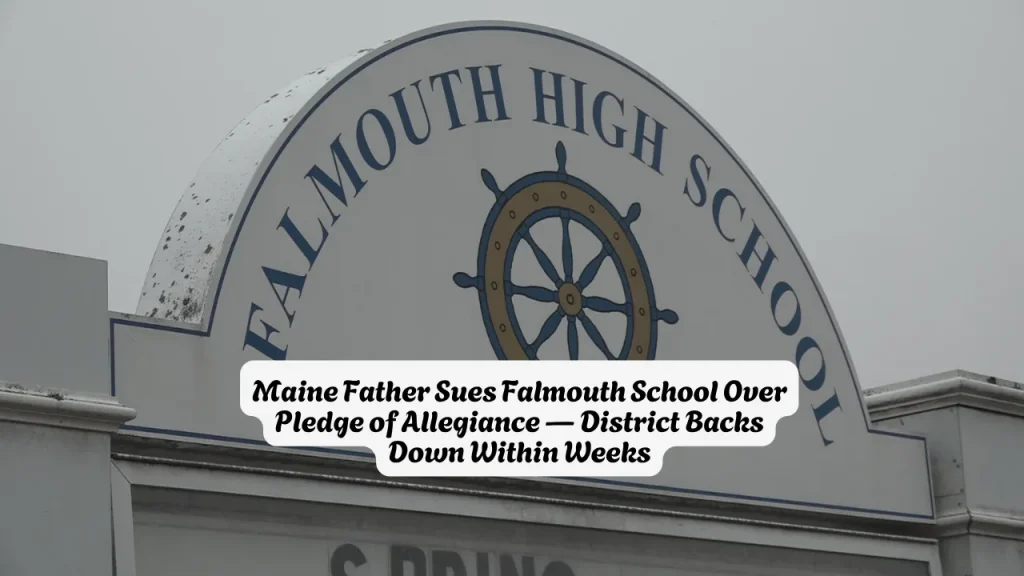
A Maine father filed a lawsuit against the Falmouth School Department on March 3, 2026, after his son spent two years at Falmouth High School without ever being given a structured opportunity to recite the Pledge of Allegiance. The lawsuit alleged the district was violating both a 2011 Maine state statute and its own 2012 policy. Within weeks, Falmouth High School reversed course and reinstated the pledge — effectively giving the Hickey family the outcome they had asked the court to order.
Quick Facts
| Field | Detail |
| Plaintiff | Christopher Hickey, on behalf of his son Clayton Hickey |
| Defendant | Falmouth School Department and Superintendent Steve Nolan |
| Court | Cumberland County Superior Court, Maine |
| Lawsuit Filed | March 3, 2026 |
| Law Allegedly Violated | Maine state statute (2011) requiring daily pledge opportunity |
| Relief Sought | Court injunction ordering the school to comply with state law |
| Outcome | Falmouth High School reinstated the Pledge of Allegiance |
| Case Status | Resolved — school complied; formal dismissal TBD |
| Attorney for Plaintiff | Jack Baldacci |
Where Things Stand Right Now
- Falmouth High School reinstated the Pledge of Allegiance following the lawsuit, rendering the injunction request effectively moot.
- No monetary damages were sought or awarded — the case was about compliance with state law, not compensation.
- Whether the lawsuit has been formally dismissed or is still technically open in Cumberland County Superior Court has not been publicly confirmed as of April 10, 2026.
What Was the Dispute About?
Falmouth High School is part of the Falmouth School Department in southern Maine. The school serves students from a well-regarded suburban district outside Portland. For years, the elementary and middle schools in Falmouth conducted daily Pledge of Allegiance recitations. Falmouth High School did not.
The lawsuit, filed against the Falmouth School Department and Superintendent Steve Nolan, alleges that the district is violating a state statute from 2011 that requires schools to allow every student the opportunity to recite the Pledge of Allegiance at some point during the school day.
The plaintiff, Christopher Hickey, on behalf of his son Clayton, said in the lawsuit that in the two years Clayton attended Falmouth High School, there has been no structured recitation of the pledge — neither over the intercom nor led by classroom teachers.
The lawsuit argued that without any structured opportunity, a student who wanted to say the pledge would have to do so on their own — randomly and without any facilitation — which attorneys argued was not a genuine “opportunity” within the meaning of the law. Attorney Jack Baldacci wrote in a statement that the lawsuit “highlights a straightforward violation of Maine law and the Falmouth School Department’s own policy,” adding that his client was seeking “to ensure compliance so that his son Clayton and all Falmouth students can benefit from this important civic tradition.”
Related article: Michael Wolff vs. Melania Trump, The Epstein Lawsuit That Just Got a Lot More Public
What Maine Law Actually Requires
Maine enacted a statute in 2011 that places a clear obligation on public schools. The law states that a school administrative unit must allow every student the opportunity to recite the Pledge of Allegiance at some point during a school day in which students are required to attend. The Falmouth School Department went further and adopted its own district policy in 2012 mirroring that requirement.
Crucially, Maine law — like federal law — does not require students to participate. Both district and state policies state that school administrations cannot require a student to recite or participate in the pledge. The right at issue here ran in both directions: students who wanted to say the pledge were entitled to a structured opportunity to do so, and students who did not want to participate could not be compelled.
The lawsuit did not challenge a school’s right to make the pledge optional. It challenged the school’s failure to provide any structured opportunity for it at all — which Hickey argued denied his son and every other willing student a right the law explicitly protects.
How the School Responded
Superintendent Steve Nolan — who had taken the position only in September 2025 — responded to the lawsuit by saying he encouraged families to bring concerns to school officials directly. Nolan stated: “Now that this matter has been brought to our attention, we plan to take steps to provide an opportunity during the school day for students who wish to say the Pledge of Allegiance to do so during a designated time.”
The school followed through. Within weeks of the lawsuit being filed, Falmouth High School reinstated the Pledge of Allegiance. The district did not publicly contest the legal merits of the lawsuit or argue it had been complying with state law.
Why This Case Matters Beyond Falmouth
This lawsuit is a reminder that state education laws carry real legal weight — and that parents have standing to enforce them when schools fall short. Maine’s 2011 pledge statute is not a suggestion. It is a binding legal obligation on every public school district in the state.
The case also illustrates a broader principle in education law: parental and student rights in public schools are often more concrete and enforceable than people realize. A parent does not need to wait for a regulatory agency to act. A direct legal challenge in state court — asking a judge to order compliance — can produce results faster than a bureaucratic complaint process.
In 2015, three students at South Portland High School challenged how the pledge was introduced each day, igniting local tensions and eventually leading to a change in the introduction to make clear that recitation was optional. Maine has seen this tension play out before — from students asserting the right not to say the pledge, to students asserting the right to say it. Both sides of that debate rest on the same foundational principle: participation must be a genuine, structured choice.
Key Dates & Timeline
| Milestone | Date |
| Maine Pledge Statute Enacted | 2011 |
| Falmouth School Department Adopts Pledge Policy | 2012 |
| Clayton Hickey Begins Attending Falmouth High School | Approximately 2024 |
| Lawsuit Filed in Cumberland County Superior Court | March 3, 2026 |
| Superintendent Nolan Acknowledges Issue Publicly | March 2026 |
| Falmouth High School Reinstates Pledge | April 2026 |
| Formal Case Dismissal | TBD |
Frequently Asked Questions
Is the Pledge of Allegiance required in Maine public schools?
Maine law requires that every public school give students the opportunity to recite the Pledge of Allegiance at some point during each school day. The law does not require students to participate — recitation must be voluntary. Schools that fail to provide a structured opportunity are violating both state law and, in Falmouth’s case, the district’s own policy.
Can a school force students to say the Pledge of Allegiance?
No. The U.S. Supreme Court ruled in West Virginia State Board of Education v. Barnette (1943) that public schools cannot compel students to salute the flag or recite the pledge. Students have a First Amendment right to opt out. Maine law reflects this — it requires an opportunity for willing students, not mandatory participation.
Did Christopher Hickey win the lawsuit?
In practical terms, yes. The school reinstated the pledge within weeks of the lawsuit being filed — which was exactly the outcome Hickey asked the court to order. No court hearing was required. Whether the case was formally dismissed following the school’s compliance has not been publicly confirmed.
Can other Maine parents take similar legal action if their school doesn’t offer the pledge?
Yes. Maine’s 2011 statute applies to every public school district in the state. If a school fails to provide a structured daily opportunity for students to recite the pledge, a parent or student could file a similar action in the relevant county superior court seeking an injunction requiring compliance.
Do students have to say “under God” in the pledge?
No. Students who object to any part of the pledge — including the phrase “under God,” which was added by Congress in 1954 — cannot be compelled to say it. The right to remain silent or decline to participate is protected under the First Amendment. Schools must offer the opportunity; they cannot dictate participation or specific wording.
What is an injunction and what did the lawsuit ask for?
An injunction is a court order requiring a party to do — or stop doing — something. The Hickey lawsuit asked the court to order Falmouth High School to comply with Maine’s pledge statute. Because the school acted before the court needed to rule, no formal injunction was issued — but the practical effect was the same.
Last Updated: April 10, 2026
Disclaimer: This article is for informational purposes only and does not constitute legal advice. Legal claims and outcomes depend on specific facts and applicable law. For advice regarding a particular situation, consult a qualified attorney.
About the Author
Israr Ahmad is a legal content researcher with 4+ years of experience covering class action settlements and consumer rights cases. He has researched and published coverage of 2,500+ settlements using verified court records, settlement administrator filings, and government sources. Learn more about Israr.