
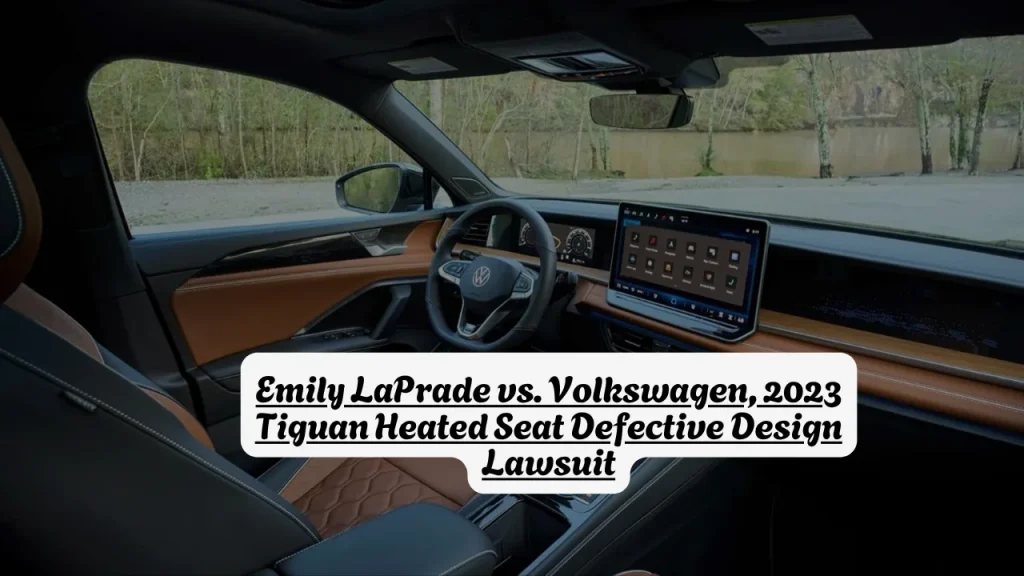
Emily LaPrade vs. Volkswagen, 2023 Tiguan Heated Seat Defective Design Lawsuit
Emily LaPrade vs. Volkswagen is a personal injury product liability lawsuit in which the plaintiff alleges a defectively designed seat heater in a 2023 Volkswagen Tiguan caused second-degree burns during a September 2023 ride. A federal judge dismissed the failure-to-warn portion of the case but allowed the design defect claim to proceed to trial. Volkswagen denies the seat heater was defective.
Quick Facts
| Field | Detail |
| Plaintiff | Emily LaPrade |
| Defendant | Volkswagen (manufacturer of the 2023 Tiguan) |
| Case Type | Product liability — design defect; personal injury |
| Court | U.S. District Court for the Western District of Washington, Tacoma |
| Date of Incident | September 3, 2023 |
| Legal Claim | Defective design of heated seat system; failure to warn (partially dismissed) |
| Damages Sought | TBD — specific dollar amount not confirmed in available public records |
| Current Stage | Design defect claim proceeding to trial; failure-to-warn claim dismissed |
| Case Number | TBD — not confirmed in public records as of May 9, 2026 |
| Attorneys of Record | TBD — plaintiff counsel not confirmed by name in available sources |
| Last Updated | May 9, 2026 |
Case Timeline
| Date | Event |
| January 1, 2014 | LaPrade involved in unrelated car crash, left paralyzed below T10 vertebra |
| September 3, 2023 | Incident occurs — seat heater used on Tiguan passenger seat |
| TBD | Lawsuit filed in U.S. District Court, Western District of Washington |
| TBD | VW moves to dismiss; judge partially grants motion |
| May 2026 | Design defect claim confirmed proceeding to trial; warning claim dismissed |
| TBD | Trial date not yet confirmed on public docket as of May 9, 2026 |
LaPrade vs. Volkswagen — Tiguan Heated Seat Design Defect Claim
Emily LaPrade was riding in the passenger seat of her 2023 Volkswagen Tiguan on September 3, 2023, when she turned the heated seat to the highest of three settings for 20 to 30 minutes, then lowered it to the middle setting for approximately an hour. LaPrade was not aware of any injury during the drive. She only noticed a problem when she arrived home and found a blister on her buttocks. By the next morning, the outer skin of the blister had peeled off — leading to her claim of second-degree burns.
The lawsuit, filed in the U.S. District Court for the Western District of Washington in Tacoma, asserts a product liability design defect claim — meaning the plaintiff alleges the seat heater’s design was unreasonably dangerous, not that it was improperly built. The case will now turn on temperature data from the plaintiff’s own car and whatever VW can put forward about its design process. LaPrade’s expert witness testified the heater could reach temperatures high enough to cause burns, and the judge allowed that testimony to stand.
LaPrade’s paralysis is central to why the injury happened without her knowledge. A car crash on New Year’s Day 2014 left her paralyzed below her hips with no sensation below her T10 vertebra. She trained to remain hyperaware of her legs because sharp objects or excess heat could injure her without her feeling it. This background directly shapes both sides of the argument — VW says the manual warned her, LaPrade says the seat ran too hot for anyone to use safely. For readers interested in how product liability claims like this one work, see McDonald’s Hot Coffee Lawsuit — How Burn Injury Claims Work on AllAboutLawyer.com.
Who Are Emily LaPrade and Volkswagen in This Case?
Emily LaPrade is a private individual and co-owner of the 2023 VW Tiguan involved in this lawsuit. She has lived with partial paralysis since 2014 and, according to court filings, received medical training to monitor her lower body for injuries she might not feel. She brought this lawsuit individually against Volkswagen as the vehicle manufacturer.
Volkswagen is a German automaker and one of the world’s largest vehicle manufacturers. VW informed the judge that the seat heater was not defective, adding that it had not been deemed defective by the manufacturer or regulators, and stated that the plaintiff’s injuries were not caused by defects in the seat heater. VW also challenged the credentials of LaPrade’s expert witness, arguing he lacked vehicle design background and had not referenced relevant SAE or ISO safety standards. The judge rejected VW’s motion to exclude that expert and allowed the testimony to proceed.
Related article: Authors Guild vs. National Endowment for the Humanities, DOGE Humanities Grant Cuts Ruled Unconstitutional
Seat heater burns are not a new concern for the auto industry. Between January 2005 and March 2011, 138 complaints about malfunctioning seat heaters were sent to the NHTSA, including incidents involving burning smells and visible flames — mostly involving Mercedes-Benz and BMW models. This case puts the spotlight back on whether industry-wide temperature thresholds for heated seats are safe enough for all drivers and passengers. For more on how ICE — or in this case, industry safety defects — create legal exposure, see 3M Earplug Lawsuit — What a $6 Billion Product Defect Settlement Looks Like on AllAboutLawyer.com.
The Dismissed Claim and the Surviving Design Defect Argument
The judge dismissed one part of LaPrade’s case entirely. LaPrade argued VW failed to warn occupants about the potential dangers of the heated seats and had not provided adequate instructions for use. The judge dismissed these claims after it was noted that the Tiguan’s owner’s manual states the function should not be enabled if the seat is occupied by a person with a limited perception of pain or temperature. A separate warning under an orange header in the manual specifically addressed people with paralysis. LaPrade and her husband acknowledged they had not read the manual. That claim is gone.
What remains is the design defect claim — and it is more consequential. If a seat heater gets hot enough to cause second-degree burns in under two hours regardless of who is sitting in it, the warning in the manual becomes a secondary concern. A design defect claim does not require proof that VW failed to warn anyone. It requires proof that the product itself — the way the heater was engineered to operate — created an unreasonable risk of injury. The judge ruled in favor of the plaintiff, allowing testimony from her expert based on his test results using the plaintiff’s own Tiguan.
Frequently Asked Questions
Who is the plaintiff in the VW Tiguan heated seat lawsuit?
The plaintiff is Emily LaPrade, who alleges the heated seat in her 2023 Volkswagen Tiguan caused second-degree burns after a September 3, 2023 drive during which she used the seat heater on its highest and then middle settings for approximately 90 minutes total.
What court is handling the case?
The case is filed in the U.S. District Court for the Western District of Washington in Tacoma.
Has the VW Tiguan seat heater case been resolved?
No. The failure-to-warn claim was dismissed, but the design defect claim is proceeding to trial. No trial date has been confirmed on the public docket as of May 9, 2026.
How much is LaPrade seeking in damages?
A specific damages figure has not been confirmed in publicly available court records as of May 9, 2026. TBD — the complaint details have not been fully disclosed in verified public sources.
Can I read the court documents?
Yes. The case is filed in the U.S. District Court for the Western District of Washington. Documents are accessible through PACER and CourtListener by searching for LaPrade and Volkswagen in the Western District of Washington.
Why was the failure-to-warn claim dismissed?
The judge dismissed it after finding that the Tiguan’s owner’s manual explicitly warned that the seat heater should not be used by anyone with limited perception of pain or temperature, and that LaPrade and her husband admitted they had not read the manual.
Why does the design defect claim still matter if there was a warning in the manual?
The design defect claim rests on whether the seat’s temperature exceeded safe levels regardless of who was sitting in it. If the heater runs hot enough to cause second-degree burns within two hours of normal use, that is a design problem — not a user error problem — and the warning in the manual does not eliminate VW’s potential liability for the design itself.
Sources
- Autoblog — VW Tiguan Seat Heater Lawsuit Moves Forward, May 2026
- MotorBiscuit — VW Tiguan Heated Seat Lawsuit Heads to Trial, May 2026
Disclaimer: This article is for informational purposes only and does not constitute legal advice. Information is based on publicly available court records and verified reporting. Allegations described have not been proven in court. For advice about a specific legal situation, consult a qualified attorney.
Prepared by the AllAboutLawyer.com Editorial Team and reviewed for factual accuracy against verified public sources on May 9, 2026. Last Updated: May 9, 2026.
About the Author
Israr Ahmad is a legal content researcher with 4+ years of experience covering class action settlements and consumer rights cases. He has researched and published coverage of 2,500+ settlements using verified court records, settlement administrator filings, and government sources. Learn more about Israr.