
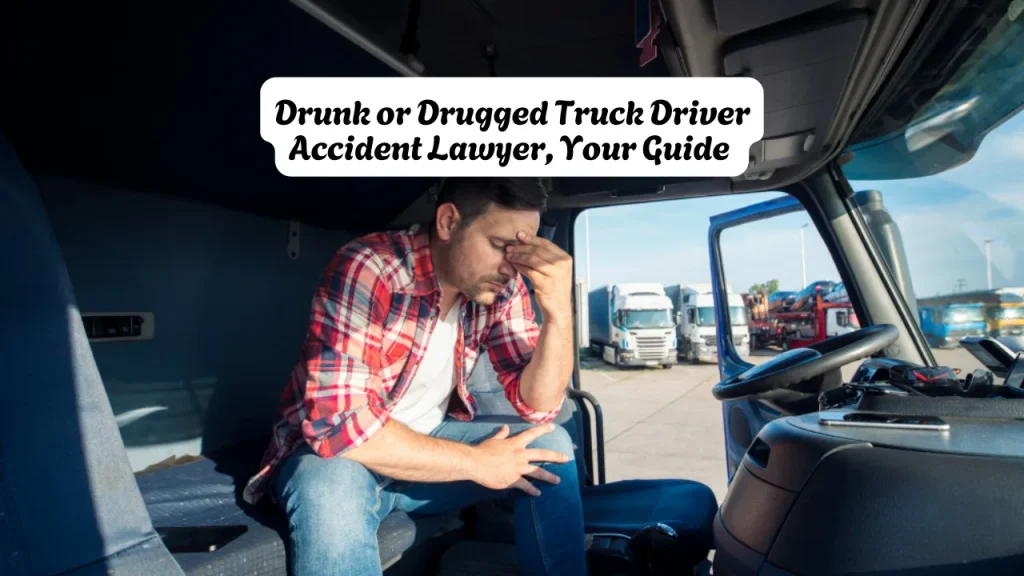
Drunk or Drugged Truck Driver Accident Lawyer, Your Guide
A drunk or drugged truck driver accident lawyer helps victims injured by chemically impaired commercial drivers recover full compensation. Impaired truck drivers violate federal FMCSA regulations and state DUI laws simultaneously. Attorneys prove impairment through toxicology reports, police records, and breathalyzer results, then hold both the driver and their trucking company liable for the crash and your injuries.
What does a drunk or drugged truck driver accident lawyer do?
A drunk or drugged truck driver accident lawyer represents victims hurt by chemically impaired commercial drivers. These attorneys secure toxicology reports, police blood-alcohol records, and drug test results to prove impairment at the time of the crash. They then pursue compensation from the driver, the trucking company, and any other liable party — working on contingency, so you pay nothing unless you win.
A drunk driver operating a pickup truck is dangerous. A drunk driver operating an 80,000-pound tractor-trailer is something far worse — a rolling catastrophe with a stopping distance of 525 feet and the destructive force of a freight train.
When a commercial truck driver operates their vehicle while impaired by alcohol, prescription drugs, illegal substances, or even certain over-the-counter medications, they violate both federal safety regulations and state criminal law simultaneously. That dual violation creates powerful legal accountability — and it gives victims and their families grounds to pursue significant compensation.
If a drunk or drugged truck driver hurt you, the law is firmly on your side. This guide explains how impaired truck drivers cause accidents, what federal rules prohibit alcohol and drug use, what evidence proves impairment, how trucking companies share the blame, and how an attorney fights to recover everything you are owed.
How Alcohol and Drugs Impair a Commercial Truck Driver
Impairment does not wait for a driver to feel drunk. Alcohol begins degrading driving performance well below the legal limit. Drugs — whether illegal, prescription, or over-the-counter — disrupt the neurological functions a truck driver depends on to safely control a 40-ton vehicle.
Here is what chemical impairment does to a truck driver’s ability to operate safely:
- Reaction time slows dramatically, preventing timely braking or steering corrections
- Depth perception deteriorates, making it harder to judge gaps between vehicles
- Divided attention collapses, so the driver cannot simultaneously monitor mirrors, speed, lane position, and road conditions
- Risk assessment fails, causing impaired drivers to make dangerous speed and passing decisions
- Coordination degrades, leading to erratic steering inputs and loss of vehicle control
- Drowsiness compounds quickly with alcohol, accelerating the risk of microsleep behind the wheel
The consequences for large trucks are severe. A passenger car that drifts slightly may clip a guardrail. A semi-truck that drifts slightly may cross the center line and collide head-on with oncoming traffic. The physics of commercial trucking make every degree of impairment exponentially more dangerous than the same impairment in a smaller vehicle.
Additionally, drugs do not follow the same predictable impairment curve as alcohol. Some substances cause extreme overconfidence and aggression. Others cause sedation. Stimulants used to fight fatigue — including methamphetamine and certain prescription medications — can cause erratic, unpredictable driving behavior that is just as dangerous as intoxication.
Federal Rules Prohibiting Alcohol and Drug Use by Truck Drivers
Commercial truck drivers are held to a significantly stricter legal standard than ordinary motorists. Federal regulations enforced by the FMCSA set specific limits and testing requirements that apply to every driver operating a commercial motor vehicle (CMV) in interstate commerce.
| Federal Rule | Requirement |
| BAC legal limit for CMV drivers | 0.04% — half the 0.08% limit for passenger car drivers |
| Pre-duty alcohol prohibition | No alcohol within 4 hours before operating a CMV |
| On-duty alcohol prohibition | Zero alcohol use while on duty or driving |
| Post-accident drug and alcohol testing | Mandatory following any accident involving fatalities, injuries, or disabling vehicle damage |
| Random drug testing | Carriers must test at least 50% of drivers annually for drugs, 10% for alcohol |
| Pre-employment drug testing | Mandatory before any driver begins operating a CMV |
| Prohibited substances | Marijuana, cocaine, opiates, amphetamines, PCP, MDMA, and certain prescription drugs |
When a driver violates any of these rules, that violation is direct evidence of negligence. In most jurisdictions, a BAC above the legal limit — or a positive drug test following a crash — establishes negligence per se, meaning the driver is automatically deemed negligent as a matter of law.
Understanding how federal safety violations create carrier liability in major truck accident cases is essential, because FMCSA violations do not just prove driver fault — they also expose the trucking company to direct legal accountability.
Related article: Truck Brake Failure Accident Lawyer, Who Pays When the Brakes Give Out?
Common Substances That Impair Truck Drivers
Alcohol gets most of the attention in impaired driving discussions, but drug-related impairment among commercial drivers is a serious and growing problem. Post-accident drug testing data collected by the FMCSA consistently shows that a meaningful percentage of truck drivers involved in crashes test positive for controlled or impairing substances.
The most commonly identified substances in impaired truck driver cases include:
- Alcohol — the most frequently detected substance in post-accident testing, despite strict BAC limits
- Marijuana (THC) — the most commonly detected illegal drug, increasingly prevalent in states with legalization; it impairs short-term memory, reaction time, and depth perception
- Amphetamines and methamphetamine — often used by drivers to fight fatigue on long hauls; cause overconfidence, aggression, erratic speed, and eventual severe cognitive impairment
- Cocaine — causes similar overconfidence and risk-taking behavior, followed by crashes in alertness
- Prescription opioids — legally prescribed medications that severely impair coordination, reaction time, and alertness when used behind the wheel
- Benzodiazepines — prescription anti-anxiety and sleep medications with documented impairment effects comparable to alcohol
- Over-the-counter antihistamines — found in common allergy medications, cause significant drowsiness and cognitive slowing
A truck driver who claims a substance was legally prescribed does not escape liability. The relevant question is not whether the drug was legal — it is whether the driver was impaired at the time of the crash. Impairment by any substance, legal or not, is negligence.
Evidence That Proves a Truck Driver Was Drunk or Drugged
Building a strong impaired driving case requires securing the right evidence quickly. Here is how a drunk or drugged truck driver accident attorney constructs a case that holds up in court:
Step 1: Obtain the police report and arrest records. When law enforcement responds to a truck accident, officers document field sobriety test results, breathalyzer readings, observations of the driver’s behavior, and any arrests made at the scene. These records are foundational evidence.
Step 2: Secure toxicology and blood test results. Post-accident blood and urine testing is mandatory under FMCSA regulations when fatalities, serious injuries, or significant property damage occur. These results provide laboratory-verified proof of what substances were in the driver’s system at the time of the crash.
Step 3: Request the trucking company’s drug testing records. Carriers are required to maintain records of pre-employment, random, post-accident, and return-to-duty drug and alcohol tests. A history of failed or missed tests is evidence of both driver negligence and carrier negligent retention.
Step 4: Analyze the Electronic Data Recorder (EDR). The truck’s black box records speed, braking behavior, and steering inputs in the moments before a crash. An impaired driver who never brakes before impact — despite clear hazards — leaves a signature in the EDR data that is consistent with significant impairment.
Step 5: Review dashcam footage. In-cab cameras often capture a driver’s behavior in real time. Slurred speech, fumbling, incoherent communications with dispatch, or visible intoxication signs recorded before the crash are devastating evidence.
Step 6: Gather witness testimony. Truckers make stops at fuel stations, rest areas, and truck stops. Witnesses who observed the driver drinking, appearing impaired, or purchasing alcohol before the crash provide powerful corroborating testimony.
Step 7: Depose the driver under oath. Attorneys ask detailed questions about alcohol and drug use in the hours before the crash, prescription medication use, and prior testing history. Inconsistencies between sworn testimony and objective toxicology results expose the truth.
Evidence deteriorates quickly. Dashcam footage is overwritten, witnesses become harder to reach, and drug metabolites in blood samples have limited testing windows. The moment you suspect an impaired driver caused your accident, contact a lawyer — that same day if possible.
Why Trucking Companies Are Legally Responsible Too
When an impaired truck driver causes a crash, the instinct may be to focus only on the driver. However, the trucking company that employed that driver often shares equal or greater legal liability. Here is why:
Negligent hiring. Carriers are required to conduct thorough background checks before putting a driver behind the wheel. A driver with prior DUI convictions, substance abuse history, or a pattern of failed drug tests should never have been hired. When a company skips this due diligence, the hiring decision itself is negligent.
Negligent retention. If a carrier discovers a driver has a substance abuse problem — through failed random tests, behavioral reports, or prior incidents — and keeps that driver employed anyway, the company is liable for every subsequent crash that driver causes while impaired.
Failure to test. FMCSA regulations require carriers to conduct random alcohol and drug testing on a specific percentage of their drivers every year. Companies that fail to meet this testing requirement create a gap in safety oversight that enables impaired drivers to stay on the road.
Vicarious liability. Under the legal doctrine of respondeat superior, trucking companies are automatically liable for their drivers’ negligent acts committed during the course of employment. The driver’s impairment is the company’s legal problem, regardless of whether the company directly caused it.
Understanding how courts have established trucking company liability in cases involving driver misconduct makes clear that carriers cannot escape accountability simply by pointing at the driver.
How Punitive Damages Apply in Drunk and Drugged Truck Driver Cases
Impaired truck driver accidents are among the cases most likely to produce punitive damage awards — and that matters significantly for your recovery.
Unlike compensatory damages, which reimburse you for medical bills, lost wages, and pain and suffering, punitive damages exist to punish reckless conduct and deter future misconduct. Courts award them when the defendant’s behavior was not merely careless but consciously and egregiously dangerous.
Driving an 80,000-pound commercial vehicle while drunk or drugged meets that standard in most jurisdictions. A jury that hears evidence of a truck driver with a 0.12 BAC — three times the federal limit for commercial drivers — operating a fully loaded tractor-trailer on a busy interstate is unlikely to view that behavior as ordinary negligence.
In cases where the trucking company also knew about the driver’s impairment problem and failed to act, punitive damages against the carrier become an additional possibility. Carriers that knowingly retain drivers with substance abuse histories, skip required drug testing, or ignore evidence of on-duty impairment expose themselves to punitive awards that far exceed the underlying compensatory damages.
The legal principles governing punitive damages and gross negligence apply across both criminal prosecution and civil liability — and in drunk trucking cases, both often proceed simultaneously.
What Compensation Can You Recover?
Victims injured by drunk or drugged truck drivers can pursue several categories of compensation:
Economic damages cover measurable financial losses — past and future medical expenses, lost wages, reduced earning capacity, rehabilitation and physical therapy costs, home modification costs for long-term disability, and vehicle replacement.
Non-economic damages address intangible losses — physical pain and suffering, emotional distress, psychological trauma, loss of enjoyment of life, and loss of companionship if the crash killed a loved one.
Punitive damages punish egregious, reckless impairment — especially when the carrier knew about the driver’s substance problem and kept them on the road anyway.
Wrongful death damages are available to surviving family members when impaired truck driver crashes are fatal. These include funeral and burial expenses, loss of financial support, and loss of consortium.
The strength of your impairment evidence directly shapes your settlement value. Cases with clear toxicology results, dashcam footage of impaired behavior, and documented carrier negligence produce significantly larger recoveries than cases that rely on circumstantial evidence alone. An attorney who understands how to build impaired driving negligence cases knows how to present that evidence in a way that maximizes every dollar you are entitled to receive.
Frequently Asked Questions
What evidence proves a truck driver was drunk or drugged at the time of the accident?
The most direct evidence is the official toxicology report from post-accident blood or urine testing, which federal law requires following serious crashes. Police field sobriety test results, breathalyzer readings, dashcam footage of impaired behavior, and witness accounts of the driver’s condition before and after the crash all corroborate impairment. Your attorney can also subpoena the carrier’s drug testing history to reveal prior failed tests that support a negligent retention claim.
How long do I have to file a claim against a drunk or drugged truck driver?
Most states allow two to three years from the accident date to file a personal injury lawsuit, but deadlines vary significantly by state and by the type of defendant involved. Evidence windows are far shorter — toxicology results have narrow testing validity periods, dashcam footage is often overwritten within days, and witnesses become harder to locate over time. Contacting a lawyer immediately after the crash is far more important than tracking the filing deadline.
Can I sue the trucking company if the driver was drunk, not just the driver personally?
Yes — and in most cases, suing the carrier is more important than suing the driver individually. Trucking companies carry commercial liability insurance with substantially higher policy limits than individual drivers. Beyond vicarious liability, carriers can face direct negligence claims for hiring the impaired driver, failing to conduct required drug testing, retaining a driver with a known substance history, and failing to enforce company safety policies. Both the driver and the carrier should be named as defendants.
What if the drunk driver was criminally charged — does that help my civil case?
A criminal conviction for DUI or drugged driving is powerful evidence in your civil case, but you do not need a criminal conviction to win civil compensation. Civil and criminal cases operate under different legal standards. Criminal cases require proof beyond a reasonable doubt. Civil cases require only a preponderance of the evidence — meaning it is more likely than not that the driver was impaired. Even if criminal charges are dropped or result in a plea deal, you can still pursue full civil compensation independently.
What if I was partly at fault for the accident with an impaired truck driver?
Comparative fault rules in most states allow you to recover compensation even when you share partial responsibility for the accident. Your total damages are reduced by your percentage of fault, but they are not eliminated unless your fault exceeds the threshold set by your state’s law. Given that the driver was chemically impaired — a clear and serious violation of federal law — juries rarely assign significant fault to victims in these cases. An attorney will evaluate the full picture before making any determination about shared fault.
Legal Terms Used in This Article
Blood Alcohol Concentration (BAC): The percentage of alcohol in a person’s bloodstream, measured by breathalyzer or blood test. The federal BAC limit for commercial truck drivers is 0.04% — half the 0.08% limit that applies to ordinary motorists.
Negligence Per Se: A legal doctrine that automatically establishes negligence when a defendant violates a statute designed to protect the public. A truck driver operating above the federal BAC limit or testing positive for prohibited drugs is negligent per se.
Post-Accident Drug and Drug Testing: Mandatory testing required by FMCSA regulations following commercial truck crashes involving fatalities, injuries, or significant property damage. Results are admissible evidence in civil litigation.
Vicarious Liability: Legal responsibility imposed on an employer for the negligent acts of their employee committed during employment. Trucking companies are vicariously liable for their impaired drivers’ crashes under the doctrine of respondeat superior.
Negligent Retention: A direct carrier liability claim based on a trucking company keeping a driver employed despite knowledge of that driver’s substance abuse history, failed drug tests, or prior impairment-related incidents.
Negligent Hiring: A direct carrier liability claim based on the trucking company’s failure to conduct adequate background checks before hiring a driver with a history of DUI convictions or substance abuse.
Punitive Damages: Compensation awarded above and beyond actual losses, designed to punish especially reckless conduct and deter future misconduct. Impaired commercial driving is among the categories of conduct most likely to support a punitive damages claim.
Compensatory Damages: Financial compensation designed to restore the victim to their pre-accident position. Compensatory damages include both economic losses (medical bills, lost wages) and non-economic losses (pain, suffering, emotional distress).
Hold the Impaired Driver and Their Employer Fully Accountable
A truck driver who chooses to operate an 80,000-pound commercial vehicle while drunk or drugged does not make a mistake — they make a decision. That decision, and the devastation it causes, demands full legal accountability from every party responsible.
If you or a loved one was injured by a drunk or drugged truck driver, do not wait to act. Toxicology evidence has a limited testing window. Dashcam footage is overwritten within days. Witness memories fade.
A drunk or drugged truck driver accident lawyer can move immediately to preserve the evidence that proves impairment, holds the carrier responsible for their negligent hiring and retention decisions, and secures the maximum compensation you deserve. Contact a truck accident attorney today for a free consultation. You pay nothing unless your attorney wins your case.
Disclaimer: This article is for general informational purposes only and does not constitute legal advice. Laws vary by state and individual circumstances differ. Always consult a licensed attorney in your jurisdiction for advice specific to your situation.