
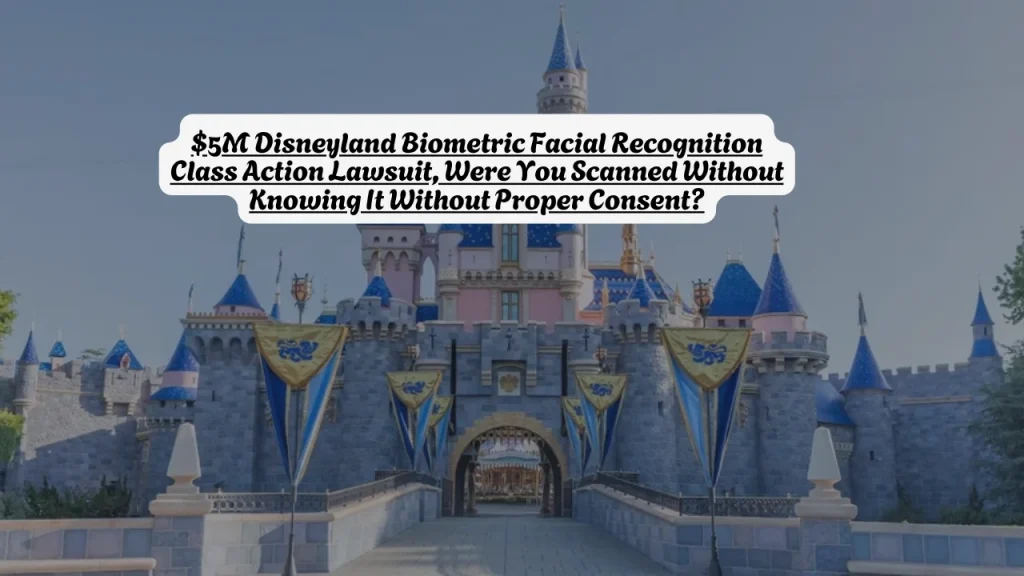
$5M Disneyland Biometric Facial Recognition Class Action Lawsuit, Were You Scanned Without Knowing It Without Proper Consent?
In April 2026, Disney quietly installed facial recognition technology at the entrances of Disneyland Park and Disney California Adventure. Disney has been collecting and comparing photographs of guests’ faces to ticket and Annual Pass images at the Disneyland Resort park entrances.
Quick Facts: Duffield v. The Walt Disney Company
| Field | Detail |
| Lawsuit Filed | May 15, 2026 |
| Plaintiff | Summer Christine Duffield, on behalf of herself and all similarly situated guests |
| Defendant | The Walt Disney Company; Disney California Adventure |
| Alleged Violation | California consumer protection, competition, and privacy laws — unlawful biometric data collection without adequate disclosure or opt-in consent |
| Facial Recognition Rolled Out | April 2026 — Disneyland Park and Disney California Adventure entrances |
| Damages Sought | At least $5,000,000 |
| Who Is Affected | Guests who entered Disneyland or Disney California Adventure since April 2026 |
| Court & Jurisdiction | California federal court (specific docket number TBD — not yet confirmed in public filings) |
| Plaintiff’s Attorney | Blake Yagman |
| Disney’s Position | Disputes claims; states data is deleted within 30 days and opt-out lanes are available |
| Last Updated | May 19, 2026 |
A class action lawsuit filed May 15, 2026 now challenges that practice directly. If you visited Disneyland or Disney California Adventure since April 2026, your face may have been scanned — and according to this lawsuit, you likely had no real idea it was happening.
No settlement exists yet. No claim form is available. This is an active lawsuit in its earliest stage.
What Disney Did at the Park Entrances Starting April 2026
The software uses images of guests’ faces taken by a camera at the entrance and compares them with the image of their face that was saved when they first used the ticket or pass. The stated purpose is to speed up entry and prevent ticket fraud — someone cannot walk through with another person’s ticket if the system has already matched your face to your pass.
Company officials have said that it helps make entering and reentering the park easier and prevents fraud. Disney’s privacy policy states that biometric data is deleted within 30 days, and that entrance lanes without facial recognition are available for guests who prefer them.
But here is the problem the lawsuit puts front and center: since April 2026, a significant number of guests have entered the park without being explicitly informed that a facial recognition system was in use to compare their faces against a ticket database.
There are signs of a slash through a silhouette at four entrances that allow visitors to avoid the technology, but the lawsuit says that it doesn’t constitute meaningful notice. Most guests who walked through the standard lanes did so without realizing they were opting into a biometric scan.
What the Lawsuit Accuses Disney Of
Plaintiff Summer Christine Duffield alleges Disneyland and Disney California Adventure violated privacy, competition, and consumer protection laws by collecting the biometric data of guests without adequate disclosure. Duffield visited Disneyland on May 10 with her minor children.
The complaint cuts straight to the point: “The company does not adequately disclose the use of their biometric collection, so consumers — which almost always include children — have no idea that Disney is collecting this highly sensitive data.”
Attorney Blake Yagman wrote in the complaint: “Guests should be able to expressly opt in to this type of sensitive facial recognition technology with written consent. The onus of privacy rights should not be on the victim.”
The lawsuit disputes whether an opt-out model constitutes meaningful informed consent under California law, and whether the current level of disclosure is sufficient for the kind of sensitive biometric data a facial recognition system collects. That opt-in versus opt-out distinction is the heart of this case. Defaulting everyone into a facial scan unless they notice a small sign and seek a different lane is not the same thing as getting someone’s informed agreement.
Related article: Connecticut Joins 24-State Lawsuit Against the Education Department Over Student Loan Eligibility for Nursing and Healthcare Degrees
This lawsuit also raises a concern that goes beyond theme parks. There have been instances of companies turning over biometric data to law enforcement. What happens to your face scan is not always just between you and the company that collected it.
Disney’s recent privacy record is also relevant context here. In February 2026, California AG Rob Bonta secured a $2.75 million penalty against Disney for failing to honor consumer opt-out requests for data sharing on Disney+, Hulu, and ESPN+. You can read the full breakdown in our article on the Disney $2.75M CCPA streaming privacy settlement.
Are You Part of This Class Action Against Disney?
You may be part of the proposed class if:
- You visited Disneyland Park or Disney California Adventure at any point since April 2026
- You entered through a standard entrance lane using a ticket or Annual Pass
- Your face was photographed and compared to your ticket’s stored image without your explicit written consent
- This includes children — the complaint specifically notes that minors are among those whose biometric data was collected
You are likely NOT included if:
- You actively used an opt-out lane and had a cast member manually validate your ticket instead
- You visited before April 2026, when facial recognition had not yet been installed
- You gave explicit written consent to facial scanning (Disney’s current policy does not require this — which is the point of the lawsuit)
What California Law Says About Facial Recognition and Biometric Data
In California, businesses can use facial recognition but must comply with a growing set of rules. These include disclosure and allowing consumers to limit the utilization and sharing of their data. Other states, like Illinois, Washington, and New Jersey, have stricter laws that require affirmative consent and notice before any collection occurs.
California does not yet have Illinois-style opt-in requirements under its Biometric Information Privacy Act (BIPA) equivalent — but the California Consumer Privacy Act (CCPA) and California’s Unfair Competition Law both impose obligations around transparency and consumer rights. The lawsuit argues Disney fell short of those California standards.
The broader legal question this case puts on the table: is putting a small sign in a parking garage, with no verbal notice and no digital alert through the Disneyland app, enough to satisfy California’s disclosure requirements for collecting facial scans from millions of visitors, including children?
If you have been following biometric data privacy lawsuits, this case parallels the Google biometric data class action settlements where Google paid millions in Illinois over collecting students’ face and voice data without proper consent.
What Disney Says in Response
Disneyland spokesperson Jessica Jakary said: “We respect and protect our guests’ personal information and dispute the plaintiff’s claims, which we believe are without merit.”
Disney also points to its privacy policy, which states that biometric data is deleted within 30 days of creation and that participation is optional. The company notes that opt-out lanes exist and that cast members manually validate tickets in those lanes.
The lawsuit disputes Disney’s data deletion claim directly, arguing the assertion “simply cannot be true given the biometric” nature of the data collected. The plaintiffs contend that a buried privacy policy and a small silhouette sign at a select number of gates do not add up to the kind of disclosure consumers need to make an informed choice about surrendering their face data.
What Should You Do If You Visited Disneyland Since April 2026
No claim form exists right now. No settlement has been reached. But here is what makes sense to do today:
- Save your visit records. Keep any confirmation emails, ticket receipts, or Annual Pass records showing you visited after April 2026. These establish your connection to the class if a settlement is eventually reached.
- Check your Disneyland account. Log into the Disneyland app or your online account and review what data Disney has stored for your tickets and Annual Pass.
- Do not use third-party “claim sites.” No authorized claim portal exists yet. Any site asking you to file now is not legitimate.
- Monitor this case. A hearing date has not been set as of May 19, 2026. If the court certifies the class, Disney could face liability covering millions of visitors.
- If you have concerns about how your data is being used, a free legal consultation with a data privacy attorney can clarify your individual rights under California law.
Disney Disneyland Facial Recognition Lawsuit Timeline
| Milestone | Date |
| Facial recognition technology installed at Disneyland entrances | April 2026 |
| Plaintiff Duffield visits Disneyland with minor children | May 10, 2026 |
| Class action lawsuit filed in California federal court | May 15, 2026 |
| Disney publicly disputes claims | May 19, 2026 |
| Class certification motion | TBD — not yet filed as of May 19, 2026 |
| Next court hearing | TBD — no date set |
| Expected settlement or resolution | TBD — early-stage litigation |
Frequently Asked Questions
Is there a class action lawsuit against Disneyland over facial recognition?
Yes. A class action was filed on May 15, 2026 in California federal court against The Walt Disney Company. Plaintiff Summer Christine Duffield alleges Disney collected guests’ biometric facial data without adequate disclosure or opt-in consent, in violation of California privacy and consumer protection laws. The lawsuit seeks at least $5,000,000 in damages.
Did Disneyland scan my face without telling me?
If you entered Disneyland Park or Disney California Adventure through a standard entrance lane after April 2026, the facial recognition system photographed your face and compared it to your ticket or Annual Pass image. The lawsuit argues most guests did not receive adequate notice this was happening. Disney says opt-out lanes were available and signs were posted.
Do I need to do anything right now to be included in the Disney lawsuit?
No action is required yet. The lawsuit has just been filed and no class has been certified. If Disney ultimately settles, class members who visited the park during the relevant period would likely receive notice. Save your visit records and ticket confirmations in the meantime.
How much could I receive from a Disney facial recognition settlement?
TBD — no settlement exists yet. The lawsuit seeks at least $5,000,000 total for the class. Per-person amounts would depend on the final settlement terms, total valid claims, and how the court structures any payout. No estimate is possible at this stage.
When will the Disney facial recognition lawsuit be resolved?
TBD — the case was just filed. Class action lawsuits of this type typically take two to four years to reach a settlement or trial. A class certification hearing would be the next major milestone. No date has been set as of May 19, 2026.
Does this lawsuit affect Disney World in Florida too?
Based on publicly available filings as of May 19, 2026, the lawsuit specifically names Disneyland Park and Disney California Adventure in Anaheim, California. Florida’s Disney World was not named in this complaint, though the broader legal questions it raises about biometric disclosure apply to any venue using similar technology.
Can I opt out of facial recognition the next time I visit Disneyland?
Yes. Disney states that alternative entrance lanes are available where a cast member manually validates your ticket instead of using the facial recognition system. Look for signs indicating the opt-out lanes, typically marked with a silhouette icon with a line through it. The lawsuit argues this signage is not sufficient notice — but the lanes do exist.
Disclaimer: This article is for informational purposes only and does not constitute legal advice. Legal claims and outcomes depend on specific facts and applicable law. For advice regarding a particular situation, consult a qualified attorney.
Prepared by the AllAboutLawyer.com Editorial Team and reviewed for factual accuracy against court complaint sources, official Disney communications, and verified news reporting on May 19, 2026. Last Updated: May 19, 2026
About the Author
Israr Ahmad is a legal content researcher with 4+ years of experience covering class action settlements and consumer rights cases. He has researched and published coverage of 2,500+ settlements using verified court records, settlement administrator filings, and government sources. Learn more about Israr.