
Connecticut Joins 24-State Lawsuit Against the Education Department Over Student Loan Eligibility for Nursing and Healthcare Degrees
Connecticut has joined 23 other states and the District of Columbia in filing a lawsuit against the U.S. Department of Education over a new rule that limits access to federal student loans for students pursuing professional degree programs, including many healthcare and other critical workforce fields.
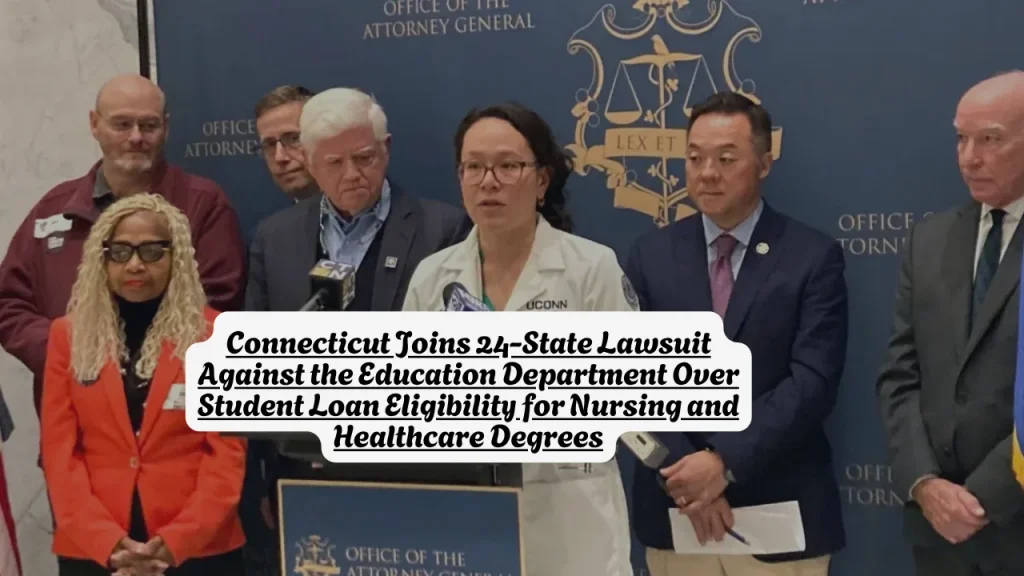
The lawsuit challenges a recently finalized Department of Education rule that narrows the federal definition of “professional degree” and imposes restrictions Congress did not authorize. Connecticut Attorney General William Tong announced the state’s participation on May 19, 2026.
Quick Facts — Connecticut v. U.S. Department of Education
| Field | Detail |
| Defendant | U.S. Department of Education |
| Lead Plaintiffs | New York, Massachusetts, California, Colorado AGs |
| Connecticut AG | William Tong |
| Total Coalition | 24 states + District of Columbia |
| Rule Challenged | Final rule narrowing “professional degree” definition |
| Affected Programs | Nursing, physical therapy, nurse anesthesia, social work, and more |
| Loan Caps at Stake | $50,000/year and $200,000 lifetime for professional degree students |
| Underlying Law | One Big Beautiful Bill Act (passed July 2025) |
| Rule Finalized | TBD — exact finalization date not specified in CT reporting |
| Rule Takes Effect | TBD — pending court ruling |
| Court & Jurisdiction | TBD — federal court, exact district not yet confirmed in reports |
| Court Stage | Active litigation — filed May 19, 2026 |
| Last Updated | May 19, 2026 |
What the Education Department Rule Actually Does
To understand why 24 states are suing, you need to know what Congress passed — and what the Department of Education did with it.
Republicans passed new limits on graduate student loans as part of the One Big Beautiful Bill Act. The law does not change limits for undergraduate borrowers, but it dramatically scales back how much graduate students can borrow. The law does distinguish, however, between graduate students and professional degree students — setting higher borrowing limits for the latter.
In implementing the changes, the Trump administration has scaled back the types of graduate degrees that qualify as “professional” — and for which students can borrow up to $50,000 a year and $200,000 overall. It is limiting those exempted programs to just 11 categories: chiropractic, clinical psychology, dentistry, law, medicine, optometry, osteopathic medicine, pharmacy, podiatry, theology, and veterinary medicine.
Nursing, physical therapy, and nurse anesthesia are among the many healthcare-related programs excluded from that short list. Graduate students in those fields would instead face the lower borrowing caps set for general graduate students — $20,500 per year and $100,000 total — even when the cost of their programs far exceeds those limits.
In Colorado, for example, the total cost of advanced nursing degrees at state institutions already exceeds $100,000 — the proposed lifetime loan cap — not including textbooks, clinical placements, or lab fees.
Why Connecticut Says the Rule Violates Federal Law
The states’ core argument is straightforward: Congress never gave the Department of Education the authority to create this narrow list.
Congress broadly defined “professional degree” as any degree that signifies both completion of academic requirements for beginning practice in a given profession and a level of professional skill beyond that normally required for a bachelor’s degree. Congress also provided a list of examples — such as medicine — but they were illustrative, not exhaustive.
The lawsuit itself points out that the department’s list of professional degree examples was taken from a regulation that had not been changed since the 1950s — a time when graduate programs in nursing and other healthcare professions barely existed.
Related article: Ashley Lopez Lawsuit Against Wedding Kiss Ballroom, A Philadelphia Bride’s Wedding Day That Fell Apart
The coalition argues the rule unlawfully excludes many degree programs that qualify under the standards established by federal law, potentially reducing access to financial aid for students pursuing advanced education. The complaint also challenges provisions that limit protections for students already enrolled in programs, noting that the statute includes a grandfathering provision meant to delay implementation for currently enrolled students.
Connecticut AG Tong put it plainly. “We need more nurses, therapists and social workers, and our federal government should be supporting their studies, not defunding them,” Tong said. “The Trump/McMahon plan to magically drive down education costs by barring student loans defies Congress, defies the law, defies reality, and will do real damage to Connecticut students and workers.”
How This Affects Connecticut Specifically
Connecticut’s concern is not abstract. The coalition argues the rule could harm states by reducing support for public institutions of higher education, creating barriers for students pursuing advanced training, and worsening workforce shortages in critical professions — particularly in healthcare, where states already face ongoing workforce challenges.
The American Nurses Association has also weighed in nationally. When the Trump administration finalized its rule last month, the ANA said it was “profoundly dismayed.” Jennifer Mensik Kennedy, president of the American Nurses Association, said: “This Department of Education has chosen to make it harder for nurses to advance their education and their careers.”
The Education Department has defended the rule, noting that the new loan caps are limited to graduate programs and have no impact on undergraduate nursing programs, including four-year bachelor’s of science in nursing degrees and two-year associate’s degrees in nursing, and that 80% of the nursing workforce does not have a graduate degree.
Which States Joined the Lawsuit
Arizona, California, North Carolina, Kentucky, and Nevada are among the states that joined the lawsuit. The full coalition includes Connecticut, New York, Massachusetts, California, Colorado, Arizona, Delaware, Hawaii, Illinois, Maine, Maryland, Michigan, Minnesota, Nevada, New Jersey, New Mexico, North Carolina, Oregon, Rhode Island, Vermont, Virginia, Washington, Wisconsin, Kentucky, and the District of Columbia.
The lawsuit was led by the attorneys general of New York, Massachusetts, California, and Colorado.
Are You Affected by This Rule?
If you are currently enrolled in or planning to pursue a graduate degree in nursing, physical therapy, nurse anesthesia, social work, or another healthcare-related field — and you rely on federal student loans — this lawsuit directly affects your borrowing limits.
You are likely affected if you are a graduate student in a healthcare field not included in the Department’s 11-category list. You are not directly affected if you are an undergraduate nursing student, since the new loan caps do not change limits for undergraduate borrowers, including those in four-year BSN or two-year associate nursing programs.
No action is required right now. The lawsuit asks the court to declare the rule unlawful and block enforcement. If the court grants that relief, the lower loan caps would not take effect. Monitor this case for updates — the outcome will determine your borrowing options before the next academic year.
For a broader look at how federal student loan policy changes affect borrowers, see our related coverage at AllAboutLawyer.com.
Case Timeline
| Milestone | Date |
| One Big Beautiful Bill Act passed by Congress | July 2025 |
| Coalition comment letter opposing proposed rule | March 3, 2026 |
| Department of Education finalized the rule | TBD — exact date not yet confirmed |
| Lawsuit filed by 24-state coalition | May 19, 2026 |
| Court ruling / injunction | TBD — pending |
| Rule scheduled to take effect | TBD — pending court ruling |
Frequently Asked Questions
Is there a lawsuit against the U.S. Department of Education over student loan eligibility?
Yes. Connecticut joined 23 other states and the District of Columbia in filing a lawsuit against the U.S. Department of Education over a rule that limits federal student loan access for professional degree programs including healthcare fields.
Does this affect undergraduate nursing students?
No. The new loan caps are limited to graduate programs and have no impact on undergraduate nursing programs, including four-year BSN degrees and two-year associate’s degrees.
Which healthcare programs lose access to higher loan limits under this rule?
Nursing, physical therapy, and nurse anesthesia are among the programs excluded from the 11-category professional degree list under the Department’s rule.
What are the new borrowing limits for affected graduate students?
Graduate students not classified under “professional degree” programs face caps of $20,500 per year and $100,000 total — compared to the $50,000 per year and $200,000 lifetime limit available to professional degree students.
Do I need to do anything right now to protect my student loans?
Not yet. The lawsuit is in active litigation. If the court blocks enforcement, the lower caps will not apply. Keep monitoring official court updates and your school’s financial aid office for guidance specific to your program.
When will a ruling come in this case?
TBD — the lawsuit was filed May 19, 2026. Federal courts can move quickly on injunctions when enforcement dates are imminent, but a firm hearing date has not yet been publicly announced.
Can I file my own legal claim over this rule?
This is a state-level lawsuit challenging the rule’s legality — not a class action for individual student borrowers. Individual borrowers cannot join this specific case. If you believe your federal loan rights have been violated, consult a student loan attorney or contact your state’s attorney general’s office for guidance.
Sources & References
- Colorado Attorney General — Official Press Release, March 3, 2026
- Vermont Attorney General — Official Press Release, March 2, 2026
- New York Attorney General — Official Press Release
Disclaimer: This article is for informational purposes only and does not constitute legal advice. For advice regarding your specific student loan situation, consult a qualified attorney or your school’s financial aid office.
Prepared by the AllAboutLawyer.com Editorial Team and reviewed for factual accuracy against official attorney general press releases, NPR, and CT News Junkie reporting. Last Updated: May 19, 2026.
About the Author
Israr Ahmad is a legal content researcher with 4+ years of experience covering class action settlements and consumer rights cases. He has researched and published coverage of 2,500+ settlements using verified court records, settlement administrator filings, and government sources. Learn more about Israr.