
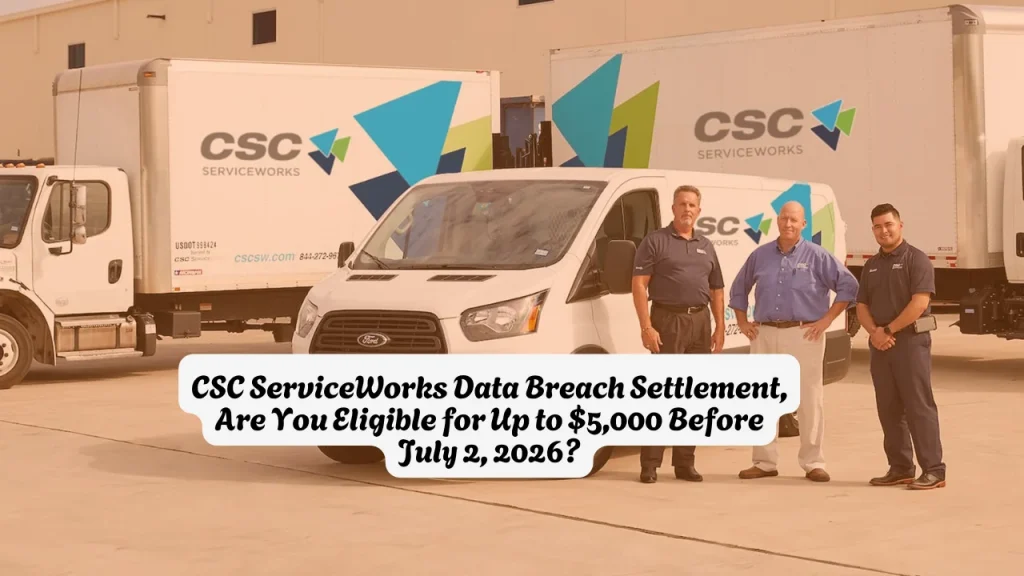
CSC ServiceWorks Data Breach Settlement, Are You Eligible for Up to $5,000 Before July 2, 2026?
A cyberattack on CSC ServiceWorks exposed the personal data of 35,340 people across the United States between September 23, 2023, and February 4, 2024. The company agreed to settle a class action lawsuit brought by affected individuals. If a data breach notice from CSC ServiceWorks reached you, you may be eligible to claim up to $5,000 in cash plus two years of free credit monitoring. The claim deadline is July 2, 2026.
Quick Facts
| Field | Detail |
| Settlement Amount | TBD (fund amount not publicly disclosed) |
| Claim Deadline | July 2, 2026 |
| Who Qualifies | U.S. residents whose personal information was compromised in the CSC ServiceWorks data breach announced in or around August 2024 |
| Payout Per Person | Up to $5,000 for documented losses; up to $100 for lost time; 2 years of credit monitoring |
| Proof Required | Yes — for out-of-pocket expense claims; No — for credit monitoring and lost time attestation |
| Settlement Status | Preliminarily approved — open for claims |
| Administrator | Atticus Administration |
| Official Website | cscserviceworksdatasettlement.com |
What Happens Next
- The court holds a Final Approval Hearing (Fairness Hearing) on July 28, 2026, to decide whether to formally approve the settlement.
- The opt-out and objection deadline is June 2, 2026 — earlier than the claim deadline.
- Payments go out after the court grants final approval and resolves any appeals.
What Is CSC ServiceWorks and What Happened?
CSC ServiceWorks is a New York-based company that operates commercial laundry equipment — the kind you find in apartment buildings, college dormitories, and other shared facilities across the country. Millions of people interact with their services without ever knowing the company’s name.
On February 4, 2024, CSC ServiceWorks detected unusual activity on its computer network. A forensic investigation later confirmed that an unauthorized third party had accessed a portion of the company’s systems from September 23, 2023, through February 4, 2024. The company finished reviewing the compromised files on June 17, 2024, and began notifying affected individuals in August 2024.
A class action lawsuit followed, alleging CSC ServiceWorks failed to put adequate security measures in place to protect the sensitive personal information it stored. Plaintiffs accused the company of negligence, breach of implied contract, and unjust enrichment. CSC ServiceWorks denies any wrongdoing but agreed to settle to avoid the expense and risk of a trial. The case is Conaway, et al. v. CSC ServiceWorks Inc., Case No. 2:24-cv-05719-JMA-ARL.
Related article: FTC Refunds in March 2026, Did You Get a Check or PayPal Payment? 5 Programs Sending Checks Now
What Personal Information Was Exposed?
The breach may have compromised any of the following types of data:
- Full name
- Date of birth
- Contact information (address, phone number, email)
- Social Security number
- Driver’s license number
- Financial account information (bank account and routing numbers)
- Health insurance information
- Medical information
- Other personally identifiable information CSC ServiceWorks collected and maintained
If your Social Security number or financial data was exposed, your risk of identity theft and financial fraud is real. This settlement gives you a path to compensation for any harm you have already experienced — and credit monitoring to help protect you going forward.
Do You Qualify to File a Claim?
You may qualify if:
- You resided in the United States at the time of the breach.
- The CSC ServiceWorks data breach announced in or around August 2024 may have compromised your personal information.
- You did not already receive a full refund or settlement from CSC ServiceWorks for this incident.
The simplest sign that you qualify: CSC ServiceWorks sent you a data breach notification letter. Even if you did not receive a letter but believe your data was involved, you may still be able to file — check the official settlement website or contact the administrator to confirm.
How Much Money Can You Receive?
The settlement offers three separate types of benefits. You can claim more than one.
Out-of-Pocket Expense Reimbursement — Up to $5,000
You can claim reimbursement for actual, documented, unreimbursed losses caused by the breach. Qualifying expenses include bank fees, costs for credit reports or identity theft protection services you purchased between September 23, 2023, and July 2, 2026, long-distance telephone charges, data charges, postage, and local travel costs related to dealing with the breach.
You must provide supporting documentation such as receipts or account statements. Self-prepared documents alone are not sufficient, but you can use them to support other records.
Lost Time Reimbursement — Up to $100
You can claim up to four hours of your time spent dealing with the breach at a rate of $25 per hour. You do not need receipts for this. You must submit a signed statement (attestation under penalty of perjury) describing the time you spent and what you did.
Two Years of Free Credit Monitoring
All eligible class members can claim two years of one-bureau credit monitoring and identity theft protection, which includes $1,000,000 in identity theft and fraud insurance coverage. No documentation is required — simply select this option on the claim form.
How to File Your Claim
Step 1 — Go to the official claim portal at cscserviceworksdatasettlement.com
Step 2 — Enter your Claimant ID from the settlement notice you received and your last name
Step 3 — Select which benefits you want to claim: out-of-pocket expenses, lost time, credit monitoring, or a combination
Step 4 — Upload supporting documentation for any out-of-pocket expense claims (receipts, bank statements, or similar records)
Step 5 — Complete the attestation for lost time if applicable — describe how you spent that time responding to the breach
Step 6 — Choose your preferred payment method and submit your claim, then save your confirmation number
You can also download a paper claim form from the settlement website and mail or email it to the administrator:
Mail: CSC Data Settlement, c/o Atticus Administration, PO Box 64053, St. Paul, MN 55164 Email: [email protected]
Paper forms must be postmarked or emailed by July 2, 2026.
Estimated time to complete: 5–10 minutes (longer if gathering documentation for expense claims)
Important Deadlines
| Milestone | Date |
| Breach Discovered | February 4, 2024 |
| Notifications Sent to Victims | August 2024 |
| Claims Period Opens | Open now |
| Opt-Out Deadline | June 2, 2026 |
| Objection Deadline | June 2, 2026 |
| Claim Filing Deadline | July 2, 2026 |
| Final Approval Hearing | July 28, 2026 |
| Expected Payment Date | TBD — after final approval and resolution of any appeals |
Frequently Asked Questions
Do I need a lawyer to file a claim?
No. You can file your claim directly at cscserviceworksdatasettlement.com without hiring an attorney. Class counsel already represents all class members in court. If you want independent legal advice about your specific situation, you may hire your own attorney at your own expense.
Is this settlement legitimate?
Yes. A federal court — the U.S. District Court for the Eastern District of New York — has preliminarily approved this settlement. Atticus Administration, a court-approved settlement administrator, operates the official claim site and processes all claims.
When will I receive my payment?
The court holds a Final Approval Hearing on July 28, 2026. If the court approves the settlement and no appeals are filed, payments go out after the case fully closes. Appeals, if filed, can delay payments by a year or more.
What if I missed the claim deadline?
The deadline is July 2, 2026. Claims submitted after that date will not be accepted. Missing the deadline also means you remain bound by the settlement and lose your right to independently sue CSC ServiceWorks over this breach.
Will this settlement payment affect my taxes?
Payments that compensate for actual financial losses are generally not taxable, but payments beyond your documented losses may be. The tax treatment depends on your individual circumstances. Consult a tax professional if you are unsure how any payment affects your return.
What does the credit monitoring actually cover?
The two-year credit monitoring benefit includes one-bureau credit monitoring, alerts for suspicious activity, and up to $1,000,000 in identity theft and fraud insurance coverage. This is available to all eligible class members at no cost, regardless of whether you also claim cash reimbursement.
What is the difference between opting out and objecting?
Opting out means you leave the settlement entirely, receive no payment, and keep your right to sue CSC ServiceWorks independently — but your opt-out request must be postmarked by June 2, 2026. Objecting means you stay in the class, can still file a claim, but ask the court to change or reject the deal. You must file an objection by June 2, 2026.
What if I did not receive a notice letter but think my data was affected?
You can still attempt to file a claim. Visit the official settlement website or call Atticus Administration at 1-800-245-1963 to check whether your information appears in the class member records. The administrator can help confirm your eligibility.
Sources & References
- Official settlement website — cscserviceworksdatasettlement.com
- Official online claim form — Atticus Administration
- Settlement documents including class notice and agreement
Last Updated: April 10, 2026
Disclaimer: This article is for informational purposes only and does not constitute legal advice. Legal claims and outcomes depend on specific facts and applicable law. For advice regarding a particular situation, consult a qualified attorney.
About the Author
Israr Ahmad is a legal content researcher with 4+ years of experience covering class action settlements and consumer rights cases. He has researched and published coverage of 2,500+ settlements using verified court records, settlement administrator filings, and government sources. Learn more about Israr.