
Can ICE Agents Still Be Required to Identify Themselves? Federal Rules, California Law and What Residents Can Do
Yes, but the federal rule is narrower than many people think. Under 8 C.F.R. § 287.8(c)(2)(iii), an immigration officer making an arrest must identify themselves as an authorized immigration officer, state that the person is under arrest and give the reason, as soon as it is practical and safe to do so. That is not the same as requiring every ICE agent to visibly display a name and badge number in every encounter.
On October 14, 2026, the Ninth Circuit blocked California from enforcing its own visible-identification requirement (Penal Code § 13654) against the federal government, federal agencies and federal officers. That ruling does not erase the federal identification regulation, does not make ICE agents immune from every law and does not decide that any particular arrest is lawful.
The Limits of the California Ruling at a Glance
- It blocks California’s visible-ID rule against covered federal officers. It does not cancel the federal regulation.
- It is a preliminary injunction, not a final judgment.
- It does not decide California’s separate mask law.
- It does not decide whether any ICE arrest, search or home entry is lawful.
- It does not remove constitutional protections or accountability channels.
Quick Facts
| Detail | Information |
| Federal identification rule | 8 C.F.R. § 287.8(c)(2)(iii): identify as an immigration officer, state the arrest and the reason, as soon as practical and safe |
| Universal visible name and badge display required by federal regulation? | No |
| California rule | Penal Code § 13654, blocked against covered federal officers by the Ninth Circuit’s October 14, 2026 preliminary injunction order |
| Case | United States v. State of California, No. 26-926 (9th Cir.) |
| Home entry | Judicial warrants, administrative warrants, consent and emergencies are legally different; an ICE home-entry memo is in active litigation |
| Right to remain silent | Generally applies to everyone in the U.S., with some separate documentation rules for noncitizens |
| Court documents and regulations | See the Sources and Legal Authorities section at the end of this article |
What Does Federal Law Require ICE Agents to Do?
Identification at arrest
8 C.F.R. § 287.8(c)(2)(iii) requires the officer, at the time of arrest and as soon as practical and safe, to:
- Identify themselves as an immigration officer authorized to make the arrest.
- State that the person is under arrest.
- State the reason for the arrest.
“As soon as practical and safe” recognizes that circumstances can affect timing. The rule is focused on arrests, not every conversation or stop.
Questioning and brief detention
Under 8 C.F.R. § 287.8(b), an immigration officer may question a person without that questioning automatically becoming a detention, and may briefly detain a person for questioning if the officer has reasonable suspicion, based on specific facts, that the person is unlawfully present or involved in an offense against the United States. A 2021 nonprecedential Ninth Circuit memorandum, Ortiz Becerra v. Garland, explained that the arrest-identification duty applies at the time of arrest, not at every initial approach. Because it is nonprecedential, treat it only as an illustration.
Warrantless arrests
Federal law allows certain warrantless immigration arrests in specified circumstances, such as when an officer has reason to believe a person is in the U.S. unlawfully and is likely to escape before a warrant can be obtained (8 U.S.C. § 1357(a)(2); 8 C.F.R. § 287.8(c)(2)). Whether a given arrest is lawful depends on the facts.
Badges, vests and credentials
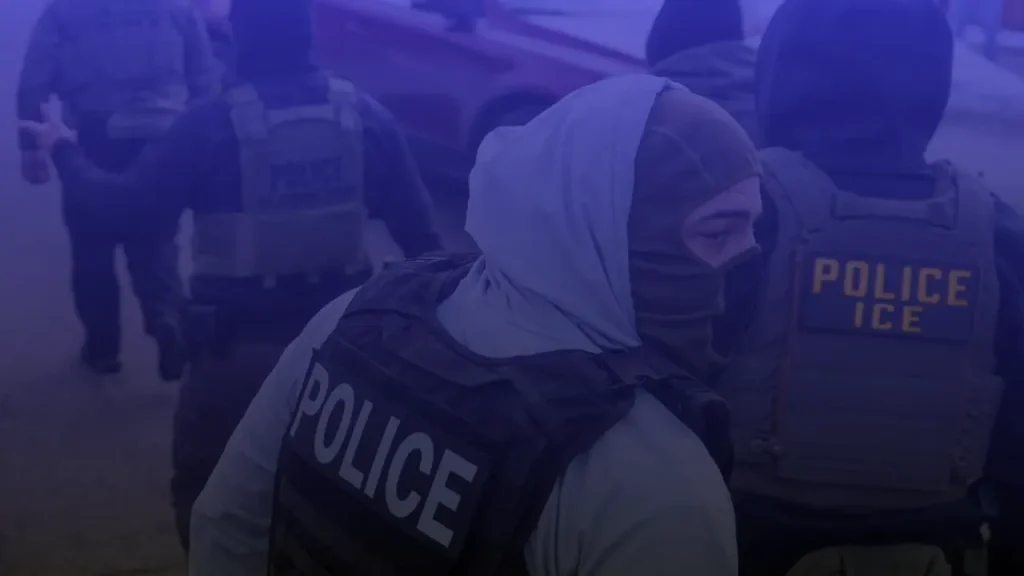
Nothing in the federal regulation expressly requires a visible name and badge number in all situations. ICE policy and common practice often include agency-marked clothing, badges and credential cards, and agents sometimes work in plain clothes or unmarked vehicles. A missing badge number does not by itself prove an encounter is unlawful or that someone is an impersonator, but it is reasonable to ask for credentials.
What Did the Ninth Circuit Decide?
California’s No Vigilantes Act (S.B. 805), Section 10, codified at Penal Code § 13654, required nonuniformed officers performing specified enforcement duties to visibly display identification showing their agency and a name, badge number or both, with exceptions and misdemeanor penalties for knowing and willful violations.
The United States argued California was directly regulating how federal officers perform federal duties. On October 14, 2026, the Ninth Circuit reversed the district court’s refusal to block Section 10 and directed it to enter a preliminary injunction barring California, Governor Gavin Newsom and Attorney General Rob Bonta from applying or enforcing it against the United States, federal agencies and federal officers. The reasoning rests on the Supremacy Clause and intergovernmental immunity: a state generally cannot directly regulate federal governmental functions without congressional authorization.
| Rule | What it does |
| 8 C.F.R. § 287.8 (federal) | Requires identification and statement of the reason at arrest, as soon as practical and safe |
| Cal. Penal Code § 13654 (state) | Required visible identification during specified enforcement duties |
| Ninth Circuit ruling | Blocks enforcement of § 13654 against covered federal officers |
Does California’s Ruling Also Decide the Mask Law?
No. California’s separate No Secret Police Act (S.B. 627; Penal Code § 185.5) restricts face coverings by officers. The district court had already enjoined the facial-covering restriction as applied to federal officers, on a different legal theory, and that issue was not part of the October 14 appeal. The Denver mask-ban litigation is a separate case.
Can ICE Agents Still Be Held Accountable?
Yes. Federal officers remain subject to the Constitution and federal law. Fourth Amendment limits on searches and seizures and Fifth Amendment due process protections apply, though what rights and procedures are available can differ in an immigration case. Possible avenues include:
- Complaints: the DHS Office of Inspector General hotline, the DHS Office for Civil Rights and Civil Liberties, and ICE’s Office of Professional Responsibility.
- Civil claims: the Federal Tort Claims Act (28 U.S.C. §§ 1346(b), 2671 et seq.) has strict deadlines and administrative steps. Constitutional damages suits against federal officers are narrowly limited by Egbert v. Boule (2022).
- Criminal law: federal officers can be investigated or prosecuted for misconduct in appropriate cases, subject to doctrines such as Supremacy Clause immunity (In re Neagle).
An officer’s procedural misstep does not automatically make every part of an encounter unlawful or require a case to be dismissed. The consequences depend on the rule involved and the remedy available.
Related AllAboutLawyer.com Coverage
- Did the Ninth Circuit Permanently Ban California’s ICE Identification Law? What the October 14 Ruling Actually Says:
- Can States Regulate Federal ICE Agents? The Supremacy Clause and Intergovernmental Immunity Explained:
- Trump Administration Sues Denver Over ICE Mask Ban, What The Law Says
- Do ICE Have The Same Rights As Police? Legal Authority
What Warrant Does ICE Need?
Judicial warrant
Issued by a judge or magistrate. It authorizes the actions it describes, such as an arrest or search of a specified place, within constitutional limits. It is not unlimited permission to search anywhere.
Administrative immigration warrants
ICE uses administrative forms such as Form I-200 (warrant for arrest of an alien) and Form I-205 (warrant of removal), issued within DHS, not by a judge. Under the traditional Fourth Amendment rule, an administrative warrant alone generally does not authorize forced entry into a home without consent (see Payton v. New York, 445 U.S. 573 (1980), and Steagald v. United States, 451 U.S. 204 (1981)). A federal regulation also bars entering non-public areas of a residence to question occupants about their right to be in the U.S. unless the officer has a warrant or consent (8 C.F.R. § 287.8(f)(2)).
The disputed 2025 home-entry memo
An internal ICE memo issued May 12, 2025, titled “Utilizing Form I-205, Warrant of Removal,” reportedly authorized agents to enter homes forcibly to arrest people subject to final removal orders using Form I-205 without a judicial warrant. It became public in January 2026 after whistleblower disclosures. In April 2026, residents and civil-rights groups filed Gibson Brown v. Mullin, No. 1:26-cv-01131 (D.D.C.), arguing the policy violates the Fourth Amendment and the Administrative Procedure Act. Reports indicate DHS has since said it paused the practice while reviewing it, rather than rescinding the memo. Check the docket before relying on the current status. The memo’s existence does not settle its constitutionality.
The practical lesson: do not assume every document called a “warrant” carries the same authority, and do not assume a simple rule fully describes current home-entry practice.
Is a warrant always needed?
No. Public arrests and home entries are governed by different rules, and exceptions such as consent and genuine emergencies (Kentucky v. King, 563 U.S. 452 (2011)) exist. A document authorizing one action is not general permission for every action.
What Residents Can Do: Action Guide
If immigration officers approach you in public
- Stay calm and do not run, resist or obstruct. Resisting or assaulting a federal officer can be a federal crime (18 U.S.C. § 111).
- Ask who they are. For example: “Are you with immigration? What agency? May I see your credentials?”
- Ask if you are free to leave. If yes, you can calmly leave.
- You can remain silent. You can say you wish to remain silent and want a lawyer. You generally do not have to answer questions about where you were born or your status.
- Do not lie or show false documents. False claims to U.S. citizenship and false documents can be crimes (18 U.S.C. §§ 911, 1546). Some noncitizens have separate legal duties to carry registration documents (8 U.S.C. § 1304(e)), so ask a lawyer about your situation.
If agents come to your home
- You generally do not have to open the door. You can speak through the closed door.
- Ask what legal authority they have. Ask them to show the document through a window or slide it under the door, if safe. Check who signed it (a judge or a DHS official), the address and the person or place named.
- If you object to entry, say so clearly, for example “I do not consent to your entering or searching.” Do not physically block or fight agents. If they enter anyway, do not resist, stay calm and contact a lawyer as soon as possible.
If you witness an encounter
- You may generally record in public from a safe distance without interfering. The First Amendment protects recording of officers in public (see Askins v. U.S. Department of Homeland Security, 899 F.3d 1035 (9th Cir. 2018), and Fordyce v. City of Seattle, 55 F.3d 436 (9th Cir. 1995)). Audio recording rules can vary by state; California’s law on confidential communications (Penal Code § 632) generally concerns private communications, not officers working in public.
- Do not touch officers, block vehicles or interfere.
- Note useful details: date, time, place, agency markings, badge or credential numbers if visible, vehicle descriptions and plates, witness contact information and whether paperwork was shown. Preserve original photos and video.
- If anyone is injured or in danger, prioritize safety and call emergency services.
If you suspect impersonation
Do not confront the person. Move to safety and call 911 so local police can verify. Impersonating a federal officer is a federal crime (18 U.S.C. § 912), and impersonating a peace officer is a crime under California Penal Code § 538d.
If someone is detained
Family members can try to locate the person through official channels and contact an immigration attorney or legal-aid organization. Do not sign documents you do not understand without legal advice if possible.
If you want to report misconduct
Use the DHS Office of Inspector General, the DHS Office for Civil Rights and Civil Liberties or ICE’s Office of Professional Responsibility. Describe what you personally observed separately from what you suspect. A missing badge number or masked face may be worth documenting, but no single detail proves a crime.
This is general information, not legal advice. For your situation, consult an immigration attorney or a reputable legal-aid organization.
Are ICE Agents Required to Wear Body Cameras?
Body cameras are separate from visible badges. ICE Directive 19010.2 (effective January 12, 2024) establishes rules for its body-worn camera program where cameras are deployed. A Government Accountability Office report released October 14, 2026, reportedly found that ICE and CBP had not updated early camera program plans to reflect later deployment changes and that many offices lacked tailored operational guidance, and it recommended controls to help ensure cameras are activated when required. That does not mean every officer lacks a camera or every encounter is unrecorded, but you should not assume a camera is always present or turned on. Verify the GAO findings in the report before relying on them.
What the Ruling Does Not Establish
- It does not establish that every ICE operation is lawful.
- It does not remove the federal regulation requiring identification at arrest.
- It does not create blanket immunity from the Constitution, federal law or misconduct investigations.
- It does not establish that an officer must always show a name and badge number at the start of every encounter.
The better question is not simply whether an agent showed a badge. It is what the officer was doing, which rule applied at that stage, whether the officer had legal authority and whether constitutional protections were respected.
Frequently Asked Questions
Can ICE agents still be required to identify themselves?
Yes, at arrest, under 8 C.F.R. § 287.8(c)(2)(iii), as soon as practical and safe. The regulation does not require visible display of a name and badge number in every encounter.
Did California lose the right to require ICE agents to display ID?
The Ninth Circuit directed a preliminary injunction blocking enforcement of Penal Code § 13654 against the federal government, federal agencies and federal officers. The ruling concerns that state requirement and does not erase federal rules.
Do ICE agents have to show a badge when asked?
You can ask to see credentials and the agency. The federal regulation requires identification as an immigration officer at arrest but does not set one universal display rule. Internal policies may also apply.
Can ICE enter my home with an administrative warrant?
Under the traditional rule, an administrative warrant alone generally does not authorize forced entry without consent. A 2025 internal memo claiming otherwise for certain Form I-205 cases is being challenged in court, so check current developments.
Can ICE arrest someone without a warrant?
In some circumstances, yes. Public arrests and home entries are governed by different rules.
Can I record ICE agents?
Generally yes in public from a safe distance without interfering. Do not obstruct and do not put yourself or others at risk.
Does the California ruling mean ICE is above the law?
No. It addresses California’s authority to enforce one state identification rule against federal officers.
What should I do if I think someone is an impersonator?
Move to safety and call 911 so local police can verify the person’s identity.
Sources and Legal Authorities
- 8 C.F.R. § 287.8, Standards for enforcement activities (eCFR): https://www.ecfr.gov/current/title-8/chapter-I/subchapter-B/part-287/section-287.8
- Ninth Circuit, United States v. California, No. 26-926 (October 14, 2026): https://cdn.ca9.uscourts.gov/datastore/opinions/2026/10/14/26-926.pdf
- Ninth Circuit, Ortiz Becerra v. Garland, No. 17-70859 (April 29, 2021) (nonprecedential memorandum): https://law.justia.com/cases/federal/appellate-courts/ca9/17-70859/17-70859-2021-04-29.html
- California Penal Code § 13654: https://leginfo.legislature.ca.gov/faces/codes_displaySection.xhtml?sectionNum=13654.&lawCode=PEN
- Payton v. New York, 445 U.S. 573 (1980): https://supreme.justia.com/cases/federal/us/445/573/
- Steagald v. United States, 451 U.S. 204 (1981): https://supreme.justia.com/cases/federal/us/451/204/
- Gibson Brown v. Mullin, No. 1:26-cv-01131 (D.D.C.), docket: https://dockets.justia.com/docket/district-of-columbia/dcdce/1%3A2026cv01131/291085
- Protect Democracy, Home Entry Memo case page: https://protectdemocracy.org/work/home-entry-memo/
- U.S. Government Accountability Office, report on CBP and ICE body-worn camera program management: https://www.gao.gov/products/gao-26-108157
- ICE Directive 19010.2, Body Worn Camera: https://www.ice.gov/doclib/foia/policy/19010.2.pdf
- DHS Office of Inspector General hotline: https://www.oig.dhs.gov/hotline
- Statutes and cases cited for orientation: 8 U.S.C. §§ 1304(e), 1357(a)(2); 18 U.S.C. §§ 111, 911, 912, 1546; 28 U.S.C. §§ 1346(b), 2671 et seq.; Cal. Penal Code §§ 185.5, 538d, 632; Kentucky v. King, 563 U.S. 452 (2011); Egbert v. Boule, 596 U.S. 482 (2022); In re Neagle, 135 U.S. 1 (1890); Askins v. DHS, 899 F.3d 1035 (9th Cir. 2018); Fordyce v. City of Seattle, 55 F.3d 436 (9th Cir. 1995)
AllAboutLawyer.com provides general legal information, not legal advice, and is not a law firm. This article is based on federal regulations, a Ninth Circuit ruling issued October 14, 2026, and public reporting available as of October 15, 2026. Immigration enforcement law and policy change quickly, and rights can depend on your status and the facts. Verify citations and current case status against official sources, and consult a licensed attorney about your situation.
About the Author
Israr Ahmad is a legal content researcher with 4+ years of experience covering class action settlements and consumer rights cases. He has researched and published coverage of 2,500+ settlements using verified court records, settlement administrator filings, and government sources. Learn more about Israr.