
The Blurred Lines Lawsuit, Explained, Verdict, Appeal, and Why It Still Matters
This case closed years ago. There’s no new filing, no pending trial, no reason it’s back in the news this week. What it left behind is a legal precedent musicians and copyright lawyers are still arguing about — so here’s the full case, start to finish.
Williams v. Gaye — Key Facts
| Plaintiffs (Counterclaimants) | Frankie Gaye, Nona Gaye, and Marvin Gaye III, heirs of Marvin Gaye |
| Defendants (Original Plaintiffs) | Pharrell Williams, Robin Thicke, and Clifford “T.I.” Harris Jr. |
| Songs at Issue | “Blurred Lines” (2013) vs. Marvin Gaye’s “Got to Give It Up” (1977) |
| Claim | Copyright infringement |
| Case Filed | August 2013, as a preemptive suit by Williams and Thicke |
| Trial Court | U.S. District Court for the Central District of California |
| Jury Verdict | March 10, 2015 — $7.3 million awarded to the Gaye family |
| Post-Trial Reduction | Reduced by the trial judge to roughly $5.3 million |
| Appeal Court | U.S. Court of Appeals for the Ninth Circuit |
| Appeal Ruling | March 21, 2018 — verdict against Williams and Thicke upheld; T.I. and a record label executive cleared |
| Final Amended Judgment | Approximately $5 million plus ongoing royalties |
| Case Status | Fully resolved. No further appeals pending. |
| Last Updated | August 24, 2026 |
How the Case Started
Most copyright lawsuits begin with the copyright owner suing. This one started backward. In August 2013, months after “Blurred Lines” became the best-selling single of the year, Pharrell Williams and Robin Thicke filed a preemptive lawsuit of their own, asking a federal court to declare that their song didn’t infringe on Marvin Gaye’s “Got to Give It Up” — before Gaye’s family had even sued them. Their filing came after the Gaye family’s representatives raised concerns that “Blurred Lines” borrowed too heavily from Gaye’s 1977 hit.
The Gaye family countersued for copyright infringement. The case that followed argued over something copyright law has always struggled to define clearly: the line between being inspired by a song and copying it.
What the Jury Decided
The case went to trial in Los Angeles federal court in early 2015. The Gaye family’s side didn’t argue that Thicke and Williams sampled or directly copied any specific note-for-note melody. Since Gaye’s copyright, registered in 1977, only covered the sheet music deposited with the U.S. Copyright Office — not the actual sound recording — the jury was instructed to compare the two songs based on their written compositions, not how they sound on record.
After a seven-day trial and two days of deliberation, the jury sided with the Gaye family. On March 10, 2015, it awarded $7.3 million in damages, finding “Blurred Lines” infringed the copyright in “Got to Give It Up.” The trial judge later reduced that figure to about $5.3 million. T.I., who contributed a rap verse to the song, was found not liable.
Related article: Michaels False Discount Lawsuit, Were You Affected? Crow v. The Michaels Companies, Inc., No. 1:26-cv-03142
Why the Verdict Was Controversial
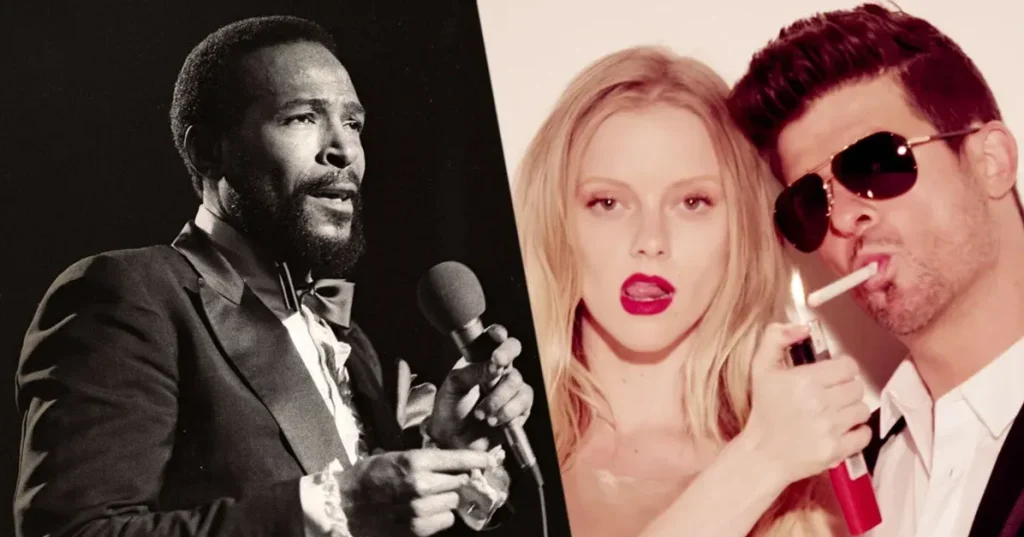
The ruling immediately divided the music industry and copyright lawyers. Critics argued the jury wasn’t comparing specific melodic or lyrical copying — the kind of thing copyright has traditionally protected — but rather the overall feel, groove, and genre of a late-1970s funk record. Pharrell Williams later said publicly that he believed the two songs only shared a “feeling,” which he argued isn’t something copyright law is supposed to protect.
That distinction — style versus specific expression — is the same tension at the center of plenty of other entertainment lawsuits since. A pair of copyright suits against Netflix’s “Stranger Things” turned on nearly identical reasoning: ideas and genre conventions aren’t protectable, but the specific arrangement and expression of them can be.
What Happened on Appeal
Williams and Thicke appealed to the Ninth Circuit, asking the court to throw out the verdict entirely or order a new trial. On March 21, 2018, a divided three-judge panel upheld the jury’s finding in a 2-1 decision, ruling that the trial court hadn’t made a legal error in letting the jury’s substantial-similarity finding stand.
Judge Jacqueline Nguyen dissented sharply. She argued the two songs weren’t objectively similar as a matter of law once you separated out unprotectable elements like a general funk-era groove and instrumentation, and warned the majority’s reasoning effectively let the Gaye estate copyright a musical style rather than a specific composition — a concern echoed by much of the legal commentary that followed the ruling. Williams and Thicke petitioned for the full Ninth Circuit to rehear the case; that petition was denied.
The Final Numbers
The amended final judgment split the damages: Thicke and Williams jointly owed roughly $2.85 million, Thicke individually owed an additional $1.77 million in his share of profits, and Williams and his publishing company owed about $358,000 more. On top of that, the court awarded the Gaye family ongoing royalties equal to 50% of future songwriter and publishing revenue from “Blurred Lines” — meaning the family’s financial interest in the song didn’t end with the lawsuit.
Frequently Asked Questions
Is the Blurred Lines case still ongoing?
No. The case concluded in 2018 when the Ninth Circuit denied the petition for rehearing. There’s no active litigation tied to this case.
Did Robin Thicke and Pharrell Williams have to pay damages?
Yes. The final amended judgment required them to pay a combined total of roughly $5 million, plus interest, and gave the Gaye family an ongoing 50% royalty share in the song’s songwriter and publishing revenue going forward.
Was T.I. found liable? No. The jury found Clifford “T.I.” Harris Jr., who contributed a rap verse, not liable for infringement.
Can you copyright a musical “feel” or style?
Not directly — copyright protects specific creative expression, not general styles, genres, or “feelings.” That said, critics of the Blurred Lines verdict argue the jury’s decision blurred that line in practice, which is part of why the case remains controversial among copyright lawyers.
Why does this case still get cited in other lawsuits?
Because it’s one of the highest-profile examples of a jury finding infringement based on the overall feel of a song rather than a specific copied melody or lyric, later cases — including other music copyright disputes — have cited it as either a precedent or a cautionary example, depending on which side is arguing.
Sources Used in This Article
- Ninth Circuit Court of Appeals — Williams v. Gaye, 895 F.3d 1106 (9th Cir. 2018), official opinion: https://law.justia.com/cases/federal/appellate-courts/ca9/15-56880/15-56880-2018-07-11.html
- Loeb & Loeb LLP — “Williams v. Gaye” case analysis: https://www.loeb.com/en/insights/publications/2018/03/williams-v-gaye
- Jones Day — “Blurred Lines Between Inspiration and Infringement: Ninth Circuit Holds ‘Blurred Lines’ Infringes Copyright”: https://www.jonesday.com/en/insights/2018/07/blurred-lines-between-inspiration-and-infringement
Researched and written by Israr Ahmad, legal content researcher and founder of AllAboutLawyer.com. All facts verified against the Ninth Circuit’s official opinion and independent legal analysis from Loeb & Loeb and Jones Day on August 24, 2026. Last Updated: August 24, 2026.
This article is for informational purposes only and does not constitute legal advice. Laws vary by state and individual circumstances differ. For advice about your specific situation, consult a qualified attorney.
About the Author
Israr Ahmad is a legal content researcher with 4+ years of experience covering class action settlements and consumer rights cases. He has researched and published coverage of 2,500+ settlements using verified court records, settlement administrator filings, and government sources. Learn more about Israr.