
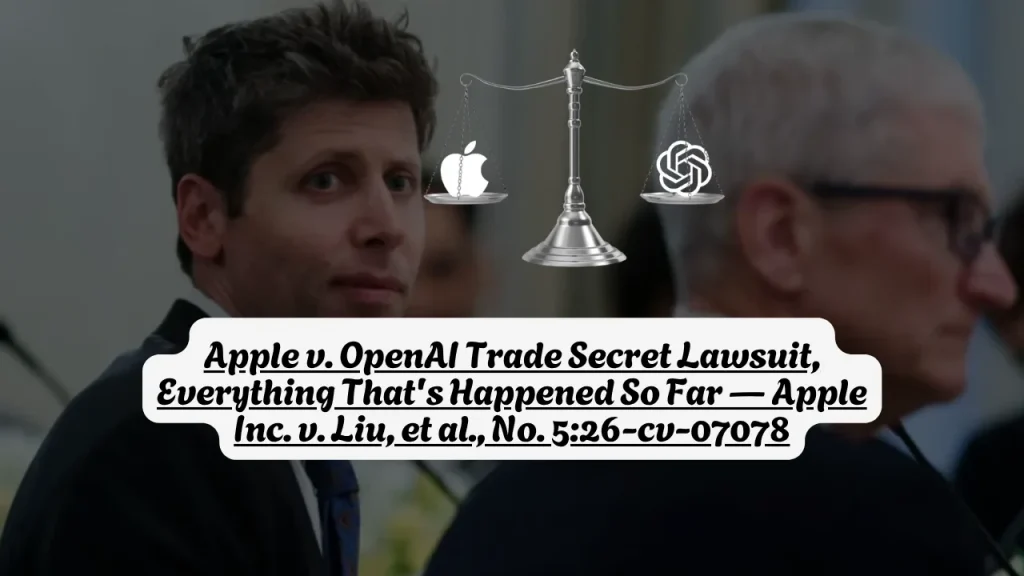
Apple v. OpenAI Trade Secret Lawsuit, Everything That’s Happened So Far — Apple Inc. v. Liu, et al., No. 5:26-cv-07078
Apple sued OpenAI on Friday, July 10, 2026, accusing the ChatGPT maker, its Chief Hardware Officer, and a former Apple engineer of running a coordinated campaign to steal Apple’s confidential hardware secrets. It’s a stunning reversal for two companies that stood together at a 2024 product announcement. Here’s everything confirmed so far, pulled directly from the complaint and court filing.
Who’s Being Sued and Why
Apple filed the complaint in the U.S. District Court for the Northern District of California, case number 5:26-cv-07078, titled Apple Inc. v. Liu, et al. The defendants are OpenAI Foundation, OpenAI Group PBC, io Products LLC, Tang Yew Tan, and Chang Liu. The claims are trade secret misappropriation and breach of contract.
Apple’s opening line in the filing sets the tone: “This case is about Apple’s former employees stealing Apple’s trade secrets for the benefit of OpenAI. Apple brings this suit to put a stop to it.”
Who Is Tang Tan, and What Does Apple Say He Did?
Tang Yew Tan spent 24 years at Apple, most recently as Vice President of Product Design for the iPhone and Apple Watch. He left in February 2024 to help start io Products alongside former Apple design chief Jony Ive. OpenAI acquired io last year for roughly $6.5 billion to build its hardware division. Tan is now OpenAI’s Chief Hardware Officer.
Apple’s specific allegations against Tan:
- He used Apple’s internal project codenames during OpenAI job interviews with Apple staff, to draw out more confidential detail from candidates who still worked at Apple
- He directed job candidates to bring “actual parts” — batteries, logic boards, system-in-package chips — from Apple to interviews for what the complaint calls “show and tell” sessions
- He circulated an internal Apple document marked “Need to Know,” describing Apple’s exit security procedures, so new OpenAI hires could avoid scrutiny when they left
- He advised recruits not to tell Apple they were leaving for OpenAI, so they could stay inside Apple longer and gather more information
- Before his own departure, he emailed himself information about Apple’s suppliers and used that knowledge to help OpenAI reach out to Apple’s manufacturing partners
Here are more lawsuits thats are on OpenAI:
Musk vs. OpenAI Lawsuit 2026
OpenAI vs Microsoft Legal Fight 2026
Also there are cases on Apple too: Apple Intelligence False Advertising $250M Settlement
Who Is Chang Liu, and What Does Apple Say He Did?
Chang Liu spent eight years at Apple as a senior systems electrical engineer before joining OpenAI in January 2026. According to the complaint, Liu failed to return his Apple-issued laptop after leaving, didn’t respond to Apple’s requests to sign a confidentiality reminder or complete an exit interview, and gained access to a former colleague’s Apple work computer after he’d already left the company. Apple says he used that access to download dozens of confidential hardware files — including unreleased product details, engineering presentations, technical specifications, and proprietary project data. Liu is also accused of sharing that confidential information with other Apple employees who were applying to OpenAI, advising at least one on what to study before her interview.
The Manufacturing Partner Allegation
Beyond the two named individuals, Apple’s complaint says OpenAI used stolen information to approach Apple’s own contract manufacturers. One specific claim: OpenAI got a manufacturing partner to perform a proprietary Apple metal-finishing technique for an OpenAI device, “misleading the partner to believe they had Apple’s permission to do so.” Apple says its investigation also found evidence that other former employees, beyond Tan and Liu, took confidential information with them when they left for OpenAI.
How Big Is This, According to Apple?
Apple says roughly 400 former Apple employees are now working at OpenAI. The complaint doesn’t allege all 400 stole information — but Apple uses that number to frame the scale of talent movement between the two companies as context for why it says the misconduct wasn’t isolated. One line from the filing: “This is the tip of the iceberg. Apple lacks visibility into what’s been happening behind closed doors at OpenAI, where such misconduct is normalized and exemplified by leadership.”
Related article: Target Water Beads Wrongful Death Lawsuit, What’s Been Alleged So Far — Bethard v. Target Corporation, Hennepin County District Court
What Apple Is Asking the Court to Do
Apple wants the court to bar OpenAI from possessing, using, or disclosing its trade secrets, order the return of all confidential materials, require OpenAI to preserve evidence, and award damages “in an amount to be determined at trial.” Apple is separately suing Tan and Liu individually for breach of contract, tied to confidentiality agreements they signed as Apple employees. Apple has also asked for a jury trial. Notably, some reporting indicates Apple wants OpenAI to redesign any products that incorporate the disputed trade secrets — a demand that, if granted, could delay OpenAI’s hardware launch.
Did Apple Try to Resolve This Before Suing?
Yes. According to the complaint, Apple sent OpenAI a letter in February 2026 raising its concerns and asking OpenAI to investigate. OpenAI never responded, Apple says, which is part of why Apple moved to litigation five months later.
What Has OpenAI Said?
OpenAI’s public statement, from spokesperson Drew Pusateri: “We have no interest in other companies’ trade secrets. We remain focused on building innovative technology that empowers people everywhere.” OpenAI has not filed a formal response with the court yet, and multiple outlets reported the company did not respond to individual requests for comment ahead of publication on the day the suit was filed.
Is Jony Ive Named in the Lawsuit?
No. Ive, who co-founded io Products with Tan and two other former Apple designers (Evans Hankey and Scott Cannon), is referenced in the filing but is not named as a defendant, and Apple does not accuse him of wrongdoing. The same goes for Hankey and Cannon. OpenAI CEO Sam Altman is referenced but also not named as a defendant.
How Did the Apple-OpenAI Relationship Get Here?
This is the part that makes the story land. In 2024, Apple and OpenAI announced a partnership to integrate ChatGPT into Siri and Apple Intelligence, with Altman appearing at Apple’s announcement event. That partnership has been fraying for a while. Apple’s rebuilt version of Siri, expected later this year, reportedly runs on Google’s Gemini instead of OpenAI’s technology. Separately, Bloomberg and The New York Times reported earlier this year that OpenAI was itself weighing legal action against Apple, over claims that Apple hadn’t sufficiently integrated or promoted ChatGPT under their deal. Apple’s filing explicitly states that the ChatGPT partnership agreement isn’t at issue in this new lawsuit — the two disputes are being kept separate, at least for now.
A Related Lawsuit: iyO v. OpenAI
This isn’t OpenAI’s first trade-secret dispute tied to its hardware push. A startup called iyO Inc. sued Ive and Altman over trademark issues shortly after the io acquisition was announced, then amended its complaint in March 2026 to add trade secret misappropriation claims. That amended lawsuit also named Tang Tan as a defendant, alleging a former iyO engineer downloaded confidential files and passed them to Tan. OpenAI has disputed those allegations as well.
What This Means for OpenAI’s Hardware Plans and IPO
OpenAI hasn’t publicly confirmed what its first hardware device will be. The Information has reported it’s a camera-equipped smart speaker; other reporting points to a possible smartphone as far out as 2028. Altman said in November that the company had finished its first prototypes, and OpenAI’s global affairs chief said at Davos in January that a device was targeted for the first half of 2026. A court order restricting OpenAI’s use of contested technology, or forcing a redesign, could meaningfully delay that timeline. The suit also lands at a sensitive moment: OpenAI is reportedly preparing for a historic IPO, and added legal risk in an S-1 filing period is not the kind of headline a company wants mid-process.
Case Snapshot
| Detail | Information |
| Case Name | Apple Inc. v. Liu, et al. |
| Case Number | 5:26-cv-07078 |
| Court | U.S. District Court, Northern District of California |
| Filed | July 10, 2026 |
| Defendants | OpenAI Foundation, OpenAI Group PBC, io Products LLC, Tang Yew Tan, Chang Liu |
| Claims | Trade secret misappropriation, breach of contract |
| Relief Sought | Injunction, return of materials, damages “to be determined at trial,” jury trial |
| Settlement Status | No settlement — lawsuit just filed |
Timeline
| Date | Event |
| 2024 | Apple and OpenAI announce ChatGPT integration into Siri and Apple Intelligence |
| February 2024 | Tang Tan leaves Apple |
| 2025 | OpenAI acquires io Products for approximately $6.5 billion |
| January 2026 | Chang Liu leaves Apple for OpenAI |
| February 2026 | Apple sends OpenAI a letter raising concerns; OpenAI does not respond |
| March 2026 | iyO amends its separate lawsuit against OpenAI to add trade secret claims, naming Tan |
| June 2026 | Apple announces its rebuilt Siri will use Google Gemini instead of ChatGPT |
| July 10, 2026 | Apple files Apple Inc. v. Liu, et al. in N.D. Cal. |
| Next hearing | UNVERIFIED — no hearing date reported yet |
Frequently Asked Questions
Did Apple actually file a lawsuit against OpenAI, or is this just a threat?
It’s a real, filed lawsuit — case number 5:26-cv-07078 in the U.S. District Court for the Northern District of California, filed July 10, 2026.
Who are the individual defendants, and are they still employed?
Tang Yew Tan (OpenAI’s Chief Hardware Officer) and Chang Liu (a former Apple engineer, now at OpenAI) are both named individually. As of the filing, both remain employed at OpenAI.
Is Sam Altman being sued?
No. Altman is referenced in coverage of the case and the broader OpenAI-Apple relationship, but he is not named as a defendant in this lawsuit.
Is Jony Ive being sued?
No. Ive co-founded io Products, which is named as a defendant, but Apple does not name Ive personally or accuse him of wrongdoing.
Does this affect the existing ChatGPT-Siri partnership?
Apple’s filing says that partnership agreement is not at issue in this lawsuit. Apple has not commented on whether the suit will affect that separate relationship.
What is OpenAI’s official response?
“We have no interest in other companies’ trade secrets. We remain focused on building innovative technology that empowers people everywhere,” per spokesperson Drew Pusateri. OpenAI has not filed a court response yet.
Could this delay OpenAI’s hardware device launch?
Possibly. Apple is asking the court to bar OpenAI from using its trade secrets and, per some reporting, to require a redesign of any affected products — either of which could push back OpenAI’s rumored 2026 device timeline.
Is this related to Elon Musk’s lawsuit against OpenAI?
No, they’re unrelated cases. Musk’s suit concerns OpenAI’s nonprofit-to-for-profit conversion; this one concerns alleged trade secret theft for hardware development.
Sources
- CourtListener federal docket — Apple Inc. v. Liu, 5:26-cv-07078, filed July 10, 2026: https://www.courtlistener.com/docket/73602437/apple-inc-v-liu/
- https://www.cnn.com/2026/07/10/tech/apple-openai-devices-lawsuit
This article is for informational purposes only and does not constitute legal advice. The claims described are allegations only and have not been proven in court.
About the Author
Israr Ahmad is a legal content researcher with 4+ years of experience covering class action settlements and consumer rights cases. He has researched and published coverage of 2,500+ settlements using verified court records, settlement administrator filings, and government sources. Learn more about Israr.