
Amazon Stingless Bees Just Became Legal Subjects What That Actually Means
A tiny bee that has never stung anyone just made legal history. Two municipalities in Peru have passed ordinances making stingless bees the first insects on Earth to hold formal legal rights — including the right to be defended in a court of law. Under the new laws, stingless bees now have the fundamental right to exist and flourish in a healthy environment, without pollution, habitat loss, climate change, or human activity getting in the way of their survival. Humans can also file lawsuits on the insects’ behalf. Here is what that actually means — and why people everywhere should pay attention.
Quick Facts
| Field | Detail |
| What Happened | Two Peruvian municipalities granted legal rights to stingless bees |
| First Ordinance | Satipo, Peru — October 2025 (Ordinance No. 33-2025-CM/MPS) |
| Second Ordinance | Nauta, Loreto region, Peru — December 2025 |
| Legal Status | First insects in history to be recognized as rights-bearing legal subjects |
| Rights Granted | Right to exist, thrive, reproduce, live in clean habitat, and be represented in court |
| Who Can Sue | Any person, community, or organization, on behalf of the bees |
| Who Can Be Sued | Any company, agency, or individual that harms bee colonies |
| Global Petition | Over 390,000 signatures calling for national-level protection across Peru |
| Countries Watching | Bolivia, the Netherlands, the United States |
What Are Stingless Bees — And Why Does Anyone Care?
Before getting into the law, it helps to understand what stingless bees actually are and why their decline matters far beyond the Amazon.
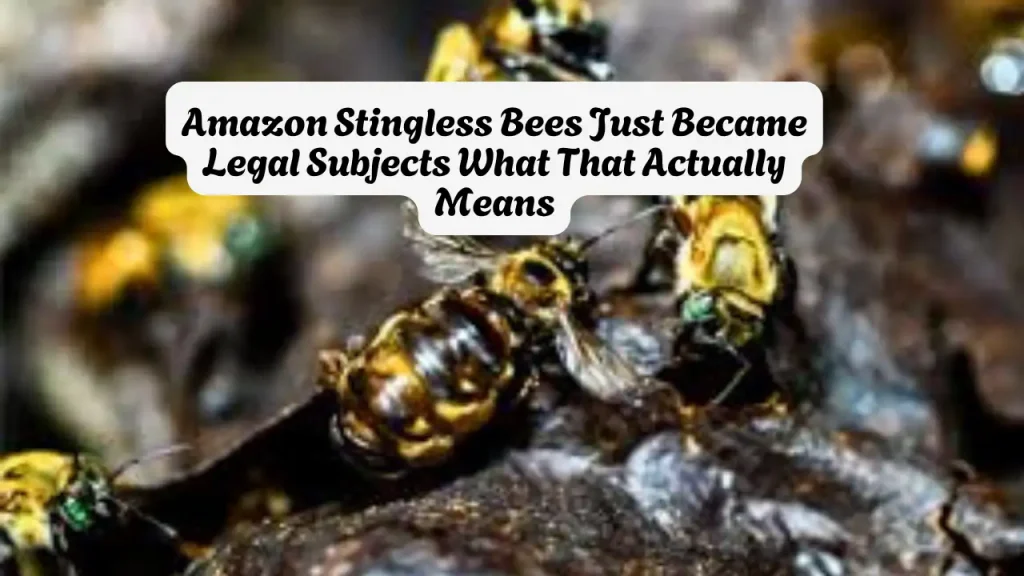
Stingless bees are so ancient that they shared the planet with dinosaurs. For the past 80 million years, stingless bees have been pollinating 80% of the Amazon’s flora, including crops like bananas, avocados, coffee, and cacao plants. They are not the honeybees you see in a garden. They are smaller, mostly black, and — as the name says — they do not sting. They bite if threatened, but gently. Indigenous communities in Peru call one species angelitas — little angels.
Stingless bees contribute to the pollination of at least 75% of agricultural crops in the Amazon region. One of the reasons that stingless bees are so little known is that they are tiny. They are often dismissed as flies or wasps. People don’t know the major role they play in pollinating the Amazon rainforest — the lungs of the world.
More than 600 known species of stingless bees live in tropical and subtropical regions around the world. Peru is home to at least 175 species. Their honey is medicinally remarkable. Researchers credit stingless bee honey with molecules that have anti-inflammatory, antiviral, antibacterial, antioxidant, and even anticancer properties.
And they are disappearing. Deforestation removes their nesting sites. Land conversion for cattle and crops destroys foraging areas. Heavy pesticide use poisons colonies. Climate-stressed weather patterns disrupt flowering cycles. Africanized honeybees, which are more aggressive, compete for and take over nest sites. Elders who once walked half an hour to find a hive now report walking for hours with no guarantee they will see one at all.
What the Law Actually Says — In Plain English
The Two Ordinances
In an unprecedented legal development, the Provincial Municipality of Satipo, Peru approved Municipal Ordinance No. 33-2025-CM/MPS, which grants legal rights to native stingless bees within the Avireri VRAEM Biosphere Reserve — a region that spans nearly 16,000 square miles from the Amazon rainforest to the Andes mountains and is one of the most biologically and culturally diverse landscapes on Earth.
Following this lead, the Municipality of Nauta in the Loreto region became the second local government in Peru to legally uphold the rights of these native pollinators through Ordinance No. 17-2025-MPL-N.
What Rights Do the Bees Actually Have?
The ordinances read almost like a small bill of rights for bees. The texts recognize the right to exist and prosper, to maintain healthy populations, to live in a clean and intact habitat with ecologically stable climate conditions, to regenerate natural cycles, and to receive legal representation if pollution, deforestation, or new projects threaten their survival.
Related article: That Electric Motorcycle You’re Riding on the Street May Be Illegal Here’s What the Law Says
That last right — legal representation — is the one that makes lawyers sit up. It means the bees are not just “protected.” They are legal subjects who can be represented in court proceedings. There is a meaningful difference between those two things.
Who Can Actually Sue? And for What?
In practical terms, individuals, communities, or organisations may bring legal actions on behalf of the bees where activities such as deforestation, pesticide use, or pollution threaten their survival. Any company or individual that damages their colonies can now be subject to legal action in Peru.
Courts are now required to consider not only human losses but damage to the species and the forest itself. That last point is a quiet revolution in how courts think about harm. Previously, a company could destroy a bee habitat and only face accountability if a human landowner or farmer suffered a measurable financial loss. Now the damage to the bees themselves is legally cognizable — it counts on its own, separate from any harm to a person.
How Does This Fit the Law? The “Rights of Nature” Movement
The Satipo and Nauta ordinances are the most dramatic example yet of a legal movement that has been building for decades. Though a handful of other creatures have been granted legal rights — such as sea turtles in Panama and all wild animals in Ecuador — experts say these are the first such instances involving insects.
Peru took an important step in 2024 when it enacted national legislation recognizing native bees as species of economic importance and affording them protections. Until then, the law shielded only the European honeybee — a non-native species — while completely ignoring the native stingless bees that actually keep the Amazon alive.
The municipal ordinances go further. Rather than simply regulating what humans can do to bees, they reframe bees as participants in the legal system — entities whose interests the law must directly serve, not merely account for as a side effect of protecting human economic interests.
How This Story Started: One Scientist, Indigenous Knowledge, and a Pandemic
This change did not start in a legal office. It began when chemical biologist Rosa Vásquez Espinoza and her team at Amazon Research Internacional were asked to analyze honey that Indigenous communities used during COVID-19. When medical supplies failed to reach remote villages, communities turned to the honey’s natural antibacterial and antiviral properties for survival.
Espinoza said she saw hundreds of medicinal molecules — molecules known to have biological medicinal effects, including anti-inflammatory, antiviral, antibacterial, antioxidant, and even anticancer properties. The diversity was truly amazing.
As she expanded her fieldwork alongside Indigenous experts, the same warning kept surfacing everywhere she went. Community members kept reporting: “I cannot see my bees anymore.” Laboratory tests then revealed pesticide residues in honey collected far from industrial farms, suggesting widespread environmental contamination far beyond what anyone had mapped.
The campaign that followed brought together Indigenous leaders, scientists, and environmental lawyers — including the U.S.-based Earth Law Center — to draft what became the Declaration of Rights for Native Stingless Bees, which the Satipo municipal government then adopted into law.
What This Means for the Broader Legal World
Could This Happen in the United States?
Enabling nature to seek judicial redress is not a radical fringe theory. It is a public policy trajectory that may soon find its way into courtrooms in the United States, according to environmental attorneys who have analyzed the Satipo ordinance.
There is already growing interest from countries including Bolivia, the Netherlands, and the United States in developing similar regulations to protect wild bees. Environmental groups in all three countries are actively studying Peru’s model.
The U.S. already has precedents — rivers, marshes, and other natural features have been granted limited legal standing in specific jurisdictions. The step from granting standing to a river to granting rights to an insect species is conceptually significant, but the legal machinery to do it already exists in principle.
What the Legal Experts Say
Constanza Prieto, the Latin America director at the Earth Law Center, described the reform as “a turning point in our relationship with nature,” arguing it makes stingless bees visible as rights-bearing subjects rather than invisible economic contributors.
As one environmental attorney put it, the ordinance is not sentimental advocacy for insects — it is a measured, culturally grounded, science-informed response to a biodiversity emergency. Recognizing rights of nature reframes the legal paradigm. It affirms that non-human life forms possess inherent interests that the law must respect, not merely manage.
The doctrinal challenges are real — questions of standing, guardianship models, enforcement capacity, and separation of powers all need answers. But the conceptual shift is already happening, and legal scholars say the precedent will be studied in environmental law programs around the world for years.
Why This Matters to People Who Will Never Visit the Amazon
It is easy to read a story about Peruvian bees and think it has nothing to do with your life. That assumption is wrong. The morning coffee, the chocolate bar after lunch, and even avocado toast all depend to a large extent on pollinators that seldom make the news.
Giving legal standing to stingless bees will not by itself save the Amazon. It does, however, shift the legal spotlight toward the small workers that keep forests and food systems running, and invites other governments to ask a simple question: if an insect can have the right to exist, what else in nature deserves a legal voice?
That question is now officially in front of the global legal community — and it is not going away.
Frequently Asked Questions
What does it mean for a bee to be a “legal subject”?
A legal subject is an entity the law recognizes as having rights of its own — rights that can be defended in court. Until now, only humans, corporations, and a small number of other entities like rivers in some countries held this status. Making a bee a legal subject means its interests are not just incidentally protected by environmental rules — they are directly enforceable, on the bee’s behalf, in a court of law.
Can someone actually file a lawsuit for a bee?
Yes. In practical terms, individuals, communities, or organisations may bring legal actions on behalf of the bees where activities such as deforestation, pesticide use, or pollution threaten their survival. Any company or individual that damages their colonies can now be subject to legal action in Peru.
Are stingless bees dangerous?
No. Stingless bees do have stingers, but they are small and ineffective. Instead, the creatures primarily bite to defend themselves. They are considered gentle and are culturally important to Indigenous Amazonian communities who call some species “little angels.”
Why weren’t stingless bees protected before?
For decades, Peruvian law protected the honeybees brought over from Europe while completely ignoring the native stingless bees that actually keep the Amazon alive. Stingless bees lacked formal legal classification entirely, which blocked conservation funding and made it nearly impossible to challenge activities that harmed their habitats.
Is this the first time any animal has received legal rights?
It is the first time any insect has received legal rights. A handful of other creatures have previously been granted legal rights — such as sea turtles in Panama and all wild animals in Ecuador — but experts say these are the first such instances involving insects.
Could this lead to similar laws in the United States?
Possibly. There is growing interest from the United States in developing similar regulations to protect wild bees. Environmental groups are already studying Peru’s model. The U.S. has existing legal frameworks — like the Endangered Species Act — that protect pollinators in limited ways, but none that grant insects the status of legal subjects with their own enforceable rights.
What happens to companies that harm the bees now?
Any company, agency, or individual that harms stingless bee colonies in the protected areas of Peru can now be sued on behalf of the bees. Courts are required to consider not only human losses but damage to the species and the forest itself.
Sources & References
- Earth Law Center — Satipo Ordinance Press Release
- Smithsonian Magazine — Honey-Making Stingless Bees Become First Insects to Gain Legal Rights
Last Updated: April 6, 2026
Disclaimer: This article is for informational purposes only and does not constitute legal advice. The legal frameworks described here apply to Peruvian municipal and national law. For advice about environmental law in your specific jurisdiction, consult a qualified attorney.
About the Author
Israr Ahmad is a legal content researcher with 4+ years of experience covering class action settlements and consumer rights cases. He has researched and published coverage of 2,500+ settlements using verified court records, settlement administrator filings, and government sources. Learn more about Israr.