
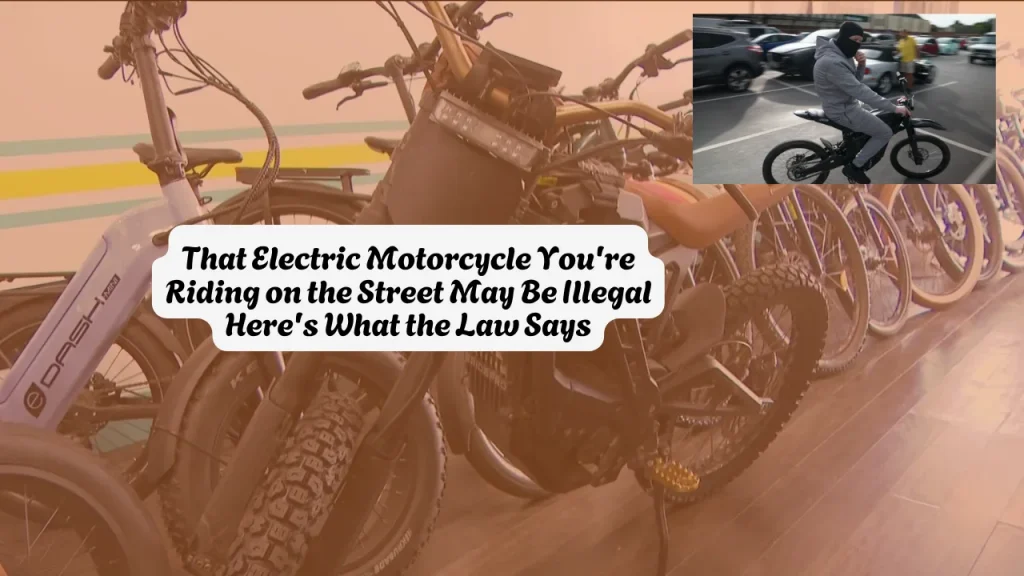
That Electric Motorcycle You’re Riding on the Street May Be Illegal Here’s What the Law Says
Electric bikes like the Sur-Ron, Talaria, and similar high-powered models are selling fast across the United States. They look like bicycles. They are quiet. They are fun. And in most states, riding them on a public street without registration, a license plate, and insurance is illegal — full stop. Police departments across the US are increasingly cracking down on their use on public roads, and these higher-performance vehicles can reach speeds twice as fast as legal electric bicycles and often feature five times the power level. Here is exactly what the law says and what happens if you get caught.
Quick Reference: What’s Legal and What’s Not
| Situation | Legal? |
| Riding a Sur-Ron or Talaria on a public street | ❌ Illegal in most states |
| Riding a Sur-Ron on private land or OHV trails | ✅ Generally legal |
| Riding a compliant e-bike (under 750W, under 28 mph, with pedals) | ✅ Legal in all 50 states |
| Riding a high-powered electric bike without registration | ❌ Illegal — treated as unregistered motor vehicle |
| Riding without a motorcycle license on a street-legal electric motorcycle | ❌ Illegal |
| Owning a Sur-Ron or Talaria | ✅ Legal everywhere |
| Converting an off-road electric bike to street-legal | ✅ Possible in some states with proper equipment and registration |
| Riding an unregistered electric motorcycle and getting in an accident | ⛔ Insurance likely denied — full personal liability |
The Legal Line Everyone Gets Wrong
The root of all the confusion is one number: 750 watts.
The Federal Consumer Product Safety Act defines what a “low-speed electric bicycle” is. According to federal law, an e-bike is a consumer product — not a motor vehicle — if it has two or three wheels, fully operable pedals, an electric motor of less than 750 watts, and a maximum speed of 20 mph on a paved level surface while powered solely by the motor.
Meet all those requirements and your bike is an e-bike. No registration needed. No motorcycle license needed. No insurance required in most states.
Exceed any one of those requirements and your bike legally becomes a motor vehicle — the same legal category as a car or motorcycle. That means it needs a Vehicle Identification Number (VIN), registration, a license plate, insurance, and a rider with a valid motorcycle license endorsement to legally operate on public roads.
Sur-Ron bikes like the Light Bee X have power levels of 3,000 to 6,000 watts — far exceeding the 750-watt e-bike limit — and also lack the pedals required to qualify as an electric bicycle. They also fail to have required safety features such as mirrors that are required for motorcycles.
So the Sur-Ron sits in a legal no man’s land: too powerful to be an e-bike, not equipped enough to be a street-legal motorcycle. The result? It is illegal to ride on any public road in most US states, no matter how you market it or how it was sold to you.
What Makes an Electric Vehicle Street Legal vs. Illegal
The Three-Class E-Bike System
The foundation of e-bike law in the U.S. is the three-class system. Most states have adopted this framework. This system comes from a federal law definition of a low-speed electric bicycle. Here is how the classes break down:
Class 1 — Pedal-assist only, no throttle, maximum 20 mph. Allowed almost everywhere bikes are allowed.
Class 2 — Has a throttle, maximum 20 mph under motor power alone. Allowed on most roads and bike paths.
Class 3 — Pedal-assist only, maximum 28 mph. Generally restricted to roads only, not bike paths.
All three classes require working pedals and a motor under 750 watts. Every class is street legal across all 50 states when the bike meets the definition.
When a Bike Stops Being an E-Bike
An electric vehicle stops being an e-bike and legally becomes a motor vehicle when it exceeds specific performance limits. There are three main triggers: motor power exceeds 750W, speed capability is too high — if the motor can assist beyond 28 mph it is no longer an e-bike — or a throttle-equipped bike can move itself faster than 20 mph without pedaling.
Once any of these lines are crossed, the vehicle must be registered, insured, and operated by a licensed rider to be legal on public roads. Riding one of these unregistered motor vehicles on the street is illegal.
What About “Class 4” Electric Bikes?
Some retailers and marketing materials use the term “Class 4” for powerful electric bikes. This is not a legal category under federal or most state law. These bikes go too fast to fit in the three-class system, and they also do not have pedals, so they can never be classified as an e-bike. Calling something “Class 4” is a marketing description, not a legal one — and it does not give you any protection if law enforcement stops you.
Specific Brands That Are Illegal on US Streets
Sur-Ron
Sur-Ron is one of the most popular electric off-road bikes in the US. It is also one of the most frequently seized. The Manhattan Beach Police Department in California has explicitly stated that “Talaria, Surron, ERidePro, and other similar-type electric motorcycles are not safe or legal for operation on city streets, sidewalks, or The Strand. A few juveniles have learned the hard way and found their bikes on the back of a tow truck.”
Sur-Ron electric motorbikes are designed primarily for trails, motocross tracks, and private land. They lack the requirements of bicycles and e-bikes for legal on-road use, including speed and power limits that exceed legal limits for electric bikes.
Talaria
Talaria faces the same classification problem as Sur-Ron. These higher-performance vehicles can reach speeds twice as fast as legal electric bicycles and often feature five times the power level. Police departments are explicitly naming Talaria by brand in their enforcement advisories alongside Sur-Ron.
Other High-Powered Electric Bikes
Any electric two-wheeler marketed with power ratings of 1,000W, 2,000W, or higher is not a legal e-bike under federal or most state law. Many powerful two-wheelers blur the legal lines. A vehicle with a motor rated higher than 750W is not legally an electric bicycle. If a bike fails to meet the legal definition of an e-bike, it must be registered with the DMV, insured, and operated by a driver with a valid license and motorcycle endorsement to be ridden on public roads.
Related article: Toyota Recalls 144,200 Lexus NX, RX, and TX SUVs Over Rearview Camera Going Blank in Reverse
What Happens If You Get Caught Riding an Illegal Electric Motorcycle on the Street
Fines
Fines can range from $50 to over $1,000 depending on the violation type and location. In California, illegal modifications can incur fines up to $1,000. New York City starts fines at $100 for speeding violations and goes to $500 for riding on sidewalks.
Impoundment
Repeated or serious violations, such as operating illegally modified e-bikes, can lead to confiscation or impoundment of the vehicle. Cities like New York impose impoundment for reckless behavior and repeated offenses, requiring riders to pay towing and storage fees to reclaim their bikes. In California, riding unregistered electric dirt bikes on public roads frequently results in citations or impoundment.
Criminal Charges
This is where it gets serious. In Florida, for example, operating an unregistered motor vehicle violates Florida Statute 320.02(1) and is considered a criminal offense. This is not just a traffic ticket — you must appear in court and could face fines and court costs, potential misdemeanor charges, points on your driver’s license, and possible vehicle impoundment.
The Biggest Risk: No Insurance in an Accident
If you are involved in an accident while riding an illegal e-moto, your bicycle or homeowner’s insurance will almost certainly deny the claim. You could be held personally and financially responsible for all damages and injuries, which could be financially devastating.
This is the consequence most riders never think about until it is too late. A single accident while riding an unregistered electric motorcycle on a public road could result in a lawsuit that costs far more than the bike itself.
State-by-State Enforcement: Who Is Cracking Down Hardest?
California strictly enforces electric dirt bike laws. Riding unregistered electric dirt bikes on public roads frequently results in citations or impoundment. Texas enforcement varies widely — rural areas are often lenient, while cities enforce vehicle codes aggressively. Florida treats electric dirt bikes as motor vehicles, and street use without registration is illegal. New York has increased enforcement in urban areas, and electric dirt bikes ridden on streets are frequently confiscated.
Cities like New York, Los Angeles, and San Francisco have seen sharp spikes in e-bike-related accidents, many involving minors. Police departments are seizing bikes, issuing fines, and warning parents that these toys are not legal for street use.
One additional state development worth noting: New Jersey passed a 2026 law that effectively abolished the three-tier e-bike classification system by reclassifying all e-bikes as motorized bicycles with licensing, registration, and insurance requirements. New Jersey riders now face motorcycle-style requirements even for standard e-bikes.
Can You Make an Off-Road Electric Motorcycle Street Legal?
In some states, yes — but it requires significant work and may not be accepted by every state DMV.
To convert an off-road electric bike to street-legal status, you generally need to install all of the following and then have the bike inspected and registered:
- DOT-approved headlight and brake/tail lights
- Front and rear turn signals
- Side-view mirrors on both sides
- A horn
- A speedometer
- DOT-approved tires
- A Vehicle Identification Number (VIN) — without this, registration is impossible in most states
- Proof of insurance before registration is issued
Most electric dirt bikes are sold as off-road-only units — lacking VINs, DOT lights, legal mirrors, or compliant tires. Without these upgrades and proper registration, the bike remains off-road only and legally restricted from public roads.
Improper or unregistered on-road use of electric dirt bikes can lead to fines, vehicle impoundment, and denied insurance claims. Even after a successful conversion, some states will not register off-road vehicles regardless of what equipment is added.
Before spending money on a conversion, call your state DMV directly and ask whether they will register a converted off-road electric vehicle with a VIN added by a shop. The answer varies significantly by state.
Where Can You Legally Ride a Sur-Ron or Talaria?
You have real options — they just are not on public streets.
Electric dirt bikes are legal on private land and OHV areas but illegal on public streets without registration. Riders who stay on private property or trails rarely encounter issues. Problems arise when electric dirt bikes are ridden like street motorcycles without compliance.
Specifically, legal riding locations for unregistered high-powered electric bikes typically include: private property where you have permission to ride, designated off-highway vehicle (OHV) parks and trails that allow motorized vehicles, motocross tracks and purpose-built riding facilities, and some state and federal off-road areas that issue OHV registration stickers.
Many states have extensive OHV trail systems. California, for example, offers a robust OHV registration program that allows legal trail riding. That OHV sticker does not give you permission to ride on a public road — but it gives you access to hundreds of miles of legal riding terrain.
Frequently Asked Questions
Is riding a Sur-Ron or Talaria on the street illegal in the US?
In most states, yes. Sur-Ron electric motorbikes exceed the 750-watt e-bike limit and lack pedals required to classify as a bicycle, yet also fail to have required safety features such as side-view mirrors required for motorcycles. They do not fit any street-legal category without modification and registration.
Can I get arrested for riding an electric bike on the street illegally?
Yes, in some states. In Florida, operating an unregistered motor vehicle is a criminal offense, not just a traffic ticket. You must appear in court and could face misdemeanor charges, fines, points on your license, and vehicle impoundment.
What is the 750-watt rule?
Federal law defines an e-bike as a consumer product — not a motor vehicle — if its motor is under 750 watts and it meets other requirements including working pedals and a top motor-assisted speed of 20 mph. Any motor over 750 watts makes the vehicle a motor vehicle subject to registration, licensing, and insurance laws.
Will my insurance cover me if I crash while riding an illegal electric motorcycle?
Almost certainly not. If you are involved in an accident while riding an illegal e-moto, your bicycle or homeowner’s insurance will almost certainly deny the claim, leaving you personally and financially responsible for all damages and injuries.
Do I need a motorcycle license to ride a street-legal electric motorcycle?
A DOT street-legal electric motorcycle is treated like a motorcycle in every state, meaning insurance and a motorcycle endorsement typically apply. Yes — a motorcycle license endorsement is required to legally ride a registered electric motorcycle on public roads.
Can I ride my electric dirt bike on bike paths?
No. Even if the bike were somehow street-legal, bike paths are generally restricted to e-bikes meeting the three-class definition. A high-powered electric dirt bike does not qualify for bike path access regardless of how it is labeled.
What should I do if my electric bike has already been impounded?
Contact the agency that impounded it to find out the specific charges, what fees are owed, and whether you need to appear in court. Consult a traffic or criminal defense attorney in your state, especially if you are facing criminal charges rather than just a civil fine.
Last Updated: April 6, 2026
Disclaimer: This article is for informational purposes only and does not constitute legal advice. Electric vehicle laws vary significantly by state and municipality and change frequently. For advice about your specific situation or jurisdiction, consult a qualified attorney familiar with your state’s motor vehicle laws.
About the Author
Israr Ahmad is a legal content researcher with 4+ years of experience covering class action settlements and consumer rights cases. He has researched and published coverage of 2,500+ settlements using verified court records, settlement administrator filings, and government sources. Learn more about Israr.