
AFSCME vs. Illinois State University, Employment of Strikebreakers Act Lawsuit Full Case Breakdown
This article covers a recently filed lawsuit. Information is limited to the complaint as filed and verified court reporting. This page will be updated as the case develops.
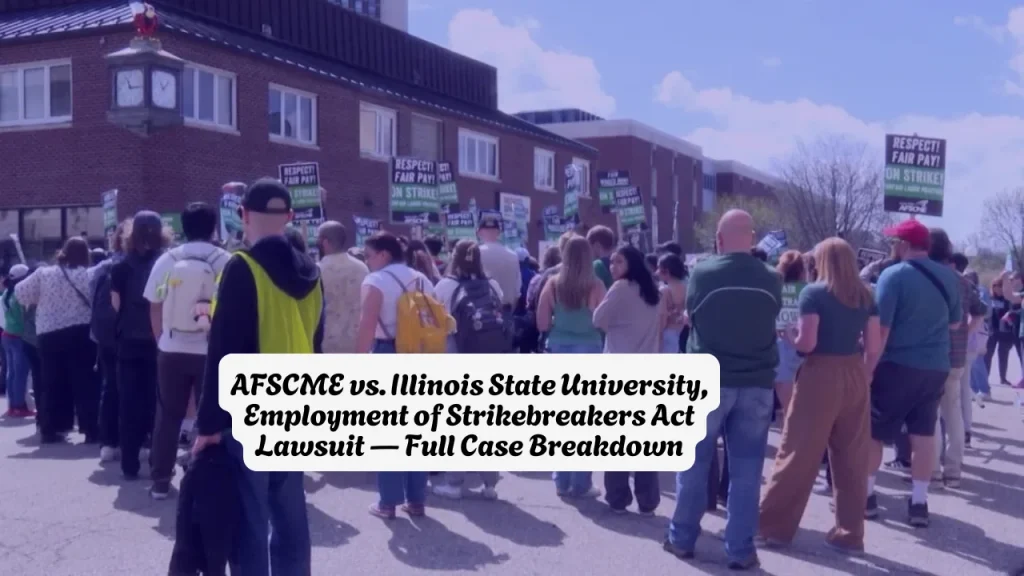
AFSCME Council 31 et al. v. Illinois State University Board of Trustees et al. is a labor lawsuit filed April 22, 2026, in which union AFSCME Local 1110 alleges that Illinois State University violated the Illinois Employment of Strikebreakers Act (820 ILCS 30/2) by contracting with at least four private companies to provide temporary replacement workers after more than 300 building services, grounds, and dining staff went on strike on April 8, 2026. The union seeks a permanent injunction barring the university from using those workers. No court date has been set.
Quick Facts
| Field | Detail |
| Case Name | AFSCME Council 31, et al. v. Illinois State University Board of Trustees, et al. |
| Court | Circuit Court for the Eleventh Judicial District, McLean County, Illinois |
| Judge Assigned | Judge Rebecca Foley |
| Date Filed | April 22, 2026 |
| Plaintiffs | AFSCME Council 31; AFSCME Local 1110 President Chuck Carver; Normal Township Supervisor Krystle Able; two ISU students |
| Defendants | ISU Board of Trustees; President Aondover Tarhule; Glen Nelson (VP Finance & Planning); Janice Bonneville (AVP Human Resources); Angie Doolin (Assistant — role TBD per complaint) |
| Legal Claim | Violation of the Illinois Employment of Strikebreakers Act, 820 ILCS 30/2 |
| Relief Sought | Permanent injunction barring ISU from contracting with temporary labor agencies to replace striking workers; declaratory judgment that ISU violated the Act |
| Damages Sought | No monetary damages sought — injunctive relief only |
| Current Stage | Complaint filed; ISU not yet formally served as of April 23, 2026; no hearing date set |
| Next Date | TBD — not yet scheduled by McLean County Circuit Court |
| Last Updated | April 24, 2026 |
Case Timeline
| Date | Event |
| June 30, 2025 | Previous AFSCME Local 1110 collective bargaining agreement with ISU expires |
| March 26, 2026 | AFSCME Local 1110 holds news conference as contract negotiations reach stalemate |
| April 8, 2026 | AFSCME Local 1110 strike begins — more than 300 building services, grounds, and dining employees walk out |
| April 15, 2026 | AFSCME sends letter to ISU identifying four contracted companies and demanding ISU stop using temporary labor |
| April 15–21, 2026 | ISU gives no response to AFSCME’s letter, according to the complaint |
| April 22, 2026 | AFSCME Council 31 files lawsuit in McLean County Circuit Court |
| April 23, 2026 | ISU spokesperson Chris Coplan states university has not received formal court notification; ISU denies wrongdoing |
| TBD | ISU formal response deadline — not yet set |
| TBD | Hearing on injunction — not yet scheduled |
What Is the AFSCME vs. ISU Lawsuit About? AFSCME Council 31, et al. v. ISU Board of Trustees, et al., McLean County Circuit Court
AFSCME Local 1110 represents roughly 350 ISU employees in building services, grounds maintenance, and dining operations. Their collective bargaining agreement with ISU expired on June 30, 2025. After months of failed negotiations over wages — the sticking point described in court filings as an “overall economic offer” — the union served ISU with a 10-day strike notice and workers walked off the job on April 8, 2026. The lawsuit was filed in the Circuit Court for the Eleventh Judicial District in McLean County, Illinois, and has been assigned to Judge Rebecca Foley.
The legal foundation of the complaint is the Illinois Employment of Strikebreakers Act (820 ILCS 30/2), a state labor statute with two key prohibitions. The law states that “no person shall knowingly employ any professional strikebreaker in the place of an employee, whose work has ceased as a direct consequence of a lockout or strike.” The 2004 amendments to the Act — the specific provision AFSCME invokes in this complaint — go further: the statute also prohibits any person or entity from knowingly contracting with a day and temporary labor service agency to provide a replacement for striking or locked-out employees. Violations of the Act are classified as a Class A misdemeanor under Illinois law — the most serious misdemeanor classification, carrying penalties of up to one year in jail and fines of up to $2,500 per offense.
According to the complaint, AFSCME identified four private, for-profit companies that ISU contracted to hire replacement workers, some of whom were being paid at higher rates than the striking employees receive. AFSCME sent a letter to the university on April 15, 2026, identifying the contractors and urging ISU to stop using them. The university gave no response. The complaint argues that ISU’s use of replacement workers directly distorts the labor power balance the Strikebreakers Act was designed to protect — making it easier for the university to sustain operations during the strike and reducing AFSCME’s leverage at the bargaining table.
Related article: 25 Class Action Settlements You Can Claim in May 2026
Who Are the Parties in AFSCME vs. Illinois State University Case?
AFSCME Council 31 is the statewide organizing body of the American Federation of State, County and Municipal Employees in Illinois. AFSCME Local 1110 is the specific local representing ISU’s building services, grounds, and dining staff — the employees currently on strike. The complaint’s named plaintiffs also include Local 1110 President Chuck Carver, an ISU building service worker himself; Normal Township Supervisor Krystle Able, whose inclusion signals the dispute’s community impact beyond the campus; and two ISU students, whose dormitory services and dining access have been disrupted by the strike.
The defendants are institutional rather than personal in nature. The ISU Board of Trustees is named as the governing body with ultimate authority over ISU’s labor contracts and procurement decisions. President Aondover Tarhule is named in his capacity as the university’s chief executive. Three senior administrators are also named: Glen Nelson, Vice President for Finance and Planning; Janice Bonneville, Associate Vice President for Human Resources; and Angie Doolin, whose specific administrative title is TBD — not fully confirmed in verified public reporting as of publication.
ISU spokesperson Chris Coplan responded to the lawsuit on April 23, 2026, stating: “While as a general practice, the University does not comment on pending litigation, it does follow a state procurement process that ensures it is compliant with the law.”
What Does AFSCME Allege?
According to the complaint as filed — all allegations are unproven:
- ISU allegedly contracted with at least four private, for-profit companies to hire temporary employees to cross AFSCME’s picket lines and perform the work of the striking building services, grounds, and dining workers
- ISU allegedly did this knowingly — a required element of the Strikebreakers Act — having been put on written notice by AFSCME on April 15, 2026, and choosing not to respond or change course
- The replacement workers are allegedly being paid higher hourly rates than the striking ISU employees currently receive — a fact the union argues illustrates that cost was not a barrier to paying fair wages in the first place
- ISU’s use of replacement workers allegedly gives the university an unfair advantage in the ongoing contract dispute by allowing it to maintain full operations despite the strike, reducing AFSCME’s leverage to negotiate a better agreement
- The complaint argues that the striking workers face “irreparable” harm because there are no damage remedies available under the Strikebreakers Act — only injunctive relief — meaning the only way to fix the alleged violation is for a court to order ISU to stop the practice immediately
- A longer strike, according to the complaint, harms not just union members but students, the broader ISU community, and the Normal, Illinois local economy
What Happens Next In AFSCME vs. Illinois State University Case?
The case is in its opening stage. ISU had not yet been formally served as of April 23, 2026, and no hearing date had been set. The first procedural step will be formal service of the complaint on ISU, after which the defendants will have a set number of days to respond — either by filing an answer or a motion to dismiss.
This lawsuit is the second legal filing related to the strike. ISU’s faculty union filed an unfair labor practice complaint against the university last week, alleging its members were asked to work in capacities outside their job descriptions to cover striking workers’ duties. That complaint is separate from this case and involves different legal theories and a different union.
The AFSCME complaint asks McLean County Judge Rebecca Foley to issue a permanent injunction — a court order directing ISU to immediately cease using temporary labor contractors to replace the striking workers. If granted, that order would stay in place for the duration of the strike. All specific hearing dates remain TBD — not yet set by the McLean County Circuit Court.
Frequently Asked Questions
Who filed this lawsuit and why?
AFSCME Council 31, the Illinois statewide affiliate of the American Federation of State, County and Municipal Employees, filed the complaint on April 22, 2026, in McLean County Circuit Court. The union alleges ISU illegally hired replacement workers through private contractors during an active strike by building services, grounds, and dining employees — a practice the union says violates 820 ILCS 30/2 and tips the bargaining table against workers.
What court is handling this case?
The Circuit Court for the Eleventh Judicial District, McLean County, Illinois, in Normal/Bloomington, Illinois. The case has been assigned to Judge Rebecca Foley. This is a state court case — not federal — because the Employment of Strikebreakers Act is an Illinois state statute.
What is the current status of the lawsuit?
As of April 24, 2026, the complaint was filed on April 22, ISU had not yet been formally served, and no hearing date had been set. The case is in the earliest pre-response stage. Judge Foley has been assigned but has not yet taken any action on the complaint.
How much money is AFSCME seeking?
None. The complaint does not seek monetary damages. The complaint explicitly states there are no damage remedies available for violations of the Strikebreakers Act — the only relief available is injunctive. AFSCME asks the court to declare ISU in violation of the Act and to permanently bar ISU from contracting with temporary labor agencies to replace the striking workers.
Can I read the court documents?
Yes. The complaint is publicly available. NPR Illinois published the full PDF of the complaint at nprillinois.org. The McLean County Circuit Court docket can also be searched through the Illinois courts public access portal at illinoiscourts.gov.
Is violating the Strikebreakers Act a criminal offense?
Yes — but criminal enforcement is separate from this civil lawsuit. The Employment of Strikebreakers Act classifies violations as a Class A misdemeanor. A Class A misdemeanor in Illinois carries a potential sentence of up to one year in jail and fines of up to $2,500. AFSCME’s lawsuit is a civil action seeking an injunction — it does not itself result in criminal charges, but the union’s attorneys have publicly stated they intend to pursue every available legal avenue as quickly as possible.
What is ISU’s position?
ISU denies wrongdoing. Spokesperson Chris Coplan stated the university follows a state procurement process that ensures compliance with the law. University officials have separately described ISU’s final contract offer as including multiple wage increases and hourly rates comparable to similar positions at other area employers.
Has the Employment of Strikebreakers Act faced legal challenges before?
Yes. The Illinois Employment of Strikebreakers Act was originally enacted in 1975 and expanded in 2003. Legal challenges began even before the 2003 amendments took effect, centering on whether the Act is preempted by the federal National Labor Relations Act (NLRA). The Seventh Circuit Court of Appeals remanded an earlier challenge back to the district court for a merits determination, leaving some ongoing legal uncertainty about the Act’s enforceability — a background issue that ISU may raise in its defense.
Sources & References
- NPR Illinois / WGLT — AFSCME Sues Illinois State University for Allegedly Hiring Strikebreakers, April 22, 2026 (nprillinois.org / wglt.org)
- Central Illinois Proud (WEEK/WMBD) — Union Sues Illinois State University Over Hiring Replacement Workers, April 22, 2026
- Illinois Employment of Strikebreakers Act, 820 ILCS 30/2 — Illinois General Assembly (ilga.gov)
Prepared by the AllAboutLawyer.com Editorial Team and reviewed for factual accuracy against the filed complaint (McLean County Circuit Court, April 22, 2026), NPR Illinois court reporting, and the Illinois Employment of Strikebreakers Act (820 ILCS 30/2) on April 24, 2026. Last Updated: April 24, 2026
Disclaimer: This article is for informational purposes only and does not constitute legal advice. Information about ongoing legal cases is based on publicly available court records and verified reporting. Allegations described in this article have not been proven in court. For advice regarding a particular legal situation, consult a qualified attorney.
About the Author
Israr Ahmad is a legal content researcher with 4+ years of experience covering class action settlements and consumer rights cases. He has researched and published coverage of 2,500+ settlements using verified court records, settlement administrator filings, and government sources. Learn more about Israr.