
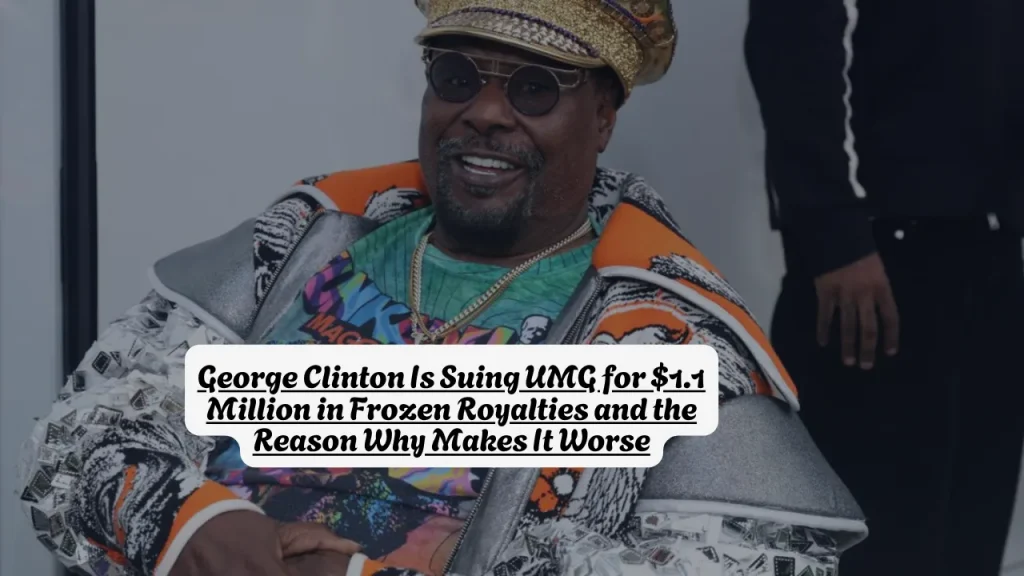
George Clinton Is Suing UMG for $1.1 Million in Frozen Royalties and the Reason Why Makes It Worse
George Clinton is suing UMG Recordings, claiming the music corporation owes him more than $1.1 million in royalties. Clinton says UMG has been withholding 100% of his royalties for more than three years based on the company’s involvement in a separate case filed by the estate of a former bandmate. Clinton is the founder of the Rock & Roll Hall of Fame collective Parliament-Funkadelic, and the royalties at issue cover music he recorded starting in 1969 and into at least the 1990s, across multiple catalogs now controlled by UMG. The court already ruled against that former bandmate’s estate. UMG is still holding the money.
Quick Facts: Clinton v. UMG Recordings
| Field | Detail |
| Plaintiff | George Clinton |
| Defendant | UMG Recordings |
| Alleged Violation | Breach of contract — wrongful withholding of royalties under longstanding recording agreements |
| Amount Sought | $1.1 million+ in unpaid royalties, plus damages, interest, and a court-ordered accounting |
| Court & Jurisdiction | U.S. District Court, Eastern District of Michigan (Detroit) |
| Case Type | Individual breach of contract — not a class action |
| Lawsuit Filed | May 2026 |
| Settlement Status | No settlement — early litigation phase |
| UMG Response | TBD — UMG had not responded to press inquiries as of filing |
| Last Updated | May 17, 2026 |
What UMG Did — and Why Clinton Says It Has No Legal Basis
Clinton alleges that UMG is withholding all his royalties based on a separate lawsuit in which the estate of late Parliament-Funkadelic keyboardist and songwriter Bernie Worrell claimed that Clinton deceived Worrell and failed to share millions of dollars generated by dozens of their songs, including hits like “Give Up the Funk,” “Flash Light,” and “Maggot Brain.”
Here is the problem with UMG’s position: that case is over, and Clinton won it.
In September 2025, federal Judge F. Kay Behm in Detroit dismissed the Worrell estate’s claims, ruling that Worrell was not reasonably diligent in protecting his alleged co-authorship rights for decades. The Worrell estate’s case is currently pending in a federal appeals court, but the trial court already ruled against the estate.
Even before that ruling, Clinton’s complaint makes the point plainly. “UMG faces no claim, no demand, no judgment, and no potential liability in the Worrell Litigation,” the lawsuit states. “The amount UMG is withholding bears no rational relationship to any ‘potential liability in issue.’ Indeed, no such potential liability exists at all.”
Furthermore, UMG also froze tens of thousands of dollars in royalties generated from Clinton’s independent production work for the rock band the Red Hot Chili Peppers — recordings the Worrell estate never claimed any interest in, created decades after Worrell’s involvement with Parliament, on a different label, with different artists, and under a completely different contract.
This is what makes the lawsuit significant beyond just the dollar amount. UMG used a third party’s legal dispute — one that Clinton was winning — as a reason to freeze every dollar Clinton earned, including money from projects that had nothing to do with Bernie Worrell or Parliament. For a broader look at how streaming platforms and labels have handled music royalty disputes with artists, see our breakdown of the Spotify royalty lawsuit and fraudulent stream allegations.
Are You Part of the George Clinton Lawsuit Against UMG?
This is not a class action. It is Clinton’s individual breach of contract case against UMG Recordings. There is no open claim form and no settlement fund.
That said, the legal issue at the center of this case — a record label unilaterally freezing an artist’s royalties as a precaution against a third-party lawsuit, with no court order requiring it — is not unique to Clinton. If you are a musician or rights holder with royalties held by a major label, here is how to know if this case is relevant to your situation:
Related article: Carnival Valor Mobility Scooter Lawsuit, What Happened to Etta Brock and Why It Matters to Every Disabled Cruise Passenger
- You may have a similar claim if a record label has frozen or withheld your royalties citing pending litigation that does not name you as a party and does not impose any court-ordered hold on your accounts
- You may have a similar claim if a label has withheld royalties from recordings that have no connection to any disputed claim — different artists, different contracts, different eras
- You are NOT part of this specific case because this is Clinton’s individual lawsuit — it does not automatically include other artists
- You do NOT qualify if the royalties being withheld are the subject of an active, valid legal dispute or court order in which your rights are genuinely at issue
If you believe a label is withholding royalties without legal justification, you need a consumer rights lawyer or entertainment attorney who specializes in music contracts and compensation for damages under breach of contract claims.
George Clinton’s Broader Fight for His Catalog
The UMG lawsuit is the latest front in a decades-long legal battle Clinton has fought over control of his own music.
In March 2025, Clinton filed a separate $100 million lawsuit against music executive Armen Boladian and his companies, including Bridgeport Music, accusing them of orchestrating a decades-long scheme to fraudulently obtain the copyrights to approximately 90% of his music catalog. Clinton alleged that Boladian withheld royalties, failed to provide proper accounting, and added fictitious songwriters to Clinton’s songs to dilute his share of publishing royalties.
That case is separate from the UMG lawsuit and remains in active litigation. It involves different defendants, different contracts, and different legal theories — but it is part of the same underlying reality: one of the architects of American funk music has spent decades fighting to receive payment for his own work.
The UMG complaint was filed in Detroit’s federal court because the Worrell case was originally filed there and because many of the recordings at issue were created in Michigan. Clinton resides in Florida. UMG is headquartered in California. The case crosses three states and spans more than 50 years of recorded music.
Artists navigating similar label disputes will find useful context in our coverage of how the Eminem publishing lawsuit revealed the hidden mechanics of streaming royalty liability.
George Clinton v. UMG — Lawsuit Timeline
| Milestone | Date |
| Bernie Worrell dies of lung cancer | June 2016 |
| Worrell estate files lawsuit against Clinton in Detroit federal court | 2022 |
| Court dismisses UMG and other music companies from Worrell litigation | 2023 |
| UMG begins withholding 100% of Clinton’s royalties | Approximately 2022–2023 |
| Clinton files separate $100M lawsuit against Armen Boladian / Bridgeport Music | March 11, 2025 |
| Judge Behm rules against Worrell estate — case dismissed at trial level | September 4, 2025 |
| Worrell estate appeals ruling — case pending in federal appeals court | Late 2025 |
| Clinton files lawsuit against UMG in Detroit federal court | May 2026 |
| UMG response due | TBD — not yet filed as of publication |
| Next scheduled hearing | TBD — case in early stages |
Frequently Asked Questions
Is there a class action lawsuit against UMG for withholding artist royalties?
No. Clinton’s case is an individual breach of contract lawsuit. No class action against UMG over royalty withholding has been filed in connection with this case. If you are an artist with a similar dispute, you would need to pursue your own claim.
How can UMG legally freeze Clinton’s royalties if the Worrell case was dismissed?
Clinton’s complaint argues that UMG faces no claim, no demand, no judgment, and no potential liability in the Worrell litigation — and that the amount being withheld has no rational relationship to any actual exposure. Whether UMG had contractual authority to do this is the core legal question the court will now decide. No court has yet ruled on it.
Did George Clinton win the Bernie Worrell lawsuit?
Yes. In September 2025, a federal judge in Detroit dismissed the Worrell estate’s claims, ruling that Worrell was not reasonably diligent in protecting his alleged co-authorship rights for decades. The estate is currently appealing that decision.
What recordings are at stake in the Clinton v. UMG lawsuit?
The recordings include Parliament-era work from 1969 onward, later solo and production work, and collaborations with other artists — including Clinton’s independent production work for the Red Hot Chili Peppers, which the Worrell estate never claimed any interest in.
Can I sue a record label for freezing my royalties?
If a label is withholding your royalties without a court order, contractual basis, or valid legal justification, you may have a breach of contract claim. The specifics depend entirely on your recording agreements. Consult an entertainment attorney or class action lawsuit attorney who handles music industry contracts before taking action.
When will Clinton receive his royalties from UMG?
TBD — the case was filed in May 2026 and is in its earliest stages. No settlement has been announced. UMG had not publicly responded to the lawsuit as of publication.
Disclaimer: This article is for informational purposes only and does not constitute legal advice. Legal claims and outcomes depend on specific facts and applicable law. For advice regarding your particular situation, consult a qualified entertainment or music law attorney.
Prepared by the AllAboutLawyer.com Editorial Team and reviewed for factual accuracy against court records and verified news reporting. Last Updated: May 17, 2026.
About the Author
Israr Ahmad is a legal content researcher with 4+ years of experience covering class action settlements and consumer rights cases. He has researched and published coverage of 2,500+ settlements using verified court records, settlement administrator filings, and government sources. Learn more about Israr.