
ACLU vs. National Park Service, First Amendment ‘Obscene’ Anti-Trump Protest Sign Dispute Full Case Breakdown
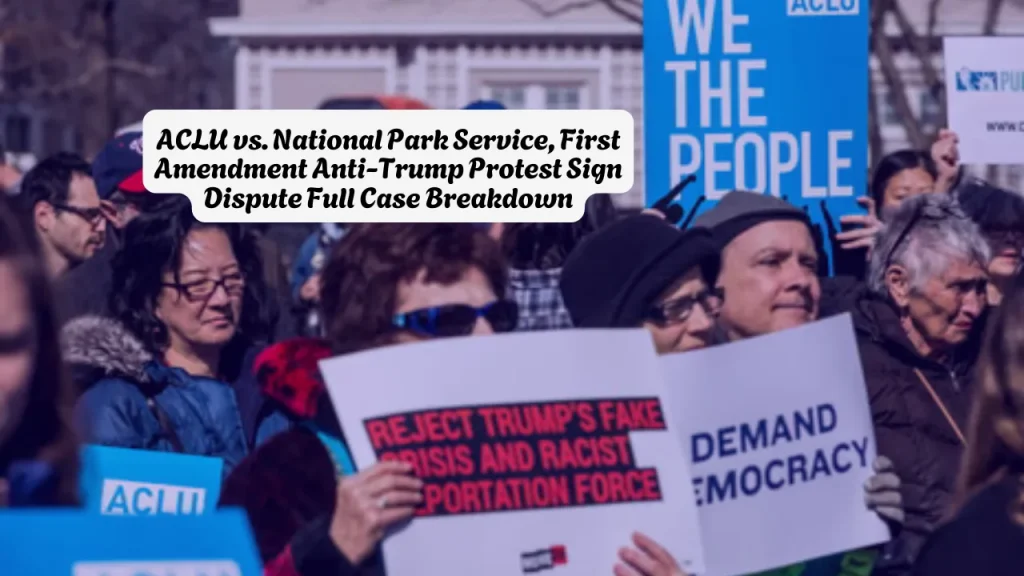
ACLU of Washington, D.C. vs. National Park Service is a First Amendment civil lawsuit in which the American Civil Liberties Union alleged that officials with the National Park Service violated the free speech rights of anti-Trump demonstrators on the National Mall by labeling their protest signs “obscene” and threatening to revoke their demonstration permit. The lawsuit, filed on April 24, 2026, in the U.S. District Court for the District of Columbia, names NPS Superintendent Dr. Kevin Griess and Interior Secretary Doug Burgum as defendants. The ACLU seeks a court declaration that the signs are constitutionally protected political speech under the First Amendment.
Quick-Facts
| Field | Detail |
| Plaintiff | Accountability NOW USA (represented by ACLU of Washington, D.C.) |
| Defendants | Dr. Kevin Griess, Superintendent of Washington’s National Mall and Memorial Parks; Doug Burgum, U.S. Secretary of the Interior |
| Case Type | Civil Rights — First Amendment / Free Speech |
| Court | U.S. District Court for the District of Columbia |
| Date Filed | April 24, 2026 |
| Legal Claims | Violation of the First Amendment to the U.S. Constitution; viewpoint-based censorship of protected political speech |
| Relief Sought | Declaratory judgment that the protest signs are not legally obscene and are protected by the First Amendment; injunctive relief against permit revocation |
| Current Stage | Active — recently filed; no hearing date set |
| Next Scheduled Date | TBD — pending court scheduling |
| Plaintiff’s Counsel | Laura Follansbee, Staff Attorney, ACLU of Washington, D.C. |
| Last Updated | April 24, 2026 |
Case Timeline
| Date | Event |
| December 12, 2025 | Accountability NOW USA begins continuous permitted demonstration on the National Mall |
| Early 2026 | Brief demonstration hiatus due to inclement weather |
| April 13, 2026 | National Park Service issues Accountability NOW USA a current demonstration permit valid through August 12, 2026 |
| April 14, 2026 | NPS agent emails Accountability NOW USA, claiming anti-Trump signs are “not protected by the first amendment and is therefore prohibited and a violation of law,” according to the complaint |
| Shortly after April 14, 2026 | Dr. Kevin Griess, Superintendent of the National Mall and Memorial Parks, sends follow-up correspondence stating the signs were “evaluated under all appropriate standards and tests” and determined to be unlawfully obscene, per the complaint |
| April 24, 2026 | ACLU of Washington, D.C. files lawsuit in the U.S. District Court for the District of Columbia on behalf of Accountability NOW USA |
| Next hearing | TBD — pending court scheduling |
What Is the ACLU vs. National Park Service Lawsuit About? Accountability NOW USA v. Griess et al., U.S. District Court for the District of Columbia
This lawsuit centers on whether the National Park Service (NPS) violated the First Amendment to the U.S. Constitution by applying an obscenity designation to political protest signs critical of President Trump — and by threatening to revoke a standing demonstration permit as a consequence. According to the complaint, Accountability NOW USA — an unincorporated group of volunteers that has maintained a continuous permitted protest on the National Mall since December 12, 2025 — began displaying two new signs in early April 2026 that referenced allegations of sexual misconduct by President Trump in connection with the late convicted sex offender Jeffrey Epstein. The signs emerged in the wake of public controversy over allegations that the Justice Department withheld Trump-related materials from the public Epstein files.
On April 14, 2026, an NPS agent emailed the group claiming the signs were “not protected by the first amendment and is therefore prohibited and a violation of law,” according to the complaint. After the group sought clarification, Dr. Kevin Griess — the Superintendent of Washington’s National Mall and Memorial Parks — sent correspondence stating the material had been “evaluated under all appropriate standards and tests” and determined to be unlawfully obscene. Griess allegedly warned the NPS could take further steps to “ensure compliance,” including removal of the signs. The group alleges this constituted a credible threat that its demonstration permit, which runs through August 12, 2026, would be revoked if it did not comply.
The legal standard for obscenity under U.S. law is deliberately narrow. Under the framework established by the Supreme Court in Miller v. California (1973), material qualifies as obscene only if it meets a three-part test: it must appeal predominantly to prurient interests, depict sexual conduct in a patently offensive way under community standards, and lack serious literary, artistic, political, or scientific value. The ACLU argues the signs at issue — political commentary referencing alleged presidential misconduct — cannot meet this standard.
According to the complaint, the ACLU stated that “political criticism of the President is not obscene simply because it references alleged sexual misconduct.” The Interior Department responded to press inquiries by stating that “this language is not protected under the First Amendment” and referenced America’s upcoming 250th anniversary celebrations and the presence of visitors of all ages on the National Mall. Accountability NOW USA organizer Anita Carey said in a statement the government was “making up charges as a weapon against the First Amendment to shut down speech they don’t like.”
Related article: Catrine Jarman vs. Karen Spencer Medical Privacy Lawsuit: The Full Story and Final Outcome
Who Are Accountability NOW USA and the Named Defendants?
Accountability NOW USA is an unincorporated group of volunteers who have maintained an anti-Trump demonstration on the National Mall since December 12, 2025, under a permit issued by the National Park Service. The group has held its demonstration at the same location without interruption — save for a brief weather-related pause in early 2026. Its current permit was issued by the NPS on April 13, 2026, and runs through August 12, 2026. The group received its ACLU representation through the Washington, D.C. chapter, with staff attorney Laura Follansbee named as counsel of record in the filing.
Dr. Kevin Griess is the Superintendent of Washington’s National Mall and Memorial Parks, the NPS unit that manages the federally controlled public spaces around the monuments and memorials in the District of Columbia. According to the complaint, Griess personally sent the correspondence characterizing the protest signs as unlawfully obscene and warning of potential enforcement action to ensure compliance.
Doug Burgum, the U.S. Secretary of the Interior and head of the agency that oversees the National Park Service, is named as a co-defendant in his capacity as the cabinet official responsible for NPS policy. The complaint alleges the threat against Accountability NOW USA fits within a broader pattern of the Trump administration’s actions against demonstrations critical of the president — including the September 2025 dismantling of a long-running peace vigil near the White House and the removal of a permitted satirical statue depicting Trump and Epstein on the National Mall.
What Is at Stake in ACLU vs National Park Service Lawsuit?
The immediate stakes for Accountability NOW USA are direct: if NPS officials revoke the group’s demonstration permit or physically remove its signs before the court acts, the group loses its legal right to continue a protest it has maintained continuously since December 2025. The permit currently runs through August 12, 2026, and the complaint alleges the government’s threat to revoke it — tied specifically to the content of the signs — amounts to viewpoint-based censorship, one of the most disfavored forms of government action under First Amendment doctrine. Federal courts have consistently held that the government may regulate the time, place, and manner of speech in public forums but cannot restrict speech based on its viewpoint or content, particularly in places like the National Mall that courts have long recognized as a traditional public forum for political expression.
The broader constitutional stakes extend well beyond this specific demonstration. If a federal court rules in the plaintiffs’ favor and declares the NPS obscenity determination unlawful, it would set a clear boundary against government agencies using obscenity law as a tool to suppress political speech critical of sitting officials. A ruling against the ACLU, conversely, would give federal land managers broader authority to restrict demonstration content based on content judgments. The lawsuit also sits within a documented series of NPS actions under the current administration involving public expression — from removing historical exhibits about slavery and civil rights to voiding national park passes that visitors altered to cover the president’s image.
Civil liberties organizations argue that taken together, these actions represent a coordinated effort to reshape what political and historical expression is permitted on federally managed public land. The ACLU is seeking both a declaratory judgment — a court ruling that the signs are constitutionally protected — and injunctive relief to prevent permit revocation while the case proceeds.
What Happens Next in the ACLU vs National Park Service Case?
The lawsuit was filed on April 24, 2026, in the U.S. District Court for the District of Columbia — the federal court with jurisdiction over legal challenges to federal agency actions in Washington, D.C. The next step involves the court issuing a scheduling order, and the ACLU may seek a temporary restraining order (TRO) or a preliminary injunction to block any permit revocation or sign removal before the case resolves on the merits. A TRO can be granted within days if the court finds the plaintiff faces imminent, irreparable harm — the allegation that removal is threatened and the permit may be revoked could support such a request.
The defendants will have an opportunity to respond to the complaint and contest the plaintiffs’ characterization of the emails and their legal significance. Neither the White House, the National Mall superintendent’s office, nor the Interior Department has commented on the specific legal merits beyond the Interior Department’s statement to The Independent asserting the speech is unprotected. No hearing date has been set. This page will be updated as the federal docket develops.
Frequently Asked Questions
Who filed this lawsuit and why?
The ACLU of Washington, D.C. filed the lawsuit on April 24, 2026, on behalf of Accountability NOW USA, an unincorporated volunteer group that has protested against President Trump on the National Mall since December 12, 2025. According to the complaint, the group filed suit after NPS officials threatened to revoke its demonstration permit unless it removed two signs that officials labeled unlawfully obscene.
What court is handling this case?
The case is pending in the U.S. District Court for the District of Columbia — the federal court that handles civil lawsuits involving federal agencies and government officials operating in Washington, D.C.
What is the current status of the case?
The case is active and in the earliest stage of proceedings. The complaint was filed on April 24, 2026. No hearing date has been set. The ACLU may seek emergency injunctive relief to prevent any permit revocation before the court rules on the merits.
How much is the plaintiff seeking in damages?
The complaint does not seek monetary damages. Accountability NOW USA is asking the court for a declaratory judgment that its protest signs are constitutionally protected political speech and injunctive relief preventing the NPS from revoking its demonstration permit or removing its signs based on the government’s obscenity determination.
Can I read the court documents?
The complaint was filed in the U.S. District Court for the District of Columbia. Court filings in this case should be accessible through PACER at pacer.gov, and E&E News by POLITICO has linked directly to the court filing in its coverage dated April 23, 2026.
What is the legal definition of obscenity and why does it matter here?
Under the Supreme Court’s 1973 Miller v. California ruling, material is legally obscene only if it meets all three parts of a specific test: it must appeal primarily to prurient interests, depict sexual conduct in a patently offensive manner by community standards, and lack serious literary, artistic, political, or scientific value. The ACLU argues that political signs criticizing a sitting president — even those referencing allegations of sexual misconduct — carry inherent political value and therefore cannot satisfy this test. The NPS obscenity designation is central to the lawsuit because obscenity is one of the narrow categories of speech that the First Amendment does not protect.
What pattern of protest restrictions does the complaint reference?
According to the complaint, the threat against Accountability NOW USA’s signs is part of a broader set of actions the Trump administration has taken against demonstrations on federal land. The filing specifically references the September 2025 removal of a long-running peace vigil near the White House — which the administration attributed to homeless encampment clearance — and the removal of a satirical statue depicting Trump and Epstein on the National Mall, even though the creators held a permit. Separately, the administration has also directed the removal of NPS historical displays related to slavery, civil rights, and climate change.
What does the Interior Department say about the obscenity designation?
The Interior Department issued a statement to The Independent saying: “As a reminder, we are approaching America’s 250th and we have visitors of all ages coming to our nation’s capital. This language is not protected under the First Amendment.” The department did not address the specific legal framework for obscenity or explain how the signs were evaluated under the Miller test.
Sources & References
- E&E News by POLITICO (April 23, 2026): ACLU sues National Park Service over ‘obscene’ Trump protest signs
- ACLU of Washington, D.C. Press Release (April 24, 2026): Anti-Trump demonstrators sue over First Amendment violation based on false obscenity claims
Prepared by the AllAboutLawyer.com Editorial Team and reviewed for factual accuracy against verified reporting from E&E News by POLITICO and The Independent on April 24, 2026. Last Updated: April 24, 2026
Disclaimer: This article is for informational purposes only and does not constitute legal advice. Information about ongoing legal cases is based on publicly available court records and verified reporting. Allegations described in this article have not been proven in court. For advice regarding a particular legal situation, consult a qualified attorney.
About the Author
Israr Ahmad is a legal content researcher with 4+ years of experience covering class action settlements and consumer rights cases. He has researched and published coverage of 2,500+ settlements using verified court records, settlement administrator filings, and government sources. Learn more about Israr.