
Xenia YMCA Case That Started It All, What Actually Happened and Why Ohio Lawmakers Used It to Push HB 249
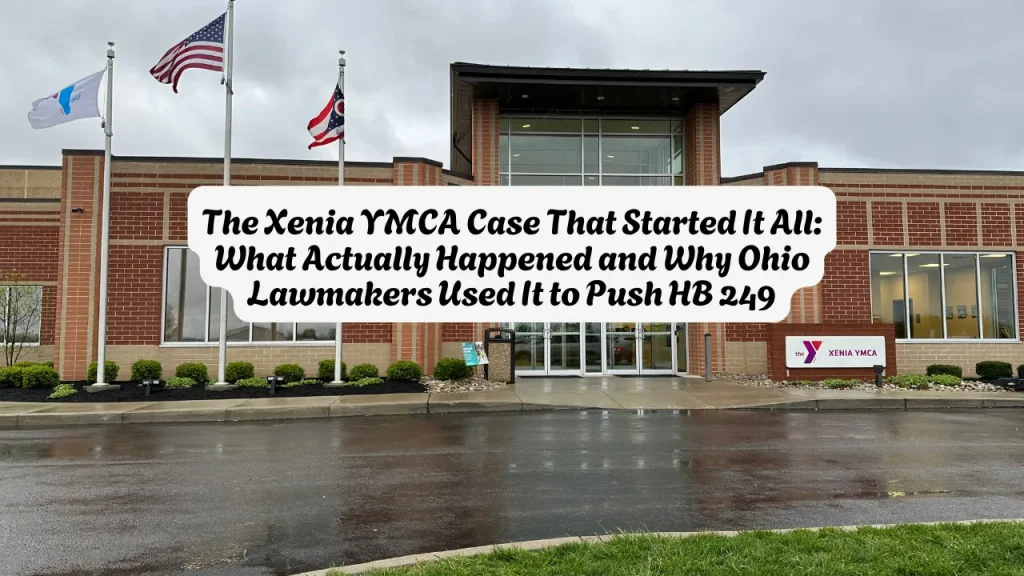
Every major piece of legislation has a story behind it. For Ohio House Bill 249 — the Indecent Exposure Modernization Act — that story begins not in the Ohio Statehouse but in a women’s locker room at a YMCA in Xenia, a small city in Greene County about fifteen miles east of Dayton.
Supporters of HB 249 cited the Xenia case repeatedly in committee hearings and floor debate as the real-world evidence that Ohio’s indecent exposure law had a gap that needed closing. Critics said the case was being misrepresented — that the acquittal at the center of it was not a loophole but the law working correctly.
This article tells the complete story of what happened in Xenia, what the court actually found, and why it became such a central justification for a bill that reaches far beyond a single locker room in southwestern Ohio.
The Setting: Xenia, Ohio, and the YMCA Policy
The Greater Dayton YMCA is a regional network of fitness facilities serving communities across the Dayton metropolitan area, including a branch on Progress Drive in Xenia. Like other YMCA organizations across the country, it operates under a policy consistent with Ohio’s civil rights protections for transgender individuals.
The YMCA of Greater Dayton has stated that state non-discrimination laws require it to allow transgender individuals to use locker rooms, changing rooms, and bathrooms that align with their gender identity. The organization does ask, in posted locker room guidelines, that patrons remain properly covered while in public areas of the locker room.
Rachel Glines, a 31-year-old transgender woman from Fairborn, Ohio, was a member of the Greater Dayton YMCA. She had not undergone gender-affirming surgery. The executive director of the Fairborn YMCA, Jacqueline Brockman, testified in court that Glines had been authorized by herself and other employees to use the women’s locker room at all Greater Dayton YMCA locations, including Xenia.
That authorization, and the YMCA’s broader inclusive access policy, would become the focal point of everything that followed.
The Incidents: 2021 and 2022
The complaints that eventually led to criminal charges were filed across a span of roughly a year. Xenia police received several complaints of a naked man in the females’ locker room of the YMCA’s Xenia branch.
Three specific incidents formed the basis of the charges:
Incident One occurred sometime between November 2021 and 2022. The timeline was disputed enough that Glines’ attorneys later argued this third charge should be dismissed for vagueness alone.
Incident Two occurred in September 2022. Janell Holloway, one of the witnesses, admitted she did not see the defendant but could hear her breathing loudly. Holloway had known Glines personally for years — she had coached Glines on a tennis team years earlier.
Incident Three occurred in November 2022. Witness testimony indicated that Glines had been in a state of complete undress during the incident, which happened in the common area of the women’s locker room. A mother who encountered Glines told her two daughters to hide in the showers until Glines left.
The women who filed complaints described being deeply disturbed. Janell Holloway testified: “In the weeks following this horrifying experience, I discovered that dozens of women and young girls had also seen Glines completely naked in the women’s locker room at the YMCA. My life has been forever changed because of that one incident in the women’s locker room.”
Those feelings were real, and they were shared by multiple women who encountered Glines at the facility. That human context is important to understanding why the case generated the attention it did in Xenia and eventually in Columbus.
Related article: $24.75M Grubhub Driver Misclassification Settlement, Are You Eligible to Claim? File Claim Before June 18
The Political Temperature: Before Charges Were Filed
Before the criminal process began, the case had already become politically charged at the local level.
Xenia City Council President Will Urschel told a meeting of the Greene County Tea Party that if the city successfully prosecuted the person involved, they might bring legal action against the YMCA for aiding and abetting the alleged crime.
Those remarks created immediate controversy. A spokesperson for the City of Xenia released a statement clarifying that Urschel’s comments were his own and were not authorized by or on behalf of the rest of the City Council, the Mayor, the City Manager, or the Law Director. The spokesperson also said the city’s law department did not plan to bring charges against the YMCA.
Xenia Law Director Donnette Fisher stated directly that it is the policy of her office that the Xenia City Council does not have input in the criminal justice process and that they played no role in the prosecution of the YMCA case. “We will not prosecute anyone for political reasons,” she said.
The criminal charges, when they came, were based on the Xenia Police Division’s own investigation and the language of the state statute — not on political direction from council. But the public statements had already shaped how the case was perceived in the community.
The Charges: Three Counts of Public Indecency
Rachel Glines was charged in Xenia Municipal Court with three counts of public indecency, all fourth-degree misdemeanors, for incidents in September and November 2022, and a third incident between November 2021 and 2022.
Under Ohio law at the time, public indecency required proof that a person recklessly exposed their “private parts” under circumstances likely to affront others nearby who were not members of their household. That phrase — “private parts” — was the legal center of gravity for the entire case, and ultimately the reason it ended as it did.
Glines had been authorized to use the women’s locker room. She was never charged with trespass. The question before the court was narrower: did she expose her private parts, as that term was defined under Ohio law?
The Trial: What the Evidence Actually Showed
The trial took place in March 2023 before Xenia Municipal Court Judge David McNamee, an appointee of Republican Governor Mike DeWine.
Witness testimony in court indicated that Glines had been in a state of complete undress during the incidents. The city prosecutor, Melvin Planas, argued that Glines’ actions recklessly caused the likelihood of affront to others.
Glines’ defense attorneys, Lauren Dever and Keara Dever, challenged the prosecution on the specific element of exposure. Their argument was precise: Ohio’s public indecency law required proof that Glines exposed her genitalia — not merely that she was naked, not merely that others were offended, but that her genitals were actually visible.
The defense argued in its final brief that there was “zero evidence presented that Glines ever exposed her genitals. Therefore, the state has presented zero evidence that there was ever any risk that genitals could be exposed, let alone whether or not that risk was known to Ms. Glines.”
The prosecution countered that regardless of gender identity, Glines showed recklessness by disregarding posted YMCA guidelines to remain properly covered in public areas of the locker room.
One witness testified she could see Glines’ buttocks as Glines walked up and down the common hallway. But the buttocks, under the undefined term “private parts” in Ohio law at the time, did not meet the statutory requirement for the charge.
The Verdict: Not Guilty on All Three Counts
On April 28, 2023, Judge McNamee issued his written decision. The ruling was not guilty on all three counts.
McNamee wrote: “The Court finds that the evidence and testimony is insufficient to support a finding of guilty of Public Indecency. There is no question that the Defendant was in the Women’s Locker Room. However, the Defendant was not charged with trespass, nor was the Defendant charged with being in an area of the YMCA where the Defendant was not supposed to be. Quite simply, the facts do not exist to support a finding of guilt, as charged.”
The judge’s decision focused on two elements required for the offense: exposure of private parts and a culpable state of mind. On the key question of exposure, he wrote: “The state argues that the court should subjectively determine the quality and nature of the coverage that prevents exposure of genitalia. The court declines to do so.”
The legal logic was straightforward. Ohio’s public indecency statute required proof of genital exposure. The prosecution had not proved genital exposure. Therefore, the prosecution had not proved the elements of the offense. The verdict followed from the law as written.
Glines’ attorneys said in a statement: “The facts and law have been on Ms. Glines’ side from the beginning. It’s unfortunate not only for her, but for the entire community, that the filing of these charges ever occurred. We are grateful that the rule of law and the truth prevailed so that Ms. Glines and the community can move on in peace.”
Tom Hagel, professor emeritus at the University of Dayton School of Law, said the judge’s ruling was the right one, though he noted that similar issues would continue to arise until Ohio reached a permanent resolution on whether transgender people who are transitioning can access gender-affirming spaces.
How Supporters Framed the Acquittal as a Legal Loophole
The acquittal did not end the story. For conservative Ohio lawmakers and advocacy groups, the Xenia verdict became Exhibit A for why Ohio’s indecent exposure law was broken.
Their argument was specific: the court’s ruling hinged on the undefined term “private parts.” Because that term had never been defined in the Ohio Revised Code, the judge interpreted it narrowly to mean genitalia only. A transgender woman who was fully undressed in front of other women and girls in a shared locker room was found not guilty because her genitals, specifically, were not provably visible.
During a committee hearing on HB 249, the bill’s co-sponsor, CCV Policy Executive Director David Mahan, addressed the Xenia case directly: “In a previous hearing, legislators said Glines would have been convicted under HB 249, which changes Ohio law from prosecuting exposure of ‘private parts’ to ‘private area,’ meaning ‘the genitals where nude or covered by an undergarment.'”
Mahan made his intent explicit: “This bill would prevent judges from being able to do that in the future.”
That statement — made in public legislative testimony — is one of the most significant pieces of evidence in the debate over what HB 249 is actually designed to do. It confirms that the bill’s private area language change is directly aimed at producing a different legal outcome for situations like the Xenia case.
Janell Holloway also testified directly before the House Judiciary Committee in support of HB 249, recounting her experience and telling lawmakers her life had been forever changed by the encounter in the locker room.
How Critics Framed the Same Acquittal
Critics of HB 249 read the Xenia acquittal very differently — not as evidence of a legal loophole but as evidence of the justice system working correctly.
Their argument was equally specific: Rachel Glines did not commit a crime. She was authorized to use the women’s locker room by the YMCA, which was itself complying with Ohio’s nondiscrimination laws. She was never charged with trespass. The evidence of genital exposure — the element required by law — was not proved. A judge appointed by a Republican governor found her not guilty on all three counts.
Rep. Josh Williams confirmed during House floor debate that the bill would stop transgender Ohioans from using gendered public facilities like locker rooms to change their clothing — a use case that has nothing to do with drag performance.
That admission is what opponents call the tell. HB 249 is titled the Indecent Exposure Modernization Act, and its stated focus is protecting children from obscene performances. But the Xenia case involved no performance. It involved a woman changing her clothes. The bill’s sponsors explicitly stated on the floor of the Ohio House that they wanted the law to produce a different result for exactly that type of situation.
Equality Ohio Executive Director Dwayne Steward stated: “This bill takes regular, everyday activities and turns them into potential crimes, based on whether somebody else might be offended by what other people are wearing. This bill gives government the unacceptable power to police what people wear.”
The Specific Legal Change HB 249 Makes — And Its Consequence for Cases Like Xenia
This is where the legal analysis becomes concrete.
Ohio’s current public indecency law uses the term “private parts,” which is undefined. The Xenia judge interpreted it to require proof of genital exposure. HB 249 replaces “private parts” with “private area,” which the bill defines explicitly to include the genitals, pubic area, buttocks, and the female breast below the top of the areola — whether nude or covered only by an undergarment.
Under this expanded definition, the Xenia analysis changes. A witness who testified she could see Glines’ buttocks walking through the common locker room hallway would now be describing exposure of a “private area” as defined by law. The prosecution’s argument — that full nudity in a shared locker room constituted reckless exposure — would have a clearer statutory basis.
That is the precise legal mechanism HB 249’s supporters designed in response to the Xenia verdict. It is not subtle. It is not incidental. The bill’s own sponsors said so on the record.
What the Case Reveals About HB 249’s Dual Purpose
The Xenia case illuminates something important about HB 249 that gets lost in the drag performance debate: the bill operates on two separate tracks, and one of them has very little to do with performances.
The adult cabaret performance provision in ORC § 2907.39 targets public performances — drag shows, stage performances, festival acts. That is the provision generating most of the national attention.
But the private area change in ORC § 2907.09 targets daily life — locker rooms, changing facilities, situations where transgender individuals who have not undergone surgery use facilities that match their gender identity. That provision was built specifically around the Xenia case.
A law with two very different targets, packaged under a single title, passed by a single vote of 63–32. The Xenia YMCA case is the reason the second target exists in the bill at all.
Where Things Stand Now
As of April 4, 2026, HB 249 has passed the Ohio House and now sits in the Ohio Senate awaiting a vote. The bill has not been signed into law. Existing Ohio law — the law under which Rachel Glines was acquitted in 2023 — remains in effect.
If the Senate passes HB 249 unchanged and the Governor signs it, the legal framework that produced the Xenia acquittal will no longer exist. A transgender person in a similar situation — changing in a locker room matching their gender identity, without genital exposure that could be directly observed, in the presence of people who are offended by their presence — could face a first-degree misdemeanor under the new “private area” standard.
That is not a speculative reading of the bill. It is what the bill’s own sponsors described as their intent.
By AllAboutLawyer.com | Updated April 4, 2026
Also on AllAboutLawyer.com:
- What Does “Regardless of Whether It’s for Consideration” Mean in Ohio HB 249?
- Does Ohio HB 249 Criminalize Being Transgender in Public?
- Ohio HB 249 Penalties: When Does a Misdemeanor Become a Felony?
Legal Disclaimer: This article is for general informational and educational purposes only. It does not constitute legal advice and does not create an attorney-client relationship. Case facts are drawn from court records, news reports, and public legislative testimony. HB 249 has not been signed into law. If you have questions about how this or any other law may affect your specific situation, consult a licensed Ohio attorney in your jurisdiction.
About the Author
Israr Ahmad is a legal content researcher with 4+ years of experience covering class action settlements and consumer rights cases. He has researched and published coverage of 2,500+ settlements using verified court records, settlement administrator filings, and government sources. Learn more about Israr.