
Where Is Assisted Suicide Legal in the World? Every Country Explained
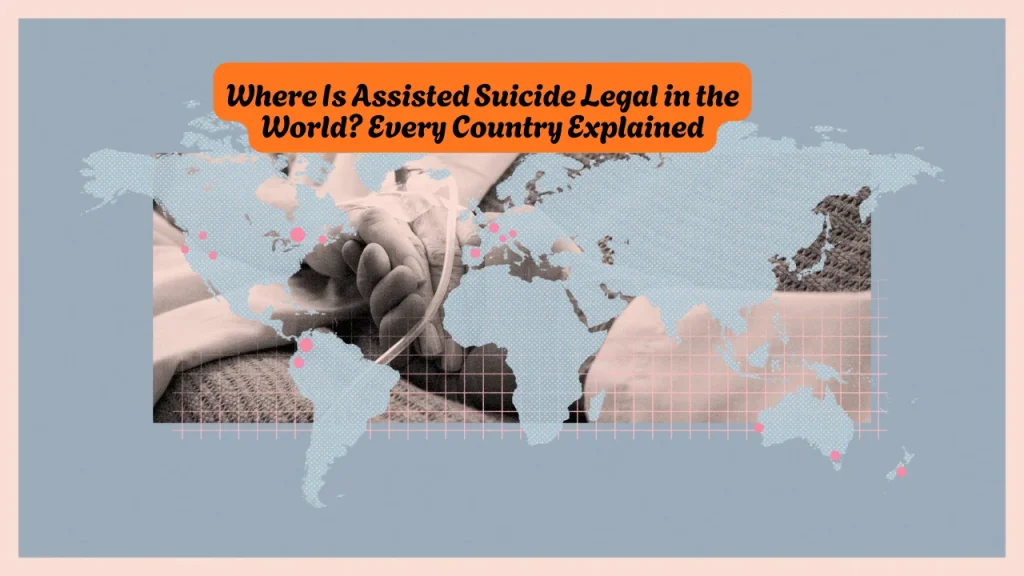
As of 2026, assisted suicide or euthanasia is fully legal in the Netherlands, Belgium, Luxembourg, Canada, Colombia, Ecuador, Spain, New Zealand, Switzerland, Austria, Germany, Uruguay, and all states of Australia. Several U.S. states also permit it. The practice remains illegal in most countries, including the United Kingdom, though legislation there is under active consideration.
Where is assisted suicide legal worldwide?
As of 2026, assisted suicide or euthanasia is fully legal in the Netherlands, Belgium, Luxembourg, Canada, Colombia, Ecuador, Spain, New Zealand, Switzerland, Austria, Germany, Uruguay, and all states of Australia. Several U.S. states also permit it. The practice remains illegal in most countries, including the United Kingdom, though legislation there is under active consideration.
The global legal landscape for assisted suicide — also called medical aid in dying, voluntary assisted dying, or euthanasia — has changed faster in the past decade than in all of history combined. More than 200 million people now reside in jurisdictions where some form of assisted dying is legally permitted.
But the rules vary enormously. Some countries allow only physician-assisted suicide, where the patient self-administers the medication. Others allow euthanasia, where a doctor administers it directly. Some restrict eligibility strictly to terminal illness. Others extend access to chronic conditions, mental illness, or even non-terminal suffering.
This article covers every country and major jurisdiction where assisted dying is legal, permitted, or pending as of 2026 — organized by region, with key facts on what each place allows and who qualifies. For a detailed look at U.S. state laws specifically, see our guide to assisted suicide laws in the United States.
Europe: The Pioneering Continent
Europe is home to the world’s longest-running assisted dying laws and the broadest eligibility criteria anywhere.
The Netherlands
In April 2002, the Netherlands became the first country in the world to legalise euthanasia and assisted suicide. Both physician-assisted suicide and euthanasia are permitted. The Netherlands legalized assisted dying in 2002, allowing assisted suicide and euthanasia. Minors can also request the practice starting at the age of 12 but need parental consent until they are 16. The patient must be suffering unbearably from an incurable condition and must make a voluntary, well-considered request. A second physician must independently confirm eligibility.
Belgium
Belgium legalized assisted death in 2002 and has more open laws than other nations. Belgium’s policy allows for children to access euthanasia, though they must have a terminal illness, be in “great pain” and fully understand the procedure. Belgium also allows euthanasia in patients with mental illnesses, such as degenerative neurological conditions. There is no minimum age for minors, but eligibility criteria for children are strictly applied.
Luxembourg
Luxembourg legalized assisted suicide and euthanasia in 2009 for a person suffering “from an incurable condition constantly in unbearable physical or mental pain.” Parental consent is required for those between the ages of 16 and 18, and assisted dying is not permitted for anyone younger.
Switzerland
Switzerland has permitted assisted suicide since 1942 under its penal code — the longest-standing framework in the world. Switzerland’s laws regarding euthanasia are among the most lenient in the world. Euthanasia is not allowed if the person advocating for doctor-assisted suicide stands to gain anything, such as an inheritance, from the person’s death, but is widely allowed otherwise. Crucially, Switzerland does not require residency — making it a destination for people from countries where assisted dying is illegal, through organizations such as Dignitas and Exit. Active euthanasia by a physician remains prohibited; only assisted suicide is legal.
Spain
Spain passed its euthanasia law in 2021. Those requesting euthanasia must have Spanish nationality or legal residence, must suffer from a serious — though not necessarily terminal — and incurable disease, must have complete knowledge of the process and alternatives, must request the procedure twice with fifteen days between the requests, and must give informed consent. Both euthanasia and assisted suicide are permitted.
Austria
In Austria, a law legalizing assisted suicide passed in 2021 and took effect in 2022. Adults who want to end their lives must produce a diagnosis and have confirmation that they are able to make their own decisions. Minors and those with mental health conditions are excluded. Only assisted suicide is legal — not active euthanasia administered by a physician.
Germany
Germany’s path to legality came through the courts. Germany’s federal constitutional court ruled in 2020 that a law criminalising assisted suicide services was unconstitutional, stating that legislators needed to ensure that sufficient space remains for the individual to exercise their right to a self-determined death. As a result, assisted suicide is legally tolerated in Germany, though no comprehensive statute has yet been passed. Access in practice depends on physicians and organizations willing to participate.
Portugal
Portugal passed a law permitting both euthanasia and physician-assisted suicide in May 2023. However, as of January 2026, the regulation has not yet been drafted and approved by the government. The law will only enter into force 30 days after the regulation is published. Portugal is therefore in a legal gray zone — the law exists but is not yet in force.
Italy
Italy’s situation is similar to Germany’s — legality came through a court ruling rather than legislation. Courts declared the criminalization of assisted suicide unconstitutional, but Italy has extremely narrow eligibility criteria and no comprehensive statute. Access is limited and inconsistent in practice.
Isle of Man
The Isle of Man, a self-governing British Crown dependency, passed the Assisted Dying Act 2025, making it the first jurisdiction in the British Isles to legalize assisted dying.
Related article: What Is Physician-Assisted Suicide? Legal Definition, Eligibility, and Key Facts
The Americas
| Country | Legal Status | Type Permitted | Year |
| Canada | Legal nationally | Both euthanasia and assisted suicide | 2016 |
| Colombia | Legal — court-ordered | Both | 1997/2021 |
| Ecuador | Legal — court-ordered | Euthanasia | 2024 |
| Uruguay | Legal — legislation | Euthanasia only | 2025 |
| United States | Legal in 14 jurisdictions | Assisted suicide only | 1997–2026 |
| Argentina | Passive only | Passive euthanasia | 2012 |
| Chile | Passive only | Passive euthanasia | 2012 |
| Mexico | Passive only (some states) | Passive euthanasia | 2008 |
| Peru | One individual — court ruling | Euthanasia (single case) | 2021 |
| Brazil | Illegal | — | — |
Canada
In Canada, assisted dying was legalized in 2016 for mentally competent adults with an irredeemable medical condition. The condition does not have to be terminal as long as it is irreversible and causes severe mental or physical suffering. Canada also legalized physician-administered euthanasia in 2021. Canada’s Medical Assistance in Dying program is one of the most well-known examples of assisted dying in the world. Canadian euthanasia does not require patients to be terminally ill. Only those eligible for Canadian health insurance may access the program, preventing what is sometimes called “suicide tourism.”
Colombia
Colombia on Thursday became the first Latin American country to authorize assisted medical suicide for patients under a doctor’s supervision, according to a constitutional court decision. Colombia decriminalized euthanasia in 1997 and expanded eligibility in 2021 to patients with non-terminal conditions. Assisted suicide was decriminalized in 2022.
Ecuador
On February 5, 2024, the Constitutional Court of Ecuador ruled that active euthanasia is legal when it is performed by a physician, the patient has given free and informed consent, and the patient is experiencing intense suffering because of a serious and irreversible bodily injury or a serious and incurable disease.
Uruguay
Uruguay’s senate passed a law decriminalizing euthanasia on October 15, 2025, putting the South American nation among a handful of other countries where seriously ill patients can legally obtain help to end their lives. It makes Uruguay the first country in predominantly Catholic Latin America to allow euthanasia via legislation. The legislation permits euthanasia but not assisted suicide, which involves a patient self-administering a lethal dose of prescribed medication. Unlike laws in U.S. states, Australia and New Zealand restricting euthanasia to those with a life expectancy of no more than six months or a year, Uruguay sets no time limits.
United States
Assisted suicide is legal in Colorado, Oregon, Hawaii, New Mexico, Washington, Vermont, Maine, New Jersey, California, the District of Columbia, and is de facto legal in Montana. New York and Illinois also passed laws in 2026, bringing the total to 14 jurisdictions. In all U.S. jurisdictions, only assisted suicide is legal — not physician-administered euthanasia. For a full breakdown of U.S. state laws, eligibility criteria, and how to file requests, see our detailed guide to assisted suicide laws across U.S. states.
Oceania: Australia and New Zealand
Australia
As of November 2025, all states and the Australian Capital Territory have implemented schemes providing assisted suicide and euthanasia for eligible individuals. These laws typically refer to the practices as “voluntary assisted dying.” Voluntary assisted dying schemes have been in effect in Victoria since June 2019, Western Australia since July 2021, Tasmania since October 2022, Queensland since January 2023, South Australia since January 2023, New South Wales since November 2023, and the Australian Capital Territory since November 2025. The Northern Territory does not yet have a scheme in place, though a government inquiry recommended legislation in September 2025.
New Zealand
New Zealand legalized euthanasia and assisted suicide in 2021 for terminally ill patients aged 18 and older. To be approved for an assisted death, two doctors must assess whether the patient’s condition is eligible. Patients must have a terminal illness likely to end their life within six months.
Countries Where Assisted Dying Is Illegal — But Debate Is Active
Many countries have passed legislation or are actively debating it. The following table summarizes the most significant pending situations as of 2026.
| Country | Current Status | Notes |
| United Kingdom | Pending — bill passed House of Commons Nov. 2024 | Further parliamentary votes required before becoming law |
| France | Pending — bill passed National Assembly May 2025 | Senate vote and implementation timeline TBD |
| Slovenia | Voted down in referendum | Referendum held November 2025 — bill rejected by voters |
| Chile | Bill under debate | Bill stalled in Senate; active push by President Boric |
| Ireland | Under discussion | No bill introduced yet |
| Denmark | Neither legal nor criminalized | No specific law either way |
| Finland | Passive euthanasia only | Active euthanasia remains prohibited |
| Sweden | Passive euthanasia only | Active euthanasia prohibited |
| India | Passive euthanasia only | Legal for brain-dead or vegetative state patients since 2018 |
| Germany | Legally tolerated | No comprehensive statute; access varies |
Countries Where Assisted Suicide Is Strictly Illegal
The vast majority of the world’s countries — including most of Asia, Africa, the Middle East, and large parts of Latin America — prohibit assisted suicide and euthanasia entirely. In many of these countries, assisting in a person’s death can result in murder or manslaughter charges regardless of consent. These include Brazil, Japan, South Korea, China, Russia, Pakistan, Nigeria, Saudi Arabia, and most other nations not listed above.
Frequently Asked Questions
Is there any country where non-residents can access assisted dying legally?
Switzerland is the only country where residency is not required to access assisted suicide. Organizations such as Dignitas and Exit in Switzerland legally assist non-residents. All other countries with legal frameworks — including Belgium, Canada, and the Netherlands — require legal residency or citizenship, specifically to prevent what critics call “suicide tourism.”
How long does the assisted dying process typically take in most countries?
Most countries require multiple requests with waiting periods between them. The Netherlands and Belgium require a second independent physician consultation and typically take several weeks. Canada requires a minimum 10-day reflection period. Uruguay and Colombia have no mandatory waiting period. In most jurisdictions, the full process from first request to the procedure takes a minimum of two to four weeks.
Do I need a lawyer to access assisted dying in another country?
You do not need a lawyer for the medical process itself. However, if you are considering traveling to another country — particularly Switzerland — consulting a healthcare attorney in both your home country and the destination country is strongly advisable. Legal implications for family members who accompany you vary significantly by jurisdiction. An estate planning attorney can also help ensure your advance directives and end-of-life documents are in order before you travel.
Which country has the most permissive assisted dying laws in the world?
Belgium, the Netherlands, and Canada are generally considered to have the most permissive frameworks. Belgium has no minimum age restriction for terminally ill minors and permits euthanasia for mental illness. Canada does not require terminal illness and is expanding access to mental health conditions. The Netherlands also permits assisted dying from age 12 with parental consent.
Is assisted dying legal in the United Kingdom?
Not yet. The Terminally Ill Adults (End of Life) Bill passed the House of Commons in November 2024 with 330 votes to 275. It must still pass the House of Lords and receive Royal Assent before becoming law. The timeline for full implementation remains uncertain. Currently, assisting someone to die in the UK is punishable by up to 14 years in prison under the Suicide Act 1961.
Legal Terms Used in This Article
Euthanasia: The deliberate act of ending a patient’s life by a physician or healthcare professional, usually by administering a lethal drug. Legal in Belgium, Netherlands, Canada, Colombia, and others.
Assisted suicide: A situation where a physician prescribes or provides lethal medication that the patient self-administers. Different from euthanasia in that the patient — not the doctor — takes the final action.
Passive euthanasia: Withdrawing or withholding life-sustaining treatment to allow natural death. Legal in many more countries than active euthanasia, including India, Germany, Sweden, and Argentina.
Medical aid in dying (MAID): The umbrella legal term used in Canada, Australia, and U.S. states for lawful physician-assisted death, whether by prescription or direct administration.
Terminal illness: A disease or condition medically expected to cause death within a defined period — most commonly six months or twelve months. Required for eligibility in most jurisdictions.
Unbearable suffering: A subjective eligibility standard used in Belgium, the Netherlands, and Luxembourg that includes both physical and psychological suffering, not limited to terminal conditions.
Residency requirement: A legal condition in most MAID frameworks requiring the patient to be a legal resident or citizen of the jurisdiction where they request assisted dying.
Conclusion
Assisted dying laws have expanded significantly across the globe in the past five years alone — with Uruguay, Ecuador, the Isle of Man, the Australian Capital Territory, New York, and Illinois all joining the list since 2024. As of 2025, at least 12 countries have regulated assisted dying nationally or in selected jurisdictions, and legislation is actively being discussed in France, Ireland, Italy, and the United Kingdom.
The law in this area changes rapidly. If you or a loved one is navigating end-of-life options — whether in the United States or internationally — consulting a qualified healthcare attorney is the most important step you can take. Visit AllAboutLawyer.com to connect with a licensed attorney who can guide you through the legal options available in your jurisdiction.
This article is for informational purposes only and does not constitute legal advice. Laws vary by country and change frequently. Consult a licensed attorney in your jurisdiction for advice specific to your situation. Visit AllAboutLawyer.com to find a qualified healthcare or estate planning attorney.