
When Tyranny Becomes Law Rebellion Becomes Duty — The Phrase America Can’t Stop Debating
When tyranny becomes law rebellion becomes duty is one of the most shared political slogans of the modern era. It means that when a government’s laws become so unjust or oppressive that they violate basic human rights, citizens hold not just a right but a moral obligation to resist — through speech, protest, or principled refusal to comply. The phrase captures centuries of political thought in a single sentence.
Few phrases travel as far or spark as much debate as this one. You have seen it on protest signs, tattooed on arms, trending on social media after every major political flashpoint — immigration raids, healthcare cuts, election controversies. It resurfaces whenever Americans feel the government has crossed a line that law alone cannot justify.
But what does it actually mean legally? Where did it come from? And when you act on it, what happens to you?
Those are the real questions people are asking — and they deserve straight answers.
The Quote Everyone Gets Wrong
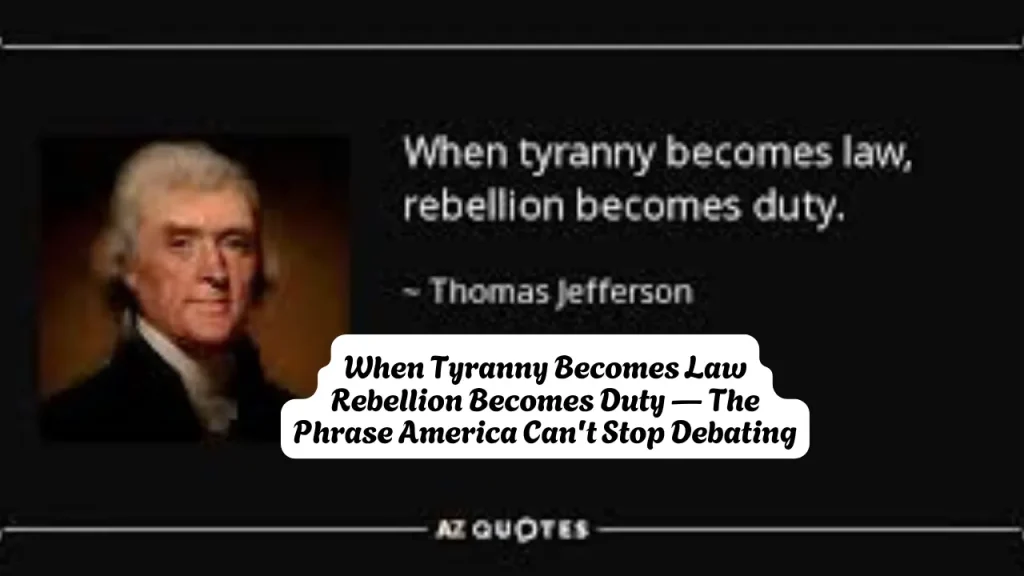
The phrase is almost universally attributed to Thomas Jefferson. The Thomas Jefferson Foundation, which maintains his property at Monticello, has declared the quote “spurious,” meaning there is no documented record of Jefferson ever writing or saying it. Etymologist Barry Popik found no connection to Jefferson, noting the first known attribution to him appeared only in a 2006 book, though the phrase had circulated for decades before that.
Jefferson did, however, genuinely believe in the spirit behind it. In an 1787 letter he wrote that “the spirit of resistance to government is so valuable on certain occasions, that I wish it to be always kept alive.”
So the words are not his — but the idea absolutely is. And it did not originate with one person. The phrase encapsulates a philosophy that echoes through pivotal moments in history, from the Enlightenment era through modern social justice movements. It belongs to a tradition of thought, not a single author.
Why does this matter? Because how you understand the source shapes how you understand the idea. This is not a founding document. It is not constitutional law. It is a moral claim — and one with a very complicated legal shadow.
The Philosophy Behind It — Why It Resonates So Deeply
The idea that unjust laws lose their claim on your conscience is ancient. Thomas Aquinas argued in the 13th century that human law has the capacity to be unjust, and that laws contrary to human dignity carry no moral weight. John Locke, whose writing directly influenced America’s founders, held that governments derive their authority from the consent of the governed — and forfeit that authority when they turn against the people.
The philosophical justification for resistance rests on the tension between legal obligation and moral conviction. Under natural law theory, universal moral principles exist independently of government-made laws, and civil disobedience aligns human law with that higher moral standard. Under social contract theory, governments derive legitimacy from implicit agreements with citizens — agreements that can be broken.
Martin Luther King Jr. gave this tradition its most powerful American expression. In his Letter from a Birmingham Jail, King argued directly: “One has not only a legal, but a moral responsibility to obey just laws. Conversely, one has a moral responsibility to disobey unjust laws.” He also insisted that accepting the legal penalty for breaking an unjust law was itself an expression of the highest respect for the law.
That last part is critical — and it is where the slogan and reality diverge. The phrase says rebellion is a duty. King said it is a duty you must be willing to suffer for. That distinction changes everything when you are standing in front of a judge.
Related article: Florida’s Free Kill Law, How One Statute Lets Doctors Kill Without Consequences and What Your Family Can Still Do
What the Law Actually Says About Resistance
Here is the part most people sharing the slogan have not thought through.
Civil disobedience falls outside the legal protections provided by the First Amendment. Even when done for moral reasons, intentional violations of the law are not protected by the Constitution.
The First Amendment protects your right to assemble and express your views through protest. However, police and other government officials are allowed to place certain narrow restrictions on the exercise of those rights.
The distinction the law draws is precise: advocating for resistance is protected speech. Performing acts of resistance that break the law is not. The First Amendment protects advocating for law changes — but not actually breaking laws.
From the Boston Tea Party to the abolition of slavery to the Civil Rights Movement, encouraging others to engage in civil disobedience has been a consistent feature of American history — and one the First Amendment has historically protected as speech. Frederick Douglass advocated for enslaved people to flee bondage. King urged sit-ins at segregated lunch counters. Both were legally prosecuted. Both are now considered moral heroes.
The legal system has never cleanly resolved this tension — and that is not an accident. Courts have traditionally not provided civil disobedience First Amendment protection, leaving demonstrators engaged in peaceful unlawful conduct excessively exposed to criminal and civil liability. Some legal scholars argue this chills legitimate political dissent and needs to change.
Where the Law Draws the Line in 2025
Recent events have sharpened this debate considerably.
In June 2025, U.S. Capitol Police arrested 34 peaceful protesters, including several people in wheelchairs, during demonstrations over proposed cuts to Medicaid spending. Most were charged with blocking or impeding access to a Senate office building. Legal? No. Morally defensible in their view? Yes. That gap is exactly what the slogan describes.
Also in 2025, National Guard and active-duty Marines were deployed to assist Los Angeles police during protests over federal immigration policies, with many demonstrators blocking freeways — nonviolent, but unlawful.
Some states have responded by substantially increasing criminal penalties for peaceful unlawful conduct associated with protest movements, and organizers of demonstrations now face expansive civil liability theories when others at their events commit violence.
Participants in civil disobedience should understand both their rights and their risks. Knowing the law about permits, curfews, and trespass rules matters. Practicing nonviolence strengthens constitutional protection. Documenting actions with video and witness statements supports claims of peaceful conduct.
The practical reality: you can say the slogan. You can hold the sign. You can organize the march. The moment you block the road, you are in legally unprotected territory — and the consequences depend heavily on where you are, who is watching, and what political climate surrounds the moment.
The Political Dimension — Who Uses It and Why
One of the deepest problems with the phrase is the question it leaves unanswered: how do we truly know the difference between a tyrannical law and a law that people simply dislike or detest?
This is not a small problem. The same slogan has appeared on signs at Black Lives Matter marches, anti-vaccine mandate protests, January 6th rallies, and immigration resistance demonstrations. Every political faction in America has, at some point, believed it was the righteous rebel and the other side was the tyrant.
The Jeffersonian tradition this phrase draws from was never a license for arbitrary disobedience. It presumes a clear and substantial injustice — not a mere policy disagreement. It requires proportionality in response, concern for the rights of others, and genuine efforts to use lawful channels before escalating.
That framework is demanding. It asks the person invoking it to honestly assess whether they face genuine oppression or whether they are simply losing a democratic argument. History shows that people are not always honest — or accurate — in that assessment.
The phrase is most powerful when the oppression is undeniable: Jim Crow laws, the internment of Japanese Americans, forced sterilization programs. It becomes dangerous when it functions as a rhetorical shortcut that lets anyone frame their political grievance as a moral emergency requiring lawbreaking.
What You Can Legally Do Right Now
If you believe a law is unjust, the Constitution provides substantial tools — tools that are protected, effective, and do not put you at legal risk:
Protected speech and expression — You can write, speak, publish, organize, and demonstrate your opposition to any law. Courts have consistently protected sharp, forceful political speech, even when it calls for resistance in general terms.
Peaceful assembly — Peaceful expression is typically protected, even when it conveys unpopular or controversial messages, and nonviolent assembly and organized protests are generally protected rights, subject to reasonable time, place, and manner restrictions.
Legal challenges — Courts exist precisely to strike down unconstitutional laws. Civil rights organizations like the ACLU have dismantled unjust laws through litigation that did not require a single person to be arrested.
Voting and electoral organizing — The most powerful legal tool citizens have is also the most underused. Changing who writes the laws changes the laws.
Conscientious refusal with accepted consequences — Following King’s model, refusing to comply with a specific unjust law while openly accepting arrest turns an individual act into a political statement courts and the public must respond to.
Frequently Asked Questions
Did Thomas Jefferson actually say “when tyranny becomes law rebellion becomes duty”?
Almost certainly not. The Thomas Jefferson Foundation, which manages Monticello, has labeled the attribution spurious. No documented record of Jefferson writing or saying these exact words exists, and the earliest known attribution to him dates only to 2006. Jefferson did hold beliefs consistent with the sentiment, but the phrase itself has no verified origin.
Is civil disobedience protected by the First Amendment?
Advocating for civil disobedience is generally protected speech. Actually performing it — breaking a law as a form of protest — is not constitutionally protected, even when peaceful. You can be arrested and prosecuted. The First Amendment protects your right to speak and assemble, not to violate laws, regardless of your moral justification.
What is the legal risk of participating in a protest that involves civil disobedience?
It depends on the act and the jurisdiction. Blocking traffic, trespassing, or impeding public access to buildings can result in misdemeanor or felony charges. Some states have significantly increased penalties for protest-related offenses. You can also face civil liability. Always know the specific laws in your location before participating, and consult a civil rights attorney if you face charges.
How long does a civil disobedience arrest typically take to resolve?
Minor charges like trespassing or obstruction are often resolved within weeks through plea agreements, especially for first-time offenders. More serious charges, or cases where prosecutors pursue them aggressively, can take months to over a year. Retaining an attorney experienced in protest defense significantly affects the outcome.
Do I need a lawyer if I’m arrested at a protest?
Yes. Even for what seems like a minor charge, an attorney can protect you from consequences that follow you long after the arrest — employment background checks, professional licensing, and future legal proceedings. Many civil rights organizations provide legal support for protesters. Contact the ACLU or the National Lawyers Guild if you need immediate help.
Legal Terms Used in This Article
Civil Disobedience: The deliberate, nonviolent refusal to comply with a specific law or government directive as a form of political protest, typically accompanied by willingness to accept legal consequences.
First Amendment: The constitutional provision protecting freedom of speech, press, religion, assembly, and petition — the foundational legal protection for political expression in the United States.
Social Contract: A philosophical concept holding that governments are legitimate only so long as they uphold the rights of the people who granted them authority.
Natural Law: The theory that universal moral principles exist independently of any government’s written laws, and that human laws derive their legitimacy from conformity with those principles.
Statute of Limitations: The legal deadline by which a criminal charge or civil lawsuit must be filed. For most misdemeanor protest charges, this period is relatively short — typically one to three years depending on the state.
Injunction: A court order requiring a person or government entity to stop or start a specific action. Courts have both issued injunctions against protesters and used them to protect protest rights.
The Line Between a Slogan and a Strategy
“When tyranny becomes law rebellion becomes duty” is a powerful moral statement. It has inspired genuine courage throughout history — abolitionists, suffragettes, civil rights marchers, labor organizers. It captures something real about the limits of legal obligation.
But it is not a legal defense. It does not protect you from arrest. And it does not answer the hardest question it raises — who decides what counts as tyranny?
The law gives you considerable tools to resist, challenge, and change unjust laws without putting yourself in legal jeopardy. Understanding those tools is not a compromise of the slogan’s spirit. It is the most effective way to act on it.
If you believe your rights have been violated by a law or government action, do not simply take to the streets without understanding what you are walking into. Speak with a civil rights attorney who can help you identify the legal avenues available to you. Visit AllAboutLawyer.com to learn more about your constitutional rights and find legal guidance you can actually use.
About the Author
Israr Ahmad is a legal content researcher with 4+ years of experience covering class action settlements and consumer rights cases. He has researched and published coverage of 2,500+ settlements using verified court records, settlement administrator filings, and government sources. Learn more about Israr.