
Olive Trees Burned, Crops Stolen, Farmers Beaten and Almost Nobody Goes to Prison West Bank Farmers Pay the Price
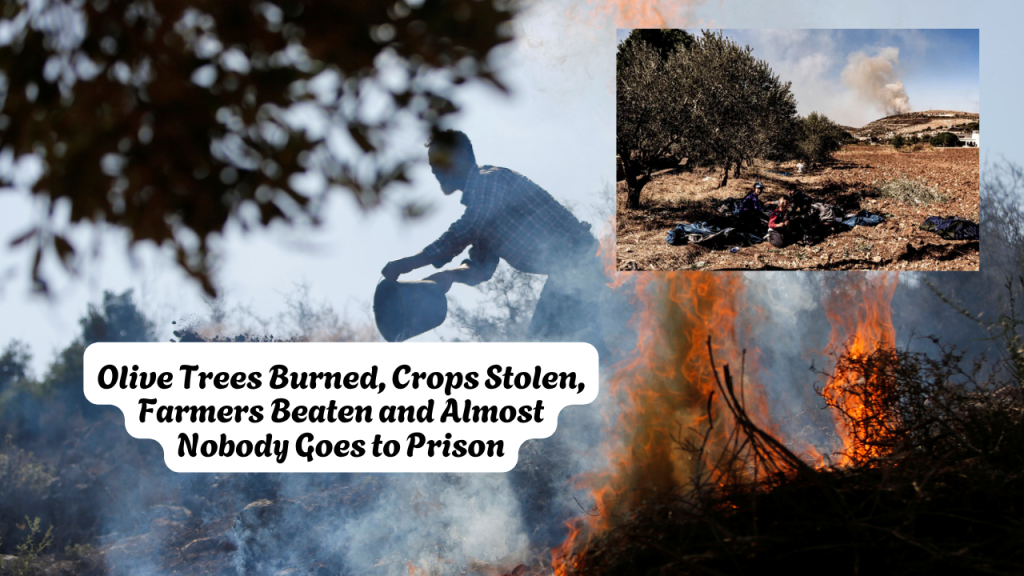
Every October, Palestinian farmers in the West Bank start their olive harvest — a season that for centuries marked a time of family, income, and connection to the land. Today it marks something else too. October 2025 recorded the highest monthly number of Israeli settler attacks since OCHA began documenting such incidents in 2006, with more than 260 attacks — an average of eight per day. Farmers were beaten walking to their groves. Trees were chainsawed overnight. Harvested olives were stolen in daylight. And in the vast majority of cases, no one was charged with anything.
What Is Actually Happening on the Ground
By early December 2025, OCHA had documented 1,680 settler attacks across more than 270 communities throughout the West Bank — averaging five incidents every single day. These are not isolated confrontations between neighbors. They follow a documented geographic pattern: the worst-affected communities consistently sit near Israeli settlement outposts, many of which were established recently and without authorization even under Israeli law.
In the village of Deir Jarir alone, OCHA recorded 12 settler attacks causing casualties or property damage between January and October 2025 — a threefold increase over the annual average from 2020 to 2024. The attacks began after a new road was built connecting a nearby military base to the village and a new settlement outpost was established in the area.
A UN Human Rights Office report covering the 12-month period to October 2025 documented 1,732 incidents of settler violence resulting in casualties or property damage. The report’s language was direct: settler violence occurred in a coordinated, strategic and largely unchallenged manner, with Israeli authorities playing a central role in directing, participating in, or enabling the conduct — making it difficult to distinguish between state and settler violence.
The Olive Harvest: When Palestinian Farmers Are Most Exposed
The olive harvest runs from October through November. For many West Bank families, it represents their primary annual income. In 2023 alone, 96,000 dunums of olive groves were left unharvested due to settler violence, causing over $10 million in losses for Palestinian farmers — a trend that continued through 2024 and 2025.
Between October 1 and November 3, 2025, OCHA documented 150 olive-harvest-related settler attacks, resulting in injury to more than 140 Palestinians and vandalism of over 4,200 trees and saplings across 77 villages. The attacks included farmers being beaten inside their groves, crops and harvesting equipment stolen, and overnight tree destruction.
Access restrictions compounded the damage. In Tarqumiya, coordination for land access was granted for a single day, covering only 500 dunums out of over 5,000 previously accessible. In Bani Na’im, accessible land dropped from about 150 dunums in prior years to just 12 dunums this season. Farmers who had worked their own land for generations were told they needed “prior coordination” from Israeli military authorities to return.
Related article: Google’s Lawyers Said Their Privacy Settlement Was Worth $1.4 Billion. The Judge Disagreed Loudly
94% of Investigations Go Nowhere — The Numbers Behind the Impunity
The attacks are documented. The problem is what happens — or doesn’t happen — afterward.
Since 2005, Yesh Din has monitored thousands of police investigation files into ideologically motivated offenses by Israelis against Palestinians in the West Bank. Their data shows that 93.6% of all concluded investigation files ended without an indictment, and just 3% led to a full or partial conviction.
Between 2020 and 2025, over 96% of police investigations into settler violence concluded without an indictment. Out of 368 cases tracked in that period, only eight — two percent — resulted in full or partial convictions.
The reasons cases close are themselves contested. Israeli law enforcement authorities cite inability to identify perpetrators or gather evidence. Yesh Din argues the data points to systemic failure — and that the government’s stated intention to expand settlements, combined with the appointment of far-right figures to oversee the police, has sent a clear message that organized settler violence is tolerated as a means of achieving territorial goals.
One result is that Palestinian victims largely stopped filing complaints at all. Between January 2023 and September 2024, Yesh Din documented 328 incidents of harm to Palestinians, and in 60.6% of them, the crime victims chose not to file a complaint — with most citing deep mistrust of Israeli authorities or fear that doing so would cost them a work or entry permit.
Former Israeli Security Chiefs Called It “Organised Jewish Terrorism”
The impunity crisis is not only documented by Palestinian rights groups or UN bodies. Dozens of former Israeli military, police, and intelligence chiefs — including two former heads of the military, five former chiefs of the Mossad and Shin Bet agencies, and four former police commissioners — signed a public letter to Israel’s military chief warning that the failure to address settler violence poses an existential threat to the country. They described the situation as “organised Jewish terrorism.”
A UN report found that out of 1,500 killings between 2017 and September 2025, Israeli authorities opened 112 investigations and secured only one conviction.
Displacement: When Violence Empties Entire Villages
The UN Human Rights Office found that over 36,000 Palestinians were forcibly displaced during the 12-month period covered by its report, with Israeli authorities having advanced or approved 36,973 housing units in settlements in occupied East Jerusalem and around 27,200 more in the rest of the West Bank.
UN experts estimated that settler violence caused approximately $76 million in direct agricultural damages in the West Bank between October 2023 and late 2024. The West Bank GDP declined by more than 19%, and unemployment rose to 35%.
Communities near newly established outposts face the most sustained pressure. In Khallet al Louza, a village of about 700 people in Bethlehem governorate, residents have faced sustained attacks by Israeli settlers since September 2023, following the establishment of a settlement outpost on village land — pressure that intensified again in August 2024 when additional outpost structures were installed.
International Sanctions Imposed — Then Partly Reversed
Several governments imposed targeted financial and travel sanctions on violent settlers. In February 2024, U.S. President Biden issued an executive order sanctioning extremist settlers and groups. The European Union followed in April 2024, sanctioning individuals and entities responsible for serious human rights abuses. The UK froze trade negotiations with Israel in May 2025 and imposed sanctions on individuals linked to violent settlement expansion.
On January 21, 2025, President Donald Trump revoked all U.S. sanctions on violent Israeli settlers — reversing the Biden-era measures on his first day in office.
UN experts have called on Israel — as the occupying power — to immediately end its occupation and provide full reparation for human rights violations, including returning land and allowing displaced Palestinians to return. Israel has not complied.
What International Law Says Israel Is Required to Do
Under the Fourth Geneva Convention, an occupying power has an obligation to protect civilians in the territory it occupies. This applies to Palestinian residents of the West Bank under Israeli military control.
UN experts stated that Israel, as the occupying power, bears the obligation to take necessary measures to safeguard Palestinian communities at risk of displacement and violence, and that silence and inaction only embolden further violations.
The International Court of Justice issued an Advisory Opinion in July 2024 affirming that Israel’s presence in the occupied Palestinian territories is unlawful and calling for its dismantlement. Even after that opinion, states have largely failed to act to halt settlement expansion or ensure protection for occupied Palestinian civilians.
Frequently Asked Questions
Is attacking Palestinian farmers illegal under Israeli law?
Yes. Assault, arson, destruction of property, and theft are all criminal offenses under Israeli law. The documented problem is not that these acts are legal — it is that investigations consistently close without charges. Yesh Din’s two-decade monitoring found that 94% of cases end without an indictment.
Why do most Palestinian victims not report attacks to Israeli police?
Yesh Din data shows that in 2024, 66% of documented Palestinian victims chose not to file a complaint. Most cited deep mistrust of the Israeli law enforcement system — which operates as part of the same occupation authority — and fear that filing could result in losing a work or entry permit.
What is a settlement outpost and why does it matter?
An outpost is a settlement structure established without formal Israeli government authorization — though many eventually receive retroactive approval. Many of the worst-documented attack hotspots in the West Bank are located near recently established outposts, where settlers have an economic and territorial interest in driving nearby Palestinian farmers off their land.
Have any countries taken legal action against Israel over this issue?
The International Court of Justice issued an Advisory Opinion in July 2024 declaring Israel’s occupation unlawful. The ICC has issued arrest warrants for senior Israeli officials in connection with conduct in Gaza. Several countries — the U.S. under Biden, EU member states, UK, Australia, France — imposed sanctions on individual settlers, though some of those sanctions have since been reversed.
Who documents these attacks and how reliable is the data?
Primary sources include the UN Office for the Coordination of Humanitarian Affairs (OCHA), the UN Human Rights Office (OHCHR), Israeli human rights organization Yesh Din (which monitors police investigation files with direct legal access), Amnesty International, and Human Rights Watch. Israeli government-aligned organizations such as Regavim dispute some characterizations but do not contest the core pattern of very low prosecution rates.
What happens to farmers whose olive trees are destroyed?
Olive trees take years — sometimes decades — to mature. When trees are uprooted or burned, farmers lose not just that year’s harvest but potentially years of future income. UN estimates put direct agricultural damages across the West Bank at $76 million between October 2023 and late 2024, not counting economic losses from land access restrictions.
Sources & References
- OCHA Humanitarian Situation Update #337 — West Bank, November 2025
- UN Human Rights Office: Israel’s Settlement Expansion Drives Mass Displacement, March 2026
Last Updated: March 29, 2026
Disclaimer: This article is for informational purposes only and does not constitute legal advice. The situation described involves active geopolitical and legal disputes. Multiple governments, international bodies, and organizations hold differing positions on the legal status of the West Bank and actions taken there. For legal advice regarding a specific situation, consult a qualified attorney.
About the Author
Israr Ahmad is a legal content researcher with 4+ years of experience covering class action settlements and consumer rights cases. He has researched and published coverage of 2,500+ settlements using verified court records, settlement administrator filings, and government sources. Learn more about Israr.