
Wayfair False Advertising Return Policy Class Action Lawsuit, How to Join And You Should Know
A California shopper has filed a class action lawsuit accusing Wayfair of advertising a sitewide “30-Day Returns” policy while hiding the fact that a large number of its products are completely non-returnable. The case, Stansfield v. Wayfair, Inc. (Case No. 26STCV09347), was filed on March 23, 2026, in California state court, bringing claims under the California Unfair Competition Law, the California Consumers’ Legal Remedies Act, and the California False Advertising Law. No settlement exists yet. This article explains what the lawsuit alleges, who may be affected, and what to watch for next.
Quick Facts
| Field | Detail |
| Defendant | Wayfair, Inc. |
| Plaintiff | Edward Stansfield |
| Case Number | 26STCV09347 |
| Court | Superior Court of California, Los Angeles County |
| Date Filed | March 23, 2026 |
| Claims | False advertising, unfair competition, consumer protection |
| Settlement | None — active litigation phase |
| Claim Deadline | TBD — no claims process open |
| Who May Be Affected | U.S. consumers who bought non-returnable items from Wayfair.com |
Current Status & What Happens Next
- This lawsuit is in its early litigation phase. No settlement has been proposed, and no claims process is open to consumers at this time.
- The case must first proceed through class certification — a legal step where the court decides whether to officially recognize the case as a class action on behalf of a broader group of consumers. This process typically takes several months to over a year.
- Wayfair has not yet publicly responded to the complaint. Consumers who believe they were affected should monitor this case for future settlement announcements.
What Is the Wayfair Return Policy Lawsuit About?
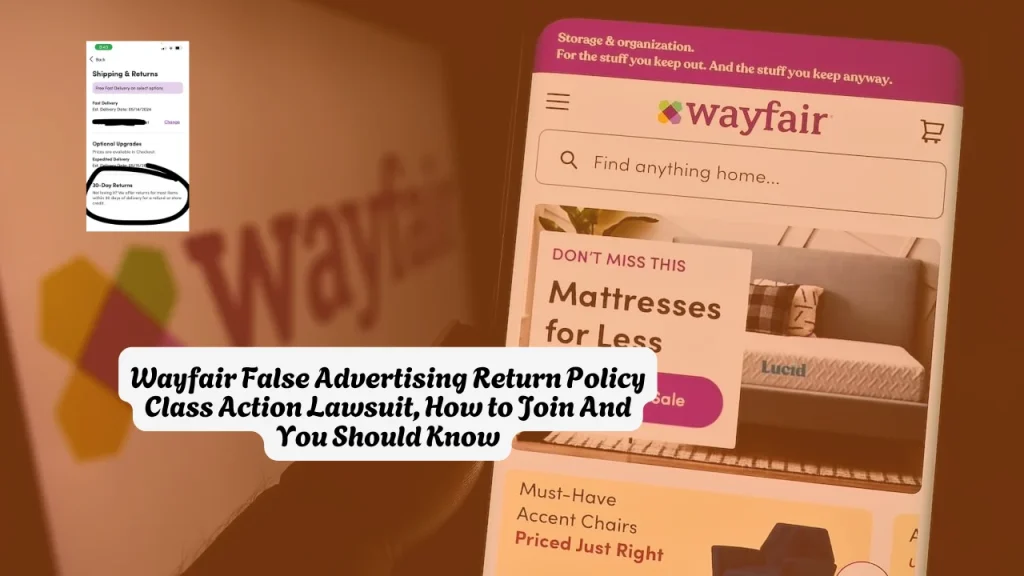
The 13-page complaint argues that Wayfair promotes its 30-day return policy “prominently and pervasively” across its homepage, product pages, shopping cart pages, and checkout pages, creating the impression that the vast majority of products are returnable. In reality, the lawsuit states, a “substantial volume” of Wayfair’s merchandise is designated non-returnable, something many shoppers do not discover until they have already reached the final checkout page.
The lawsuit focuses specifically on how the return disclosure disappears as you move through the purchase process. On certain product pages, a small notice does indicate the 30-day policy is not available for all items, but the filing says it fails to specify which items are excluded. On the shopping cart page, any non-returnable notice appears only as a small “i” information icon in light text, described as “easily overlooked” when placed next to prominently bolded “30-day returns” text. By the time a consumer reaches the checkout page, the complaint states, the non-returnable notice has “disappeared entirely.”
The filing contends that the option to return an item is a factor that can significantly influence a consumer’s purchasing decision, and that Wayfair fraudulently strips consumers of this knowledge by failing to conspicuously disclose which items can and cannot be returned within the 30-day window. The lawsuit treats this sequence as a deliberate pattern — not an oversight — that funnels shoppers into purchases they might not otherwise have made.
Related article: Babbel Class Action Lawsuit About False Advertising On Fake Deadlines Email Are Washington Consumers Eligible?
What Happened to the Named Plaintiff?
The named plaintiff, a California resident, claims he purchased an item for $98.98 in early 2026 without being made aware that it was non-returnable. Throughout his shopping and checkout experience, he was presented with the “30-day return policy on most items” banner, including on the final checkout page, with no clear indication that his specific item was excluded.
Stansfield argues this is despite Wayfair’s return policy being a “key feature” of its marketing to consumers, with the company prominently advertising a “30-Day Returns” policy throughout its website, including on product pages, in the shopping cart, and on the checkout page. His experience is presented as representative of a broader pattern affecting potentially thousands of Wayfair shoppers.
What Laws Does the Lawsuit Cite?
The case brings claims under the California Unfair Competition Law, the California Consumers’ Legal Remedies Act, and the California False Advertising Law. Here is what each law means in plain terms:
- California Unfair Competition Law (UCL): Prohibits businesses from engaging in unlawful, unfair, or fraudulent business practices. It gives California courts broad power to stop deceptive conduct and order businesses to fix their practices going forward.
- California Consumers’ Legal Remedies Act (CLRA): Specifically protects consumers from deceptive tactics in the sale of goods or services. It allows courts to award actual damages, injunctions, and attorney’s fees when companies mislead buyers.
- California False Advertising Law (FAL): Makes it illegal to advertise goods or services using statements that are untrue or misleading, even if the company did not intend to deceive.
All three laws are regularly used in California-based consumer class actions involving e-commerce retailers, because California courts have a long track record of enforcing disclosure obligations in online shopping environments.
Who Does This Lawsuit Potentially Cover?
No class has been officially certified yet by the court, so the full class definition remains TBD. Based on the complaint’s allegations, consumers who may be affected include:
- You may be affected if you purchased an item from Wayfair.com that turned out to be non-returnable after you completed checkout.
- You may be affected if you saw Wayfair’s “30-Day Returns” banner on the homepage, a product page, or the checkout page before making your purchase.
- You may be affected if you were not clearly told at the product level — before adding an item to your cart — that your specific item could not be returned.
- You may be particularly affected if you are a California resident, since the lawsuit currently relies on California consumer protection statutes. Class scope and geographic reach may expand as the case develops.
What you should do now: If this describes your experience, document it. Take screenshots of any items you purchased, the product pages you saw at the time of purchase, any communications with Wayfair about returns, and any charges you incurred as a result. This documentation could become relevant if a settlement is reached.
What Relief Does the Lawsuit Seek?
The plaintiff is requesting public injunctive relief, along with an award of attorneys’ fees and costs. Public injunctive relief is a court order that requires a company to change its business practices going forward to protect consumers from future harm — in this case, that could mean requiring Wayfair to clearly disclose non-returnable status on every product page, before a consumer adds an item to their cart.
The class action seeks public injunctive relief to protect Californians from Wayfair’s allegedly deceptive advertising practices going forward, rather than monetary damages. This does not mean consumers cannot receive money — future settlement negotiations, if they occur, often result in cash compensation for class members even when the original complaint focuses on injunctive relief.
Is This Wayfair’s Only Pending Lawsuit?
No. Wayfair is currently facing additional class action complaints. Wayfair is currently facing two separate false advertising class action lawsuits in California, both making virtually identical allegations about fake sale prices: Prakash v. Wayfair LLC (filed January 30, 2026, in the U.S. District Court for the Eastern District of California), in which plaintiff Pooja Prakash alleges Wayfair’s website displays products with inflated strikethrough prices alongside supposed sale or percentage-off discount prices, but that Wayfair “either never or almost never” sells products at the higher strikethrough prices.
In a separate class action earlier this year, Wayfair was also sued over claims it misled consumers by advertising fake sale prices. Together, these cases paint a picture of Wayfair facing sustained legal pressure over how it presents pricing and return information to shoppers across its platform.
What Is the Dark Pattern Argument at the Center of This Lawsuit?
The return policy lawsuit is particularly notable because it centers on what regulators and legal scholars call a “dark pattern” — a user interface design that manipulates consumers into taking actions they would not otherwise take. The lawsuit’s core narrative follows a clear three-step progression:
First, Wayfair shows the “30-Day Returns” banner on the homepage and product pages — building consumer confidence. Then, on the shopping cart page, any non-returnable notice appears only as a small “i” information icon in light text, described as “easily overlooked” when placed next to prominently bolded “30-day returns” text. Finally, at the checkout page where the consumer commits to the purchase, the non-returnable designation disappears entirely.
Courts and the FTC have increasingly scrutinized dark patterns in e-commerce. The FTC published guidance in 2022 warning companies that confusing or hidden disclosures can constitute deceptive advertising under federal law — and California’s consumer protection statutes go even further. This lawsuit tests whether Wayfair’s checkout UI crosses that legal line.
Frequently Asked Questions
Do I need a lawyer to join this lawsuit or file a future claim?
No. If this case reaches a settlement, consumers typically receive notice directly by email or mail with instructions to file a claim online at no cost and without hiring an attorney. Class counsel represents all class members automatically. Monitor this case at AllAboutLawyer.com for settlement updates.
Is this lawsuit legitimate?
Yes. The case was filed on March 23, 2026, in California state court as Case No. 26STCV09347. It is a real, active legal proceeding. No settlement or claims portal exists yet, so be cautious of any third-party site claiming to accept claims for this specific lawsuit right now.
When will I receive a payment?
There is no payment timeline at this stage. The lawsuit must first survive any motions to dismiss, obtain class certification, and either reach a settlement or go to trial before any money flows to consumers. Based on comparable false advertising cases in California, this process typically takes one to three years.
What if I already tried to return an item and Wayfair refused?
Document everything. Save emails, chat transcripts, and screenshots showing what Wayfair’s website displayed when you purchased the item and when you attempted your return. This kind of evidence becomes valuable in class action discovery and settlement verification processes.
Will a potential settlement payment affect my taxes?
It depends on how a future settlement is structured. Compensation categorized as a refund of a purchase price is generally not taxable, while amounts characterized as damages for a separate harm may be. Consult a tax professional after receiving any payment.
What is public injunctive relief, and does it mean I won’t get money?
Public injunctive relief is a court order telling a company to change how it does business — here, that likely means requiring clearer return disclosures. It does not preclude cash payments. Many California consumer class action settlements that start with injunctive relief demands end with a settlement fund for affected buyers.
Does this lawsuit only cover California residents?
The complaint currently focuses on California laws and names a California plaintiff. However, class definitions often expand during litigation. If the court certifies a nationwide class or if additional complaints are filed in other states, consumers across the U.S. could become eligible. This is a key development to watch.
What should I do right now if I think I was affected?
You do not need to take any formal action today. No claim form exists yet. The most useful thing you can do is preserve records of your Wayfair purchases, especially any items you were unable to return, along with any screenshots of product pages or checkout screens you saw at the time.
Last Updated: April 15, 2026
Disclaimer: This article is for informational purposes only and does not constitute legal advice. Legal claims and outcomes depend on specific facts and applicable law. For advice regarding a particular situation, consult a qualified attorney.
About the Author
Israr Ahmad is a legal content researcher with 4+ years of experience covering class action settlements and consumer rights cases. He has researched and published coverage of 2,500+ settlements using verified court records, settlement administrator filings, and government sources. Learn more about Israr.