
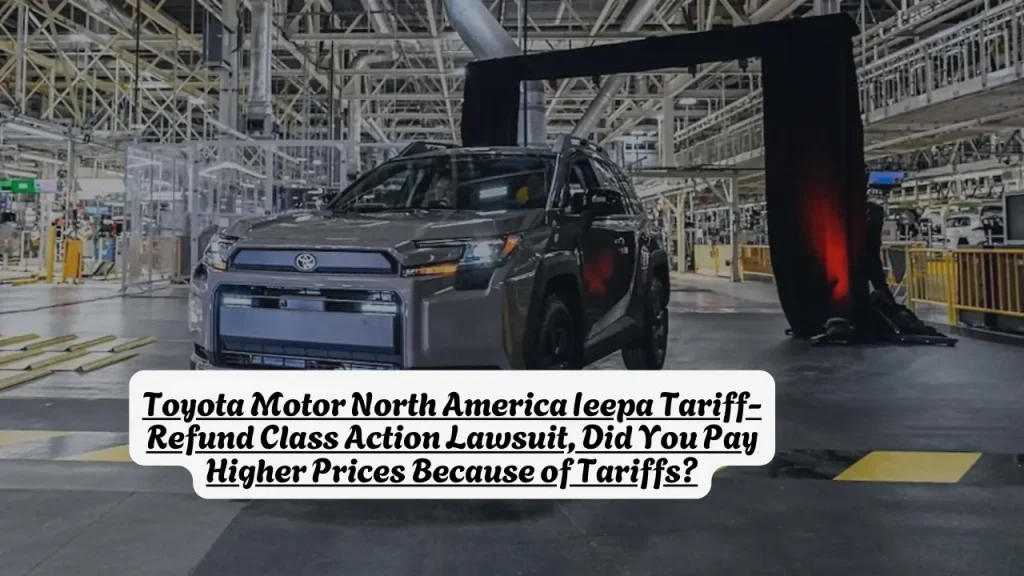
Toyota Motor North America Ieepa Tariff-Refund Class Action Lawsuit, Did You Pay Higher Prices Because of Tariffs?
Toyota is facing a class action lawsuit filed in the U.S. District Court for the Central District of California alleging the company passed billions of dollars in illegal tariff costs onto vehicle buyers — and now must share any government refunds it receives. California plaintiff Ananias Cornejo filed the case against Toyota Motor North America, arguing that consumers who paid inflated prices during the tariff period deserve compensation if Toyota recovers those tariff costs from the government. The case is in early litigation. No settlement exists, and no claim form is open.
Quick Facts: Toyota IEEPA Tariff Refund Class Action
| Field | Detail |
| Lawsuit Filed | 2026 |
| Defendant | Toyota Motor North America, Inc. |
| Alleged Violation | Unjust enrichment / state consumer protection statutes — passing unlawful IEEPA tariff costs to consumers |
| Who Is Affected | U.S. consumers who purchased or leased Toyota vehicles or products between February 2025 and February 2026 |
| Current Court Stage | Early litigation — no class certification yet |
| Court & Jurisdiction | U.S. District Court for the Central District of California |
| Lead Plaintiff | Ananias Cornejo |
| Next Hearing Date | TBD — no hearing scheduled as of May 17, 2026 |
| Official Case Website | TBD — none established yet |
| Last Updated | May 17, 2026 |
What Is the Toyota Tariff Lawsuit About? Cornejo v. Toyota Motor North America, Inc., C.D. Cal. (2026)
In February 2026, the U.S. Supreme Court invalidated tariffs imposed under the International Emergency Economic Powers Act (IEEPA), ruling those import taxes were unlawful. That ruling opened the door for companies to seek billions in refunds from the U.S. government — and it also opened the door for consumers to ask a pointed question: if Toyota raised prices to cover a tariff that was illegal all along, where does that money go now?
The complaint alleges Toyota passed significant tariff-related expenses directly onto buyers through higher vehicle pricing during the affected period, which ran from February 2025 through February 2026. The filing claims Toyota incurred roughly $9.7 billion in tariff costs tied to its reliance on imported parts from Japan, Canada, and Mexico. The plaintiff argues that those costs landed on consumers — and that consumers are entitled to restitution if Toyota recovers those same tariffs from the government.
Related article: Westport Pools LLC Sued Webster Groves Over $636,000 in Alleged Unpaid Work on New Aquatic Center In St. Louis County Circuit Court
The core legal argument is that Toyota received a “double recovery” — once from consumers who paid higher prices, and again from the government through tariff refunds — without sharing any of that money back. Legal claims are grounded in unjust enrichment and state consumer protection law. This consumer rights lawsuit follows a broader wave of similar cases filed against major companies across multiple industries since the Supreme Court’s ruling. If you bought or leased a Toyota between February 2025 and February 2026 and paid an inflated sticker price, this case may directly involve you. For background on how these cases work, see AllAboutLawyer.com’s Guide to Consumer Class Action Lawsuits.
Are You Part of the Toyota Tariff Class Action Lawsuit?
If you’re wondering whether the Toyota tariff class action lawsuit 2026 includes you, here is how to think through it. The proposed class is broad — it covers ordinary vehicle buyers, not importers or businesses.
You may be part of this class if:
- You purchased or leased a new Toyota vehicle in the United States between February 2025 and February 2026
- You bought Toyota-branded products or accessories during that same window
- You paid a price that was inflated by tariff surcharges passed through by Toyota Motor North America
- You are a U.S. resident or made your purchase in the United States
You are likely NOT included if:
- You purchased your Toyota before February 2025 or after February 2026
- You purchased a used vehicle through a third-party seller unaffiliated with Toyota
- You already signed a binding arbitration agreement that waives class action participation (check your purchase contract)
- You are a commercial importer or a business purchaser — not an individual consumer
Under federal trade rules, only importers of record can apply directly for government refunds — consumers have no direct mechanism to recover tariff costs embedded in the prices they paid. That gap is exactly what this lawsuit targets. Similar consumer fraud lawsuits have been filed against companies like Costco, FedEx, and Lululemon over the same IEEPA tariff issue, showing how broad this legal wave is becoming. You may also want to review the GM OnStar data class action to understand what consumers can realistically expect from auto industry litigation at this stage.
What Are Toyota Buyers Seeking in This Lawsuit?
This is not a payout section — no money is available yet and no settlement has been reached. The plaintiff is asking the court to order Toyota to share any government tariff refunds with the buyers who originally paid the inflated prices.
Specifically, plaintiffs are seeking:
- Restitution equal to the tariff-driven portion of the price each buyer paid
- Unjust enrichment recovery — the argument being that Toyota cannot keep money it collected from consumers for a tax later ruled illegal
- Injunctive relief requiring Toyota to pass any recovered tariff refunds back to consumers
- Class certification to allow all affected U.S. Toyota buyers to participate together
Toyota posted a $1.9 billion operating loss in North America for the fiscal year ending March 31, 2026, even while sales grew by approximately 8.5%, which the lawsuit uses as evidence of the scale of tariff impact on the company’s operations. The legal theory connecting that loss to consumer prices is at the heart of what the court will eventually have to decide.
No specific dollar amount per person has been established. No claim form is open. The amount any individual buyer might recover — if the case succeeds and reaches a settlement — depends on the size of the class, what tariff component is proven to have been embedded in purchase prices, and how the court orders distribution.
What Toyota Buyers Should Do Right Now
Most class members are included automatically if they meet the criteria above — you do not need to file anything or take any action today. But there are smart steps to take now that protect your position later.
Save your purchase records. If you bought or leased a Toyota between February 2025 and February 2026, locate your sales contract, window sticker (Monroney label), dealer invoice, or financing agreement. These documents establish your purchase price and the date of purchase — both of which will matter if a settlement is eventually reached.
Do not sign away your rights. Review your purchase contract carefully. Some dealer agreements contain arbitration clauses that could complicate your ability to participate in a class action. If you have questions about your specific contract, consulting a consumer rights lawyer is a smart move — most handle initial consultations at no charge.
Monitor for case updates. This lawsuit is in its earliest stages. Class certification has not happened yet. There is no settlement timeline. The best way to stay informed is to monitor the PACER federal court docket for the U.S. District Court for the Central District of California and sign up for alerts from the plaintiff’s legal team once that information becomes publicly available.
Do not pay anyone to “register” for this lawsuit. No legitimate class action requires upfront payment from class members. If you see anyone asking for money to add your name to this case, that is a scam.
Toyota IEEPA Tariff Lawsuit Timeline
| Milestone | Date |
| IEEPA Tariffs First Imposed | February 2025 |
| Class Period Begins (Alleged) | February 2025 |
| Class Period Ends (Alleged) | February 2026 |
| Supreme Court Strikes Down IEEPA Tariffs | February 20, 2026 |
| Wave of Consumer Class Actions Filed | February–May 2026 |
| Cornejo v. Toyota Motor North America Filed | 2026 (exact date TBD — case number not yet publicly confirmed) |
| Class Certification Motion | TBD — not yet filed |
| Next Scheduled Hearing | TBD — no hearing set as of May 17, 2026 |
| Expected Settlement Timeline | TBD — likely 2–4 years from filing, based on comparable litigation |
Frequently Asked Questions
Is there a class action lawsuit against Toyota over tariff refunds?
Yes. A California plaintiff named Ananias Cornejo filed a proposed class action in the U.S. District Court for the Central District of California against Toyota Motor North America. The lawsuit alleges Toyota passed unlawful IEEPA tariff costs onto buyers and should share any government refunds with those consumers. The case is active and in early litigation.
Do I need to do anything right now to be included?
No immediate action is required. If you meet the eligibility criteria — a Toyota purchase or lease between February 2025 and February 2026 — you are likely part of the proposed class automatically. However, saving your purchase documents now is strongly recommended so you can support any future claim.
When will a settlement be reached in the Toyota tariff case?
There is no settlement yet and no timeline has been set. Consumer class actions of this type, filed in federal district court, typically take two to four years from filing to final resolution. The court must first certify the class before any settlement discussions become meaningful.
Can I file my own separate lawsuit against Toyota instead of joining the class action?
Yes, you have that option. Opting out of a class action preserves your right to pursue an individual claim. However, individual claims require hiring your own attorney and carry both higher costs and greater uncertainty. A class action lawsuit attorney can help you weigh whether individual action or class participation makes more sense for your situation.
How will I know if the Toyota tariff lawsuit settles?
If and when a settlement is reached, the court requires that all class members receive notice — typically by mail, email, or through a dedicated settlement website. You can also monitor the PACER docket for the Central District of California or sign up for case updates through the plaintiff’s law firm once contact information is publicly available.
am I part of the Toyota tariff class action if I leased rather than purchased my vehicle?
Yes, the proposed class includes both purchasers and lessees of Toyota products during the affected period. If you leased a Toyota between February 2025 and February 2026 and paid a lease price that was inflated by tariff costs, you may be part of this class.
Is this lawsuit just about Toyota, or are other automakers facing the same claims?
Toyota is not alone. More than 2,000 refund lawsuits connected to IEEPA tariffs have been filed in the Court of International Trade by companies across multiple industries, and several other automakers including Nissan North America have also been linked to refund efforts. Consumer class actions targeting tariff pass-through are spreading across retail, shipping, and automotive sectors.
Sources & References
- Yahoo Finance / original reporting on Cornejo v. Toyota Motor North America, U.S. District Court for the Central District of California (2026): https://finance.yahoo.com/economy/policy/articles/class-action-lawsuit-says-toyota-180001808.html
Prepared by the AllAboutLawyer.com Editorial Team and reviewed for factual accuracy against official court records and primary legal sources on May 17, 2026. Last Updated: May 17, 2026
Disclaimer: This article is for informational purposes only and does not constitute legal advice. Legal claims and outcomes depend on specific facts and applicable law. For advice regarding a particular situation, consult a qualified attorney.
About the Author
Israr Ahmad is a legal content researcher with 4+ years of experience covering class action settlements and consumer rights cases. He has researched and published coverage of 2,500+ settlements using verified court records, settlement administrator filings, and government sources. Learn more about Israr.