
Long Beach Trump Car Lawsuit, When Can a City Tell You What to Put on Your Car?
A Long Island businessman has rejected a $50,000 settlement offer from the City of Long Beach, New York, escalating a years-long First Amendment dispute over political flags and stickers on his personal vehicles. Michael Wasserman filed a lawsuit against the City of Long Beach, the Long Beach Police Department, and specific police officers in May 2021, initially seeking $25 million in compensation, after he was issued a $200 summons in March 2021 for displaying multiple flags on his vehicle while on public roads. The City Council voted to offer $50,000 to settle the matter. Wasserman turned it down flat.
Quick Case Facts
| Field | Detail |
| Plaintiff | Michael Wasserman, 62, Long Beach, New York |
| Defendants | City of Long Beach; Long Beach Police Department; Ronald Walsh (former police commissioner); specific police officers; city manager |
| Court | Brooklyn Federal Court (U.S. District Court, Eastern District of New York) |
| Original Lawsuit Filed | May 2021 |
| Amount Sought | $25 million |
| Settlement Offered by City | $50,000 (approved by City Council, February 17, 2026) |
| Settlement Accepted? | No — rejected by Wasserman |
| Wasserman’s Counteroffer | At least $100,000 |
| Core Legal Issue | First Amendment free speech; selective enforcement of local ordinance |
| Case Status | Active — ongoing litigation |
What Is the Wasserman v. Long Beach Lawsuit About?
Michael Wasserman has become known in Long Beach for plastering his home — along with his Porsche and Jeep — with a rotating variety of political flags and stickers. He filed a $25 million federal lawsuit against the City of Long Beach, the chief of police, the city manager, and specific police officers after officials forced him to remove the flags on his cars.
In March 2021, Wasserman was issued a $200 summons for displaying multiple flags on his vehicle while on public roads. The items in question included “Trump for 2024,” an expletive directed at President Biden, a thin blue line flag, and similarly themed flags. Wasserman claimed his First Amendment right to free speech was being infringed. The city maintained that the summons was based on a city ordinance which states that public signs and distractions may contribute to traffic accidents.
In 2021, city officials stepped in, citing a local ordinance that prohibits certain types of displays within city limits. They ordered Wasserman to remove the flags, arguing that his vehicles violated those rules. Wasserman argued the order crossed a constitutional line, maintaining the issue was about whether the government could dictate personal expression on private property.
What Does the Ordinance Actually Say?
The town claims the flags are a violation of an ordinance stating that no sign shall be erected, affixed, or maintained within the perimeter of any public street or public property. Wasserman parks his car on a public street outside his home.
The city’s attorney, Howard M. Miller, framed the enforcement as content-neutral. Miller told the New York Post: “It’s not a political case. It’s not the contents of the message. It’s where he had it — it’s a public street.”
Related article: $24.75M Grubhub Driver Misclassification Settlement, Are You Eligible to Claim? File Claim Before June 18
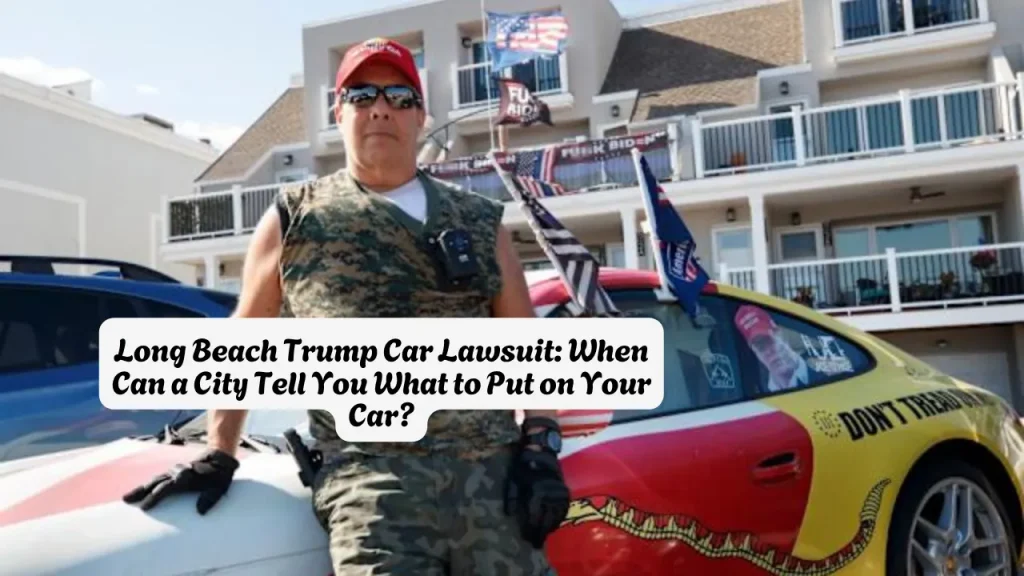
Wasserman’s $25 million lawsuit also claims that corporations are exempt from the local ordinances, arguing he was unfairly cited while businesses displaying signs face no similar enforcement. His attorney raised this inconsistency as evidence of selective targeting.
The Selective Enforcement Argument
Wasserman’s legal team frames the case primarily as one of discriminatory enforcement, not just free speech. His attorney, Victor Feraru — a self-described “liberal Democrat” who said he has taken heat for representing Wasserman — told the New York Post they are suing on the grounds of selective enforcement and discrimination, stating: “We wouldn’t be here if he were flying a Biden flag. This is selective targeting for his political ideology.”
Wasserman claimed his politics resulted in harassment from other residents and that police officers visited his home too many times to count, citing complaints from neighbors. He also alleged that his vehicles were vandalized over the years.
Despite the hostile reception from some neighbors, other neighbors privately thanked him for having the “guts” to display the flags, Wasserman said.
Why Did Wasserman Reject the $50,000 Settlement?
During the February 17, 2026 meeting of the Long Beach City Council, members voted to approve a $50,000 payment to Wasserman. Most observers considered that a meaningful offer for a case involving a $200 traffic summons.
Wasserman did not see it that way. He told the New York Post the judge said $50,000 was reasonable, to which he responded: “That’s crap.” He is holding out for at least $100,000, which he plans to give to charity.
He rejected the offer outright, insisting the amount falls short of what the case represents. He frames the fight as a matter of principle rather than profit, stating the goal is to defend what he believes are basic rights — not cash in.
The lawsuit is about principle — not money, he said. He admitted he spent the past several years battling the courts in what he called “a waste of time aggravation,” but added: “The only enjoyment I got was pissing these people off.”
What Are the First Amendment Issues at Stake?
This case raises a question that courts and legal scholars continue to debate: how far can a local government go in regulating what someone displays on their own vehicle?
The First Amendment prohibits the government from restricting speech based on its content or viewpoint. However, governments can impose what courts call “time, place, and manner” restrictions — rules that apply equally to all speech regardless of message. The key legal question in this case is whether Long Beach’s ordinance qualifies as a lawful, content-neutral restriction or whether it was selectively used to suppress a specific political viewpoint.
This case goes far beyond one man and his cars. It raises bigger questions about what drivers are allowed to display on their vehicles and where municipalities draw the line between regulation and restriction.
If Wasserman can prove the ordinance was enforced against him because of his political views — rather than applied uniformly to all drivers — courts have consistently found that type of enforcement unconstitutional under the First and Fourteenth Amendments.
Timeline of the Dispute
| Date | Event |
| March 2021 | Long Beach police visit Wasserman’s home; he receives a $200 summons for flags on his vehicle |
| May 2021 | Wasserman files $25 million federal lawsuit in Brooklyn Federal Court |
| June 2021 | Case receives national media attention; city maintains ordinance is content-neutral |
| 2021–2025 | Years of legal back-and-forth; multiple court appearances |
| February 17, 2026 | Long Beach City Council votes to approve $50,000 settlement offer |
| March 2026 | Wasserman publicly rejects the offer; demands at least $100,000 |
| April 2026 | Case remains active in federal court |
Frequently Asked Questions
Can a city legally tell you to remove flags from your car?
Generally, cities can regulate signage on public streets through content-neutral ordinances — rules that apply equally to all political views. However, if a city selectively enforces those rules only against one political viewpoint, courts have found that enforcement unconstitutional. Whether Long Beach’s enforcement was truly content-neutral is the central legal question in this case.
What is selective enforcement in a First Amendment case?
Selective enforcement means the government applies a law only to certain people based on who they are or what they believe, rather than enforcing it uniformly. Wasserman’s attorney argues that Long Beach would not have cited a driver displaying a pro-Biden flag under the same ordinance — making the enforcement unconstitutional viewpoint discrimination under the First Amendment.
Is this case a class action lawsuit?
No. This is an individual civil rights lawsuit filed by one plaintiff — Michael Wasserman — against the City of Long Beach and specific city officials and police officers. It does not involve a class of consumers or a settlement fund available to the public.
Why is Wasserman demanding more than $50,000 if it’s about principle?
Wasserman says he plans to give any settlement money to charity and is holding out for at least $100,000. He maintains the lawsuit is about principle — defending constitutional liberties — not personal financial gain.
What is Wasserman’s background?
Wasserman is a 62-year-old entrepreneur. He was a longtime Democrat but switched parties in 2004 to vote for George W. Bush. He says he has been flying flags for over a decade, including Tea Party flags, Marine flags, pro-cop flags, and the Gadsden flag.
What happens if the case goes to trial?
If Wasserman and Long Beach cannot reach an agreement, the case will proceed to trial in Brooklyn Federal Court. A jury would then decide whether the city violated Wasserman’s First Amendment rights and, if so, what damages he is entitled to receive. The city faces significant risk if a jury finds the enforcement was politically motivated.
Does this case have broader legal implications?
Potentially. A ruling in Wasserman’s favor could limit how cities enforce sign ordinances against vehicle displays and strengthen protections for political expression on private property parked in public spaces. Courts across the country regularly grapple with where free speech ends and lawful government regulation begins.
Last Updated: April 4, 2026
Disclaimer: This article is for informational purposes only and does not constitute legal advice. Legal claims and outcomes depend on specific facts and applicable law. For advice regarding a particular situation, consult a qualified attorney.
About the Author
Israr Ahmad is a legal content researcher with 4+ years of experience covering class action settlements and consumer rights cases. He has researched and published coverage of 2,500+ settlements using verified court records, settlement administrator filings, and government sources. Learn more about Israr.