
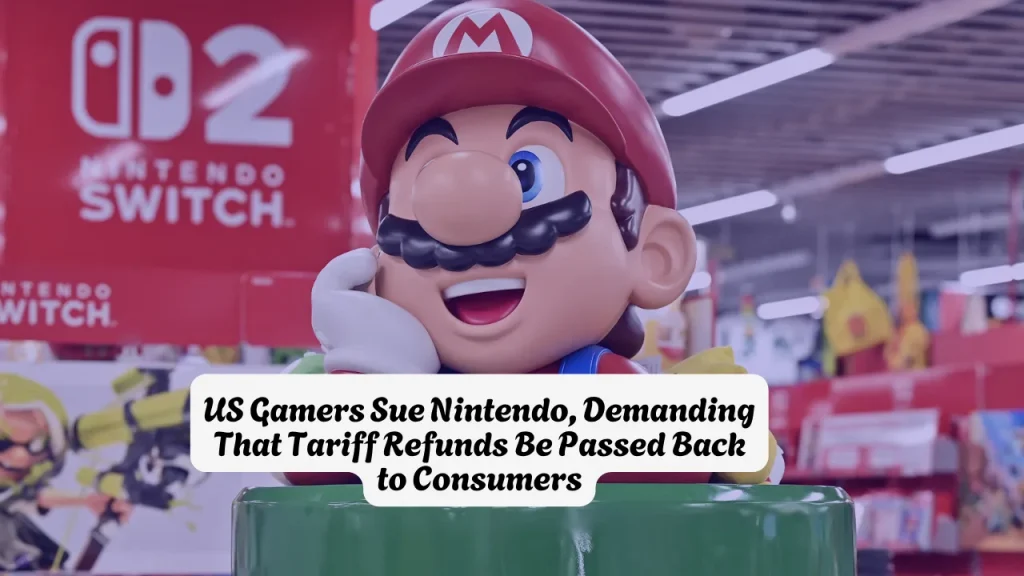
US Gamers Sue Nintendo, Demanding That Tariff Refunds Be Passed Back to Consumers
Two customers claim Nintendo would be unjustly enriched if it keeps government refunds for tariffs that were ultimately paid by the people who bought its products.
Two Nintendo customers — Gregory Hoffert of California and Prashant Sharan of Washington — filed a proposed class action complaint in the United States District Court for the Western District of Washington on April 22, 2026. They want the court to force Nintendo to pass along the money it is likely to receive from U.S. Customs and Border Protection through the newly opened tariff refund portal. The damages sought have not been individually specified but could extend to hundreds of millions of dollars across a class potentially numbering in the millions.
Quick Case
| Field | Detail |
| Plaintiffs | Gregory Hoffert (California) and Prashant Sharan (Washington) |
| Defendant | Nintendo of America, Inc. |
| Court | U.S. District Court, Western District of Washington |
| Case Number | Not yet publicly confirmed |
| Filing Date | April 22, 2026 |
| Judge | Not yet assigned |
| Claims Alleged | Unjust enrichment; consumer protection violations (specific statutes TBD per full complaint) |
| Damages Sought | Not specified; potentially hundreds of millions across proposed class |
| Current Status | Newly filed; class certification not yet granted |
The Dispute Behind the Lawsuit
To understand why two video game customers are suing one of the world’s most recognizable gaming companies, you need to follow a chain of events that starts with White House tariff policy and ends with a windfall Nintendo may be on the verge of receiving — while consumers who already absorbed the cost get nothing.
Beginning on February 1, 2025, President Donald Trump issued a series of executive orders imposing sweeping tariffs on imports from countries including Canada, Mexico, China, Brazil, and India, using authority he claimed under the International Emergency Economic Powers Act of 1977 (IEEPA). The tariff situation grew chaotic in the months that followed, with rates on Chinese goods escalating rapidly — starting at 10%, rising to 84%, peaking at 125%, and then being reduced to 34% in May 2025.
Nintendo manufactures its consoles and accessories primarily in Vietnam and China, putting the company squarely in the crossfire. It delayed Switch 2 preorders and ultimately raised prices on accessories: Joy-Con 2 controllers rose from $90 to $95 per pair ahead of the June 5 launch, and the Pro Controller increased from $79.99 to $84.99.
Then came the legal reversal. The U.S. Supreme Court struck down the IEEPA-based tariffs on February 20, ruling that the statute did not grant the president authority to impose them. Following that ruling, a federal judge determined that companies were entitled to refunds on the tariffs they had paid.
Nintendo of America filed its own lawsuit against the U.S. government on March 6, 2026, in the U.S. Court of International Trade, seeking refunds on the tariffs it paid — with interest — representing one of more than 1,000 companies that filed suit, joining FedEx, Costco, and Revlon.
That government refund is precisely what Hoffert and Sharan are now contesting.
Related article: John Paul Mitchell class action claims company’s products are not cruelty-free
What the Complaint Alleges
The core legal theory in the Hoffert-Sharan complaint is unjust enrichment — a well-established principle in civil law that prevents a party from retaining a financial benefit it did not fairly earn, at the expense of another.
The plaintiffs argue that Nintendo did not truly bear the financial hardship of the tariffs because those added costs were passed directly along to consumers through higher prices. Nintendo, according to the complaint, reported strong financials during the tariff period. Its president, Shuntaro Furukawa, said in May that the company’s sales forecast would not be impacted by tariffs, and Nintendo ultimately sold nearly 18 million Nintendo Switch 2 consoles.
As the plaintiffs’ legal team put it in the complaint: “Nintendo stands to receive a windfall: it has already recouped tariff costs from consumers through higher prices, and it now stands in line to recover the same unlawful tariff payments from the federal government.”
The complaint further states, as cited by Aftermath: “Nintendo now seeks to recover from the government duties whose economic burden was borne, in whole or in part, by Plaintiffs and Class members.”
In plain terms: consumers paid higher prices so Nintendo could offset the tariff costs. Now that those tariffs have been ruled unlawful and refunds are flowing back to importers, the plaintiffs argue the money belongs — at least in part — to the customers who funded it.
The proposed class would include anyone in the United States who purchased goods from Nintendo during the period February 1, 2025, through February 24, 2026, in which Nintendo raised prices. Lawyers for the plaintiffs suggest the class could encompass hundreds of thousands or millions of people.
Nintendo’s Position
Nintendo has not publicly responded to the consumer class action complaint filed on April 22, 2026. The outlet Aftermath has reached out to Nintendo for comment. When Nintendo filed its own tariff refund lawsuit against the U.S. government in March, the company told Aftermath it had filed the complaint but had “nothing else to share.”
It is standard practice for defendants in newly filed civil actions to have 21 days (or as set by the court) to respond formally. Nintendo’s litigation posture, if and when stated, will be reported as this case develops.
The Legal Framework: Unjust Enrichment and Class Action Mechanics
Unjust Enrichment is a common law equitable claim that requires the plaintiff to show three things: (1) the defendant received a benefit, (2) the defendant’s retention of that benefit is at the plaintiff’s expense, and (3) allowing the defendant to keep the benefit would be unjust or inequitable. Here, the benefit is the pending government tariff refund; the expense is the elevated prices consumers paid; and the alleged injustice is Nintendo pocketing both.
For this case to proceed as a class action — meaning all similarly situated Nintendo customers can be represented together rather than filing individually — plaintiffs must first obtain class certification from the court. Under Federal Rule of Civil Procedure 23, the court must find, among other things, that the class is sufficiently numerous, that common legal questions exist across all members, and that Hoffert and Sharan are adequate representatives of the broader group.
This case is part of a broader wave of consumer litigation targeting companies that raised prices during the tariff period and are now in line to receive government refunds. Several other companies, including Costco, are facing nearly identical lawsuits from customers. Some companies, like FedEx and UPS, have voluntarily announced they will pass tariff refunds back to their customers — a step Nintendo has not taken.
The legal landscape for these cases is unsettled. Because the Supreme Court’s IEEPA ruling is recent, no established body of precedent directly governs how refund obligations between companies and their consumers should be allocated. Courts will likely need to develop that framework through this generation of litigation.
What Happens Next
The immediate procedural steps are straightforward. Nintendo must be formally served with the complaint, after which it will file either an answer to the allegations or a motion to dismiss arguing the case lacks legal merit. If the case survives dismissal, the plaintiffs will move for class certification — the critical gateway that determines whether this remains a two-plaintiff dispute or becomes a nationwide consumer claim.
Discovery would follow certification, during which both sides exchange documents and take depositions. Given that the central question — who bore the economic cost of the tariffs — may turn heavily on Nintendo’s internal pricing decisions and financial records, discovery could be contentious and document-intensive.
Settlement is a possibility at any stage. Companies facing large consumer class actions frequently opt to negotiate rather than risk an adverse verdict, particularly when the underlying financial exposure (refund amounts across millions of transactions) is substantial. Whether Nintendo would do so, and on what terms, is not yet known.
The broader tariff refund portal process through Customs and Border Protection is also still being stood up, with CBP indicating a system could be operational within approximately 45 days of the court’s refund order — meaning the actual government refund money has not yet been disbursed to companies like Nintendo.
Frequently Asked Questions
What exactly are Hoffert and Sharan asking for?
They are asking the court to order Nintendo to pass along to consumers whatever tariff refund Nintendo receives from the U.S. government, on the grounds that consumers — not Nintendo — ultimately absorbed the cost of those tariffs through higher product prices.
Is this a class action or an individual lawsuit?
It is a proposed class action. A judge must first certify the class before it can proceed as one. If certified, it would represent all U.S. customers who bought Nintendo products that saw tariff-related price increases between February 1, 2025, and February 24, 2026.
How much money could be at stake?
The total is not yet specified in the complaint. Nintendo paid import duties as part of the more than $200 billion in IEEPA-related tariffs collected by the U.S. government. The consumer share of that specific to Nintendo’s transactions — and the portion attributable to the proposed class — has not been publicly quantified.
Why hasn’t Nintendo just announced it will return the money, like FedEx and UPS?
Nintendo has not publicly addressed what it plans to do with any government refund. That silence is part of what prompted this lawsuit. Companies are not legally required to make such voluntary announcements absent a court order or contractual obligation.
What does this case mean for other companies?
It signals that simply receiving a government tariff refund may not be the end of a company’s legal exposure. Businesses that passed tariff costs to consumers and are now seeking government refunds could face similar claims, as seen with the Costco litigation. In-house counsel at consumer goods companies should be closely monitoring how courts resolve the unjust enrichment theory in this novel context.
Last Updated: April 22, 2026
This article is for informational purposes only and does not constitute legal advice. Allegations contained in a complaint are not findings of fact. All parties are presumed innocent unless and until proven otherwise in a court of law. Case details may change as proceedings advance.
About the Author
Israr Ahmad is a legal content researcher with 4+ years of experience covering class action settlements and consumer rights cases. He has researched and published coverage of 2,500+ settlements using verified court records, settlement administrator filings, and government sources. Learn more about Israr.