
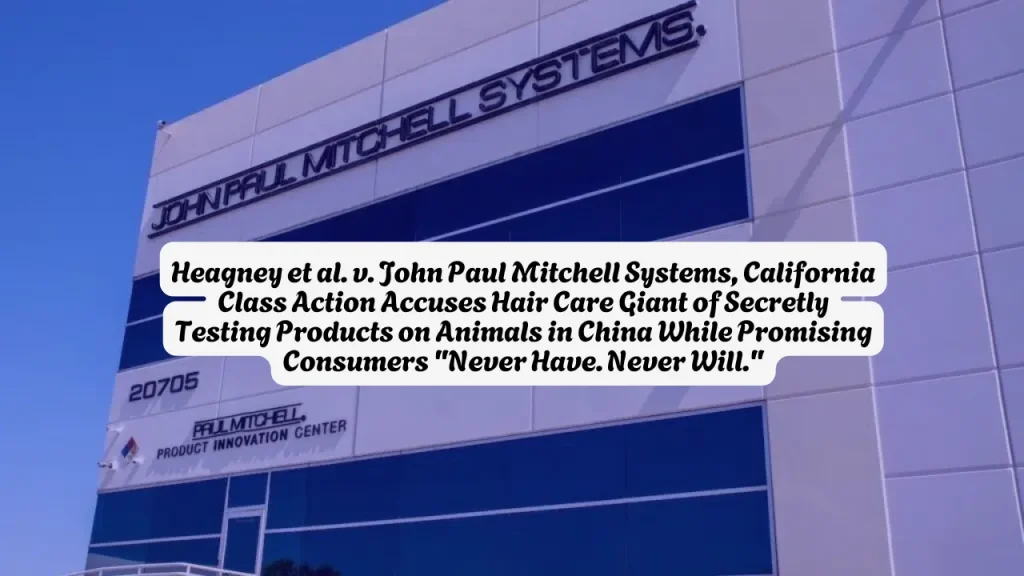
Heagney et al. v. John Paul Mitchell Systems, California Class Action Accuses Hair Care Giant of Secretly Testing Products on Animals in China While Promising Consumers “Never Have. Never Will.”
Five consumers allege that John Paul Mitchell Systems built its brand identity on a cruelty-free promise it privately violated for years, submitting dozens of products to mandatory animal testing in China to access one of the world’s most lucrative cosmetics markets.
Five hair care consumers — lead plaintiff Randall Heagney, along with Rica Guerrero, Kerrie Gonnella, John Rohloff, and Jewel Rule — filed a proposed class action complaint against John Paul Mitchell Systems (JPMS) on February 15, 2023, in the U.S. District Court for the Northern District of California.
The plaintiffs allege that JPMS misled consumers by marketing its products as “100% cruelty-free” and “never animal tested” while simultaneously operating a China-based subsidiary that registered 63 products for animal testing between May 2015 and May 2021. The case reached a significant milestone on June 27, 2025, when Judge Vince Chhabria certified a California class, allowing it to proceed as a formal class action on behalf of state residents.
Heagney v. John Paul Mitchell Systems — Quick Case Snapshot
| Field | Detail |
| Case Name | Heagney et al. v. John Paul Mitchell Systems |
| Plaintiffs | Randall Heagney, Rica Guerrero, Kerrie Gonnella, John Rohloff, Jewel Rule |
| Defendant | John Paul Mitchell Systems (JPMS) |
| Court | U.S. District Court, Northern District of California |
| Case Number | 3:23-cv-00687 |
| Filing Date | February 15, 2023 |
| Judge | Hon. Vince Chhabria (referred to Magistrate Judge Donna M. Ryu for discovery) |
| Claims Alleged | Violation of California’s Consumer Legal Remedies Act, False Advertising Law, Unfair Competition Law, and Environmental Marketing Claims Act; fraud; negligent misrepresentation; unjust enrichment; breach of express warranty |
| Damages Sought | Injunctive relief, restitution, punitive damages (amount not specified) |
| Current Status | California class certified June 27, 2025; nationwide class denied; case proceeding to next phase |
How Heagney v. John Paul Mitchell Systems Began: A Brand Built on an Animal-Testing Promise
To understand the Heagney lawsuit, you need to understand just how central the cruelty-free identity is to John Paul Mitchell Systems. This was not a footnote in the company’s marketing — it was the brand’s founding promise.
Since its founding in 1980, JPMS distinguished itself from competitors by taking a bold anti-animal testing stance. Its marketing materials proclaimed “No animal testing. Never have, never will.” The company referred to itself as a “pioneer in cruelty free” and claimed to be “the first professional hair care company to take a stand against animal testing.”
That identity was reinforced at every level of the business. JPMS appeared on PETA’s list of companies that do not participate in animal testing, and in 2020 publicly sought to change California law to punish companies that do. The company rolled out new cruelty-free logos in 2017 and 2020, which were placed on all of its products. Its website, social media platforms, and advertising all carried the same message.
The lawsuit contends that those promises were false — and that JPMS knew they were false while continuing to make them.
What the Heagney Complaint Alleges: 63 Products, One Chinese Subsidiary, and Mandatory Animal Testing
The factual core of the Heagney case rests on how China regulated imported cosmetics — and what JPMS allegedly chose to do about it.
Until 2021, foreign manufacturers seeking to sell cosmetics in China were required to register their products with the country’s National Medical Products Administration (NMPA). That registration process required the products to undergo animal testing — including skin sensitization tests and eye irritation tests, during which the product was placed on a shaved animal’s skin or directly into an animal’s eye and left for observation.
JPMS registered 62 hair care products in China between 2001 and 2010, each of which would have required animal testing under the NMPA process. When this practice was publicly exposed in 2012, the company’s response became a second point of contention in the lawsuit.
In 2012, PETA exposed several cosmetics companies that claimed to be cruelty-free for allowing animal testing on products sold in China. Following this, Paul Mitchell announced it was pulling its products from the Chinese market. In January 2013, co-founder John Paul DeJoria stated at a press conference that the company had only learned of China’s animal testing requirements in 2010 and had swiftly decided to exit the market.
Related article: GM Cadillac Lyriq EV Defect Class Action Lawsuit 2026, What Owners Need to Know
The plaintiffs allege both of those statements were false.
The lawsuit states there was, in fact, no change to Chinese regulations in 2010 — animal testing had been required for imported hair care and cosmetics products in China as early as 1990. And the lawsuit alleges Paul Mitchell did not actually pull out of the Chinese market in 2012. It merely paused its operations, which resumed in 2014.
From May 2015 to May 2021, JPMS’s China-based subsidiary, JPMS Cosmetics (Beijing) Co., Ltd. — referred to in the complaint as “JPMS Beijing” — registered 63 products with the NMPA and distributed them for sale in China. The 63 products included items sold under the Paul Mitchell, Tea Tree, and MITCH brands. Each registration required the products to undergo animal testing.
Throughout this entire period, the complaint alleges, JPMS continued placing “cruelty-free” representations on every product it sold worldwide.
John Paul Mitchell Systems’ Response in Heagney
JPMS has contested the lawsuit at multiple stages. The company previously moved to dismiss the case entirely, arguing the plaintiffs had not stated legally valid claims. Judge Chhabria rejected that motion, finding that consumers had plausibly alleged the company’s “cruelty-free” labeling and marketing gave rise to a viable breach of warranty claim.
JPMS also sought to exclude the plaintiffs’ expert witness — economist Gareth J. Macartney, whose analysis was intended to estimate by how much consumers overpaid for JPMS products as a result of the alleged misrepresentations. Judge Chhabria denied JPMS’s motion to exclude that expert, allowing the damages methodology to proceed.
The company has not made any public admission of wrongdoing and has not announced a settlement. JPMS’s litigation strategy — challenging class certification, seeking to exclude expert testimony, and contesting the scope of the class — reflects a consistent posture of contesting both liability and damages.
The Legal Framework in Heagney: What “Cruelty-Free” Claims Mean Under the Law
The Heagney case sits at the intersection of consumer protection law and what the FTC calls “environmental marketing claims” — promotional statements about a product’s ecological or ethical attributes that are regulated for accuracy.
California’s Consumer Legal Remedies Act (CLRA) prohibits deceptive business practices in consumer transactions, including false statements about the characteristics or qualities of goods. The False Advertising Law (FAL) and Unfair Competition Law (UCL) similarly prohibit misleading representations in marketing and labeling.
The Heagney complaint also alleges violations of California’s Environmental Marketing Claims Act, alongside fraud, negligent misrepresentation, and unjust enrichment. The unjust enrichment theory holds that JPMS profited from consumers who paid a premium specifically because they believed the products were cruelty-free — and that JPMS should not be permitted to retain that profit given the alleged deception.
Breach of express warranty is a claim that goes directly to what was printed on the product’s label. When a company makes a specific, affirmative statement on packaging — such as “Never Animal Tested” — that statement can constitute a warranty that the product actually has that quality. If the product does not, the warranty has been breached.
Cases of this nature — sometimes called “greenwashing” or “ethics-washing” litigation — have grown significantly in recent years as courts have become increasingly receptive to consumer claims that ethical marketing labels carry legal weight. The Heagney case is among the first to reach class certification in the cruelty-free cosmetics space and is being closely watched by the beauty industry.
Judge Chhabria’s Class Certification Ruling: What Heagney Looks Like Now
The most consequential development in Heagney to date came on June 27, 2025, when Judge Vince Chhabria issued his class certification order.
Judge Chhabria certified a class of all California residents who purchased John Paul Mitchell hair products between May 1, 2015, and January 1, 2020. That window corresponds to the period in which the alleged Chinese animal testing was actively occurring under the NMPA registration process.
In certifying the California class, Judge Chhabria rejected JPMS’s challenges, finding that the company had consistently made the cruelty-free label visible across its products, that there was sufficient evidence the statements were material to consumers’ purchasing decisions, and that the claim of “no animal testing” was not susceptible to different interpretations that might undercut class-wide treatment.
However, the ruling was not a complete victory for the plaintiffs. Judge Chhabria declined to certify a nationwide class, finding there were material differences among various state laws that made a single nationwide class unworkable. He also denied plaintiffs’ request for leave to amend the complaint, finding that doing so would improperly expand the scope of the case.
Plaintiffs’ firm, Hagens Berman Sobol Shapiro LLP, indicated that the denial of nationwide certification would likely lead to additional lawsuits being filed in other U.S. states to address consumers outside California.
What Comes Next in Heagney v. John Paul Mitchell Systems
With the California class certified, the case enters its merits phase. The parties will engage in further damages-focused discovery, and Judge Chhabria — or Magistrate Judge Donna M. Ryu on discovery disputes — will oversee pre-trial proceedings. The plaintiffs’ expert on pricing and consumer willingness-to-pay will play a central role in establishing the financial harm suffered by class members.
The certified class could encompass a substantial number of California consumers who purchased Paul Mitchell, Tea Tree, MITCH, or Clean Beauty products during the class period. JPMS is a widely distributed professional hair care brand available in salons, retail chains, and online marketplaces nationwide.
Settlement discussions are possible at any stage. Class action defendants in consumer deception cases frequently negotiate resolution before trial, particularly once class certification has been granted and the defendant faces exposure across a large defined group. No settlement has been announced in this case as of the time of publication.
Separately, Hagens Berman’s statements about filing additional state-level cases suggest this litigation may expand across multiple jurisdictions, potentially creating parallel proceedings in states with comparable consumer protection laws.
Frequently Asked Questions About Heagney v. John Paul Mitchell Systems
What does “cruelty-free” mean, and is it a regulated term?
In the United States, the term “cruelty-free” is not formally defined by federal law or the FDA. However, it carries a widely understood consumer meaning — that the product was not tested on animals. When a company applies that term as a label or marketing claim, consumer protection statutes and, in some states, environmental marketing laws regulate whether the claim is truthful and non-misleading.
Which products are at the center of the Heagney case?
The 63 products registered in China between May 2015 and May 2021 included items sold under the Paul Mitchell, Tea Tree, and MITCH brands. The class, as certified, covers California residents who purchased JPMS hair products broadly during that period.
Did JPMS directly perform the animal tests itself?
Under China’s NMPA process, registration required that testing be performed at Chinese testing institutions. JPMS’s domestic responsible agent — JPMS Beijing — submitted the applications and the associated testing reports. The plaintiffs argue this constitutes JPMS “allowing” animal testing, making its “never animal tested” claims false.
Why was nationwide class certification denied?
Judge Chhabria found that material differences among the consumer protection laws of the various U.S. states made a single nationwide class unworkable. Each state’s law would need to be applied differently, creating individualized legal questions that prevent uniform treatment of out-of-state plaintiffs alongside California residents.
What could consumers receive if the plaintiffs prevail?
The complaint seeks restitution — meaning the return of the price premium consumers paid attributable to the cruelty-free misrepresentation — along with injunctive relief (requiring JPMS to change its marketing) and punitive damages for fraudulent conduct. Specific monetary amounts have not been publicly quantified and will depend on the expert’s pricing analysis.
Last Updated: April 22, 2026
This article is for informational purposes only and does not constitute legal advice. Allegations contained in a complaint are not findings of fact. All parties are presumed innocent unless and until proven otherwise in a court of law. Court records and docket information are subject to change as proceedings advance.
About the Author
Israr Ahmad is a legal content researcher with 4+ years of experience covering class action settlements and consumer rights cases. He has researched and published coverage of 2,500+ settlements using verified court records, settlement administrator filings, and government sources. Learn more about Israr.