
Uber Class Action, Riders Allege the App Charges More for a Speed Promise It Doesn’t Keep
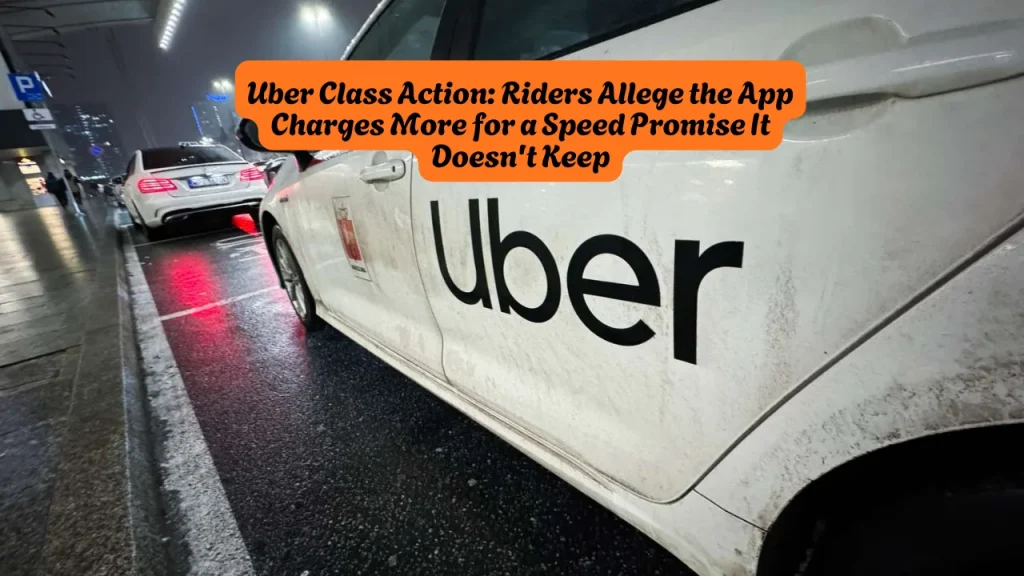
A California Uber rider filed a proposed class action lawsuit on February 27, 2026, in the U.S. District Court for the Northern District of California, alleging Uber Technologies, Inc. systematically overcharges riders who pay extra for rides advertised with precise arrival times or as arriving “Faster” than others. The suit claims Uber charges a premium for guaranteed speed it routinely fails to deliver — and keeps the money when it doesn’t. No settlement has been reached. The case is in active litigation.
Quick Facts
| Field | Detail |
| Case Name | Ye v. Uber Technologies Inc. |
| Court | U.S. District Court for the Northern District of California |
| Date Filed | February 27, 2026 |
| Defendant | Uber Technologies, Inc. |
| Lead Plaintiff | Lucy Ye |
| Alleged Violation | False advertising, deceptive pricing, unjust enrichment, unlawful arbitration clause |
| Products / Services Affected | UberX and other Uber ride options advertised with precise arrival times or “Faster” label |
| Geographic Scope | Nationwide (U.S.) |
| Settlement | None — litigation phase only |
| Claim Form Available | No |
| Plaintiffs’ Attorneys | Raphael Janove, Janove PLLC |
Current Status & What Happens Next
- The case was filed on February 27, 2026 in the U.S. District Court for the Northern District of California as Case No. 3:2026cv01744. It is in the early litigation phase with no answer, class certification, or settlement filed as of March 23, 2026.
- The complaint also asks the court to invalidate Uber’s mandatory arbitration clause, which the lawsuit alleges blocks consumers from suing in court — a threshold legal battle that could shape how the case proceeds.
- This page will be updated as the case develops.
What Is the Uber Arrival Times Lawsuit About?
Uber Technologies, Inc. operates one of the largest rideshare platforms in the United States. When riders request a trip through the Uber app, they see multiple ride options — some advertised with a precise arrival time, others with a range. UberX, often labeled “Faster,” is typically preselected and shows an exact arrival time down to the minute, such as “3 min.”
According to the complaint, Uber, rather than calculate arrival times based on driver availability and the time it would likely take to pick up a customer, appears to create arrival times — and the prices it charges for different ride options — to extract a price premium from customers. The lawsuit alleges Uber knows it cannot reliably predict or guarantee those precise times.
Plaintiff Lucy Ye filed the class action complaint against Uber Technologies on February 27 in California federal court, alleging violations of state consumer laws. She seeks to represent Uber users nationwide who paid for a ride advertised as “Faster” or with a specific arrival time but were not picked up within that advertised window.
What Does the Lawsuit Allege?
The complaint alleges that Uber does not offer any disclaimer about the imprecision of its arrival times. The lawsuit argues that by showing a specific minute — rather than a range — Uber implies those times are more accurate or dependable. But according to the complaint, all of Uber’s advertised arrival times are estimates and nothing more.
The case alleges that Uber’s UberX rides often fail to arrive on time as promised and sometimes take as long, or even longer, than the rideshare company’s Wait & Save option — its lower-cost, slower alternative. Despite this, the complaint alleges, Uber does not refund the price premium when a ride arrives late. Consumers who pay extra for UberX therefore pay a price premium for nothing, according to the lawsuit.
The complaint also accuses Uber of using dark patterns — design choices such as preselected options, visual prominence, and pressured upselling — to make consumers believe the more expensive option carries less risk of a late pickup. The lawsuit also challenges Uber’s mandatory arbitration clause, alleging it contains procedural hurdles that make it effectively impossible for most riders to pursue individual claims.
Related article: FedEx Class Action, Customers Sue to Recover Import Duties Declared Unlawful by the Supreme Court
What Laws Were Allegedly Violated?
The complaint cites multiple California and federal consumer protection statutes. Each protects consumers in a different way:
- Unfair Competition Law (California Business & Professions Code § 17200): Prohibits businesses from engaging in unlawful, unfair, or fraudulent business practices that harm consumers
- False Advertising Law (California Business & Professions Code § 17500): Bans companies from making untrue or misleading statements about their services to induce consumers to pay for them
- Consumers Legal Remedies Act (California Civil Code § 1750 et seq.): Prohibits deceptive representations about the nature or quality of goods and services sold to consumers
- California Civil Code (general provisions): Cited in connection with unjust enrichment — the allegation that Uber retained money it was not entitled to keep when promised pickup times were not met
Who Does This Lawsuit Affect?
- You may be affected if you used the Uber app to request a ride in the United States at any point before the filing date
- You may be affected if you paid for a ride option advertised as “Faster” or displayed with a precise, single-minute arrival time (e.g., “3 min”) rather than a range
- You may be affected if your driver arrived later than the exact arrival time displayed in the app at the time you booked
- You may be affected if you were not offered or received a refund for a late pickup despite paying a premium for faster service
- You may be affected regardless of which state you live in, as the complaint seeks to represent a nationwide class of U.S. Uber riders
No action is required right now. Save any purchase records, receipts, or confirmation emails — these may matter if a settlement is reached.
What Is Uber Saying?
Uber Technologies has not issued a public statement in response to this specific lawsuit as of March 23, 2026. AllAboutLawyer.com will update this article when a company response becomes available.
It is worth noting that Uber’s Terms of Use include a mandatory arbitration clause — a provision that requires users to resolve disputes outside of court. According to the complaint, this arbitration clause is more one-sided than those used by many other companies and requires consumers to follow processes that make it practically impossible for Uber riders to hold the company accountable. The lawsuit directly challenges the enforceability of this clause. Uber may argue that the clause bars the class action from proceeding in federal court. Uber has not admitted any wrongdoing.
What Happens Next?
- Uber files its response: Uber must formally respond to the complaint, either by filing an answer or a motion to dismiss. A motion to dismiss would argue the claims lack legal merit or that the arbitration clause requires individual resolution.
- Arbitration clause battle: Before the case advances, the court may rule on whether Uber’s mandatory arbitration clause is enforceable — a decision that could determine whether this case survives as a class action at all.
- Discovery phase: If the case clears early procedural hurdles, both sides exchange evidence, including data on Uber’s internal arrival time calculations, pricing algorithms, and any internal communications about the accuracy of estimated pickup times.
- Class certification: The plaintiff must ask the court to formally certify a class — confirming the lawsuit can proceed on behalf of all similarly situated Uber riders, not just Lucy Ye.
- Settlement or trial: Many class actions settle after class certification. If no settlement is reached, the case proceeds toward trial. Given the early stage of this litigation, a resolution is likely at least one to two years away.
This page will be updated as the case develops.
Important Case Dates
| Milestone | Date |
| Lawsuit Filed | February 27, 2026 |
| Defendant Answer Due | TBD |
| Arbitration Clause Ruling | TBD |
| Discovery Period | TBD |
| Class Certification Hearing | TBD |
| Trial Date (if set) | TBD |
| Settlement (if reached) | TBD |
Frequently Asked Questions
Is the Uber arrival times lawsuit real and legitimate?
Yes. The case, Ye v. Uber Technologies Inc., Case No. 3:2026cv01744, was filed on February 27, 2026, in the U.S. District Court for the Northern District of California. It is an active federal court filing, not a rumor or scam. You can verify the docket through the federal PACER court records system.
Can I file a claim against Uber right now?
No. This lawsuit has no settlement and no claim form. It is in the early litigation phase. If a settlement is reached in the future, a claims process will open. Save your Uber ride receipts and any app records in the meantime.
Do I need a lawyer to join this lawsuit?
No individual action is required now. If the court certifies a class, eligible U.S. Uber riders will automatically become class members. You do not need to hire an attorney to be included. You may later choose to opt out if you want to pursue your own individual claim.
What happens if the case settles?
If Uber and the plaintiff reach a settlement, a court must approve it as fair and reasonable. A settlement administrator will then notify class members — likely by email — with instructions on how to file a claim for compensation. Payout amounts would depend on the settlement terms and the number of valid claims filed.
Will I get notified if there is a settlement?
If a settlement is reached and the class is certified, you may receive a notification by email to the address linked to your Uber account, or by mail. Courts require reasonable notice to all class members before a settlement takes effect. Monitoring this article is also a reliable way to stay informed.
Does Uber’s app say anywhere that arrival times are just estimates?
According to the complaint, Uber does not offer any disclaimer about the imprecision of its arrival times. The lawsuit argues that by displaying a specific minute rather than a range, Uber implies those times are more accurate or dependable — even though all of Uber’s arrival times are estimates. Whether that omission constitutes an unlawful misrepresentation is what the court will determine.
What is the difference between UberX and Wait & Save?
UberX is promoted as the fastest ride option and is advertised with a specific arrival time. Wait & Save is Uber’s lower-cost option and shows a range of arrival times rather than a precise minute. The lawsuit alleges that UberX rides sometimes take as long or longer than Wait & Save — but cost more — because the speed advantage Uber advertises is not reliably delivered.
What is a mandatory arbitration clause, and why does it matter here?
A mandatory arbitration clause is a contract provision — typically buried in an app’s terms of service — that requires users to resolve disputes privately through an arbitration process instead of suing in court. According to the complaint, Uber’s arbitration clause requires consumers to follow processes that make it practically impossible to hold the company accountable, and the lawsuit seeks to have the court invalidate it. If the court upholds the clause, the class action could be blocked from moving forward.
Sources & References
Last Updated: March 23, 2026.
Disclaimer: This article is for informational purposes only and does not constitute legal advice. Legal claims and outcomes depend on specific facts and applicable law. For advice regarding a particular situation, consult a qualified attorney.
About the Author
Israr Ahmad is a legal content researcher with 4+ years of experience covering class action settlements and consumer rights cases. He has researched and published coverage of 2,500+ settlements using verified court records, settlement administrator filings, and government sources. Learn more about Israr.