
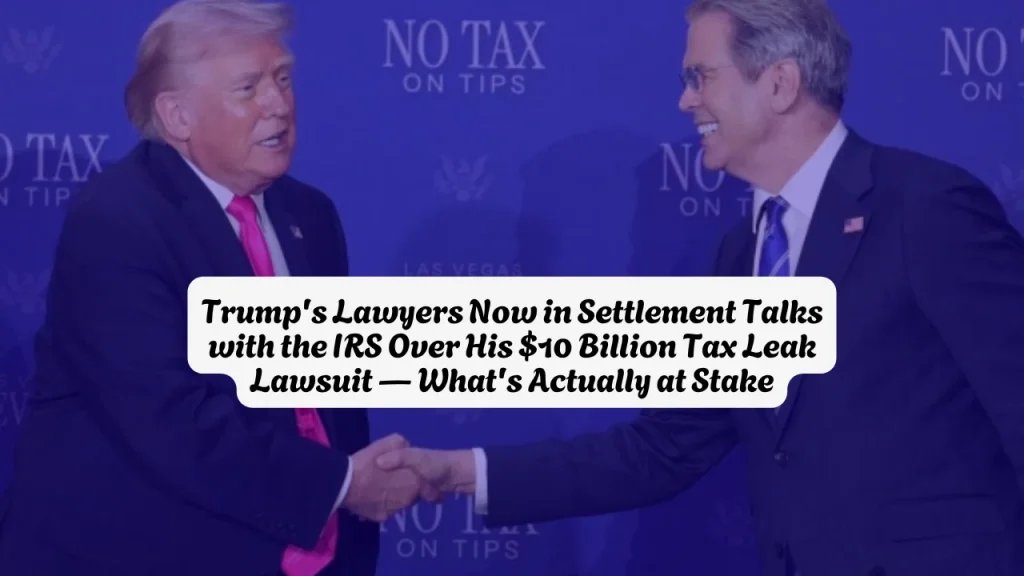
Trump’s Lawyers Now in Settlement Talks with the IRS Over His $10 Billion Tax Leak Lawsuit — What’s Actually at Stake
Lawyers for President Donald Trump have confirmed they are engaged in active settlement negotiations with the Internal Revenue Service over a $10 billion lawsuit Trump filed against his own tax collection agency — a case that legal experts say is unprecedented, legally fragile, and rife with constitutional conflicts of interest. In a federal court filing on April 18, 2026, Trump’s attorneys asked a judge to pause the case for 90 days while both sides explore a resolution. The IRS — an agency Trump oversees — consented to the pause.
Quick Case Snapshot
| Detail | Information |
| Plaintiffs | Donald J. Trump, Donald Trump Jr., Eric Trump, Trump Organization LLC |
| Defendants | Internal Revenue Service (IRS); U.S. Department of the Treasury |
| Court | U.S. District Court, Southern District of Florida |
| Case Number | No. 1:26-cv-20609 (S.D. Fla.) |
| Filing Date | January 29, 2026 |
| Judge | Kathleen M. Williams (Obama appointee) |
| Claims Alleged | Unauthorized disclosure of confidential tax return information under 26 U.S.C. § 6103 / § 7431; reputational and financial harm |
| Damages Sought | At least $10 billion (compensatory) plus punitive damages and attorneys’ fees |
| Current Status | Active; 90-day pause requested April 18, 2026 to pursue settlement |
| Plaintiff’s Attorneys | Alejandro Brito and Ian Michael Corp of Brito PLLC; Daniel Z. Epstein |
What the Lawsuit Alleges: An IRS Contractor Leaked Trump’s Tax Records
The legal foundation of this case is a real crime that already resulted in a criminal conviction.
Between 2018 and 2020, Charles Littlejohn — a contractor employed by consulting firm Booz Allen Hamilton and working inside the IRS — illegally accessed and stole the confidential tax return information of thousands of wealthy Americans, including Trump and his family. He leaked that information to media outlets including The New York Times and ProPublica, which published detailed stories about Trump’s tax history, including years in which he paid little to no federal income tax.
Littlejohn pleaded guilty in October 2023 to one count of unauthorized disclosure and was sentenced to five years in federal prison in January 2024. He is currently appealing that sentence.
Trump’s complaint, filed on behalf of himself, his sons Donald Jr. and Eric, and the Trump Organization, alleges that the IRS and Treasury Department failed to safeguard and protect their confidential tax records. The lawsuit claims the defendants “caused Plaintiffs reputational and financial harm, public embarrassment, unfairly tarnished their business reputations, portrayed them in a false light, and negatively affected President Trump and the other Plaintiffs’ public standing.”
The complaint asserts that each subsequent republication — including all New York Times and ProPublica stories, social media posts, and broadcast coverage based on the leaked data — constitutes a separate unauthorized disclosure, and that the total damages therefore reach at least $10 billion. The lawsuit also cites a 2024 order issued in a similar case brought by billionaire hedge fund manager Kenneth Griffin, which Trump’s lawyers argue establishes that the alleged facts are sufficient to support government liability.
The Unprecedented Conflict of Interest at the Center of This Case
What makes this lawsuit unlike any in American legal history is not the amount being sought — it is who is on each side of it.
Trump, as president, heads the executive branch of the federal government. The IRS and Treasury Department are executive branch agencies that report to him. Attorney General Pam Bondi — who oversees the Justice Department attorneys defending the IRS and Treasury — serves at Trump’s pleasure and can be fired by him at any time.
Trump has effectively acknowledged this dynamic himself. Asked on Air Force One in February about how a settlement would work given that he is both plaintiff and defendant, he replied: “I’m supposed to work out a settlement with myself.”
Legal experts across the political spectrum have raised alarms. David A. Super of Georgetown Law told Tax Notes: “The president can’t credibly promise to recuse himself from any decisions relating to the case. This case will be handled by people who were directly subordinate to him and must please him.” Edward Whelan, a conservative former Justice Department lawyer and former clerk to Justice Antonin Scalia, called the situation “outrageous,” stating there is “a glaring conflict of interest with Trump being on both sides of the claim.”
The concern is not abstract: Trump has the practical ability to instruct the executive branch to settle the case for any amount he wishes, without any court independently assessing whether his legal claims are valid or his alleged damages are real.
Related article: 20 Students Hospitalized After Coaches Allegedly Forced Mass Push-Up Punishment, Twelve Families Sue Texas Leadership Charter Academy
Where the Settlement Money Would Come From — and Why That Matters
If the Justice Department approves a settlement, the payment would come from the federal government’s Judgment Fund — a permanent, standing appropriation of taxpayer money used to pay court judgments and settlements against the United States. It does not require a separate congressional vote.
The $10 billion figure is staggering in context. It represents roughly two-thirds of the IRS’s entire annual budget for fiscal year 2026, which stands at $15.2 billion. It would also be, by orders of magnitude, the largest administrative settlement in Federal Tort Claims Act history. Former DOJ lawyer Rupa Bhattacharyya noted that even in the most serious FTCA cases — including claims by workers injured cleaning up after the September 11 attacks — payouts rarely exceeded $10 million. Trump is seeking 1,000 times that amount.
Trump has said publicly that any proceeds would go to charity, though he has not specified which charities. Legal and ethics experts have noted that even a charitable donation of settlement proceeds would provide Trump with a tax deduction — a personal financial benefit — and that directing congressionally appropriated funds to unspecified charities of Trump’s choosing raises its own legal and constitutional questions.
The Legal Weaknesses in Trump’s Case
Across the legal community, experts from both sides of the political aisle have identified significant obstacles in the complaint.
Statute of Limitations. The most serious legal hurdle is timing. Under 26 U.S.C. § 7431, civil lawsuits for unauthorized disclosure of tax information must be filed within two years of the date the plaintiff discovered the unauthorized disclosure. Trump’s leaked tax records were published by The New York Times as early as September 2020, and ProPublica published related stories in 2021. Trump’s complaint argues the limitations clock did not begin until January 2024, when the IRS formally notified him of the breach — but most legal experts say courts will likely find that Trump had knowledge of the disclosures when they were published. That would place his 2026 filing years outside the two-year window.
Sovereign Immunity. Federal law generally shields the United States from lawsuits unless Congress has specifically waived that immunity. Section 7431 does waive immunity in some circumstances — but only for disclosures made by “an officer or employee of the United States.” Because Littlejohn was technically a contractor employed by Booz Allen Hamilton, not a direct IRS employee, the government could argue that the statutory waiver does not apply and that Trump’s remedy, if any, lies against Booz Allen — not against the government.
Damages. Even if Trump clears the threshold issues, proving $10 billion in actual harm will be extraordinarily difficult. As Georgetown’s Super observed, Trump was reelected president in 2024 and is wealthier now than at any prior point in his life. Courts assess actual damages; they do not award billions in reputational harm to a sitting president who has continued to thrive professionally and financially since the alleged injury. Trump’s lawyers have attempted to aggregate every downstream media publication and social media mention of the leaked returns as separate disclosures — a legal theory that most experts consider unlikely to survive judicial scrutiny.
The Contractor vs. Employee Question. Several tax attorneys have argued that Littlejohn’s status as a Booz Allen contractor — not a direct government employee — is fatal to the claim against the IRS and Treasury. The statute requires that the wrongful disclosure be made by an officer or employee of the United States. Trump’s lawyers counter that Littlejohn had staff-like access and operated under IRS supervision, making him functionally equivalent to a government employee. Courts have not yet ruled on this question in this case.
What Happened Three Days Before the Lawsuit Was Filed
A detail that has drawn significant congressional scrutiny: on January 26, 2026 — just three days before Trump filed this lawsuit — the Treasury Department canceled $21 million in contracts with Booz Allen Hamilton, the firm that employed Littlejohn, citing the firm’s failure to safeguard taxpayer data.
The contract cancellation occurred more than five years after the initial breach. Democratic senators including Ron Wyden and Elizabeth Warren wrote to Treasury Secretary Scott Bessent and Attorney General Pam Bondi demanding to know whether the contract cancellation was coordinated with the White House as a predicate for the lawsuit. Bessent told lawmakers it was a matter for the Justice Department. No coordinated action has been confirmed.
The 90-Day Pause: What Happens Next
In the April 18 court filing, Trump’s lawyers asked Judge Williams to pause the case for 90 days, stating: “This limited pause will neither prejudice the parties nor delay ultimate resolution. Rather, the extension will promote judicial economy and allow the Parties to explore avenues that could narrow or resolve the issues efficiently.”
The IRS consented to the motion — meaning the government agency being sued agreed to a pause requested by the president who oversees it.
Legal experts have suggested several possible paths forward. The most commonly discussed among ethicists and constitutional lawyers is pausing the case until Trump is no longer president — removing the direct conflict of interest from the equation. Others have proposed that the court appoint an independent special counsel to represent the government’s interests on a genuinely adversarial basis, similar to oversight mechanisms used in class action settlements. Some legal scholars have suggested the court should appoint an overseer to review any settlement before approving it, precisely to prevent a collusive resolution.
If a settlement is reached, it will almost certainly face legal challenges. Watchdog organizations including CREW (Citizens for Responsibility and Ethics in Washington) have already publicly called for courts to block any unconstitutional settlement. Whether the judge approves or scrutinizes any eventual deal remains to be seen.
Congressional and Political Reaction
The lawsuit has drawn criticism from members of both parties, though Republicans have been more muted. Senate Finance Committee Ranking Member Ron Wyden called it an attempt to “steal $10 billion from the American taxpayer” through a “shameless, disgusting act of corruption.” Sen. Thom Tillis of North Carolina, a Republican not seeking reelection, publicly questioned on the Senate floor: “Where’s that money coming from? The money fairies or your pocket?”
Trump’s private legal team, in a statement, defended the lawsuit by saying: “The IRS wrongly allowed a rogue, politically-motivated employee to leak private and confidential information about President Trump, his family, and the Trump Organization to the New York Times, ProPublica and other left-wing news outlets.”
FAQs
Does Trump have a legitimate legal basis for this lawsuit?
Legal experts broadly agree that the underlying facts involve a real crime — Littlejohn did plead guilty and is serving prison time for leaking Trump’s tax data. However, most tax attorneys have identified serious legal obstacles, particularly the statute of limitations, sovereign immunity, and the difficulty of proving $10 billion in actual damages. The case has some factual legitimacy, but legal experts across the political spectrum consider the $10 billion figure legally indefensible and the procedural posture deeply problematic.
Who would pay if there is a settlement?
American taxpayers, through the federal government’s Judgment Fund — a standing appropriation of public money used to pay government settlements. Congress would not need to separately approve the payment.
Is the conflict of interest in this case illegal?
No court has ruled it illegal. However, it is described by experts across party lines as ethically extraordinary and constitutionally concerning. Trump controls the Justice Department attorneys defending the IRS, the Treasury Secretary, and ultimately the executive branch agencies he is suing. He has acknowledged publicly that he is effectively suing himself and could settle with himself.
What happened to Charles Littlejohn?
Littlejohn pleaded guilty in October 2023 to one count of unauthorized disclosure and was sentenced to five years in federal prison in January 2024. He is currently appealing his sentence. No charges have been brought against Booz Allen Hamilton as a firm.
Could the judge block a settlement?
Possibly. Judge Kathleen Williams is an Obama appointee with no obligation to approve a settlement she finds improper. Some legal scholars have argued courts have inherent authority to scrutinize collusive or constitutionally questionable settlements — particularly where a plaintiff and defendant share an institutional relationship directly.
What is the Judgment Fund and why does it matter?
The Judgment Fund is a permanent, standing appropriation administered by the Treasury that pays court judgments and agency-approved settlements against the United States. It does not require congressional action for individual payouts. A $10 billion payment would represent one of the largest single uses of the Judgment Fund in U.S. history by orders of magnitude.
Has the IRS or Treasury admitted any wrongdoing?
No. Federal officials have acknowledged the breach itself — Littlejohn’s guilt is not in dispute — but neither the IRS nor Treasury has commented on the merits of Trump’s damages claims.
Last Updated: April 18, 2026
This article is for informational purposes only and does not constitute legal advice. Allegations in the complaint are not findings of fact. All parties are presumed innocent unless and until proven otherwise in a court of law. Legal expert opinions cited reflect independent legal analysis and do not represent the position of any government agency.
About the Author
Israr Ahmad is a legal content researcher with 4+ years of experience covering class action settlements and consumer rights cases. He has researched and published coverage of 2,500+ settlements using verified court records, settlement administrator filings, and government sources. Learn more about Israr.