
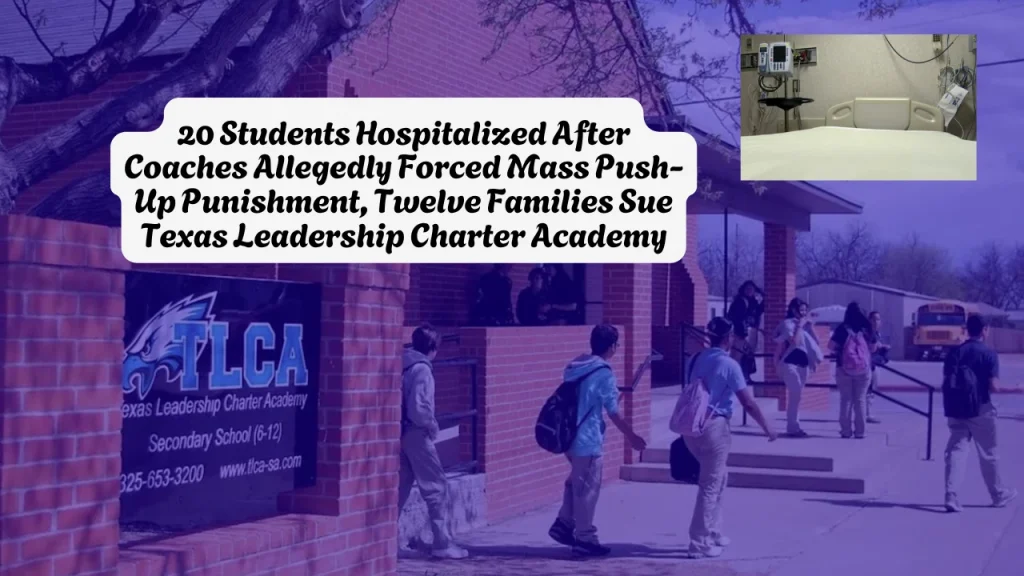
20 Students Hospitalized After Coaches Allegedly Forced Mass Push-Up Punishment, Twelve Families Sue Texas Leadership Charter Academy
Twelve families have filed a lawsuit against Texas Leadership Charter Academy (TLCA) in San Angelo, Texas, after coaches allegedly forced approximately 80 student athletes to perform hundreds of continuous push-ups without water or rest as punishment for a jersey mix-up — an error the lawsuit says was caused by the coaches themselves. Twenty students were hospitalized. Many were diagnosed with rhabdomyolysis, a life-threatening muscle breakdown condition that can cause permanent kidney damage and death. The lawsuit also alleges that school leadership attempted to cover up the incident rather than report it to authorities.
Quick Case Snapshot
| Field | Detail |
| Plaintiffs | Twelve student-athlete families (minors, names not publicly disclosed) |
| Defendants | Texas Leadership Charter Academy (TLCA) San Angelo; Texas Leadership Public Schools; CEO/Superintendent Walt Landers; Athletic Director Kent Sherill; Head Coach Bradley Gunhee Oh; Coach Stetson Emfinger; Coach Emmanuel Serna; Compliance Head Curtis Milbourn; Assistant Principal Robert Wray; and additional current and former staff |
| Court | 193rd Judicial District Court, Dallas County, Texas |
| Case Number | DC-26-06347 |
| Filing Date | April 10, 2026 |
| Law Firm | Cherry Johnson Seigmund James (Waco, TX) |
| Claims Alleged | Systemic child abuse; gross negligence; willful misconduct; failure to report abuse (Chapter 118, Texas Civil Practice & Remedies Code); failure to report to CPS (Texas Family Code Chapter 261); coordinated institutional cover-up |
| Damages Sought | At least $500,000 per student, plus punitive damages; compensatory damages for medical expenses, pain, suffering, and emotional distress |
| Current Status | Active litigation; newly filed; no trial date set |
What Happened at TLCA San Angelo — The Full Incident
According to the suit, on February 25, 2026, the head football coach ordered about 80 students to perform continuous, whistle-driven push-ups for an entire class period — roughly 45 minutes or more — without water, rest, or breaks. Students estimated they completed between 300 and 420 push-ups while five coaches walked among them, allegedly berating any child who showed signs of fatigue. The following day, students allegedly returned to school in agony, many unable to raise their arms to eat, brush their teeth, or dress themselves. Despite this, coaches required them to continue the push-ups for two more days. Twenty children were hospitalized between February 27 and March 2, many diagnosed with rhabdomyolysis — a serious condition caused by rapid skeletal muscle breakdown that can lead to kidney and organ damage.
The trigger for this punishment is one of the most alarming details in the complaint. The pretext for the mass punishment was a “jersey mix-up” in which two students were assigned the same jersey number — an error caused by the coaches themselves.
Gym doors remained closed, and when students cried out or collapsed, coaches allegedly mocked them and continued the exercise over three consecutive days. Court documents say the pain had become so severe by the third day that parents had to help their children eat, dress, and bathe. Students reported feeling intimidated, threatened, and scared, and several showed signs of psychological trauma, including nightmares about the coaches, anxiety, fear of returning to school, and depression.
Who Is Named in the Lawsuit — and What Each Person Is Accused Of
The lawsuit names not just coaches but a chain of administrators, alleging the harm went all the way to the top of the school’s leadership structure.
Coach Bradley Gunhee Oh allegedly led the punishment, monitoring students’ form and directing the exercises from start to finish. Athletic director Kent Sherill was accused of moving among the students and enforcing discipline every few minutes. Coach Emmanuel Serna was accused of pushing children to keep going and berating those who complained of pain. Coach Stetson Emfinger allegedly watched the ordeal and did nothing to stop it. Assistant Principal Robert Wray also allegedly failed to intervene.
The lawsuit names Curtis Milbourn, TLCA’s head of compliance, as a defendant, alleging he was responsible for ensuring the school’s adherence to state and federal laws and that he attempted to conceal the abuse by directing school officials to delete email communications related to the incidents.
Court documents claim Walt Landers, CEO and superintendent of Texas Leadership Public Schools and board president of TLC Academy, fostered a pattern of unchecked authority within the school’s athletic program.
Related article: DOJ Removes Lead Prosecutor From John Brennan Investigation After She Pushed Back on Charging Pressure
The Alleged Cover-Up — What the School Did After Students Were Hospitalized
The lawsuit does not stop at the physical abuse. It alleges a deliberate and coordinated effort by school leadership to suppress what happened.
The lawsuit states that school leadership failed to report the abuse, quietly reassigned coaches, inserted liability waivers into registration materials, and instructed employees to delete incriminating emails.
The lawsuit alleges no TLCA employee filed a report with Child Protective Services or the Texas Department of Family and Protective Services, despite a legal requirement under Texas Family Code Chapter 261 to report suspected child abuse within 48 hours.
Making matters worse, the lawsuit alleges that no one from the school called any of the families to inquire about their children after they were admitted for hospital treatment. Instead, the lawsuit alleges, “TLCA’s leadership went into cover-up mode.” The complaint further claims that administrators tried to force parents to sign away their children’s legal rights as a condition of returning to school — a detail that attorneys say reflects deliberate institutional self-protection rather than student welfare.
There is also a striking internal contradiction in the school’s own policies. Court documents say the TLCA Athletic Student Handbook, prepared by the athletic director and approved by school leadership, allows physical exercise as punishment. However, the Student Code of Conduct, approved by the Board of Directors and updated February 26, 2026 — the very day after the initial incident — states: “Texas Leadership will NOT administer corporal punishment upon a student for misconduct.”
What Is Rhabdomyolysis — Why This Medical Diagnosis Matters
Many readers searching this case will want to understand what the injured students were actually diagnosed with.
Rhabdomyolysis (commonly shortened to “rhabdo”) is a serious medical condition caused by the rapid breakdown of skeletal muscle tissue. When muscle cells are destroyed — through extreme physical exertion, trauma, or heat — they release proteins and enzymes directly into the bloodstream. The kidneys, which must filter this debris, can become overwhelmed, leading to acute kidney injury, permanent kidney damage, or death in severe cases.
According to the filing, the exercises reportedly led to serious medical complications, including rhabdomyolysis — a potentially life-threatening condition with a mortality rate of 30 to 50 percent in severe cases. Many of the students have been diagnosed with permanent kidney damage. The condition is well-recognized in medical and athletic training literature as a foreseeable consequence of extreme, continuous physical exertion without hydration or rest — particularly in young, still-developing bodies.
What the Law Says — Key Legal Theories in This Case
This case is being brought under several legal frameworks that non-lawyers should understand.
Chapter 118, Texas Civil Practice & Remedies Code is a newly revised Texas law that specifically expands civil rights claims against school districts and their employees for failing to report abuse. The complaint was filed under this statute, which gives affected families the ability to pursue civil claims directly against individual school employees — not just the institution itself.
Texas Family Code Chapter 261 requires any person with knowledge or reasonable suspicion of child abuse to report it to the appropriate state agency within 48 hours. Coaches, teachers, administrators, and school staff are mandatory reporters under Texas law. The lawsuit alleges none of them complied.
Gross negligence in Texas requires showing that the defendant’s conduct involved an extreme degree of risk, and that the defendant proceeded with conscious indifference to the rights, safety, or welfare of others. The allegations here — coaches continuing the punishment over three days as students collapsed — are directly aimed at meeting this legal standard.
Punitive damages are available when gross negligence or intentional misconduct is proven, and are specifically designed to punish wrongdoers and deter future conduct, rather than merely compensate victims.
The School’s Response
Texas Leadership Public Schools issued a statement saying it was aware of the litigation but, due to pending litigation, HIPAA, FERPA, and employment law considerations, it was unable to comment on the specifics of the allegations.
The school did push back on the characterization of a cover-up. Texas Leadership disputes the plaintiffs’ characterization of an alleged institutional cover-up and is confident that the facts will ultimately show that Texas Leadership administrators timely reported the alleged misconduct to DFPS/CPS, that Texas Leadership has been transparent in addressing this with parents, and that Texas Leadership is actively cooperating with law enforcement.
On March 3, the school told parents: “A situation occurred last week during the high school athletic period which resulted in multiple students seeking medical attention. We are fully cooperating with authorities. Our thoughts and prayers are with each student who has been impacted.”
Notably, the athletic director and head football coach stepped down from their positions following the incident, prior to the lawsuit being filed.
What Happens Next
The case is in its earliest stage. The defendants have not yet filed formal responses or motions in court. Key upcoming steps include:
Service of process — the defendants must be formally served with the complaint before they are required to respond.
Defendant responses — each named defendant will have an opportunity to file an answer denying the allegations, or potentially file motions to dismiss specific claims.
Discovery — if the case proceeds, attorneys will seek access to school records, the Athletic Handbook, the emails allegedly ordered deleted, CPS filings, medical records, and communications between administrators. The alleged instruction to delete emails is particularly significant, as evidence destruction is itself a serious legal matter that courts address aggressively.
Criminal referrals — the alleged conduct could also attract separate criminal investigation by Texas law enforcement, independent of this civil lawsuit. The filing specifically references cooperation with law enforcement as ongoing.
Additional plaintiffs — the lawsuit currently represents twelve families, but approximately 80 students were allegedly subjected to the initial punishment and around 20 were hospitalized. It is possible additional families join the litigation or file separately.
FAQs: What People Are Searching About the TLCA Lawsuit
What did the coaches at TLCA San Angelo actually do?
According to the lawsuit, on February 25, 2026, coaches ordered approximately 80 students to perform hundreds of continuous push-ups — estimated at between 300 and 420 — over a 45-minute or longer class period with no water, no rest, and no breaks. The punishment was allegedly triggered by a jersey-numbering error that the coaches themselves caused. The exercise continued for three consecutive days despite students showing visible signs of serious physical distress.
What injuries did the students suffer?
Twenty students were hospitalized. Many were diagnosed with rhabdomyolysis, a dangerous muscle breakdown condition that can cause permanent kidney damage and death. Some students have reportedly been diagnosed with permanent kidney damage. Beyond physical injuries, the lawsuit also describes psychological trauma including nightmares, anxiety, and depression among the affected students.
How much are the families suing for?
The plaintiffs are seeking at least $500,000 per student in damages, plus punitive damages. They are also seeking compensation for medical expenses, pain and suffering, and emotional distress for both the students and their families.
What is the cover-up allegation about?
The lawsuit alleges that after the hospitalizations, school leadership did not contact any affected families, failed to report the abuse to Child Protective Services as required by law, quietly reassigned the coaches instead of firing them, inserted liability waivers into the next year’s enrollment forms, and instructed staff to delete emails related to the incident.
Were any coaches fired?
Prior to the lawsuit, the athletic director and head football coach stepped down from their positions. According to court filings, two coaches were reassigned to other school duties rather than terminated. The lawsuit names both former and current employees as defendants.
Can the families actually sue individual coaches and administrators — not just the school?
Yes. The lawsuit is filed under recently revised Chapter 118 of the Texas Civil Practice and Remedies Code, which was specifically updated to expand civil rights claims against school districts and their individual employees for failing to report abuse. This is a key reason the lawsuit names specific administrators and coaches by name, not just the institution.
Is this a criminal case too?
This is currently a civil lawsuit filed by the families. However, the school has stated it is cooperating with law enforcement, which suggests a parallel criminal investigation may be
Last Updated: April 18, 2026
This article is for informational purposes only and does not constitute legal advice. Allegations in a complaint are not findings of fact. All parties are presumed innocent unless and until proven otherwise in court.
About the Author
Israr Ahmad is a legal content researcher with 4+ years of experience covering class action settlements and consumer rights cases. He has researched and published coverage of 2,500+ settlements using verified court records, settlement administrator filings, and government sources. Learn more about Israr.