
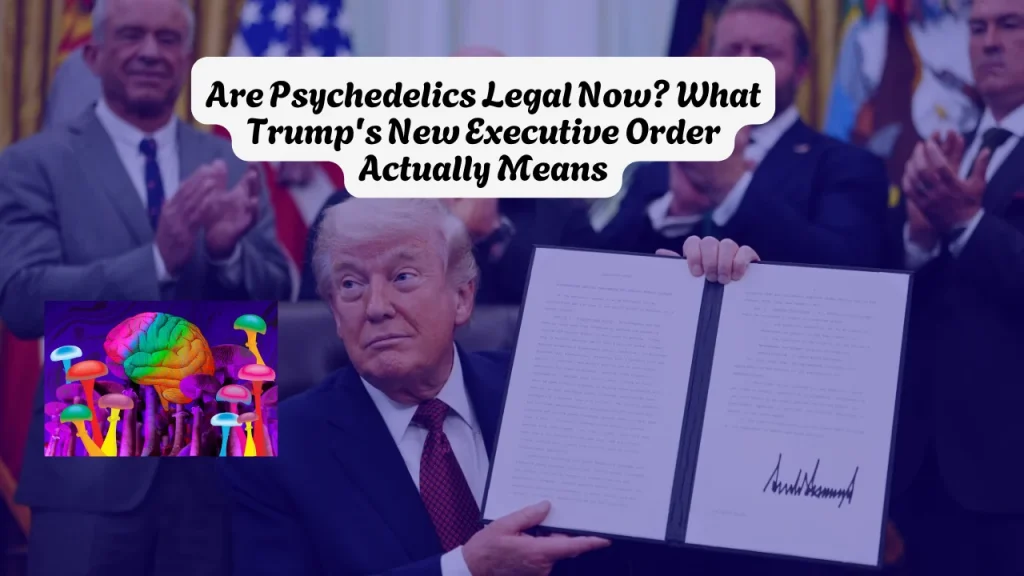
Are Psychedelics Legal Now? What Trump’s New Executive Order Actually Means
Are psychedelics legal after Trump’s executive order?
No — psychedelics like psilocybin, ibogaine, MDMA, and LSD remain illegal under federal law as Schedule I controlled substances. Trump’s executive order, signed April 18, 2026, does not legalize them. It directs the FDA and DEA to fast-track research, speed up clinical trials, and create pathways for eligible patients to access these drugs in medical settings.
What Just Happened — The Quick Version
President Trump signed an executive order directing $50 million in federal funds toward psychedelic treatments and ordering the FDA to fast-track review of drugs like psilocybin and ibogaine.
The order directs the FDA to support clinical trials and speed up approval of ibogaine, psilocybin, MDMA, and LSD — all of which remain illegal in the United States.
The bottom line: this is a research and access acceleration order, not a legalization order. If you are hoping to legally use these substances recreationally or without medical supervision, nothing has changed federally.
What the Executive Order Actually Does
The order directs the FDA Commissioner to provide Commissioner’s National Priority Vouchers to psychedelic drugs that have received Breakthrough Therapy designations for treating serious mental illnesses, ensuring that red tape does not delay the FDA’s gold standard review of any potential therapy. The order also directs the FDA and DEA to establish a pathway for eligible patients to access investigational psychedelic drugs, including ibogaine compounds, that are under FDA review.
Trump’s order also calls on the Department of Health and Human Services to direct at least $50 million to states that have enacted or are developing programs to advance psychedelic drugs for serious mental illness, described as a federal-state partnership to provide funding, technical assistance, and data sharing.
This week, the FDA will also issue “national priority” vouchers for three psychedelics, which the agency’s commissioner said will allow certain drugs to be approved quickly “if they are in line with our national priorities.” The FDA is also taking steps to clear the way for the first-ever human trials of ibogaine in the US.
Are Psychedelics Still Illegal? Yes — Here’s the Current Legal Status
All those drugs remain illegal, classified as Schedule I substances alongside drugs such as heroin. Two states — Oregon and Colorado — have legalized psychedelic therapy with psilocybin.
No psychedelic has been approved in the United States, but a number of them are being studied in large trials for various mental health conditions, including psilocybin, MDMA, and LSD.
What Schedule I means for you: Under 21 U.S.C. § 812, Schedule I drugs are defined as having no currently accepted medical use and a high potential for abuse. Possession, distribution, or manufacture remains a federal crime regardless of this executive order. If you are in Oregon or Colorado, state-supervised psilocybin therapy programs do exist — but federal law still applies.
If you or someone you know is facing drug charges related to a controlled substance, speaking with a criminal defense attorney can help you understand your options — most offer free consultations.
Related article: What Psychedelics Are Legal in the United States? A 2026 State-by-State Guide
Who Could Benefit — and When
The people most likely to gain access through this order are:
- Veterans and active military with PTSD, depression, or treatment-resistant conditions
- Patients whose mental illness has not responded to standard therapy
- Clinical trial participants at VA-partnered research sites
The Department of Veterans Affairs is now participating in at least five trials of these drugs in New York, California, and Oregon.
The order was described as a response to calls from MAHA advocates for new treatments amid a growing mental health crisis, with Trump noting that today “over 14 million American adults have a serious mental illness.”
General public access through a doctor or prescription is not available yet. There is still a long road before these substances are regulated, manufactured, and able to be prescribed to the general public, but 2026 could represent a major turning point.
What Are Ibogaine and Psilocybin — and Why Do They Matter?
Ibogaine is a psychoactive compound derived from a shrub native to West Africa. Its use has gained popularity among military veterans who have participated in clinician-guided psychedelic treatment for PTSD, depression, and anxiety. Many have traveled to clinics in Mexico to access it.
Ibogaine is known to cause irregular heart rhythms and has been linked to more than 30 deaths in the medical literature, which is why rigorous clinical trials are considered critical before any broader approval.
Psilocybin is the active compound in “magic mushrooms.” A 2025 study published in the Journal of the American Medical Association showed that a single dose of LSD could ease anxiety and depression for months. Psilocybin is currently the subject of large Phase III trials.
Safety Concerns and What Critics Are Saying
Not everyone is celebrating the order. Some medical experts urge caution.
Frederick Barrett, director of the Johns Hopkins Center for Psychedelic and Consciousness Research, said: “If the executive order can pave the way for doing objective, scientific research with this compound, it would help us understand whether it is truly a better psychedelic therapy than others.”
The concern is not the research itself — it is speed versus safety. Accelerating review timelines is useful, but skipping rigorous safety evaluation could expose vulnerable patients to serious harm, particularly with compounds like ibogaine that carry known cardiac risks.
What Happens Next — Timeline to Watch
| Milestone | Expected Timing |
| FDA issues national priority vouchers for 3 psychedelics | This week (late April 2026) |
| First-ever US human trials of ibogaine begin | 2026 |
| State programs receive $50M federal funding | After agency implementation |
| Possible FDA approval of first psychedelic drug | Estimated 2–4 years if trials succeed |
Frequently Asked Questions
Q: What is the statute of limitations for a drug possession charge involving a Schedule I substance?
Federal drug charges have a 5-year statute of limitations under 18 U.S.C. § 3282. State deadlines vary. If you have been charged or believe charges are pending, consult a criminal defense attorney immediately — time limits are strict.
Q: How long before psychedelics could be legally prescribed in the US?
Even with accelerated FDA review, clinical trials typically take several years. Most legal experts and medical researchers estimate a realistic timeline of 2 to 4 years before any psychedelic could receive full FDA approval and become prescribable — and that assumes trial data is strong.
Q: Do I need a lawyer if I was arrested for psychedelic drug possession?
Yes. These substances remain Schedule I under federal law, which carries serious criminal penalties. A criminal defense attorney can evaluate your charges, identify any constitutional issues with the arrest, and advise on your best options. Most offer free initial consultations.
Q: Does this executive order apply in all states?
The order is federal, but its effects are tied to FDA and DEA processes. Oregon and Colorado have separate state-level psilocybin therapy programs. In all other states, possession or use of these substances remains illegal under both state and federal law.
Q: Can veterans access psychedelic therapy now through the VA?
Not as an approved treatment yet. The VA is participating in at least five active clinical trials in New York, California, and Oregon, and eligible veterans may be able to enroll. Contact your VA healthcare provider for current enrollment opportunities.
Legal Terms Used in This Article
Schedule I Controlled Substance: A drug classified by the federal government as having no accepted medical use and high abuse potential. Possession is a federal crime under the Controlled Substances Act (21 U.S.C. § 812).
Executive Order: A legally binding directive issued by the President that instructs federal agencies how to act. It does not change federal law passed by Congress, but can direct how agencies prioritize enforcement and spending.
Breakthrough Therapy Designation: An FDA designation for drugs that show early clinical evidence of substantial improvement over existing treatments. It accelerates the FDA’s review and development process.
Statute of Limitations: The legal deadline by which a prosecution or lawsuit must be filed. Miss it, and the case generally cannot proceed.
Investigational Drug: A substance authorized for use in clinical trials but not yet approved by the FDA for general public use or prescription.
What This Means for You Right Now
Trump’s executive order is a significant policy shift — but it is not legalization. Ibogaine and other psychedelics remain banned under the federal government’s most restrictive category for illegal, high-risk drugs.
If you are a veteran, a patient with treatment-resistant mental illness, or a family member exploring options, this order opens doors to clinical trials — not to personal use. Speak with your doctor or a VA provider to explore enrollment in an active study.
If you are facing drug charges related to any of these substances, do not wait. Contact a criminal defense attorney today for a free consultation. Visit AllAboutLawyer.com to learn more about your rights and find the right legal help for your situation.
Disclaimer: This article is for informational purposes only and does not constitute legal advice. Laws vary by jurisdiction and change frequently. Always consult a licensed attorney for guidance specific to your situation.
About the Author
Israr Ahmad is a legal content researcher with 4+ years of experience covering class action settlements and consumer rights cases. He has researched and published coverage of 2,500+ settlements using verified court records, settlement administrator filings, and government sources. Learn more about Israr.