
Trump Targets Gavin Newsom Over 548 Death Row Commutations, Can the DOJ Legally Reverse California’s Decision?
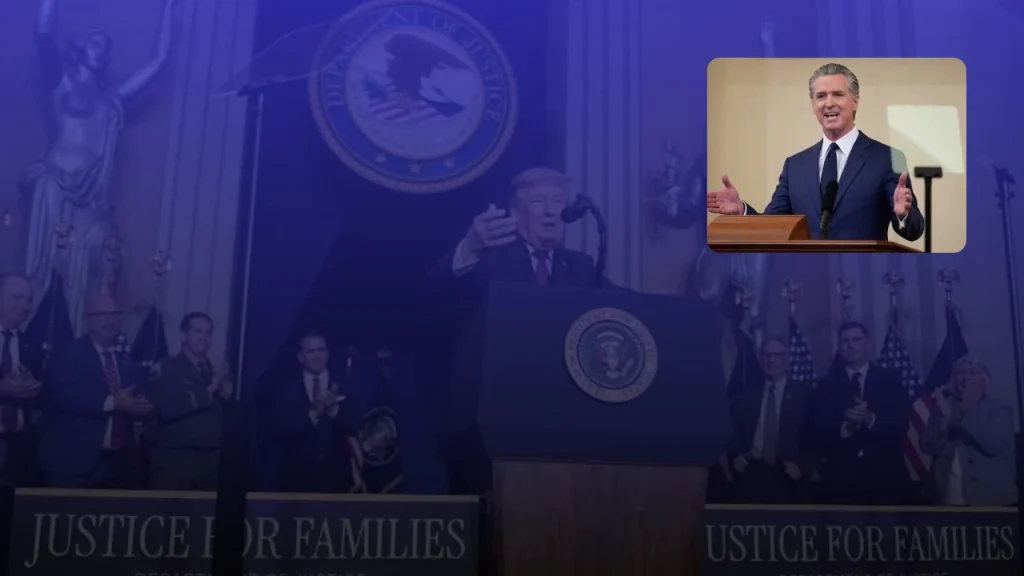
On November 23, 2026, President Donald Trump spoke at the Department of Justice alongside Attorney General Todd Blanche, FBI Director Kash Patel and relatives of murder victims, and criticized California Governor Gavin Newsom’s plan to commute the death sentences of all 548 people on California’s death row.
The legal question is whether a president can undo that decision. Not by himself. A governor’s clemency over a state conviction is governed by the California Constitution, and the immediate legal challenges are in the California Supreme Court, not in Washington.
Three facts to keep straight: the commutations have not taken effect, California has not abolished the death penalty, and the plan would convert sentences to life without parole, not free anyone.
Newsom Death Row Commutations: Quick Facts
| Detail | Current information |
| Newsom’s announcement | November 5, 2026 |
| People affected | 548 |
| Proposed new sentence | Life imprisonment without the possibility of parole |
| Cases needing a California Supreme Court recommendation | 382 (more than one felony conviction) |
| Remaining cases | 166 |
| Trump’s DOJ remarks | November 23, 2026 |
| Statewide challenge | S299690 (filed November 16, 2026, California Supreme Court) |
| Clemency recommendation request | S299513 (filed November 5, 2026) |
| Orange County challenge | S299798 (District Attorney Todd Spitzer, 18 prisoners) |
| Dates listed on the S299690 docket | November 25 (preliminary opposition); December 4 (reply) |
| Prisoners released | None under the plan |
| Death penalty abolished | No |
| Federal court action by the Trump administration | None confirmed |
Why Is Gavin Newsom Trending After Trump’s Justice Department Speech?
Trump used the DOJ appearance to attack the commutation plan, with families of murder victims in attendance, according to White House and news reports. He had also called the plan a “disaster for justice” on November 14. Reports indicate the administration opposes the plan, but no specific legal mechanism for the federal government to reverse it has been identified.
Newsom’s office responded on November 23 that California’s plan leaves victim restitution obligations in place and criticized Trump’s own use of pardons. Those are political arguments. They do not decide whether the commutations are lawful.
Why Does Gavin Newsom Want to Commute All 548 California Death Sentences?
Newsom announced on November 5 that he would convert every California death sentence to life without parole, calling state-sanctioned killing incompatible with California’s values. His office also cited the risk of wrongful convictions, unequal application of the death penalty and decades of delay in post-conviction cases. California last carried out an execution on January 17, 2006.
Opponents, including prosecutors and victims’ relatives, say the plan overrides the decisions of juries, judges and voters.
Is the Death Penalty Still Legal in California in 2026?
Yes. Penal Code §§ 190 and 190.2 still authorize death sentences for qualifying murders, and voters rejected repeal measures in 2012 and 2016. Newsom’s Executive Order N-09-19 (2019) paused executions, but a moratorium does not cancel sentences or repeal the law.
| Action | Effect |
| Moratorium | Temporarily stops executions |
| Commutation | Reduces an existing sentence |
| Pardon | Forgives a conviction or its consequences |
| Reversal | Court overturns a conviction or sentence |
| Abolition | Law no longer authorizes the punishment |
Newsom’s plan is a group commutation, not abolition.
Can Gavin Newsom Legally Commute California Death Sentences?
Yes, within limits. Article V, Section 8(a) of the California Constitution lets the governor grant reprieves, pardons and commutations after sentencing. For anyone convicted of more than one felony, the governor must first obtain a recommendation from at least four justices of the California Supreme Court. That requirement covers 382 of the 548 people.
| Group | Number | Court recommendation required? |
| More than one felony conviction | 382 | Yes |
| Others | 166 | Not ordinarily |
| Total | 548 | Subject to court challenges |
Prosecutors dispute how the governor classified some prisoners, and the statewide petition alleges criminal-history errors in that classification. Clemency over a state sentence is still reviewable for compliance with constitutional and statutory requirements.
Can President Trump Reverse Gavin Newsom’s Death Row Commutations?
Not through an order alone. The president’s pardon power under Article II, Section 2 of the U.S. Constitution covers federal offenses, not California convictions. Under the Tenth Amendment and federalism principles, a state’s clemency over state law convictions is a state matter.
A president cannot cancel a California commutation by executive order, reinstate a state death sentence by proclamation, or direct California courts to reject it. The federal government could try to bring a court challenge only if it has a valid claim and legal standing, and disagreeing with a governor’s clemency is not itself a federal claim. For background, see Can Trump Govern Without Congress? Presidential Powers Under a Divided Government Explained.
Could the Justice Department Bring Federal Death Penalty Charges Against California Prisoners?
Only in individual cases that involve separate federal crimes. Under the dual-sovereignty doctrine, reaffirmed in Gamble v. United States, 587 U.S. 678 (2019), a state prosecution does not necessarily bar a federal one for conduct that also violates federal law. Federal capital cases are governed by the Federal Death Penalty Act, 18 U.S.C. §§ 3591–3599, and would need a federal statute, jurisdiction, evidence and eligibility for a death sentence. A new federal sentence would not reverse a state commutation. No such prosecutions of the 548 have been announced.
What Are the Three California Supreme Court Cases Over Newsom’s Death Row Commutations?
Newsom’s request for recommendations (S299513)
Newsom asked the court for the recommendations the Constitution requires for the 382 prisoners, and argues his clemency power allows a decision covering the whole group.
The statewide petition (S299690)
Filed November 16, 2026 by prosecutors, victims’ relatives and advocacy groups (the Criminal Justice Legal Foundation led the announced effort, and 28 district attorneys are named, according to reports). The petition asks for a writ of mandate and an immediate stay. A writ of mandate is a court order requiring officials to follow the law or stopping action beyond their authority. Newsom’s side has argued that challengers should take part in the pending recommendation proceeding rather than file separate petitions. Per the court docket, a preliminary opposition is due November 25 and a reply December 4. Those are filing dates, not decision dates.
Orange County District Attorney Spitzer’s petition (S299798)
Filed November 19, 2026, it concerns 18 Orange County prisoners whose commutations are not part of the mandatory recommendation request. It seeks an immediate stay and challenges the governor’s reading of his clemency power.
None of these filings means the petitioners have won, or that the commutations are unlawful.
Did Newsom Violate California’s Victims’ Rights Laws?
That is disputed and undecided. Prosecutors argue victims and district attorneys were entitled to notice and a chance to be heard before the decision, and that the governor cannot skip those protections by starting the process himself. Newsom’s office says the notice provisions in Penal Code §§ 4800–4813 apply to clemency applications, not to decisions the governor initiates, and says it will notify prosecutors and work with victim services.
Article I, Section 28 of the California Constitution (Marsy’s Law) gives victims rights to fair treatment, notice of certain proceedings, a chance to be heard in specified proceedings, and restitution. Victims do not have a veto over clemency, but they may have enforceable procedural rights. See the California Attorney General’s Victims’ Bill of Rights. The court will decide how these provisions apply. Santos v. Brown, 238 Cal.App.4th 398 (2015), is one case discussing clemency and victims’ rights.
Will Any of the 548 Death Row Prisoners Be Released Under Newsom’s Plan?
No. The plan would not overturn convictions, grant pardons or make anyone eligible for ordinary parole. It would also leave restitution orders in place. The governor’s office says the affected prisoners would be excluded from new parole board commutation and resentencing rules.
Can a Future California Governor Reverse Newsom’s Commutations?
A future governor could end the execution moratorium and resume enforcing the death penalty laws. Reversing a valid, completed commutation is a different matter: a new governor generally cannot just undo it. Only a court finding that an earlier commutation was invalid would change that. California’s capital punishment laws would also remain on the books even if every current sentence is commuted. For a comparison with how another state treats execution pauses, see Christa Pike Discharged From Hospital After Surviving Tennessee Execution Attempt, What Happened and What Comes Next.
What Can California Victims’ Families Do Now?
- Contact the California Department of Corrections and Rehabilitation’s victim services office at 1-877-256-6877 or [email protected] to update contact information and ask about notification.
- Contact the district attorney’s office in the county of the original conviction.
- Talk to a California attorney who handles victims’ rights before trying to take part in the litigation.
What Happens Next in the Newsom Death Penalty Lawsuits?
| Possible outcome | Likely effect |
| Court gives the requested recommendations | Newsom could proceed with qualifying commutations, subject to remaining legal requirements |
| Court declines the recommendations | Those prisoners keep their death sentences unless another lawful process changes them |
| Court grants a stay | Implementation is delayed |
| Court requires more notice or individual review | The governor’s office must take further steps |
| Court rejects the challenges | Clemency can continue, subject to remaining requirements |
| DOJ files a federal challenge | A federal court would first decide jurisdiction and whether there is a valid claim |
Observers have noted the court has never faced a clemency request of this size and that timing matters because Newsom is nearing the end of his term. No final decision date has been announced.
Frequently Asked Questions About Newsom’s Death Row Commutations
Can Trump overturn Gavin Newsom’s commutation of California’s death row?
Not by himself. California controls clemency for state convictions, subject to its constitution and court review.
Has Newsom already commuted all 548 sentences?
He announced the plan on November 5, but the required legal steps, including the California Supreme Court recommendation for 382 prisoners, are not complete.
Are the 548 prisoners being released?
No. The plan converts death sentences to life without parole.
Has California abolished the death penalty?
No. The law still authorizes it, and executions are paused by a moratorium.
Is Newsom being sued over the commutations?
Yes. Prosecutors, victims’ relatives and advocacy groups filed a statewide petition on November 16, and Orange County District Attorney Todd Spitzer filed a separate petition on November 19.
Can victims’ families stop a governor from granting clemency?
They can bring legal challenges and assert procedural rights, but they generally have no automatic veto.
Could the dispute reach the U.S. Supreme Court?
Only if a federal constitutional or statutory question arises. The Court does not usually review state courts’ reading of purely state law.
When will the California Supreme Court decide?
No decision date has been confirmed. Check the docket dates above.
Bottom Line
Trump’s November 23 speech brought national attention to Newsom’s plan, but the president cannot unilaterally cancel a state commutation. The real fight is in the California Supreme Court, over the governor’s clemency power, notice requirements and victims’ rights. Until the court rules, the death penalty remains legal in California, the commutations are not final, and the plan would not release any prisoner.
Official Sources and Legal References
- White House, November 23, 2026 statement on California death row commutations
- Governor of California, November 5 letter on the death penalty
- Governor’s explanatory statement on the proposed commutations
- California Supreme Court docket, S299690
- Statewide petition for writ of mandate (California District Attorneys Association)
- Spitzer v. Newsom, S299798, filed petition
- California Attorney General, Victims’ Bill of Rights
- Daily Journal, November 16, 2026: lawsuit challenges Newsom’s plan
Disclaimer: AllAboutLawyer.com is a legal information site, not a law firm. This is general information, not legal advice. Arguments in pending litigation are not court findings.
Researched and written by Israr Ahmad, legal content researcher and founder of AllAboutLawyer.com. All facts verified against the official White House and Governor of California statements, the California Supreme Court docket and filed petitions, and published news reporting, as of November 24, 2026. Last Updated: November 24, 2026.
About the Author
Israr Ahmad is a legal content researcher with 4+ years of experience covering class action settlements and consumer rights cases. He has researched and published coverage of 2,500+ settlements using verified court records, settlement administrator filings, and government sources. Learn more about Israr.