
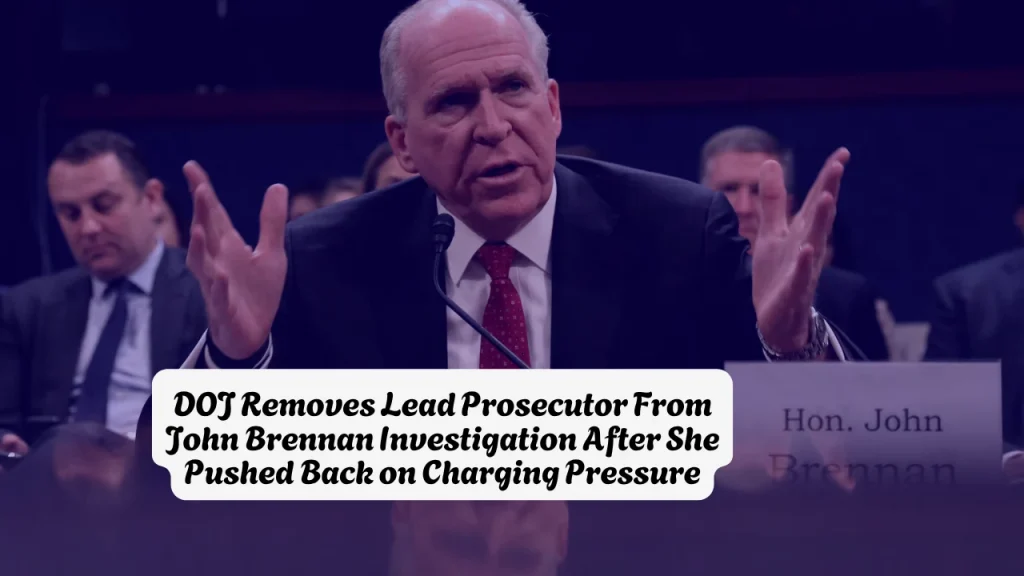
DOJ Removes Lead Prosecutor From John Brennan Investigation After She Pushed Back on Charging Pressure
The Justice Department has removed the career federal prosecutor leading the criminal investigation into former CIA Director John Brennan — a prominent Trump critic — after she resisted internal pressure to move quickly toward charges, according to multiple people familiar with the matter. The removal, which became public on April 17, 2026, immediately raised concerns among legal observers about whether the probe is being steered by evidence or by political pressure from the White House.
Quick Case Snapshot
| Field | Detail |
| Investigation Target | John Brennan, former CIA Director (2013–2017) |
| Prosecutor Removed | Maria Medetis Long, head of national security section, U.S. Attorney’s Office, Southern District of Florida (Miami) |
| Overseeing DOJ Leadership | Todd Blanche, Acting Attorney General (as of April 2, 2026) |
| Court/Venue | U.S. District Court, Southern District of Florida (Miami) |
| Investigation Opened | July 2025 |
| Criminal Referral Source | House Judiciary Committee Chairman Jim Jordan (R-OH), October 2025 |
| Alleged Offense | False statements to Congress (18 U.S.C. § 1001); lying about the Steele dossier’s role in the 2017 Intelligence Community Assessment |
| Charges Filed | None — investigation ongoing |
| Current Status | Active; new prosecutor being assigned; no charges brought |
Who Is Maria Medetis Long, and Why Was She Removed?
The Justice Department removed the career Miami federal prosecutor leading the investigation into John Brennan after she resisted pressure to quickly bring charges against the former CIA director and prominent critic of President Donald Trump. Maria Medetis Long on Friday notified attorneys representing people involved in the case that she was no longer handling the investigation.
Medetis Long is the head of the national security section for the U.S. Attorney’s Office for the Southern District of Florida. She is a career federal prosecutor — meaning she was not a political appointee and had served across multiple administrations. That distinction matters: career prosecutors are supposed to make charging decisions based on the law and evidence, not on White House priorities.
Her departure from the investigation came after she conveyed doubt that there was sufficient evidence for a criminal prosecution of the former CIA director. Her position leading the Brennan case was seen as a reassuring sign that despite pressure from Trump and officials in Washington, the probe and any decision on possible charges would be based on the evidence and not political considerations.
Her removal shatters that reassurance.
What Is the Brennan Investigation Actually About?
To understand why this matters, readers need to understand what the DOJ is actually investigating — and why it is deeply contested.
The core allegation: House Republicans claim that John Brennan lied to Congress about the role of the so-called Steele dossier in the 2017 Intelligence Community Assessment (ICA) — the landmark intelligence report that concluded Russia interfered in the 2016 presidential election to help Donald Trump win.
During a 2023 Judiciary Committee deposition, Brennan denied that the CIA used the Steele dossier in preparing the assessment, claiming the CIA was “very much opposed” to including it. House Republicans allege this was false, citing declassified documents and a 2020 House Intelligence Committee report indicating Brennan pushed to include dossier material despite objections from senior CIA officers.
The 2017 Intelligence Community Assessment included the Steele dossier, a collection of memos alleging Trump had ties to Russia, but Brennan testified before Congress that the document “was not in any way used as a basis for the Intelligence Community assessment that was done.”
The criminal referral invokes 18 U.S.C. § 1001, which makes it a federal crime to “knowingly and willfully” make materially false statements to Congress. For a prosecution to succeed, the government would need to prove that Brennan knowingly lied — not that he was mistaken or that the evidence is disputed — and that the false information was material to Congress’s work.
Brennan’s position: Lawyers for Brennan said they have been informed he is a target of the investigation but have not been told of any “legally justifiable basis for undertaking this investigation.” Brennan has consistently defended the ICA’s core conclusion that Russia interfered in 2016 and maintained the CIA did not use unverified Steele material as the foundation of the assessment’s judgments.
Related article: Supreme Court Rules 8-0 for Chevron, Putting $745 Million Louisiana Wetlands Judgment at Risk
The Broader Political Pattern — This Is Not an Isolated Event
The removal of Medetis Long does not exist in a vacuum. It is the latest in a documented pattern of the Trump administration pushing federal prosecutors to bring charges against political opponents and removing or sidelining those who refuse.
The ouster of Medetis Long recalls the internal dissension in the U.S. Attorney’s office for the Eastern District of Virginia, where Trump pushed for criminal charges against former FBI Director James Comey and New York Attorney General Letitia James. Erik Siebert, the U.S. attorney at the time, stood with the judgment of career lawyers in his office who said the Comey and James cases shouldn’t be brought for lack of evidence. Trump fired Siebert and installed Lindsey Halligan, his former personal lawyer, who brought the charges as Trump demanded — only to have both cases dismissed because of the way she was installed.
A federal judge dismissed the indictments against Comey and James after finding the U.S. attorney who brought the charges was unlawfully appointed. Those cases collapsed entirely due to the procedural manner in which the loyalist prosecutor was installed.
Trump this month replaced Pam Bondi as his attorney general, frustrated by the lack of progress in criminal investigations against political opponents like Brennan. Her deputy, Todd Blanche, is now acting attorney general and has said that Trump has the right and duty to be involved in seeking investigations against people he has had “issues with.”
Under Bondi’s DOJ, the department opened investigations into Federal Reserve Chair Jerome Powell, New York Attorney General Letitia James, former FBI Director James Comey, and former CIA Director John Brennan. The prosecutions of Comey and James were thrown out by a judge who ruled that the prosecutor who brought the cases was illegally appointed. Other investigations have either been rejected by grand juries or failed to result in criminal charges.
Serious Legal Obstacles Already Facing This Case
Even before Medetis Long’s removal, legal observers had flagged significant hurdles to any prosecution of Brennan.
Venue problems. A prosecution of Brennan based in southern Florida could face legal challenges given that Brennan’s 2023 testimony took place before a House committee in Washington, not in Florida. Judges and grand juries in Washington have been resistant to previous efforts to investigate and prosecute Trump’s targets.
Evidence sufficiency. The removed prosecutor herself reportedly concluded the evidence was not strong enough to support charges — a judgment that career national security prosecutors are uniquely positioned to make.
The “knowingly false” standard. To convict under 18 U.S.C. § 1001, prosecutors must prove the defendant knew the statement was false at the time they made it. In a case involving disputed interpretations of classified intelligence assessments made years apart, meeting that standard is genuinely difficult.
The Comey-James precedent. The collapse of charges against Comey and James — due to improper appointment of a loyalist prosecutor — is now a clear cautionary example of what happens when political pressure overrides institutional process.
What Happens Next in the Brennan Probe
A new prosecutor has been assigned to the case being built against Brennan. Investigators who in recent months have issued a flurry of subpoenas have been preparing for additional interviews in the probe, though it remains unclear whether any charges will be brought or what impact Medetis Long’s departure will have on the case or on witnesses’ willingness to cooperate.
The critical question now is whether the incoming prosecutor will reach independent conclusions about the evidence — or will bring charges as political pressure demands, repeating the same cycle that caused the Comey and James cases to collapse.
Congress is also watching closely. The Senate Judiciary Committee and Democratic leadership have signaled interest in the circumstances of Medetis Long’s removal as a potential political interference issue.
FAQs: What People Are Searching About the Brennan Probe
Why was the prosecutor removed from the John Brennan case?
According to multiple sources briefed on the matter, career prosecutor Maria Medetis Long was removed after she resisted pressure from DOJ leadership to move quickly toward charging Brennan and after she expressed doubt that the evidence was sufficient to support a criminal prosecution. She notified defense attorneys on Friday, April 17, that she was no longer on the case.
Has John Brennan been charged with anything?
No. As of April 18, 2026, no charges have been filed against Brennan. The investigation remains ongoing. Brennan has been informed he is a “target” of the probe — a formal federal designation meaning prosecutors believe there is substantial evidence linking him to potential criminal conduct — but that does not mean charges are imminent or certain.
What exactly is Brennan accused of?
House Republicans, led by Judiciary Committee Chairman Jim Jordan, allege that Brennan lied to Congress during a 2023 deposition by denying that the CIA used the Steele dossier in preparing the 2017 Intelligence Community Assessment on Russian election interference. Brennan disputes this characterization and maintains he told the truth.
What happened to other Trump DOJ cases against political opponents?
The pattern so far is notable. Criminal cases against former FBI Director James Comey and New York Attorney General Letitia James were brought after Trump publicly demanded prosecutions, then collapsed after a federal judge ruled the loyalist prosecutor who brought them was unlawfully appointed. Grand juries separately rejected charges against six Democratic lawmakers and declined to indict Federal Reserve Chair Jerome Powell.
Who is now the Acting Attorney General overseeing this investigation?
Todd Blanche, previously Trump’s personal attorney during his own criminal trials, became Acting Attorney General on April 2, 2026, after Trump fired Pam Bondi. Blanche has publicly stated that Trump has the right to be involved in seeking investigations against people he has had “issues with” — a statement that itself has drawn sharp criticism from legal ethics experts.
Could removing this prosecutor hurt the case?
It could. The removal of an experienced national security prosecutor who knows the evidence — and replacing her with someone perceived as more politically aligned — risks the same legal vulnerabilities that sank the Comey and James prosecutions. Courts and grand juries have already demonstrated skepticism toward politically-driven cases in this environment.
Last Updated: April 18, 2026
This article is for informational purposes only and does not constitute legal advice. Allegations under investigation are not findings of fact. All individuals are presumed innocent unless and until proven otherwise in a court of law.
About the Author
Israr Ahmad is a legal content researcher with 4+ years of experience covering class action settlements and consumer rights cases. He has researched and published coverage of 2,500+ settlements using verified court records, settlement administrator filings, and government sources. Learn more about Israr.