
Tampax Class Action Lawsuit, April–May 2026 Update on the P&G Lead Contamination Cases
UPDATED August 28, 2026 — P&G’s motion to transfer the Barton case to Ohio was denied on December 11, 2025, keeping the three lead-contamination lawsuits (Barton, Sanchez, Otkina) as separate cases rather than consolidating them. No settlement, class certification, or claim form has been reached in any of the three cases since our April 2026 update. Quick Facts table and timeline updated below.
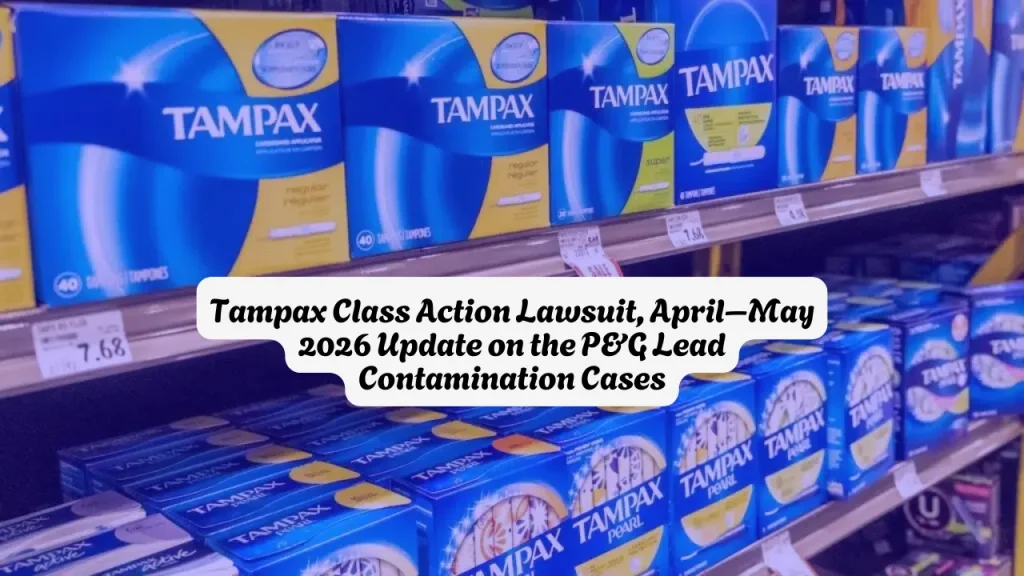
Procter & Gamble is facing a growing series of class action lawsuits filed in federal courts across California, Illinois, and Ohio, alleging that Tampax Pearl tampons contain unsafe levels of lead that can enter the bloodstream directly. As of late April 2026, no settlement has been reached and no claim form exists — but the cases are actively moving through the courts. If you have used Tampax Pearl, Radiant, or related products, here is exactly where things stand.
Tampax Lawsuit Quick Facts — May 2026
| Field | Detail |
| Defendant | The Procter & Gamble Company |
| Alleged Violation | Failure to warn of lead contamination; violation of California Consumer Protection Law, Proposition 65, and state consumer fraud statutes |
| Products Named | Tampax Pearl (Light, Regular, Super, Super Plus, Ultra), Tampax Radiant |
| Who Is Affected | Women who purchased named Tampax products within applicable statute of limitations periods |
| Current Court Stage | Active litigation — three separate cases proceeding independently after P&G’s transfer/consolidation motion was denied; settlement talks ordered in Barton case, no agreement reached |
| Court & Jurisdiction | U.S. District Court, Southern District of California (Barton); U.S. District Court, Northern District of Illinois (Otkina); U.S. District Court, Southern District of Ohio (Sanchez) |
| Lead Law Firm | KamberLaw LLP (Barton case) |
| Next Hearing Date | TBD — pending scheduling in each court |
| Official Case Website | PACER — Case No. 3:24-cv-01332-GPC-SBC (Barton, California) |
| Last Updated | August 28, 2026 |
Where the Tampax Cases Stand Right Now
Three separate federal class actions are active simultaneously:
- The Barton case (Southern District of California) is the furthest along. A federal judge denied P&G’s motion to dismiss in August 2025, allowing the case to proceed. A magistrate judge ordered both sides to attend settlement talks with full settlement authority.
- The Sanchez case (Southern District of Ohio, filed November 2024) covers plaintiffs nationwide across nine states and is still in early litigation.
- The Otkina case (Northern District of Illinois, filed January 2026) is the most recent filing and is in its earliest stage.
No global settlement has been announced. No claim form has been released. These are still active lawsuits.
What Is the Tampax Lawsuit About? Barton et al. v. The Procter & Gamble Company, No. 3:24-cv-01332-GPC-SBC
Allison Barton filed the original complaint against Procter & Gamble in July 2024 in California federal court, alleging that certain Tampax Pearl products contained unsafe levels of lead. Her independent laboratory testing detected lead amounts ranging from approximately 0.243 micrograms in Tampax Pearl Light tampons to about 0.787 micrograms in the Pearl Ultra variety.
That matters because of how tampons are used. Since tampons are inserted vaginally, any lead they contain could bypass the digestive system and enter the bloodstream directly, posing a greater risk than ingestion. The plaintiffs argue this makes P&G’s failure to warn especially serious.
Barton points out that Procter & Gamble’s own advertising suggests most consumers use three to six tampons per day. At that rate, women would be exposed to a minimum of between 0.729 and 2.36 micrograms of lead daily — amounts that exceed California Proposition 65’s Maximum Allowable Dose Level, which legally requires a clear warning label.
Where the Tampax Cases Stand Right Now
- On December 11, 2025, the court denied P&G’s motion to transfer the Barton case to the Southern District of Ohio, where the Sanchez case is pending. That means Barton, Sanchez, and Otkina remain three separate lawsuits rather than one consolidated case — so a resolution in one doesn’t automatically resolve the others.
Related article: Abby Steiner vs. Puma and Mercedes-Benz Grand Prix, The Defective Shoes Lawsuit That Could Change Athletic Footwear
The core allegation across all three cases is the same: P&G marketed Tampax Pearl as safe, “clinically tested,” and free from harmful substances — while allegedly knowing the products contained detectable lead. This type of false advertising class action and failure-to-warn claim falls under California’s Consumer Legal Remedies Act, Unfair Competition Law, and state consumer fraud statutes in Ohio and Illinois.
For a broader look at how consumer fraud lawsuits like this one are built, see our guide to P&G product liability class actions at AllAboutLawyer.com.
Are You Part of the Tampax Class Action Lawsuit?
This is a consumer fraud case, not a personal injury case — so the eligibility criteria are straightforward.
You may be part of this class if:
- You purchased Tampax Pearl (any size: Light, Regular, Super, Super Plus, or Ultra) or Tampax Radiant tampons
- Your purchase falls within the applicable statute of limitations — generally the past four years in California, or within limits set by each state in the Ohio and Illinois cases
- You did not suffer a personal physical injury (personal injury claims are handled separately and are not part of these class actions)
- You are a U.S. resident — the Otkina (Illinois) case covers all U.S. states except California, which is covered separately by the Barton case
You are likely NOT included if:
- You only purchased Tampax Pure Cotton — P&G’s own Tampax Pure Cotton line registered no detectable lead in laboratory testing, so it is not named in the lead contamination cases
- You are seeking compensation for a personal physical injury — that requires a separate product liability claim with an attorney
If you believe you experienced health effects from lead exposure — reproductive issues, neurological symptoms, or other serious conditions — you should speak with a consumer rights lawyer or product liability attorney separately. Those claims are evaluated individually.
What Are Tampax Plaintiffs Seeking in This Lawsuit?
The plaintiffs are not seeking personal injury damages in these cases. The lawsuits seek monetary damages in the form of refunds for consumers who purchased the products under false pretenses, restitution and disgorgement of profits P&G earned from misleading marketing, and injunctive relief requiring clearer product disclosures and labeling changes.
The 2026 filings allege that P&G knew of the potential for heavy metal contamination but failed to disclose it on packaging — and that vaginal absorption allows neurotoxins like lead to enter the bloodstream directly, bypassing the liver’s metabolic filters.
No specific class-wide payout figure has been confirmed by any court. If a settlement is eventually reached, compensation for class action settlement eligibility without proof of purchase would likely be modest — estimates from legal analysts suggest amounts in the range of a few dollars to around $10 without proof, with higher amounts possible for documented purchases. But no court has confirmed any figure. Do not rely on any website claiming to know your payout.
What Happened in April 2026 — and What Comes Next
As of April 2026, all three cases remain in active litigation. No new court rulings have been publicly filed in April that change the status of any case. The most significant recent development remains the August 2025 ruling in the Barton case, where U.S. District Judge Gonzalo Curiel denied P&G’s motion to dismiss, finding the plaintiffs had alleged enough facts to proceed.
A U.S. magistrate judge ordered both sides in the Barton case to bring representatives with full settlement authority to a case management conference, signaling the court views the claims seriously enough to warrant immediate settlement discussions.
P&G maintains that its products meet all FDA standards and that the trace metals found are naturally occurring in the soil. The courts, however, are beginning to favor the consumer’s right to know what is in a product.
The next major milestones to watch:
- Class certification motions in the Barton case
- Scheduling of discovery in the Otkina (Illinois) case
- Any court-ordered settlement conference outcomes
Consider retitling this section or adding a line at the top noting that, as of August 2026, the “what comes next” items listed (class certification motions, discovery scheduling, settlement conference outcomes) are all still pending — none have occurred yet. This keeps the section accurate without a full rewrite:
As of August 2026, none of the milestones below have occurred yet. Class certification has not been sought in any of the three cases, and no settlement conference outcome has been reported in Barton.
What Should You Do If You Used Tampax Pearl?
Right now, you do not need to do anything to stay included in the class action. Most class members are automatically part of the case if they purchased the named products during the relevant period.
Here is what you can do right now:
- Save your purchase records. Pull any Amazon order history, CVS receipts, or Target or Walmart purchase records for Tampax Pearl products. You will need these if a settlement is reached and you want to claim a higher tier with proof.
- Do not throw away any unused products. If you still have Tampax Pearl products at home, keep them. They could serve as evidence.
- Monitor official court records. The Barton case docket is publicly available on PACER at Case No. 3:24-cv-01332-GPC-SBC. Updates will appear there first.
- Consult an attorney if you believe you were physically harmed. If you have symptoms you connect to lead exposure, a free legal consultation with a product liability attorney is your next step — the class action alone will not cover individual health damages.
- Ignore any “claim form” websites. As of April 29, 2026, no official claim portal exists. Any site asking you to submit a claim is not authorized.
For context on how a related P&G consumer fraud case developed — and what happens when a case closes without a settlement — see our coverage of the Native Shampoo PFAS investigation and P&G consumer claims.
Tampax Class Action Lawsuit Timeline
| Milestone | Date |
| Barton v. P&G — Original Filing | July 29, 2024 |
| Sanchez v. P&G — Ohio Filing | November 19, 2024 |
| California Fraud Claims Dismissed (without prejudice) | February 13, 2025 |
| Judge Denies P&G Motion to Dismiss (Barton) | August 2025 |
| Magistrate Orders Settlement Conference (Barton) | September 2025 |
| Otkina et al. v. P&G — Illinois Filing | January 23, 2026 |
| Class Certification Motion (Barton) | TBD — not yet filed |
| Expected Settlement or Trial Date | TBD — pending class certification |
| Court Denies P&G’s Motion to Transfer Barton to Ohio | December 11, 2025 |
Frequently Asked Questions
Is there a class action lawsuit against Tampax right now?
Yes. Multiple class action lawsuits allege that Tampax Pearl tampons contain unsafe levels of lead and other heavy metals, raising concerns about long-term exposure risks for women who regularly use the products. The cases are filed in California, Ohio, and Illinois federal courts and are all currently in active litigation.
Do I need to do anything right now to be included?
No. If you purchased Tampax Pearl during the relevant period, you are likely automatically included in the class. You do not need to sign up, register, or fill out any form at this stage. Save your purchase records so you are ready when a settlement is announced.
When will a settlement be reached in the Tampax P&G case?
There is no confirmed timeline. Much like past major litigation cases, the Tampax cases must first navigate class certification and potential jury trials before any restitution is available to the public. Settlement discussions have been ordered in the Barton case, but no agreement has been announced.
Can I file my own lawsuit against P&G instead of joining the class action?
Yes, but only in specific circumstances. If you believe you suffered a personal physical injury — such as reproductive harm or neurological symptoms — you may have an individual product liability claim that goes beyond what the class action covers. Speak with a class action lawsuit attorney for a free legal consultation to understand your options.
How will I know if the Tampax lawsuit settles?
The court will issue a public notice to all known class members. You will also see announcements on PACER and coverage on AllAboutLawyer.com. This is why saving your purchase records and keeping your contact information current matters now. We also have full coverage of the earlier lead contamination findings in our Tampax lead lawsuit deep-dive.
Will a Tampax settlement payment affect my taxes?
Potentially, yes. Settlement payments classified as a refund of purchase price are generally not taxable. Payments for damages may be treated differently. Consult a tax professional once any settlement is finalized.
What products are NOT included in the lead lawsuit?
Tampax Pure Cotton is not named in the lead contamination cases. Independent testing showed no detectable lead in that product line. The lawsuits specifically target Tampax Pearl in all sizes and Tampax Radiant.
Does P&G deny the allegations?
Yes. P&G argues the lawsuits lack merit and that all Tampax products meet FDA safety requirements. The company has also argued that the FDA — not the courts — should resolve tampon safety questions first. Despite these defenses, federal judges have allowed the cases to proceed.
Sources & References
- Barton et al. v. The Procter & Gamble Company, Case No. 3:24-cv-01332-GPC-SBC, U.S. District Court, Southern District of California — PACER Docket
- Otkina et al. v. The Procter & Gamble Company, Case No. 1:26-cv-00773, U.S. District Court, Northern District of Illinois
- Sanchez et al. v. The Procter & Gamble Company, Case No. 1:25-cv-00852-DRC, U.S. District Court, Southern District of Ohio
Prepared by the AllAboutLawyer.com Editorial Team and reviewed for factual accuracy against official court records and publicly available federal court filings. Last Updated: April 29, 2026
Disclaimer: This article is for informational purposes only and does not constitute legal advice. Legal claims and outcomes depend on specific facts and applicable law. For advice regarding a particular situation, consult a qualified attorney.
About the Author
Israr Ahmad is a legal content researcher with 4+ years of experience covering class action settlements and consumer rights cases. He has researched and published coverage of 2,500+ settlements using verified court records, settlement administrator filings, and government sources. Learn more about Israr.