
SweetLeaf Monk Fruit Sweetener Class Action, Is Your “Nothing Artificial” Sweetener Mostly Erythritol?
A class action lawsuit filed against Wisdom Natural Brands — the maker of SweetLeaf — claims the company deceptively markets its SweetLeaf Monk Fruit Organic Sweetener as a natural, monk fruit–based product when it actually contains less than 1% monk fruit extract and is primarily composed of erythritol. The case, Boyd v. Wisdom Natural Brands (Case No. 2:25-cv-12080), was filed in the U.S. District Court for the Central District of California on December 22, 2025. No settlement has been reached. This case is in early litigation, but California consumers who bought this product may have a stake in what happens next.
Quick Facts
| Field | Detail |
| Case Name | Boyd v. Wisdom Natural Brands |
| Case Number | 2:25-cv-12080 |
| Court | U.S. District Court, Central District of California |
| Date Filed | December 22, 2025 |
| Settlement Amount | TBD — no settlement reached |
| Claim Deadline | TBD — case still in early litigation |
| Who Qualifies | California consumers who purchased SweetLeaf Monk Fruit Organic Sweetener |
| Payout Per Person | TBD |
| Proof Required | TBD |
| Settlement Status | Active litigation — early stage |
| Plaintiff’s Attorneys | Crosner Legal (per Law.com Radar) |
| Official Case Website | TBD — no settlement administrator assigned yet |
Current Status & What Happens Next
- The lawsuit was filed on December 22, 2025, in the Central District of California, alleging deceptive labeling of SweetLeaf’s monk fruit organic sweetener.
- The case is in its earliest stages — no motion to dismiss, class certification hearing, or settlement has been filed or scheduled yet.
- The plaintiff seeks class certification, which would allow the case to formally represent all qualifying consumers as a group rather than a single individual.
- If the court certifies the class and the parties reach a settlement, a claims deadline and official settlement website will be announced. This article will be updated at that time.
What Is the SweetLeaf Monk Fruit Sweetener Lawsuit About?
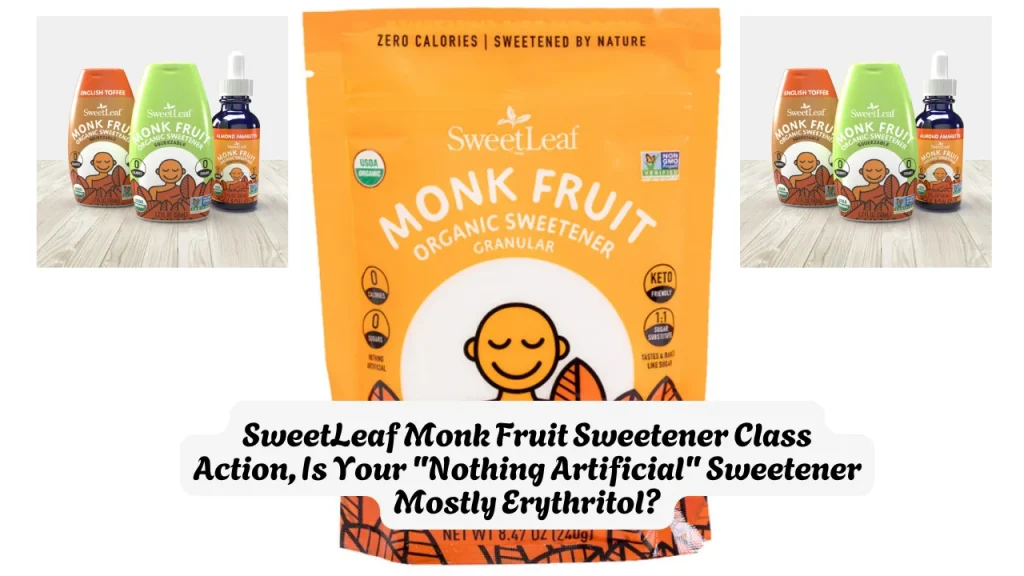
According to the complaint, the front label of SweetLeaf Monk Fruit Organic Sweetener prominently features the phrases “Monk Fruit Organic Sweetener,” “Sweetened by Nature,” and “Nothing Artificial,” along with imagery suggesting a natural, fruit-based sweetener. The complaint says these claims lead reasonable consumers to believe monk fruit is the primary ingredient.
However, independent laboratory testing cited in the complaint found the product consists of approximately 99% erythritol and only 0.87% monk fruit extract. The plaintiff asserts that erythritol is synthetically manufactured through industrial fermentation and chemical processing and does not qualify as a natural ingredient in the way consumers understand that term.
The lawsuit argues that Wisdom Natural Brands intentionally emphasized monk fruit — an ingredient widely viewed as premium and health-forward — to justify charging a higher price, while concealing that the product is primarily an industrially manufactured sweetener. The claims include violations of the California Consumers Legal Remedies Act (CLRA), the California Unfair Competition Law (UCL), the California False Advertising Law (FAL), breach of warranty, misrepresentation, and unjust enrichment.
Related article: QPharma Data Breach Settlement, Are You Eligible to Claim Up to $5,000 Deadline is July 7, 2026?
Why Does It Matter That a Sweetener Is “Mostly Erythritol”?
Many consumers who seek out monk fruit sweeteners do so specifically to avoid erythritol, which is a sugar alcohol used as a bulking agent in countless zero-calorie products. During production, monk fruit extract is often blended with erythritol to make the final product taste and look more like table sugar. The issue here is not just that erythritol is present — it is that the marketing allegedly suggests monk fruit is the main event when lab testing says it makes up less than 1% of the product.
Erythritol is added to many sugar substitutes sold as “natural” alternatives to sugar, and the FDA considers it Generally Recognized as Safe (GRAS). Because of its GRAS status, long-term safety studies of erythritol are not currently required, and food companies are not required to list erythritol content on nutrition labels.
At the same time, consumer concern about erythritol has grown after recent research. A 2024 intervention study found that drinking an erythritol-sweetened beverage rapidly elevated platelet reactivity and thrombosis risk in healthy volunteers, adding to growing evidence that the sugar alcohol may increase cardiovascular risk — though researchers note that further large-scale clinical studies are needed to confirm these findings. Consumers who chose SweetLeaf Monk Fruit specifically because they wanted to avoid erythritol and believed the label’s “Nothing Artificial” claim say they paid a price premium for a promise that, according to the complaint, was not kept.
Who Is Eligible to Potentially File a Claim?
No claim form exists yet. However, understanding who the lawsuit targets tells you whether to follow this case closely.
- You may qualify if you purchased SweetLeaf Monk Fruit Organic Sweetener at any point before the case’s resolution date.
- You may qualify if you made your purchase in California — the current proposed class is limited to California residents.
- You may qualify if you relied on front-label claims like “Monk Fruit Organic Sweetener,” “Sweetened by Nature,” or “Nothing Artificial” when deciding to buy the product.
- You may qualify if you paid a price premium for this product over a comparable sweetener, believing monk fruit was the primary or dominant ingredient.
- You likely do not qualify yet if you purchased outside California, though the outcome of this case could lead to a broader, nationwide class in the future.
How Much Could You Receive?
No confirmed payout amount exists yet because the case has not settled.
The plaintiff seeks restitution and damages reflecting the alleged price premium consumers paid, injunctive relief that would prohibit Wisdom Natural Brands from continuing to use the “monk fruit” and “nothing artificial” labeling, corrective advertising, and attorneys’ fees and costs. In similar false advertising cases involving sweeteners and food labeling, consumer settlements have historically ranged from a few dollars per claimant to full refunds of the purchase price, depending on participation and proof.
This article will update with confirmed payout information as soon as a settlement is reached.
What to Do Right Now
Step 1 — Locate and save any receipts, order confirmations, or credit card records showing you purchased SweetLeaf Monk Fruit Organic Sweetener in California.
Step 2 — If you ordered through Amazon, Thrive Market, Walmart.com, or any other online retailer, check your order history and take a screenshot. Digital records are valid proof of purchase.
Step 3 — Do not submit personal information to any website claiming to process SweetLeaf claims today. No official claim portal or settlement administrator exists yet.
Step 4 — Monitor official court filings through PACER (Case No. 2:25-cv-12080, C.D. Cal.) for updates on class certification and any settlement announcement.
Step 5 — Check back here. This article updates as the case progresses through litigation.
Estimated time to complete (once claims open): TBD
Important Deadlines & Dates
| Milestone | Date |
| Lawsuit Filed | December 22, 2025 |
| Class Certification Hearing | TBD |
| Claim Filing Deadline | TBD |
| Opt-Out Deadline | TBD |
| Objection Deadline | TBD |
| Final Approval Hearing | TBD |
| Expected Payment Date | TBD |
Frequently Asked Questions
Do I need a lawyer to file a claim?
No. If this case settles, you will be able to file a claim directly through an official settlement website without hiring your own attorney. Plaintiff’s counsel handles all class members collectively and collects fees only if the case produces a recovery.
Is this SweetLeaf lawsuit legitimate?
Yes. The case Boyd v. Wisdom Natural Brands, Case No. 2:25-cv-12080, is a verified federal court filing in the Central District of California. The lawsuit is still in its early stage — the court has not yet evaluated the merits, and Wisdom Natural Brands has not had the opportunity to respond publicly in court filings available at the time of this writing.
When will I receive a payment?
There is no payment timeline yet. The case must complete class certification and either settle or go to trial before any money reaches consumers. Cases at this early stage typically take one to three or more years to reach a resolution.
What if I no longer have a receipt?
Hold onto any proof of purchase you can locate — bank or credit card records, app order history, or subscription delivery confirmations. When a settlement opens, the court will specify exactly what documentation qualifies and whether limited claims without proof are permitted.
Will a settlement payment affect my taxes?
Possibly. Payments from consumer false advertising settlements may be treated as taxable income by the IRS, depending on how the settlement categorizes the payment. Speak with a tax professional if and when you receive a payment.
Is erythritol dangerous?
Erythritol holds GRAS (Generally Recognized as Safe) status from the FDA, and long-term safety studies are not currently required under that designation. However, emerging research — including a 2024 intervention study — found that consuming erythritol elevated platelet activity in healthy volunteers, raising questions about cardiovascular risk that researchers say require further long-term study to confirm. The SweetLeaf lawsuit is about label accuracy and price premium, not a personal injury claim for health harm.
Is SweetLeaf stevia the same as the monk fruit product being sued?
No. Wisdom Natural Brands makes multiple SweetLeaf products. The core SweetLeaf stevia line explicitly markets itself as containing zero erythritol and uses a prebiotic fiber as its bulking agent. This lawsuit targets specifically the SweetLeaf Monk Fruit Organic Sweetener product and its labeling claims — not the entire SweetLeaf product line.
Are other monk fruit sweetener brands facing similar lawsuits?
Yes. A separate class action also filed in early 2026 targets Saraya USA’s Lakanto Monkfruit Sweetener with nearly identical allegations — that independent lab testing showed the product consists of approximately 98.85% erythritol and only 1.15% monk fruit extract despite prominent monk fruit marketing on the label. This wave of monk fruit labeling lawsuits reflects growing consumer and legal scrutiny of products that highlight trace ingredients while a bulk filler does most of the work.
Sources & References
- Court Filing — Boyd v. Wisdom Natural Brands: PACER, Case No. 2:25-cv-12080, C.D. Cal., filed December 22, 2026
- Consumers tracking other food labeling and false advertising lawsuits may also want to read about Arby’s false advertising class action, where a federal judge recently allowed similar claims about misleading food marketing to move forward into discovery.
Last Updated: April 13, 2026
Disclaimer: This article is for informational purposes only and does not constitute legal advice. Legal claims and outcomes depend on specific facts and applicable law. For advice regarding a particular situation, consult a qualified attorney.
About the Author
Israr Ahmad is a legal content researcher with 4+ years of experience covering class action settlements and consumer rights cases. He has researched and published coverage of 2,500+ settlements using verified court records, settlement administrator filings, and government sources. Learn more about Israr.