
California Silicosis Lawsuits, What Countertop Workers Need to Know About the Quartz Dust Crisis
Thirty-one dead. Nearly 600 sick. That’s not a disaster headline — that’s the confirmed count from California health officials, tracking one industry, over seven years. If you’ve cut, ground, or polished engineered stone countertops in California, this isn’t background noise. It’s about whether your lungs are already damaged, and whether you have a legal claim right now.
What Did the New Study Actually Find?
A study published in NEJM Evidence documents the scope of a health crisis that’s been building since 2019. From January 2019 through June 2026, the California Department of Public Health identified 592 confirmed cases of silicosis among workers who fabricated engineered stone — commonly sold as “quartz” — countertops. Of those 592 workers, 65 needed lung transplants. Thirty-one died.
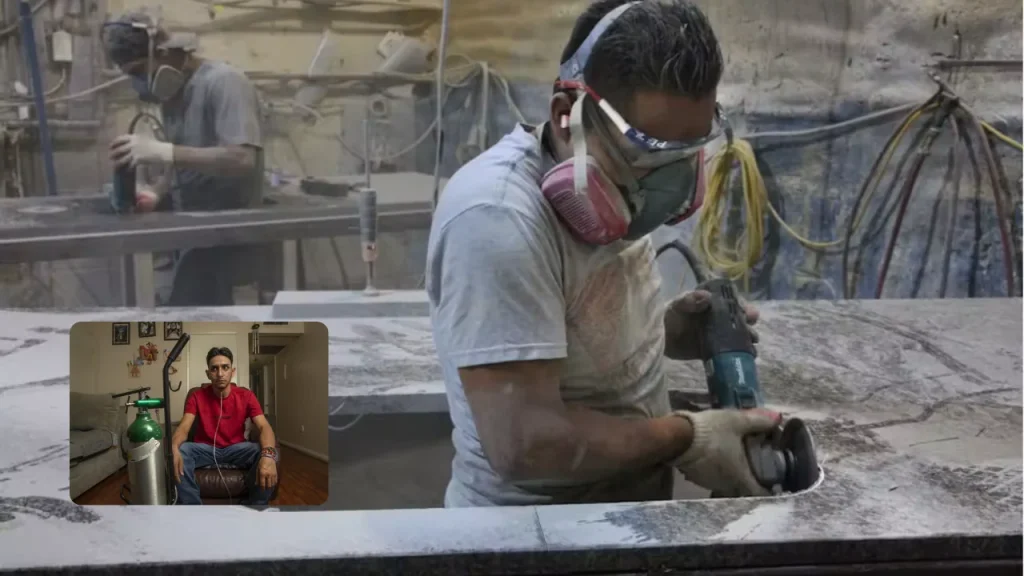
Silicosis is a lung disease with no cure. It’s caused by breathing in crystalline silica dust, and once scarring sets into lung tissue, it doesn’t reverse. What makes these cases stand out to researchers isn’t just the number — it’s how fast and how young. The workers in this study got sick after relatively short exposure periods, at younger ages, and with faster disease progression than silicosis cases researchers have documented in the past. Many also developed autoimmune disease and tuberculosis alongside the lung damage.
Engineered stone is the reason. Unlike granite or marble, which contain roughly 30-50% and under 10% crystalline silica, engineered stone slabs run about 90% silica. Cutting, grinding, and polishing it without proper controls throws fine silica dust into the air — and into workers’ lungs.
Why Are Manufacturers Being Sued?
The lawsuits argue that stone manufacturers knew engineered stone was far more dangerous to fabricate than natural stone, had internal research pointing to the risk, and didn’t adequately warn the workers cutting it. Defendants named across the current wave of cases include Caesarstone USA, Cambria Company LLC, Color Marble Inc., Cosentino (maker of Silestone), Hyundai USA LLC, EIDP Inc. (DuPont), and Francini Inc.
There’s no class action here. Because silicosis severity, exposure history, and medical outcomes vary so much from one worker to the next, these are being filed as individual product liability and toxic-exposure lawsuits — not a single case covering everyone. Most are filed in California state courts, concentrated in Los Angeles, where the fabrication industry is heavily clustered.
Starting in April 2025, the Los Angeles County Superior Court began coordinating nearly 80 of these cases across Los Angeles, Orange, and San Francisco counties — a process similar to how California handled the asbestos litigation wave decades ago. Coordination doesn’t merge the cases into one; it lets courts manage shared evidence and expert testimony efficiently while each worker’s case is still decided on its own facts.
Related article: Apple App Store Crypto Wallet Lawsuit, Were You Affected? — Ramirez v. Apple, No. 5:26-cv-07713
What Have Juries Actually Awarded?
The numbers so far are large, and they’re not slowing down.
In August 2024, a Los Angeles County jury awarded $52.4 million to Gustavo Reyes Gonzalez in his case against Caesarstone USA, Cambria Company, and Color Marble — the largest known silicosis verdict in U.S. history at the time. The jury split fault between the manufacturers and Reyes Gonzalez’s employer, and still found the manufacturers liable for tens of millions.
A related case, resolved anonymously against Caesarstone USA, Cambria, EIDP, and Francini, settled for more than $26 million. Combined, the law firm representing both workers — Brayton Purcell LLP — put the total at over $78 million in recoveries, announced March 12, 2025.
That pace hasn’t slowed. A Santa Monica jury more recently returned a $47,035,380 verdict for the family of Wilmer Ruben Martinez Paredes, a countertop fabrication worker who died with silicosis, artificial-stone-linked rheumatoid arthritis, and related conditions. Jurors assessed just over $2 million in economic damages and $45 million in non-economic damages.
Not every case ends in a plaintiff’s win. A Torrance jury returned a defense verdict for Caesarstone in one case, finding the worker’s silicosis came from how the fabrication employer handled the product rather than a defect in the stone itself. That split outcome is exactly why each case gets tried on its individual exposure history and evidence — a verdict in one case doesn’t guarantee the same result in another.
Are You Part of This — And What Should You Do?
You may have a claim if you worked cutting, grinding, polishing, or installing engineered stone countertops in California and have since been diagnosed with silicosis, pulmonary fibrosis, or a related lung disease. Workers in small fabrication shops — often without adequate ventilation, wet-cutting equipment, or respiratory protection — are the group most affected, and health officials note most confirmed cases involve Latino immigrant workers.
You do not need to have worked directly for one of the named manufacturers. These lawsuits target the supply chain — manufacturers, distributors, and in some cases retailers — not just your direct employer.
If any of this applies to you:
- Get evaluated by a doctor for silicosis or related lung disease if you haven’t been diagnosed — early identification matters for both your health and any potential claim.
- Save any records of where you worked, which companies’ stone you fabricated, and how long you were exposed.
- Ask your doctor to document occupational exposure history specifically, since causation is central to these cases.
- Talk to a product liability attorney experienced in silicosis or occupational lung disease litigation before assuming your case is too old or too small — the coordinated proceedings mean firms handling these cases are actively building on shared evidence from earlier verdicts.
- Move without unnecessary delay. California’s discovery-based statute of limitations for toxic exposure claims generally starts running once you knew or reasonably should have known the exposure caused your illness — not simply from your last day on the job.
What’s Next for These Cases?
California regulators have moved alongside the litigation. In May 2026, the California Occupational Safety and Health Standards Board granted a petition to prohibit fabrication and installation of engineered stone containing more than 1% crystalline silica — a direct regulatory response to the health data.
At the same time, the industry is pushing back in Washington. A federal bill, H.R. 5437, has been introduced that would limit manufacturer liability for injuries tied to fabrication activity that happens outside the manufacturer’s direct control — language that, if passed, could reshape how future silicosis cases against manufacturers are argued.
Occupational lung disease litigation has moved through California courts before this crisis, most notably in the state’s decades-long asbestos litigation. Workers and families dealing with a related occupational lung disease can find background on mesothelioma claims here, though silicosis and mesothelioma cases proceed under different legal frameworks.
California Silicosis Lawsuits — Frequently Asked Questions
Is there a class action lawsuit for engineered stone silicosis?
No. These are individual product liability and toxic-exposure lawsuits. Because each worker’s exposure and medical history differ, cases are filed and tried separately, though many are coordinated in Los Angeles County Superior Court for efficiency.
How many silicosis cases has California confirmed among stone workers?
As of June 2026, the California Department of Public Health had identified 592 confirmed cases dating back to January 2019, including 65 lung transplants and 31 deaths, according to the NEJM Evidence study.
Which companies are being sued over engineered stone silicosis?
Named defendants across current cases include Caesarstone USA, Cambria Company LLC, Color Marble Inc., Cosentino, Hyundai USA LLC, EIDP Inc. (DuPont), and Francini Inc.
What’s the largest silicosis verdict so far?
A Los Angeles County jury awarded $52.4 million to Gustavo Reyes Gonzalez in August 2024 — the largest known silicosis verdict in U.S. history at the time it was decided.
Do I need to have worked directly for Caesarstone or Cambria to sue?
No. These lawsuits target manufacturers and distributors in the supply chain, not just direct employers, since the claim is that the product itself wasn’t adequately labeled or warned against.
Has California banned engineered stone?
Not an outright sales ban. In May 2026, the California Occupational Safety and Health Standards Board granted a petition prohibiting fabrication and installation of engineered stone containing more than 1% crystalline silica.
Could a new federal law limit these lawsuits?
Possibly. H.R. 5437, a bill pending in Congress, would limit manufacturer liability for fabrication-related injuries. It has not passed as of this writing.
Sources Used in This Article
- NEJM Evidence — “Silicosis among Workers Fabricating Engineered Stone (‘Quartz’) Countertops in California, 2019–2026”: https://evidence.nejm.org/doi/full/10.1056/EVIDpha2600187
- Brayton Purcell LLP via PR Newswire — “Landmark Results Against Artificial Stone Manufacturers Total Over $78 Million for Workers with Fatal Silicosis,” March 12, 2025: https://www.prnewswire.com/news-releases/landmark-results-against-artificial-stone-manufacturers-total-over-78-million-for-workers-with-fatal-silicosis-302399277.html
- Brayton Purcell LLP — “$47+ Million Verdict in Artificial Stone Silicosis Case,” Martinez Paredes case summary: https://www.braytonlaw.com/47-million-artificial-stone-silicosis-verdict-california
- Verus LLC — “Engineered Stone Silica Litigation Mounts as Workers Allege Countertop Dust Caused Serious Lung Disease,” June 2026: https://verusllc.com/articles/case-management/silicosis-litigation-and-engineered-stone-an-emerging-area-of-mass-tort-exposure/
Researched and written by Israr Ahmad, legal content researcher and founder of AllAboutLawyer.com. All facts verified against the NEJM Evidence published study, law firm case announcements, and legal industry reporting on the coordinated California proceedings, as of August 17, 2026. Last Updated: August 17, 2026.
This article is for informational purposes only and does not constitute legal advice. Laws vary by state and individual circumstances differ. For advice about your specific situation, consult a qualified attorney.
About the Author
Israr Ahmad is a legal content researcher with 4+ years of experience covering class action settlements and consumer rights cases. He has researched and published coverage of 2,500+ settlements using verified court records, settlement administrator filings, and government sources. Learn more about Israr.