
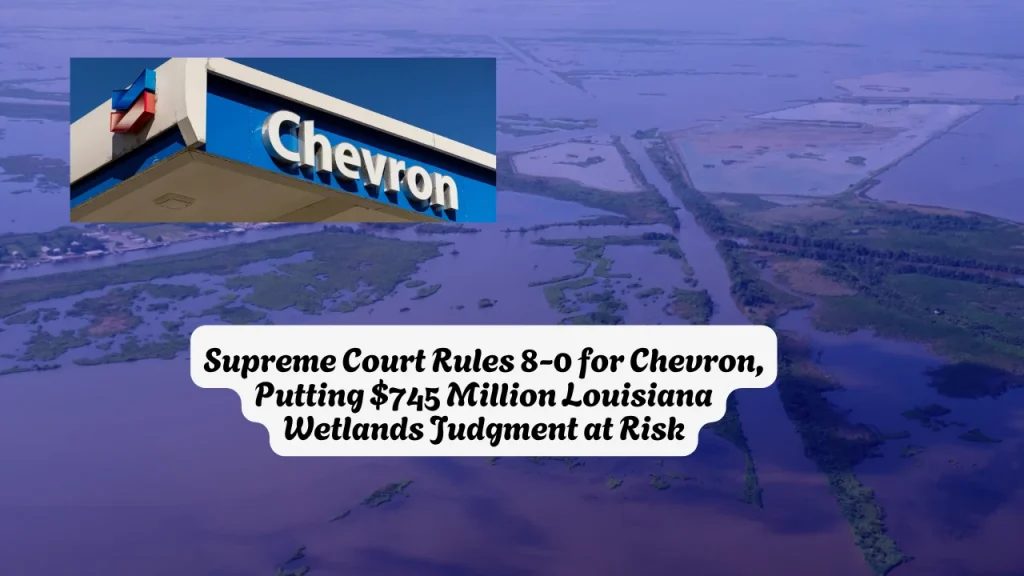
Supreme Court Rules 8-0 for Chevron, Putting $745 Million Louisiana Wetlands Judgment at Risk
The United States Supreme Court handed a unanimous victory to Chevron and the oil and gas industry on April 17, 2026, ruling that a landmark environmental damage lawsuit against the energy giant must be moved from Louisiana state court to federal court. The decision — decided 8-0 — puts into immediate question a $745 million jury verdict won by Plaquemines Parish, Louisiana, and could unravel up to a dozen similar lawsuits filed against oil companies across the state. The ruling turns on a surprising legal argument: that Chevron’s World War II-era oil production, conducted under federal government contracts, entitles the company to a federal forum more than 80 years later.
Quick Case Snapshot
| Field | Detail |
| Case Name | Chevron USA Inc. v. Plaquemines Parish, Louisiana |
| Docket Number | No. 24-813 |
| Court | U.S. Supreme Court |
| Argued | January 12, 2026 |
| Decided | April 17, 2026 |
| Vote | 8-0 (Justice Alito recused) |
| Opinion Author | Justice Clarence Thomas |
| Concurrence | Justice Ketanji Brown Jackson (concurring in judgment) |
| Outcome | Vacated and remanded — case sent back for transfer to federal court |
| What Was at Stake | $745 million state court judgment against Chevron; ~12 similar lawsuits against oil companies |
| Legal Issue | Whether the Federal Officer Removal Statute (28 U.S.C. § 1442) allows oil companies to move state environmental lawsuits to federal court based on WWII-era federal contracts |
What Was This Case Actually About?
This case has two layers — the underlying environmental damage going back decades, and the procedural fight over which court gets to decide the matter. Both matter enormously, and readers need to understand both.
The Environmental Damage: The companies appealed to the high court after jurors in Plaquemines Parish — a sliver of land straddling the Mississippi River into the Gulf — found that energy giant Texaco, acquired by Chevron in 2001, had for decades violated Louisiana regulations governing coastal resources by failing to restore wetlands impacted by dredging canals, drilling wells, and billions of gallons of wastewater dumped into the marsh.
Scientists have documented how oil and gas extraction has played a significant role in the degradation of such landscapes over time. Oil spills have stressed vegetation and wildlife. The dredging of canals and construction of pipelines have altered natural hydrology, increased saltwater intrusion, and undermined wetlands.
In April 2025, a Louisiana state court jury ruled that Chevron must pay almost $745 million to help restore coastal wetlands in Plaquemines Parish for damage that may have started during the World War II-era rush for fuel.
The Legal Fight Over Venue: Rather than argue the merits of that verdict, Chevron’s core legal strategy was to move the case entirely out of Louisiana state court and into federal court. Chevron had asked the Supreme Court to order the case moved to federal court, where legal experts say judges and juries are less likely to have a bias toward local interests. A move to federal court also means the massive judgment could be vacated.
The WWII Argument — How Chevron Won
The legal argument Chevron made — and that the Supreme Court unanimously accepted — is rooted in events from nearly 80 years ago.
Chevron argued that because its predecessor companies produced oil and refined aviation gasoline under U.S. government contracts during World War II, they were effectively carrying out federal duties. Aviation gasoline, or “avgas,” powered Allied bombers and fighters throughout the war, and the federal government’s Petroleum Administration for War tightly directed the nation’s petroleum industry during the conflict.
The Government knew that to refine crude oil into avgas, Chevron needed crude oil. The Government’s contract with Chevron adjusted the price of avgas based on the cost of obtaining crude oil. The federal Petroleum Administration for War allocated crude oil to specific refiners to maximize output and required production methods that increased crude-oil production, such as vertical drilling.
Related article: Kraftwerk vs. Moses Pelham, EU’s Top Court Delivers Landmark Ruling on Music Sampling After 27-Year Legal Case
The specific legal vehicle Chevron used is called the Federal Officer Removal Statute (28 U.S.C. § 1442), which allows defendants who were acting under the direction of a federal officer to move lawsuits out of state court and into federal court. The central question was whether three oil and gas companies’ production of crude oil sufficiently “relates to” their contracts to furnish refined aviation gasoline for the federal government during World War II.
Justice Clarence Thomas, writing for the majority, concluded that “Chevron’s wartime crude-oil production was closely connected to its wartime avgas refining, so the parish’s suit challenging that crude-oil production relates to that refining.”
Louisiana and the parish had argued the connection was too remote — that the federal contracts only covered the refining of fuel, not the methods of oil extraction that caused the environmental damage. The Court rejected that argument entirely.
Justice Ketanji Brown Jackson wrote a separate concurrence agreeing with the gist of the ruling but stating she would have applied a higher standard to the connection to federal activities — and said she felt Chevron still met that higher bar anyway.
What Happens to the $745 Million Verdict?
The Supreme Court did not rule that Chevron wins the case on the merits. It ruled on where the case must be fought. The judgment was vacated and remanded 8-0. The case now goes back to lower courts, where the transfer to federal court will be ordered.
Once in federal court, Chevron will have the opportunity to challenge the $745 million state court judgment directly — and potentially have it thrown out entirely. Federal courts and federal juries are broadly considered less sympathetic to local environmental plaintiffs and more protective of large corporate defendants, particularly in cases involving federal contracts and national security history.
The energy industry group Grow Louisiana said the decision should spell the end of the litigation. Attorneys for the parish strongly disagreed. John Carmouche, the plaintiffs’ lead attorney, said he and his team will “aggressively defend the rights of Louisiana citizens and will continue in the fight to restore and rebuild what has been harmed or destroyed.”
Why This Ruling Goes Far Beyond Louisiana
The implications of this decision stretch well beyond one parish’s coastal lawsuit.
The case is one of dozens of lawsuits filed in 2013 alleging oil giants, including Chevron and Exxon, violated state environmental laws for decades. Friday’s ruling overturns a 2024 decision from the U.S. Court of Appeals for the Fifth Circuit and will affect about a quarter of the dozens of lawsuits filed against various oil companies.
The unanimous decision could affect the outcomes of nearly a dozen other lawsuits that make similar allegations about the oil and gas industry.
The ruling also sets a broader legal precedent for federal contractors well beyond the oil industry. Other companies that do business with the federal government are likely to pursue arguments similar to Chevron’s in the future, said Mark Davis, director of the Center for Environmental Law at Tulane University. Any company that can point to past or present government contracting relationships — defense contractors, pharmaceutical companies, utilities — now has a stronger argument for moving state-level liability claims into federal court.
If defendants expand this approach, removal will reach conduct “relating to” federal direction, not simply acts expressly directed by the government — a significantly lower bar that could insulate federal contractors from state-court accountability across many industries.
The Trump Administration’s Role
This ruling did not happen in a political vacuum. The U.S. Justice Department sided with energy giant Chevron in the high-stakes Louisiana coastal lawsuit, urging the Supreme Court to move the case from state court to federal court. The Trump administration’s amicus brief argued that Texaco’s wartime production was part of a federally supervised supply chain critical to the Allied war effort, and that the federal forum was therefore appropriate.
The administration’s backing of Chevron in this case is consistent with its broader posture of scaling back environmental litigation and supporting the fossil fuel industry, and the unanimous outcome suggests its legal arguments proved persuasive even to the Court’s liberal justices.
What Louisiana Argued — and Why the Court Wasn’t Persuaded
Louisiana’s legal position had a certain common-sense appeal: Plaquemines Parish argued that, because Chevron’s refining contracts with the federal government did not address crude production, that production does not sufficiently “relate to” the refining, as required by the 2011 amendment to the removal statute. In other words, the federal contracts said “produce us avgas” — not “drill oil using canals and earthen pits that will damage wetlands for the next 80 years.”
Retired General Russel Honoré, arguing in support of Plaquemines Parish, argued that national security would not be put at risk if the Court ruled for Louisiana because the federal officer removal statute had not been construed broadly since its enactment in 1815, and companies like Chevron still “stepped forward” during World War II regardless.
The Court found these arguments unpersuasive, broadly reading the “relating to” language in the statute to encompass the crude oil production that fed the avgas refining operation.
FAQs: What People Are Searching About the Chevron Supreme Court Ruling
Did Chevron win the Supreme Court case?
Yes and no. Chevron won the procedural fight — the Supreme Court unanimously ruled 8-0 that the environmental damage lawsuit must be moved from Louisiana state court to federal court. However, the Supreme Court did not rule that Chevron is not liable for the wetlands damage. The merits of the case will now be re-litigated in federal court, where the existing $745 million verdict could be vacated.
What was the $745 million verdict for?
A Louisiana state court jury ruled in April 2025 that Chevron (through its predecessor Texaco) violated state coastal resource laws for decades by failing to restore wetlands damaged by canal dredging, oil well drilling, and the dumping of billions of gallons of wastewater into Louisiana marshland. The $745 million was ordered to fund coastal restoration.
Why does it matter whether the case is in state or federal court?
The venue of a lawsuit significantly affects its likely outcome. Louisiana state courts and local juries are seen as more sympathetic to the coastal communities that have watched their land disappear for decades. Federal courts are generally considered less hostile to large corporate defendants, particularly in cases with national defense dimensions. Moving to federal court also means the existing state court judgment can be thrown out and the case must start over.
What is the Federal Officer Removal Statute?
It is a federal law that allows people or companies sued in state court to move their case to federal court if they were acting under the direction of a federal officer or agency when the relevant conduct occurred. Chevron argued — and the Supreme Court agreed — that its World War II oil production occurred under federal government direction, qualifying it for this protection.
How many other oil company lawsuits does this affect?
The ruling directly affects approximately a quarter of the roughly 42 similar lawsuits filed in 2013 against various oil companies for coastal damage in Louisiana — potentially around 10 to 12 cases. The broader precedent it sets for federal contractor immunity in state environmental suits could influence litigation well beyond Louisiana.
What happens next for Plaquemines Parish?
The case returns to lower courts, where the transfer to federal court will be formally ordered. The existing $745 million verdict will likely be vacated, and the parish’s legal team has said it will continue fighting in federal court. The litigation timeline will likely extend for several more years.
Last Updated: April 18, 2026
This article is for informational purposes only and does not constitute legal advice. The Supreme Court’s ruling addressed procedural venue, not the underlying merits of environmental liability. All parties retain their respective legal rights to continue litigating the substantive claims in the appropriate court.
About the Author
Israr Ahmad is a legal content researcher with 4+ years of experience covering class action settlements and consumer rights cases. He has researched and published coverage of 2,500+ settlements using verified court records, settlement administrator filings, and government sources. Learn more about Israr.